Tissue Allograft Transport: Houston OR Custody Rules
September 1, 2026 · By LabPath Logistics Editorial Team, Medical Logistics Desk
Quick Answer
Tissue allograft transport is governed by the FDA's human tissue framework at 21 CFR Part 1271, not by the specimen rules that cover ordinary lab courier work. The graft has to stay traceable in both directions — donor to consignee and consignee back to donor — under a distinct identification code that may not contain a patient name, Social Security number, or medical record number; it has to move in a container designed to protect it from contamination; and its temperature has to be a record rather than an assumption, with documented corrective action any time storage conditions are not met. A courier that cannot produce a timestamped custody line and a temperature record for a transfer has not just missed a service promise. It has left a hole in the receiving facility's own compliance file.
Tissue allograft transport is the leg of hospital logistics that almost nobody audits. A graft arrives from a tissue bank in a cooler, someone at the dock signs for it, it goes into a monitored refrigerator, and the implant record gets completed in the OR. The part in the middle — who carried it, at what temperature, for how long, and whether anyone wrote that down — is usually documented by the party doing the driving and verified by no one.
That gap matters because human tissue is not regulated like a lab specimen. A blood tube travels under CLIA and DOT rules. A processed bone graft, a corneal graft, an amniotic membrane, or a segment of acellular dermis travels under the FDA's framework for human cells, tissues, and cellular and tissue-based products (HCT/Ps) at 21 CFR Part 1271 — a rule set that puts obligations on the receiving facility that do not evaporate because a third party was behind the wheel.
Tissue Is Not a Specimen, and the Rules Say So
The volume is larger than most operators assume. The Association for Advancing Tissue and Biologics reported in March 2020 that its accredited banks recover tissue from more than 39,000 donors and distribute in excess of 3.2 million allografts annually for transplants performed in the United States. Those grafts move by vehicle, through the same traffic and afternoon heat as everything else — and across Houston, a transfer between a Texas Medical Center hospital and a suburban surgery center is an hour of exposure on a good day.
3.2 million
Allografts distributed annually in the U.S. by AATB-accredited tissue banks, recovered from more than 39,000 donors — figures reported by the Association for Advancing Tissue and Biologics in March 2020.
The distinction from cell therapy is worth drawing, because Houston facilities increasingly handle both. An autologous cell therapy product is a one-of-one material tied to a single named patient, which is why it carries a chain of identity rather than a chain of custody. A tissue allograft comes from a donor and goes to a recipient who is not yet identified when the graft ships. The tracking problem is the mirror image, and Part 1271 solves it with a code.
The Tracking Requirement Runs in Both Directions
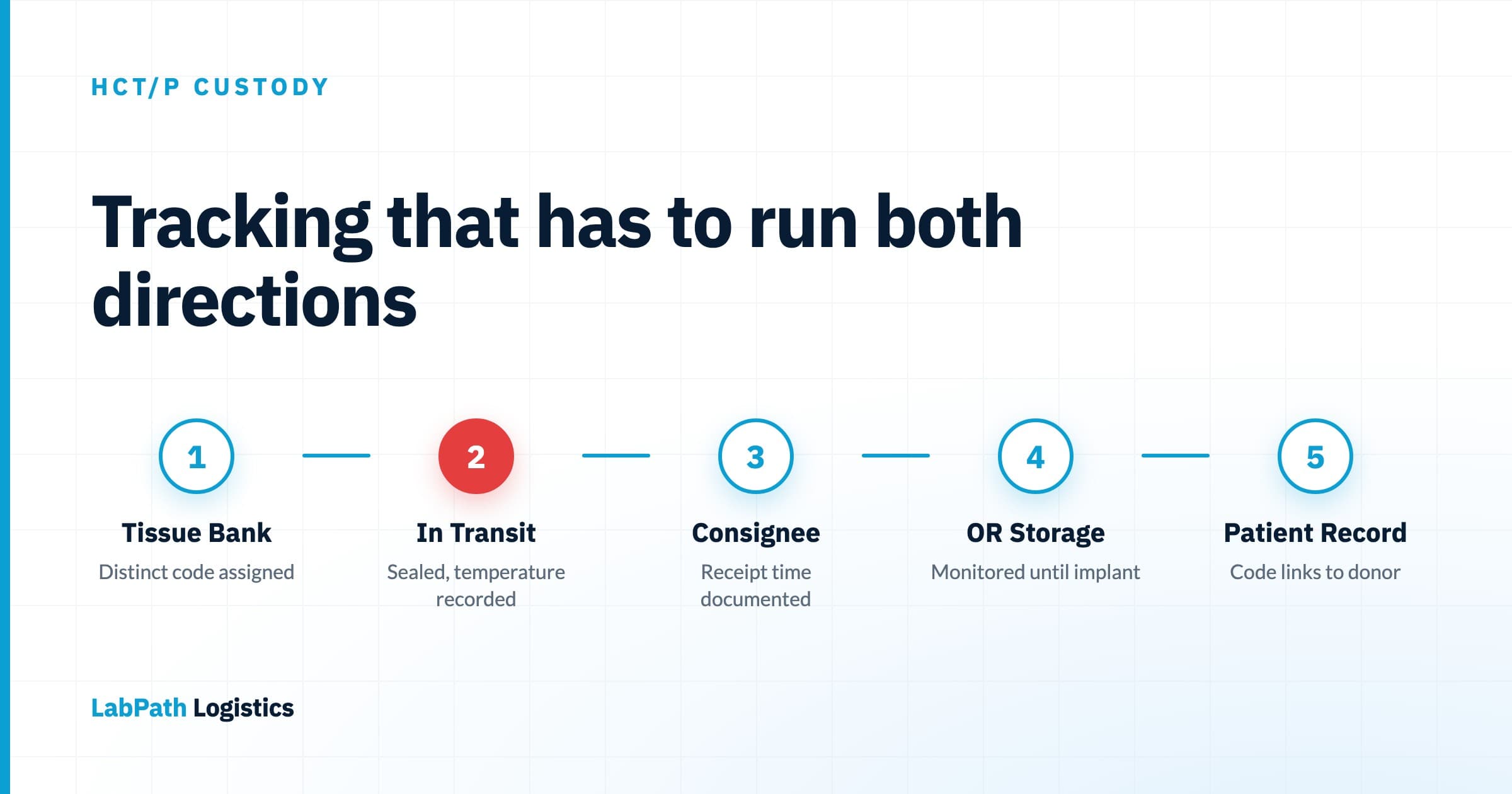
This is the sentence that governs everything else. Under 21 CFR §1271.290(b), an establishment must "establish and maintain a system of HCT/P tracking that enables the tracking of all HCT/Ps from: (i) The donor to the consignee or final disposition; and (ii) The consignee or final disposition to the donor."
Read that twice, because it is not the same as a delivery record. Forward tracking is what a recall needs: a positive donor result surfaces, and every graft from that donor has to be located wherever it went. Reverse tracking is what an infection investigation needs: a post-operative infection surfaces in one patient, and the graft in that chart has to lead back to a donor and to every other graft recovered alongside it. A transfer with no timestamped record breaks the chain in both directions at once.
The code that carries this is deliberately not a patient identifier. Section 1271.290(c) requires a distinct identification code that relates the HCT/P to the donor and to all records pertaining to it, and expressly bars that code from including an individual's name, Social Security number, or medical record number. That is the same design principle that keeps patient data off a HIPAA-compliant courier's custody record: the transport record tracks the material, never the person.
The question to ask a tissue courier
Not "do you scan?" but "can you hand me, on request, the distinct identification code, the pickup and delivery timestamps, and the temperature record for a transfer that happened four months ago?" Two years from now, that is exactly the request an investigation will make of your facility.
The Container Is a Regulated Object
21 CFR §1271.265(d) is one line long and rules out a surprising amount of common practice: "Packaging and shipping containers must be designed and constructed to protect the HCT/P from contamination."
In operating terms, the shipper the tissue bank validated is the shipper the graft arrives in. It does not get opened at a dock, moved into a personal cooler because the validated box would not fit alongside a specimen run, or repacked in a vehicle. If a courier's process includes any step that opens a sealed tissue container outside a controlled setting, that process is the problem — not the paperwork describing it.
- Transport the shipper the distributing establishment sealed, intact, with its seals and labels undisturbed.
- Never co-mingle a tissue shipper with unsealed specimen containers, chemical loads, or medical waste in the same compartment.
- Treat a damaged, wet, or opened outer container as an exception to be reported immediately, not a delivery to be completed quietly.
- Deliver to a named tissue custodian or a monitored storage unit — not to a front desk, a mailroom, or an unattended dock.
Temperature Has to Be a Record, Not an Assumption
21 CFR §1271.260 requires establishments to store HCT/Ps at an appropriate temperature, to establish acceptable temperature limits at each step designed to inhibit the growth of infectious agents, to "maintain and record storage temperatures" and periodically review them, and to "take and document corrective action whenever proper storage conditions are not met."
Nothing in that logic pauses while a graft is in a vehicle. Storage limits that hold in a refrigerator hold in a cooler, and the last clause is the one facilities routinely fail: corrective action must be documented when conditions are not met, which is impossible if nobody was measuring during the only stretch of the graft's life spent outside a monitored unit. A transfer that produces no temperature record does not produce a clean one — it produces no evidence either way, and an undocumented interval is the thing an auditor cannot resolve in your favor.
So the practical requirement is a monitored container with a readable record for the transit interval, handed over at delivery. Which range applies depends on the graft and the distributing bank's written instructions — hypothermically stored tissue, ambient processed grafts, and cryopreserved products are three different problems, and a courier with one answer for all of them has not read the paperwork. The rule is the one that governs when refrigeration helps and when it harms: the shipper's stated condition is the requirement, not a driver's judgment call.
Where Houston Transfers Actually Break
Four failure modes account for most of what goes wrong, and all four are logistics problems rather than clinical ones.
- The same-day inter-facility transfer. A graft is pulled from one campus's inventory for a case at another — a common move between a TMC hospital and an affiliated ASC — and travels on an unstructured errand with no receiving-side record. This is the single most common broken link, because it never felt like a shipment.
- The after-hours arrival. A graft reaches a facility whose tissue custodian left at five. It sits in a hallway or gets signed for by staff with no authority to accept tissue, and the receipt timestamp in the record is the next morning.
- The unused graft going back. When tissue returns to a distributing establishment, §1271.265(f) requires that establishment to determine whether it is suitable to return to inventory — a determination that depends entirely on custody and temperature information from the return trip. A graft carried back in an unmonitored trunk cannot be evaluated; it can only be discarded.
- The consolidated route. A graft is added to a multi-stop run and nobody can say afterward how long the cooler sat between the third and seventh stops. The delivery was on time. The interval is still undocumented.
What to Require Before a Courier Touches a Graft
Whether a given arrangement pulls the carrier itself into Part 1271 depends on its facts and is a question for your regulatory counsel. What is not in question is that the establishments on both ends carry tracking and storage duties, and their records are only as good as what the transport leg hands them. Six requirements close the gap.
- A custody record keyed to the distinct identification code on the shipper — never a patient name or MRN.
- Pickup and delivery timestamps captured by scan, with the name of the individual who released and the individual who accepted the graft.
- A temperature record covering the full transit interval, delivered with the graft rather than reconstructed later.
- Named, trained drivers with documented handling and custody training, and a rule that tissue is never subcontracted to an unnamed third party.
- A written exception path — what happens on a damaged seal, an excursion alarm, a closed receiving department, or a refused delivery — with a defined escalation contact and a report the facility keeps.
- Record retention and on-request retrieval that matches the retention period the distributing establishment tells you applies to that graft.
Key Takeaway
A tissue allograft stays traceable to a donor for years after it is implanted, and the facility that implanted it is the one asked to prove it. Part 1271 requires tracking that runs from donor to consignee and back, a code that excludes patient identifiers, a container built to protect the graft, and temperature recorded with documented corrective action when limits are missed. Every one of those obligations passes through a vehicle at least once. Treat the transport leg as part of the tissue record rather than an errand between two compliant buildings, and the record holds.
Frequently Asked Questions
Is a tissue allograft transported the same way as a lab specimen?
No. A diagnostic specimen moves under CLIA handling requirements and DOT packaging rules for Category B infectious substances, and its job is to survive intact until it is analyzed. A human tissue allograft is regulated under 21 CFR Part 1271 as a human cell, tissue, or cellular and tissue-based product, and it has to remain traceable to its donor long after it has been implanted in a patient. That means a distinct identification code, two-directional tracking under 21 CFR 1271.290(b), a shipping container designed to protect it from contamination under 21 CFR 1271.265(d), and recorded storage temperatures with documented corrective action under 21 CFR 1271.260. A courier competent at specimen runs is not automatically competent at tissue.
Who is responsible for tracking an allograft during transport — the tissue bank or the hospital?
Both ends carry duties, and the transport leg is where they meet. 21 CFR 1271.290(b) requires a tracking system that runs from the donor to the consignee or final disposition and from the consignee or final disposition back to the donor, and 1271.290(d) requires the distributing establishment to inform consignees in writing of those tracking requirements. In practice, the receiving hospital or ASC is the party asked to produce the record when an investigation starts, so the transport leg has to hand it evidence rather than assurance: the distinct identification code, the pickup and delivery timestamps, the individuals who released and accepted the graft, and the temperature record for the interval in between.
What temperature record does a hospital need for a tissue graft that was couriered?
One that covers the entire transit interval and is handed over at delivery. 21 CFR 1271.260 requires establishments to store HCT/Ps at an appropriate temperature, to set acceptable temperature limits at each step, to maintain and record storage temperatures, and to take and document corrective action whenever proper storage conditions are not met. The specific range is set by the distributing tissue bank for that graft — hypothermically stored, ambient, and cryopreserved products are handled differently — so the requirement is the shipper's written condition, not a generic 2–8 °C assumption. An interval with no measurement is not a passing result; it is an unresolvable gap.
Can a courier carry an unused tissue graft back to the tissue bank?
Yes, but only under the same documentation the outbound trip required, because the return trip is what determines whether the graft can be used again. Under 21 CFR 1271.265(f), the establishment receiving a returned HCT/P must have procedures to determine whether it is suitable to be returned to inventory, and that determination rests on custody and temperature information from the return leg. A graft carried back in an unmonitored cooler with no timestamped custody record cannot be assessed, so it is discarded — which turns a routine reverse trip into the full acquisition cost of the graft.