Specimen Lockbox Houston: Heat, Timing, and Pickup Rules
September 26, 2026 · By LabPath Logistics Editorial Team, Medical Logistics Desk
Quick Answer
An outdoor specimen lockbox in Houston is only safe when it is shaded, stocked with conditioned cold packs, and emptied on a short, fixed schedule. In a peer-reviewed summer study, a lockbox without cold packs averaged 42.6 °C, and glucose, potassium, AST, and LDH moved outside acceptable limits within hours. Set a maximum dwell time, a pack-change routine, and a courier pickup that keeps specimens from sitting overnight.
A specimen lockbox is the quiet workhorse of outpatient lab logistics in Houston. The clinic closes at 5, the last draws go into the box by the door, and a courier collects them later that evening. It works until the box sits in the afternoon sun on a September day and the potassium on tomorrow's report reflects the lockbox, not the patient.
This guide is for practice managers, lab outreach teams, and clinic administrators in Greater Houston. It covers what published studies found inside real lockboxes, why most lab instructions leave gaps, and the placement, cold-pack, and pickup rules that keep a lockbox from becoming a source of rejected or misleading specimens.
What the Research Shows Inside Lockboxes
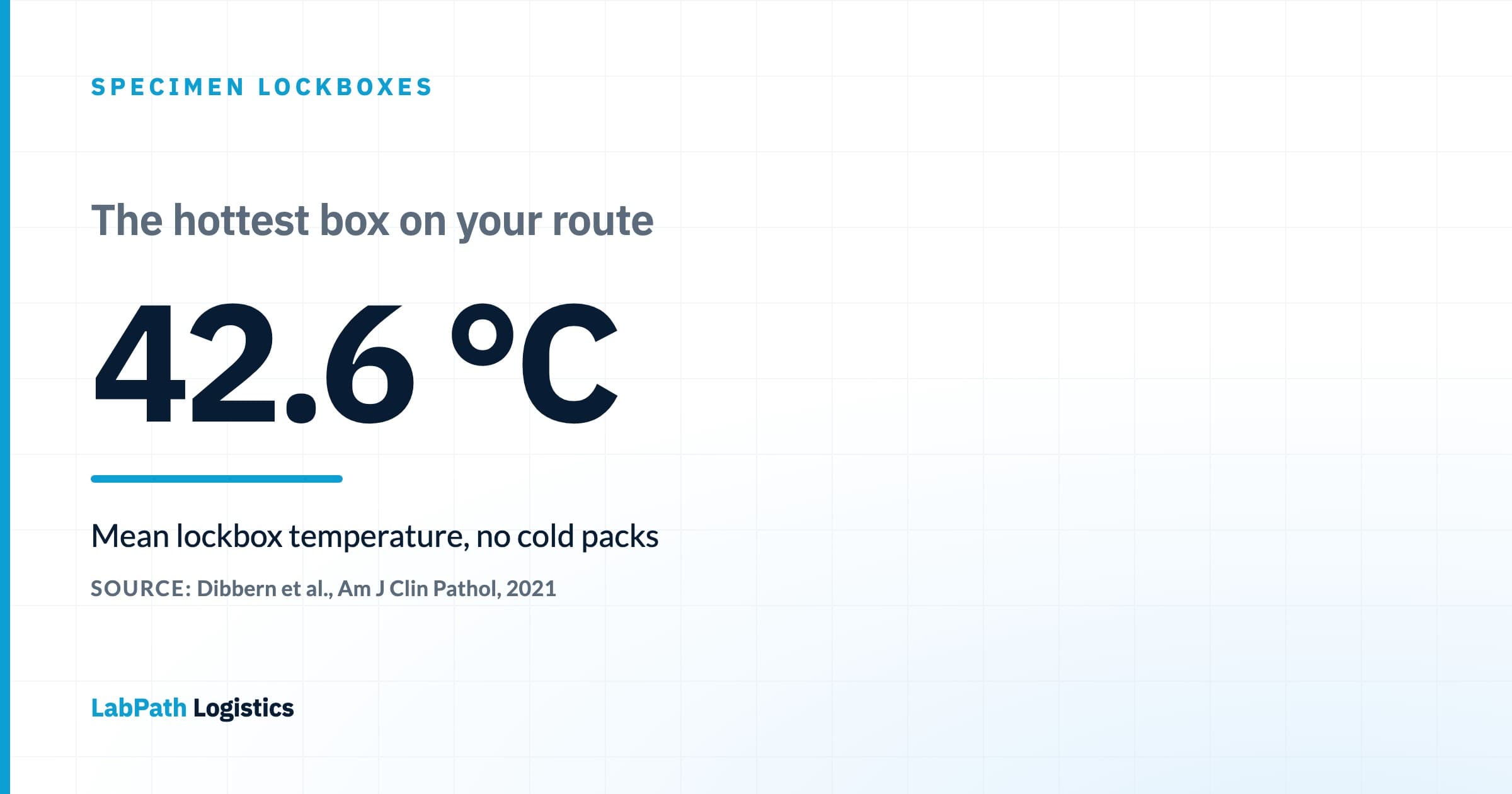
Lockbox temperature has been measured directly. In a summer 2019 study in the Mid-Atlantic, researchers placed two commercial lockboxes in direct sunlight, one with frozen cold packs and one without, and held lithium heparin samples in them for 1, 2, and 4 hours. Dibbern, Pierre, and Wiencek, writing in the American Journal of Clinical Pathology, reported a mean of 42.6 °C in the lockbox without cold packs, compared with 22.3 °C in the one with them.
42.6 °C
Mean temperature inside an outdoor summer lockbox with no cold packs, versus 22.3 °C with cold packs (Dibbern et al., American Journal of Clinical Pathology, 2021).
Four analytes consistently moved beyond acceptable limits: glucose, potassium, aspartate aminotransferase (AST), and lactate dehydrogenase (LDH). Uncentrifuged samples fared worse than spun ones, and the largest changes showed up at 4 hours. That is a normal gap between a clinic's last draw and an evening pickup.
Heat is not the only problem. An earlier year-round study in Nashville, published in The Journal of Applied Laboratory Medicine, held specimens in an outdoor lockbox for 72 hours across all four seasons. Between 7 and 10 of 21 analytes fell outside acceptable limits depending on the season, with glucose, potassium, and AST again the most affected. Long dwell times, such as a Friday draw collected on Monday, cause harm in any weather.
Why Most Lockbox Instructions Fall Short
The same AJCP team reviewed lockbox instructions from seven U.S. clinical laboratories. None set a time limit for how long specimens could stay in a lockbox, and only two clearly stated outdoor temperatures at which a lockbox should not be used. Guidance on placement and the number of cold packs varied widely.
That gap lands on the clinic. If your reference lab's instructions just say to place specimens in the lockbox with a cold pack, nothing in them tells you what to do on a Houston afternoon with the box in full sun, or when a box that missed its pickup should be brought inside.
Houston context
NOAA reported that summer 2026 was the hottest on record for the contiguous United States, averaging 74.4 °F from June through August ([CBS News](https://www.cbsnews.com/news/us-hottest-summer-on-record-2026-noaa/)). Houston lockboxes face summer conditions well into the fall, so a summer-only protocol leaves weeks of exposure uncovered.
A Cold-Pack Routine That Holds Up
A follow-up study in Nashville during June 2021, also in the American Journal of Clinical Pathology, compared a steel and a polymer lockbox. Without cooling, the polymer box reached as high as 46.7 °C. The most effective routine was 4 ice packs placed at 8 a.m., swapped for 4 fresh cold packs at 4 p.m. That brought mean temperatures during the 4 p.m. to 10 p.m. window down to 24.3 °C in the steel box and 13.4 °C in the polymer box.
The lesson is not a specific brand of box. A lockbox is only as cool as its last pack change, and the afternoon change matters most because that is when specimens go in.
A Houston Scenario
Picture a family medicine clinic in Katy that closes at 5 p.m. Its lockbox is mounted on a west-facing wall beside the entrance. The front desk drops the day's last serum and plasma tubes at 4:45, with a cold pack that went in at opening. The route courier is scheduled for 6:30 but runs late behind an I-10 slowdown and arrives at 8:15.
By then, the specimens have spent more than three hours in a box that took direct western sun all afternoon, with a pack that was spent by midday. Nothing on the requisition shows it. The fix costs almost nothing: move the box to a shaded, north-facing spot, change packs at 4 p.m., give the courier a defined pickup window, and set a rule that if pickup has not happened by a set time, staff bring specimens inside to the refrigerator or room-temperature storage the lab specifies.
Specimen Lockbox Checklist for Houston Clinics
- Mount the box in shade, away from west-facing walls, pavement glare, and vehicle exhaust.
- Keep at least two sets of cold packs so one is always conditioned in the freezer.
- Change packs at a fixed afternoon time, not only at opening.
- Follow each specimen type's storage instructions from the performing lab; some should never go in an outdoor box.
- Set a maximum dwell time and write it on the box's instruction card.
- Never leave specimens in a lockbox over a weekend or holiday.
- Place a min/max thermometer or data logger in the box and review it weekly, more often in summer.
- Agree on a pickup window with your courier and a plan for missed pickups.
- Record drop-off and pickup times so any delay can be traced.
For how temperature ranges differ by specimen type, see our guide to specimen transport temperature. Our earlier post on Houston summer heat and specimen integrity covers what happens once specimens leave the box.
When to Skip the Lockbox Entirely
A lockbox is a holding point, not a storage plan. If your clinic regularly draws specimens after the last scheduled pickup, the cleaner answer is often a later route stop or an after-hours courier run straight to the lab. Timing that stop to your draw volume is covered in our guide to sizing specimen pickup schedules.
Key Takeaway
Published studies show that outdoor lockboxes without cold packs can average above 40 °C in summer, and that common chemistry results drift within hours. Most lab instructions set no time limit. Houston clinics can close that gap on their own: shade the box, change packs in the afternoon, cap dwell time, and hold the courier to a pickup window.
Frequently Asked Questions
How hot does a specimen lockbox get in summer?
In a peer-reviewed summer study, an outdoor lockbox in direct sun with no cold packs averaged 42.6 °C, while one with cold packs averaged 22.3 °C. A second study recorded a high of 46.7 °C in an uncooled polymer lockbox.
Which lab tests are most affected by lockbox heat?
Glucose, potassium, AST, and LDH were the analytes most consistently pushed outside acceptable limits in summer lockbox research. Uncentrifuged samples changed more than centrifuged ones.
How long can specimens stay in a courier lockbox?
Follow the performing lab's instructions, but set your own maximum dwell time if they do not specify one. Research found changes within hours in summer and across all seasons after 72 hours, so specimens should never wait over a weekend.
How often should lockbox cold packs be changed?
At least once in the afternoon, before end-of-day drop-offs. One study found that ice packs placed at 8 a.m. and replaced with fresh cold packs at 4 p.m. kept evening lockbox temperatures far lower than uncooled boxes.