Specimen Pickup Schedule: One Sweep or Three Stops?
August 26, 2026 · By LabPath Logistics Editorial Team, Medical Logistics Desk
Quick Answer
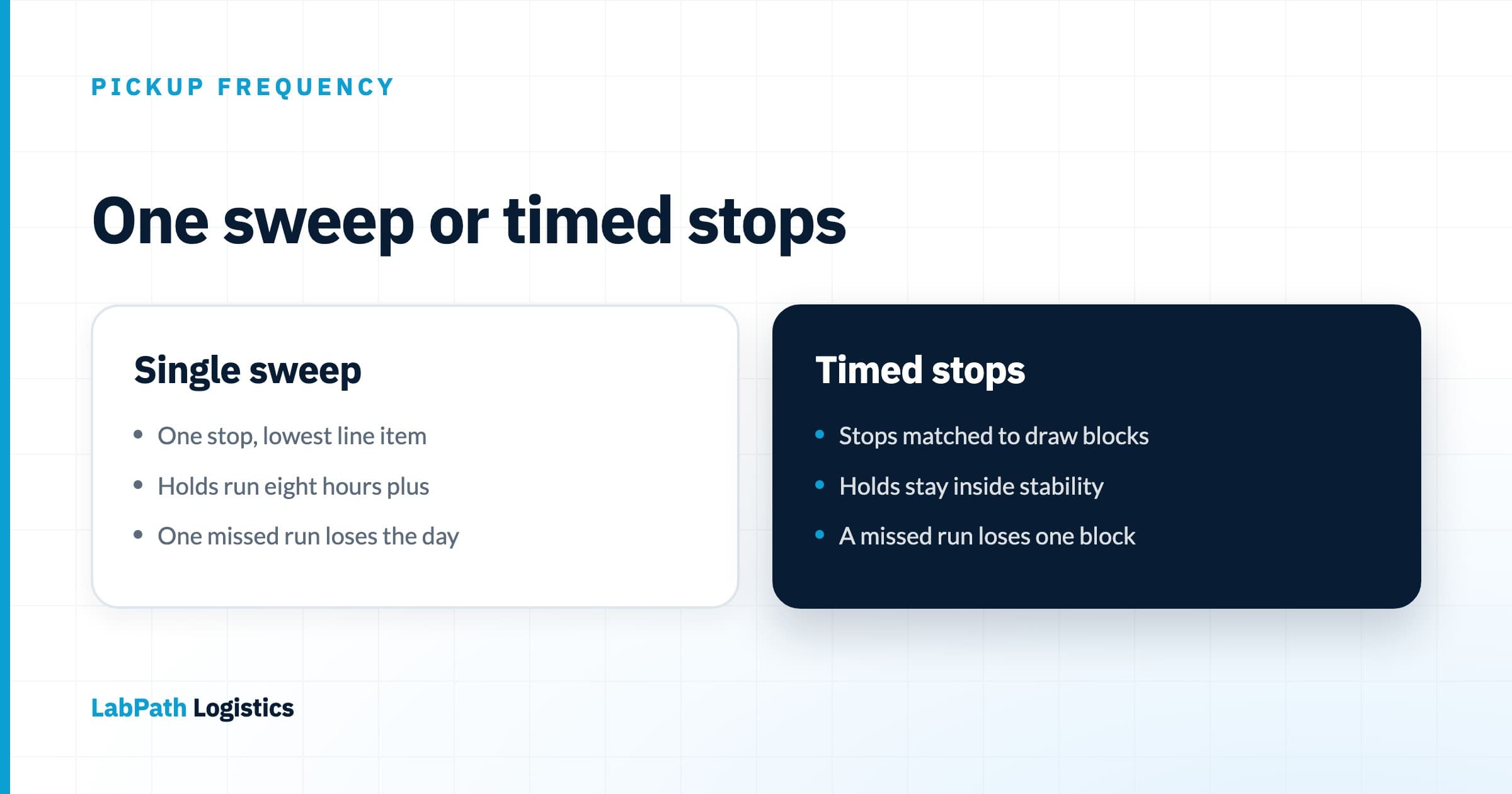
A specimen pickup schedule should be sized to the shortest stability window in your test menu, not to the convenience of a single end-of-day sweep. If your clinic draws chemistry panels and does not centrifuge and separate on site, the governing constraint is the CLSI recommendation that serum or plasma be separated from cells within two hours of collection — which means an 8 a.m. draw and a 4:30 p.m. pickup are not a schedule, they are a rejection waiting to be logged. Clinics that spin, separate, and store on site can usually run one or two timed stops a day. Clinics that send whole blood need a stop tied to each draw block, and in Houston those stops have to be placed around the traffic, not on top of it.
The specimen pickup schedule at most Houston clinics was set once, by whoever happened to be in the room when the courier contract was signed, and has not been looked at since. It usually reads "daily, end of day." That is a scheduling convenience, not a clinical decision, and it quietly commits every tube drawn before lunch to sitting on a counter for the rest of the afternoon.
The number of pickups you need is not a preference. It is arithmetic between three things you can actually measure: the shortest stability window on your test menu, what you do to a specimen before it leaves the building, and how long the drive takes at the hour you hand it over. Get those three straight and the schedule writes itself — usually to a different shape than the one you are paying for now.
The Clock That Actually Governs the Schedule
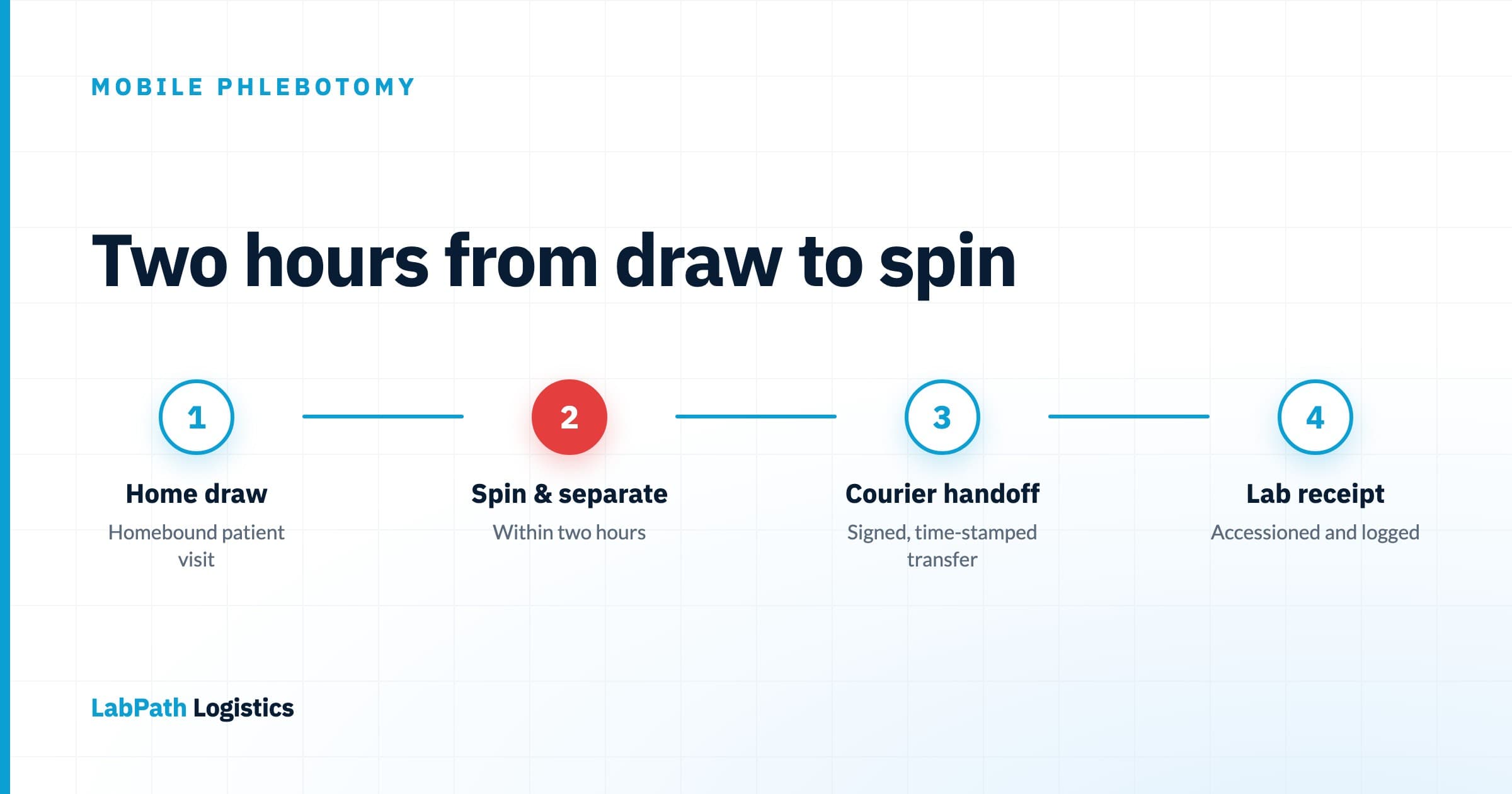
For routine chemistry, the binding constraint is not the courier's arrival — it is the moment serum or plasma stops being in contact with cells. CLSI's guidance on handling and processing blood specimens (GP44-A4) is commonly summarized as separating serum from cells within two hours of collection. The reason is a concentration gradient: red cells hold roughly 100–150 mmol/L of potassium against 4–5 mmol/L in plasma. Once the cell membrane's sodium-potassium pump falters, that gradient leaks in one direction, and the result is a potassium value that describes the tube rather than the patient.
That two-hour figure is what makes a single end-of-day sweep indefensible for a clinic that sends whole blood. A tube drawn at 8:15 a.m. and collected at 4:30 p.m. has spent more than eight hours in contact with its own cells before anyone touches a centrifuge.
The measured consequences are not subtle. A study of centrifugation delay published in Biochemia Medica held whole blood at defined temperatures before spinning and tracked deviation against baseline. At 22–30 °C for 12 hours, creatinine drifted 14.6% and hemoglobin 16.4%, both well past the study's tolerable change limits, and visible hemolysis appeared above 30 °C at just six hours.
14.6%
Mean deviation in creatinine after 12 hours of pre-centrifugation delay at 22–30 °C, against a tolerable change limit of 5.9%, per Abraham et al., "Effect of temperature and time delay in centrifugation on stability of select biomarkers," Biochemia Medica, 2019;29(2):020708
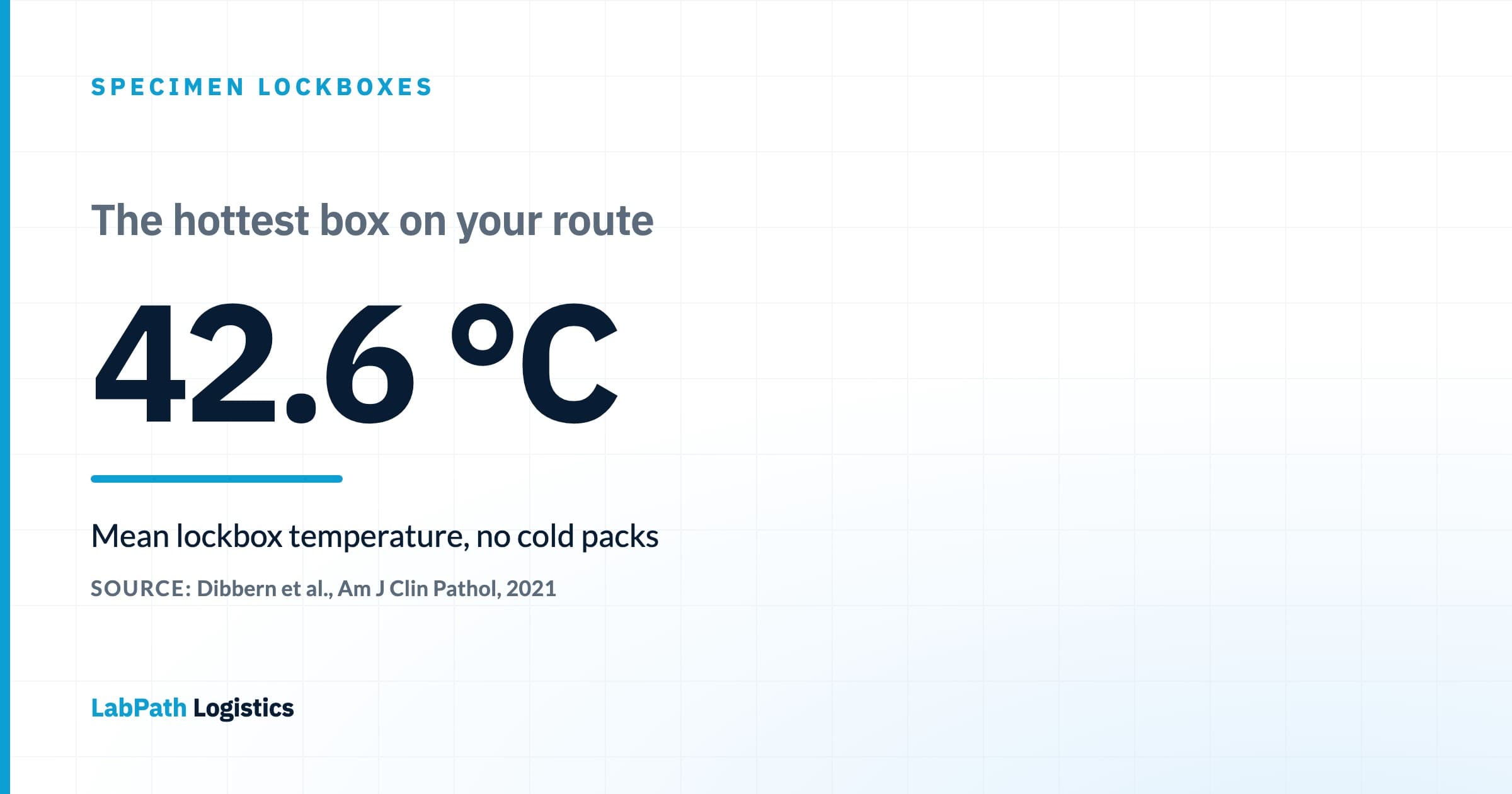
Read that against a Houston August. An exam room holds 22–24 °C. A tube waiting on a counter near a west-facing window, or riding in an unconditioned trunk, does not — which is the same failure mode we traced in Houston summer heat and specimen integrity. Six hours is not a hypothetical threshold here. It is a Tuesday.
The Single Biggest Variable Is a Centrifuge
Processing on site changes the question
A clinic that spins, aliquots, and refrigerates before pickup has stopped the two-hour clock at its own bench. From that point the constraint becomes the analyte's stability in separated serum — usually measured in days, not hours — and pickup frequency becomes a turnaround-time and cost decision instead of a specimen-integrity one. A clinic that hands over whole blood has outsourced its stability window to the courier's schedule.
This is the fork that determines everything downstream, and most frequency conversations skip it entirely. Before negotiating stops, answer one question in writing: at the moment a specimen leaves this building, has it been processed or not? Clinics that cannot answer it are usually paying for one of two mistakes — a nine-hour hold they think is fine, or three daily stops they do not need.
It is also worth checking the reference lab's own requirements before assuming. Under 42 CFR §493.1242, the receiving laboratory must maintain written policies covering specimen submission, handling, transport conditions, and preservation — including criteria for acceptability and rejection. Those criteria are the real specification for your pickup schedule, and they are already written down. Ask for them.
What Houston Adds to the Math
A pickup schedule is a promise about time, and time in this metro is not evenly distributed. In the 2025 Texas 100 Most Congested Road Segments ranking from the Texas A&M Transportation Institute and TxDOT, the I-610 West Loop held the number one position for the third consecutive year, accounting for 1,729,459 hours of annual delay and $166.4 million in congestion cost. The Houston–The Woodlands–Sugar Land area holds 36 of the state's 100 worst segments.
36 of 100
Share of Texas's 100 most congested road segments located in the Houston–The Woodlands–Sugar Land area, per the Texas A&M Transportation Institute and TxDOT, 2025 Texas 100 Most Congested Road Segments, published November 25, 2025
The operational translation is simple. A 4:30 p.m. pickup inside the Loop and a 10:30 a.m. pickup are not the same product, and pricing them identically is a mistake both parties make. A stop scheduled into the evening peak buys the clinic a longer hold at origin and a slower run to the lab at the same time — the two variables you least want moving together. Our breakdown of medical courier route design in Houston covers how stop windows and route density interact; for scheduling purposes the rule is short: place stops where the map is cheap, and pay for a dedicated run when the clinical clock will not wait.
Four Questions That Set Your Frequency
- What is the shortest stability window on the menu you actually order? Not the menu you could order — pull last quarter's send-out volume and find the tightest one.
- Do you process before handoff? Spun, aliquoted, and stored is a different logistics problem from whole blood in a rack.
- When do you draw? Frequency follows draw blocks, not office hours. Two morning blocks and a thin afternoon means two stops, not three evenly spaced ones.
- What has to be resulted today? Separate the true same-day tests from the ones that only feel urgent. That subset sizes your STAT overlay; the rest belongs on the route.
Most clinics that run this exercise land on the same shape: a scheduled stop after the morning draw block, a second stop at close, and an on-call STAT option that gets used a few times a month rather than daily. That structure is cheaper than three fixed stops and dramatically safer than one, because it matches spend to the clock that actually matters — the same logic behind sizing lab turnaround time around the courier leg.
Put the Schedule in the Contract, Not the Group Chat
A frequency decision that lives in someone's memory is not a schedule. CAP checklist item GEN.40530 expects a laboratory-contracted courier to run a tracking system that records temperature, time of specimen pickup and delivery, and specimen identity. That is the same record that proves your schedule is being met — the timestamped custody our platform captures at every handoff — so specify it once and hold both sides to it:
- Named stop windows, not "daily" — a 30-minute window per stop, with the draw block it serves stated next to it.
- A missed-stop path: who is called, how fast a recovery run launches, and what happens to specimens that miss the window.
- The temperature state each stop travels in, and who verifies it at both ends.
- A quarterly frequency review tied to volume, so the schedule tracks the practice instead of the year it was signed.
The last one is the one nobody writes down and everybody needs. Draw volume moves — a new provider, a new payer contract, a seasonal swing — and the pickup schedule that fit in January is either wasting money or leaking integrity by August.
Key Takeaway
Pickup frequency is not a line item to minimize; it is a clinical control disguised as a logistics preference. If you process on site, one or two timed stops are usually right and the decision is about turnaround and cost. If you send whole blood, the two-hour separation window sets your floor, and no amount of careful packing buys it back. Either way, the schedule should be written against your draw blocks and your reference lab's own rejection criteria — and then reviewed on a calendar, before a rejected potassium reviews it for you.
Frequently Asked Questions
How many times a day should a medical courier pick up specimens?
It depends on whether you process specimens before handoff. A clinic that centrifuges, aliquots, and refrigerates on site can usually run one or two scheduled stops a day, because the stability clock has already been stopped at its own bench. A clinic that hands over whole blood for chemistry generally needs a stop tied to each draw block, since CLSI guidance is commonly summarized as separating serum or plasma from cells within two hours of collection. Most Houston clinics land on a post-morning-block stop, a close-of-day stop, and an on-call STAT option used a few times a month.
Is one end-of-day specimen pickup enough?
Only if you process on site or your menu tolerates long holds. For unprocessed chemistry specimens, a single end-of-day sweep can leave a morning tube in contact with its cells for eight hours or more. A study in Biochemia Medica found creatinine deviated 14.6% and hemoglobin 16.4% after 12 hours of pre-centrifugation delay at 22–30 °C, with visible hemolysis above 30 °C at six hours. Check your reference lab's written acceptability criteria before assuming a single sweep is acceptable.
Does adding a second daily pickup double the cost?
Rarely. A second stop placed on an existing route at an off-peak hour is priced very differently from a dedicated same-day run, because the cost driver is route density and time of day rather than stop count alone. The expensive stops are the ones that force a vehicle off its route or into peak congestion — which in Houston means the evening peak on segments like the I-610 West Loop, ranked the state's most congested for the third year running by the Texas A&M Transportation Institute and TxDOT in 2025.
What should a specimen pickup schedule specify in the contract?
Named 30-minute stop windows tied to the draw block each one serves, the temperature state each stop travels in, a missed-stop escalation path with a recovery-run commitment, and a quarterly frequency review tied to volume. CAP checklist item GEN.40530 expects a laboratory-contracted courier to record temperature, time of pickup and delivery, and specimen identity — that record is also the evidence your schedule is actually being met.