Medical Courier Routes Houston: Scheduled vs On-Demand
August 13, 2026 · By LabPath Logistics Editorial Team, Medical Logistics Desk
Quick Answer
Most Houston facilities need both. A scheduled route buys predictability and a lower cost per stop because the vehicle is shared across sites; on-demand dispatch buys speed at a higher unit price because the vehicle is dedicated to one run. The design decision is not which model to buy — it is where to set the interval, because a specimen drawn one minute after a pickup waits the entire interval before it moves. Set the cadence so that worst case, plus Houston drive time, still lands inside the specimen's stability window.
Medical courier routes in Houston get evaluated on the wrong number. Facilities shop drive time — how fast can you get from our clinic to the lab — when the larger loss usually happens before the vehicle arrives, while a tube sits in a rack waiting for the next scheduled pickup. Drive time is bounded by geography. Waiting time is set entirely by how the route was designed, which means it is the part you can actually negotiate.
That makes the scheduled-versus-on-demand question less philosophical than it looks. Below is how the two models behave, what each one really costs you in time, and how to set a pickup cadence that survives a Houston afternoon.
Cadence Beats Speed
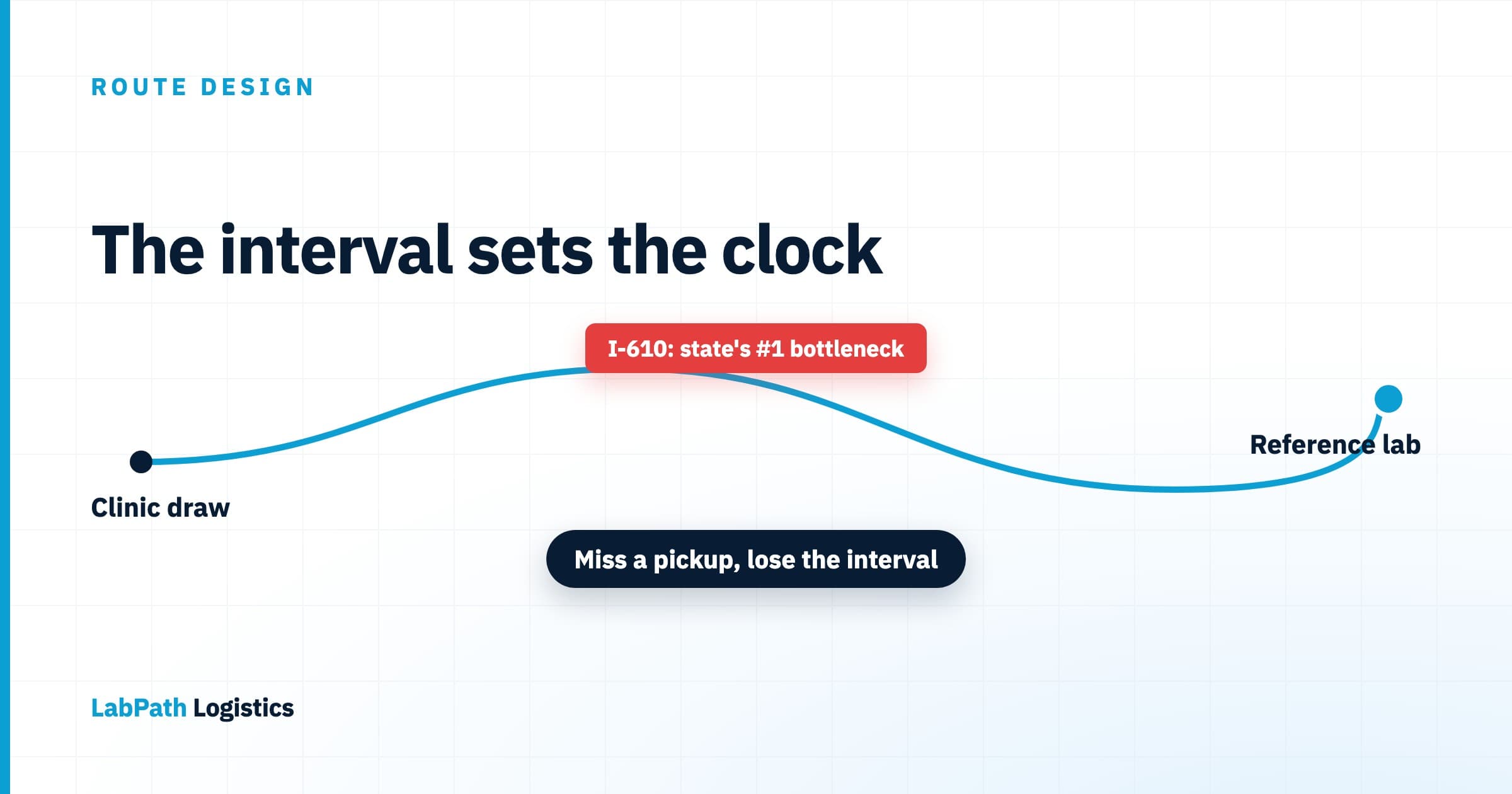
Start with the arithmetic that route salespeople skip. On a fixed route, the average specimen waits half the pickup interval and the unlucky one waits nearly all of it. A two-hour route means a tube drawn at 9:02, one minute after the 9:01 pickup, does not leave the building until 11:01. Nothing about the courier's speed changes that; it was decided when someone chose two hours.
Now add the constraint on the other end. Most routine chemistry and microbiology guidance converges on a two-hour ceiling from collection to laboratory accession, and that ceiling covers the whole journey — counter time, drive time, and accessioning. Our lab turnaround time guide walks through how the clock decomposes. The practical implication is blunt: a two-hour route cannot serve a two-hour specimen, because the interval consumes the entire allowance before the vehicle moves.
2.95 hours
mean observed transport time for pediatric blood cultures against a two-hour benchmark; only 82 of 268 specimens met it, at a hospital roughly 700 meters from the laboratory (Open Forum Infectious Diseases, 2025)
A transport-time analysis presented in Open Forum Infectious Diseases measured exactly this drift after a microbiology service was centralized. The benchmark was two hours. The mean was 2.95, and only 82 of 268 specimens made it. The detail that should end the drive-time conversation: the sending hospital sat about 700 meters from the receiving laboratory. Distance was never the problem. The gap between collection and departure was.
Ask for the interval, not the ETA
When a courier quotes "30 minutes to the lab," they are quoting the drive. Ask instead: how many pickups per day at our site, at what times, and what is the longest a specimen can sit before one arrives? That number, plus the drive, is your real transport time — and it is the one your accessioning log will reflect.
What a Scheduled Route Actually Buys
A scheduled route is a standing commitment: the same stops, in roughly the same order, at roughly the same times, every operating day. Its advantages are structural rather than heroic.
- Cost per stop falls because the vehicle and the driver's hour are shared across several facilities on one loop.
- Staff behavior stabilizes — phlebotomy and packaging organize around a known departure rather than around a phone call.
- Volume becomes forecastable, which is what lets a lab staff its bench for the hour the work will actually arrive.
- Coverage is contractual. A named route with named times is auditable in a way that best-effort dispatch is not.
The cost is rigidity. A route optimized for the group is not optimized for any single site on it, and a stop late in the sequence inherits every delay ahead of it. That is why route position belongs in your agreement alongside frequency — being third on the loop and being seventh are different service levels at the same price.
What On-Demand Dispatch Actually Buys
On-demand dispatch reverses the trade. You call, a vehicle is assigned to your run, and the specimen leaves on your clock instead of the route's. You pay for the dedication — the unit price reflects a vehicle that is not sharing its hour with anyone else. The pricing mechanics behind that difference are covered in our medical courier cost breakdown.
On-demand is the right instrument in four situations: a STAT result that changes management in the next hour; a specimen whose stability window is shorter than your route interval; an add-on ordered after the last scheduled pickup; and any volume spike a fixed loop was not sized for. What it is not is a substitute for cadence. Facilities that run everything on-demand end up paying dedicated pricing for routine work and, more quietly, lose the predictable arrival pattern their reference lab depends on.
Houston Traffic Is a Schedule Input, Not an Excuse
Any cadence built on free-flow drive times will fail in the afternoon, and the size of the gap is measured rather than anecdotal.
77 hours
annual delay per Houston auto commuter in 2024, with a travel time index of 1.36 — a peak trip takes 36% longer than the same trip in free-flow conditions (TTI 2025 Urban Mobility Report)
The Texas A&M Transportation Institute's 2025 Urban Mobility Report puts Houston at 77 hours of delay per commuter for 2024 and a travel time index of 1.36, up from 1.26 the year before. Commercial vehicles carry their own share: the same report attributes about 12.5 million person-hours of truck delay and $927 million in truck congestion cost to the Houston area in 2024.
Location matters as much as the average. TxDOT's Top 100 Congested Road Segments list, published in 2025 on 2024 data, ranks the I-610 West Loop as the single most congested segment in Texas for the third consecutive year, with roughly 1.73 million annual hours of delay. The Houston–The Woodlands–Sugar Land area holds 36 of the state's 100 worst segments. Any route that crosses the West Loop into the Texas Medical Center — where TMC reports 10 million patient encounters a year — is crossing the state's worst bottleneck on purpose.
The operational response is not to promise heroics. It is to build the schedule with a buffer that matches the measured index, sequence the congested legs against the peak rather than into it, and treat a departure time as the commitment rather than an arrival estimate. The same logic applies to weather disruption, which we cover in the hurricane season contingency guide.
Five Inputs That Set the Cadence
- The shortest stability window you routinely collect. Cadence is set by the tightest specimen on the menu, not the average one.
- Draw volume by hour. A site that draws 80% of its tubes before 10 a.m. needs a morning-weighted schedule, not evenly spaced pickups.
- The receiving lab's accessioning and run schedule. Arriving 20 minutes after a batch starts can cost more hours than the drive ever did.
- Drive time to the lab at the hour the run actually happens — peak, not average.
- Your add-on and STAT rate. If more than a small share of runs are already exceptions, the scheduled interval is set too wide.
A Four-Site Clinic Group: Worked Example
Consider a Houston-area primary care group with four clinics — inside the Loop, in Katy, in Pearland, and near Willowbrook — sending routine chemistry and microbiology to one reference lab in the Texas Medical Center corridor. All four draw heaviest between 7:30 and 10:30 a.m.
A single loop hitting all four sites once mid-morning looks efficient on a spreadsheet and fails in practice: the last stop's early draws have aged past three hours before the vehicle arrives, and the westbound return crosses the West Loop at the worst possible time. A workable design usually looks different:
- Two morning pickups at each site during the draw peak, cutting worst-case counter time from roughly three hours to under 90 minutes.
- Sites split across two loops by geography rather than one long chain, so no clinic inherits the full sequence delay.
- A committed early-afternoon run for post-lunch collections, plus a defined last pickup that staff can plan the day around.
- On-demand reserved for STAT orders and true add-ons, priced and tracked separately so its use stays visible.
Nothing in that design is exotic. It is the difference between buying a courier and designing a schedule.
What Belongs in the Route Agreement
Frequency alone is not a service level. Alongside the terms in our medical courier SLA guide, a route agreement should name:
- Scheduled pickup times per site, with an arrival window and your position in the loop sequence.
- A dispatch commitment for on-demand runs, stated as time-to-vehicle rather than a vague promise of urgency.
- The last guaranteed pickup of the day and the cutoff for same-day add-ons.
- Timestamped pickup and delivery records per stop, exportable to you — the chain-of-custody evidence described on our platform features page.
- Temperature handling by specimen category, verified rather than asserted, per the controls on our compliance page.
- A named escalation path when a route is disrupted, including who is notified and how a missed stop is recovered the same day.
- A review cadence — monthly at minimum — comparing actual pickup times against scheduled ones, using the courier's own data.
Key Takeaway
Scheduled routes and on-demand dispatch solve different problems, and the choice between them is really a choice about interval. Your worst-case specimen waits the full gap between pickups, then drives through a metro where peak trips run 36% longer than free-flow and the state's most congested segment sits between most of the city and the Texas Medical Center. Set the cadence against the tightest stability window you routinely collect, keep on-demand for the exceptions it was built for, and require the pickup timestamps that let you check the schedule against reality instead of against the sales sheet.
Frequently Asked Questions
How often should a Houston clinic schedule lab courier pickups?
Set the interval so the worst case — a specimen drawn immediately after a pickup — still reaches the lab inside its stability window after drive time. For clinics sending routine chemistry and microbiology against a two-hour collection-to-accession benchmark, a single daily pickup cannot meet it; two or more pickups during the morning draw peak, plus a committed afternoon run, is the common working pattern. Sites drawing only stable, preserved specimens can run wider intervals.
Is a scheduled route cheaper than on-demand medical courier service?
Per stop, usually yes. A scheduled route shares one vehicle and one driver hour across several facilities on the same loop, so the fixed cost is divided; on-demand assigns a vehicle to your run alone and prices accordingly. The comparison only holds if the scheduled interval actually fits your specimens — a cheap route that pushes work outside its stability window creates recollection and repeat-visit costs that dwarf the courier line item.
What should a medical courier route agreement specify beyond frequency?
Scheduled pickup times with an arrival window, your position in the loop sequence, a stated time-to-vehicle for on-demand dispatch, the last guaranteed pickup and add-on cutoff, exportable timestamped pickup and delivery records, temperature handling by specimen category, an escalation and recovery path for disrupted routes, and a monthly review comparing actual pickup times against scheduled ones.
How much should Houston traffic change a courier schedule?
Enough to be designed around. The Texas A&M Transportation Institute's 2025 Urban Mobility Report puts Houston's travel time index at 1.36 for 2024, meaning a peak-period trip takes about 36% longer than the same trip in free-flow conditions. TxDOT's 2025 Top 100 list also ranks the I-610 West Loop the most congested segment in Texas. Build buffers from peak-hour drive times, and sequence congested legs away from the peak rather than through it.