Drug Shortage Courier Houston: Loan and Borrow Rules
September 25, 2026 · By LabPath Logistics Editorial Team, Medical Logistics Desk
Quick Answer
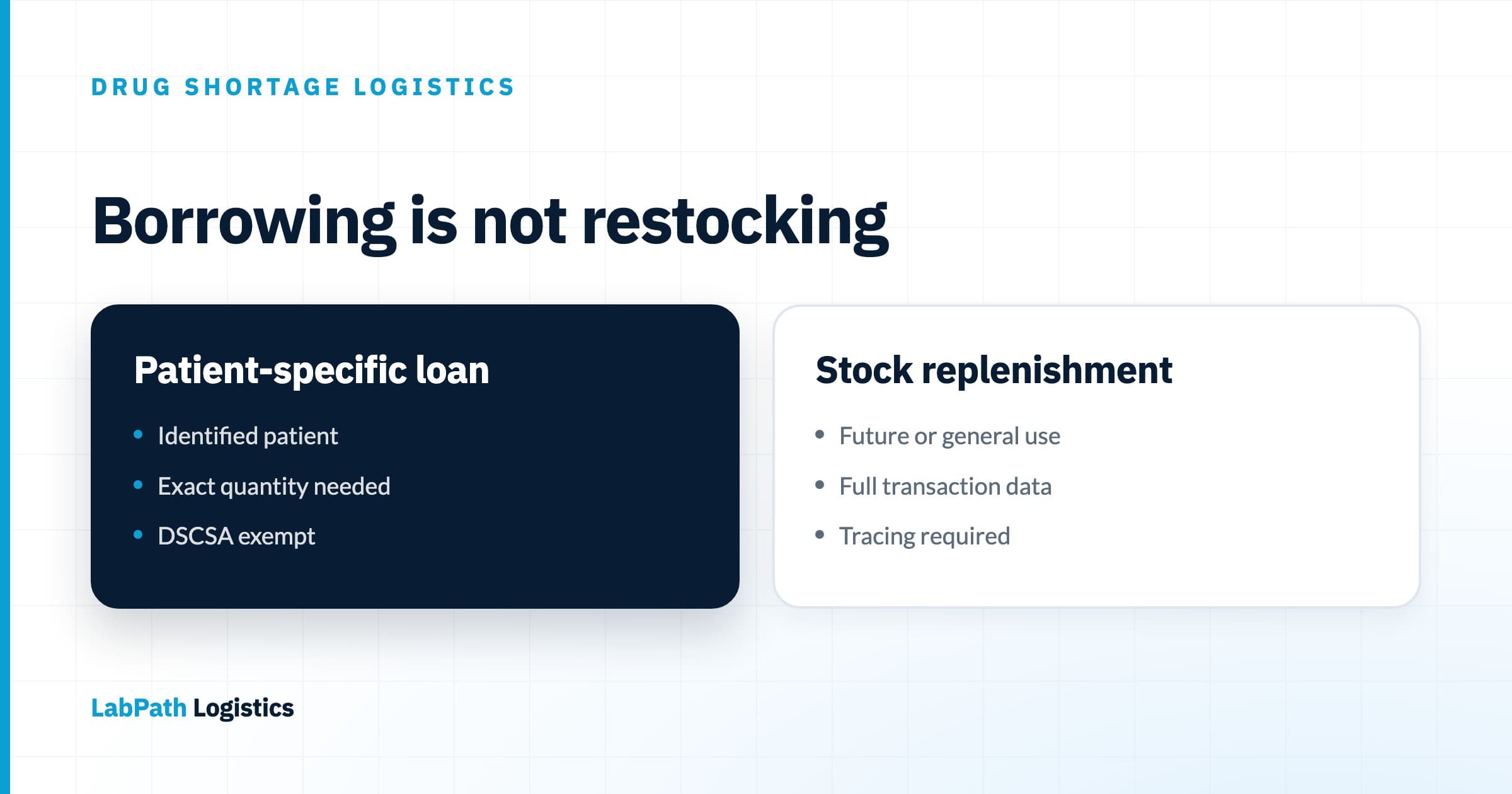
When a Houston hospital or clinic pharmacy borrows a drug from a neighbor during a shortage, the transfer is only exempt from DSCSA tracing when it fills a prescription for an identified patient or meets an emergency medical reason. A shortage on its own does not count as an emergency medical reason, and borrowing to restock shelves is treated as a regular transaction. Keep each loan tied to a specific patient need, document it, and move it by a courier who records the handoff and the required temperature.
Drug shortage courier runs are back on the schedule for many Houston pharmacies. When a wholesaler shorts an order, the fastest fix is often a call to the hospital across town: can you spare two vials until Friday? The phone call takes five minutes. Getting the drug there legally, at the right temperature, with a record both pharmacies can defend, takes more planning than most teams have written down.
This guide is for pharmacy directors, buyers, and clinic administrators in Greater Houston. It covers where shortages stand in 2026, what the Drug Supply Chain Security Act (DSCSA) allows when one pharmacy lends to another, and how to set up the transport side before the next shortage hits.
Where Drug Shortages Stand in 2026
After easing through 2025, active shortages are climbing again. The ASHP drug shortage statistics, compiled with the University of Utah Drug Information Service, counted 216 active shortages at the end of 2025, 223 at the end of the first quarter of 2026, and 227 at the end of the second quarter. That is the third straight quarterly increase.
227
Active U.S. drug shortages at the end of Q2 2026, up from 216 at year-end 2025. The all-time high was 323 in Q1 2024 (ASHP / University of Utah Drug Information Service).
The mix matters for logistics. ASHP data reported in July 2026 showed that just under half of new 2026 shortages involve sole-source products, and about 10% involve imaging contrast agents. Sole-source products have no second manufacturer to switch to, which is exactly when pharmacies start calling each other.
What DSCSA Allows When One Pharmacy Lends to Another
DSCSA requires transaction information, history, and a statement (often called T3 data) to travel with most changes of ownership of prescription drugs. A pharmacy lending stock to another pharmacy is a change of ownership. Two exemptions in the statute cover most legitimate shortage borrowing.
1. Specific patient need
The FDA's DSCSA product tracing FAQ defines a specific patient need as a transfer from one pharmacy to another to fill a prescription for an identified patient. The definition expressly excludes transfers made to increase or replenish stock in anticipation of a potential need. In practice, that means the loan should match a real order for a real patient, in the quantity that order needs.
2. Emergency medical reasons
The statute, 21 U.S.C. § 360eee(24)(B), also exempts distribution for emergency medical reasons, including a declared public health emergency. The same section adds a limit that surprises many teams: a drug shortage not caused by a public health emergency is not, by itself, an emergency medical reason. A shortage explains why you are borrowing. It does not make the transfer exempt.
The line to hold
Borrowing two vials for a patient who is due for a dose tonight fits the exemption. Borrowing a case so the shelf looks full next week does not. Treat that second transfer like any other purchase, with full transaction data.
Controlled substances follow separate rules
DSCSA is not the only framework in play. DEA rules still apply to controlled substances: Schedule II transfers between registrants require a DEA Form 222 or its electronic equivalent under 21 CFR 1305.03, and practitioner-to-practitioner distributions are capped under 21 CFR 1307.11. Our guide to controlled substance courier compliance covers the transport side.
Where the Transport Side Breaks Down
Most shortage loans are arranged in a hurry, which is why the delivery is often the weakest part. The common failures are predictable:
- A staff member drives the drug over in a personal car, with no temperature control and no record of when it left or arrived.
- A refrigerated product rides in a bag with a single ice pack on a Houston afternoon, with no way to show it stayed at 2 to 8 °C.
- The receiving pharmacy signs nothing, so the lending pharmacy cannot show the product was delivered or to whom.
- The patient-specific justification lives in someone's memory rather than on the loan record.
Each of these is fixable before the next shortage. For refrigerated products, the packaging guidance in our cold chain pharmacy delivery guide applies to borrowed stock just as it does to routine deliveries.
A Houston Scenario
Picture a community hospital in Pasadena short on a sole-source injectable that a patient on the medical floor needs for an evening dose. The pharmacy buyer calls a larger system pharmacy near the Texas Medical Center, which agrees to lend three vials. The lending pharmacist notes the order reference and the quantity on a loan log, packs the vials in a validated refrigerated container, and hands them to a courier.
The courier scans the sealed package, records the pickup time and the declared temperature range, and drives directly down the Gulf Freeway. At the receiving pharmacy, a named staff member signs for the package. Both pharmacies now have the same record: what moved, when, at what declared temperature, and who accepted it. No patient information travels outside the sealed package. When the wholesaler delivers the following week, the return loan is logged and moved the same way.
Shortage Borrowing Checklist
- Agree on reciprocal loan terms with two or three nearby pharmacies before a shortage starts.
- Tie every loan to a specific patient order and borrow only the quantity that order needs.
- Route stock replenishment through normal purchasing with full DSCSA transaction data.
- Handle controlled substances under DEA rules, including Form 222 for Schedule II products.
- Record the product, lot, quantity, and required storage temperature on the loan log.
- Use validated containers for refrigerated or frozen products, never a loose ice pack.
- Require a signed, time-stamped receipt at the destination pharmacy.
- Log the return loan the same way, and keep records together for audits.
Related reading
For a smaller pharmacy's DSCSA obligations, see our explainer on the [DSCSA small dispenser exemption](/blog/dscsa-small-dispenser-exemption-houston). If loans happen at night, our guide to [after-hours medical courier coverage](/blog/after-hours-medical-courier-houston) covers evening and weekend planning.
Key Takeaway
Shortages are rising again, and borrowing between pharmacies will be part of how Houston facilities keep patients on therapy. The legal line is simple: loans for an identified patient are exempt, restocking is not, and a shortage alone is not an emergency. The operational line is just as clear: every borrowed vial should move with a declared temperature, a recorded pickup, and a signed receipt.
Frequently Asked Questions
Can hospital pharmacies borrow drugs from each other during a shortage?
Yes, but DSCSA only exempts the transfer when it fills a prescription for an identified patient or meets an emergency medical reason. Borrowing to replenish stock for future use is treated as a regular transaction that needs full transaction data.
Is a drug shortage an emergency medical reason under DSCSA?
Not by itself. Under 21 U.S.C. § 360eee(24)(B), a drug shortage not caused by a public health emergency does not count as an emergency medical reason. The shortage may be why you borrow, but the patient-specific need is what makes the transfer exempt.
How many drug shortages are there in 2026?
ASHP and the University of Utah Drug Information Service counted 227 active U.S. drug shortages at the end of the second quarter of 2026, up from 216 at the end of 2025. The record was 323 in the first quarter of 2024.
How should a borrowed refrigerated drug be transported?
In a validated container that holds 2 to 8 °C for the length of the trip, with the pickup time and required temperature recorded and a signed receipt at the destination. A single ice pack in a bag is not enough in Houston heat.