Hospital Outreach Lab Sold? Houston Courier Checklist
September 23, 2026 · By LabPath Logistics Editorial Team, Medical Logistics Desk
Quick Answer
When a hospital sells its outreach lab, inpatient and emergency testing usually stays with the hospital, while clinic and physician-office testing moves to the buyer's network and often to a regional lab farther away. For a Houston clinic, that can change pickup times, daily cutoffs, supply ordering, and how long specimens sit before they reach an analyzer. Before the transition date, confirm the new pickup schedule in writing, decide which specimens you must process on site, and make sure STAT and after-hours work still has a defined path.
A clinic manager usually hears about a hospital outreach lab sale in a letter: same tests, new requisitions, a new portal, and a go-live date. What the letter rarely spells out is the logistics. The driver who has picked up at 3 p.m. for years may be replaced by a different route, the specimens may travel to a lab in another city, and the daily cutoff may move. For Houston clinics and physician offices, those details decide whether results come back on time.
This guide explains why health systems are selling outreach labs, what typically changes for the clinics that send them work, and a checklist for getting through the transition without rejected specimens or missed STAT results.
Why Health Systems Are Selling Outreach Labs
A hospital outreach lab tests specimens for patients who are not admitted: physician offices, clinics, nursing homes, and patient service centers. Over the past two years, several systems have sold that business to national laboratories while keeping their hospital labs.
- In December 2025, Community Health Systems completed the sale of select outpatient lab assets in 13 states, including patient service centers and in-office phlebotomy locations, to Labcorp, according to Healthcare Dive. CHS kept its inpatient and emergency department labs.
- In January 2025, Quest Diagnostics completed its purchase of select outreach lab assets from Cleveland-based University Hospitals. Quest said testing for those providers would be performed at its labs in Twinsburg, Ohio, and Pittsburgh, per its announcement. University Hospitals kept inpatient and select outpatient testing.
- In November 2025, Labcorp and Parkview Health announced a deal covering only non-emergent outreach services, with labs inside Parkview hospitals continuing to handle emergency and acute care, per Parkview. The transaction is expected to close in 2026.
$194M
Cash price Labcorp paid for select Community Health Systems outreach lab assets in 13 states, completed December 2025 (Healthcare Dive).
The pattern is consistent. The hospital keeps what it needs for admitted and emergency patients, and the outpatient book of business moves to a lab with a national network. CHS described its decision as a way to focus on core services. Whatever the reason, the clinic on the other end inherits a new logistics model.
What Changes for the Clinics That Send the Work
Test menus and requisitions get the attention in a transition. The courier side gets less, and it is where most early problems show up.
Specimens may travel farther
The University Hospitals example shows how far testing can move: from a local hospital lab to regional labs in two other cities. A longer trip is manageable for stable specimens. It is a problem for anything with a short window. CLSI GP44-A4, the standard for handling and processing blood specimens, calls for serum or plasma to be separated from cells within two hours of collection unless the lab has evidence that longer contact does not affect the result. A trip that used to be 20 minutes across town cannot absorb a hub transfer and a long-haul leg without that separation happening first.
Pickup times and cutoffs move
A national lab's route network is built around its own processing hubs and flight or linehaul times. The pickup that used to come at 4:30 p.m. may now come at 2 p.m. to make a departure. Specimens drawn after the last pickup wait overnight. If your afternoon draw volume is heavy, re-check your specimen pickup schedule against the new route before go-live, not after the first rejection report.
STAT and after-hours work needs a new answer
When the hospital ran outreach, a clinic with an urgent specimen could often send it straight to the hospital lab. After a sale, the hospital lab typically serves inpatients and the emergency department, and outreach work belongs to the buyer. Ask both parties, in writing, where a STAT specimen goes, who carries it, and what happens on a Saturday night.
A Houston Scenario
Picture a four-provider internal medicine practice in Pearland that has sent its lab work to a nearby hospital system for years. The hospital's courier stops twice a day, and the practice sends unspun chemistry tubes because the hospital lab is 25 minutes away. After an outreach sale, the new provider's route stops once, at 1:45 p.m., and specimens go to a regional hub before testing. Tubes drawn at 9 a.m. now sit for hours before separation. Within two weeks, potassium and glucose results start drawing questions from the physicians.
The fix is not complicated: add an on-site centrifuge and a separation step, move the draw schedule earlier, and use a dedicated courier for the handful of specimens that cannot wait for the route. But it is far cheaper to plan before go-live than to discover the gap in patient results.
A Transition Checklist for Houston Clinics
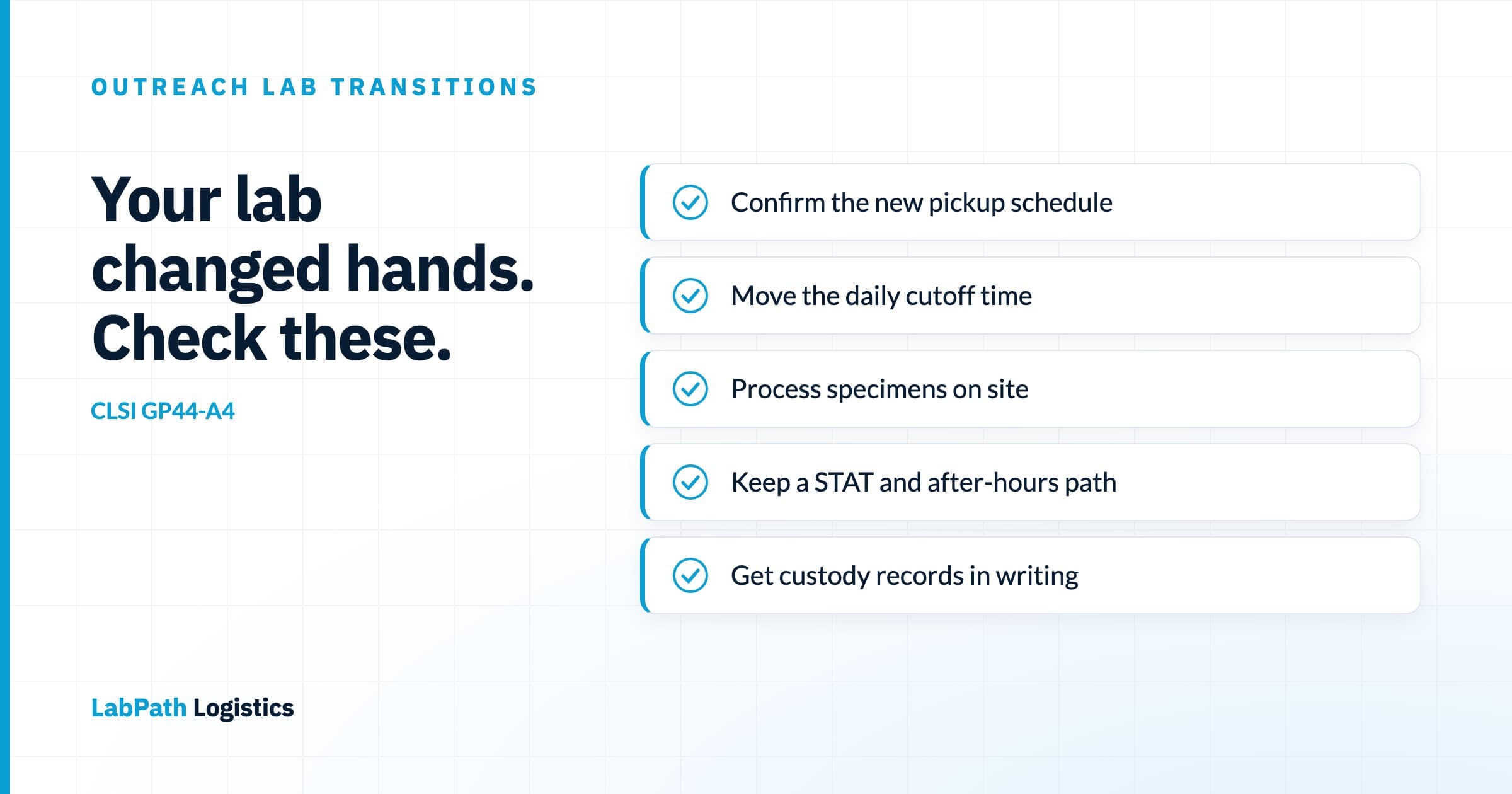
- Get the new pickup times, frequency, and daily cutoff in writing for your address, not a regional average.
- Map each test on your menu to its stability window, and decide which specimens you must centrifuge, separate, and refrigerate before pickup.
- Confirm where testing will be performed and whether specimens pass through a hub first.
- Define a STAT path: which lab, which courier, and how quickly a pickup arrives.
- Confirm after-hours and weekend coverage, including holidays and severe weather.
- Ask how custody is recorded at each handoff, and whether you can see timestamps without calling anyone.
- Order supplies for the new lab early: tubes, requisitions, specimen bags, and transport containers.
- Run a parallel week if you can, and track rejections and turnaround time against your baseline.
You can keep a courier of your own
A sale changes which lab tests your specimens. It does not stop a clinic from using an independent courier for STAT runs, send-outs to other labs, or pickups the new route does not cover. Our [send-out testing logistics guide](/blog/send-out-testing-logistics-houston) and [guide to switching couriers](/blog/switching-medical-couriers-houston) cover how to set that up without disrupting your lab relationship.
Key Takeaway
Outreach lab sales are moving outpatient testing into national networks, and the hospital lab down the street may no longer be your lab. The test menu usually survives the transition. The logistics are what change: longer trips, earlier cutoffs, and a new answer for urgent work. Clinics that plan pickup times, on-site processing, and a STAT path before go-live avoid most of the trouble.
Frequently Asked Questions
What happens when a hospital sells its outreach lab?
The hospital usually keeps its inpatient and emergency department labs, and the buyer takes over testing for clinics, physician offices, and patient service centers. Recent examples include Community Health Systems and Parkview Health with Labcorp, and University Hospitals with Quest Diagnostics.
Will my clinic's specimen pickup times change after an outreach lab sale?
Often, yes. The buyer's routes are built around its own processing hubs and linehaul schedules, so pickups can move earlier or become less frequent. Get the new schedule and daily cutoff for your address in writing before the go-live date.
Do I need to centrifuge specimens before a longer transport?
For many chemistry tests, yes. CLSI GP44-A4 calls for serum or plasma to be separated from cells within two hours of collection unless the lab has evidence that longer contact does not affect the result. If specimens now travel to a regional lab, on-site processing is usually required.
Can a clinic use its own medical courier after an outreach lab sale?
Yes. A clinic can use an independent courier for STAT specimens, send-outs to other labs, or pickups the lab's route does not cover. Confirm drop-off procedures with the receiving lab and keep custody records for each handoff.