Hospice Medication Delivery in Houston: Courier Rules
September 22, 2026 · By LabPath Logistics Editorial Team, Medical Logistics Desk
Quick Answer
Medicare's hospice rules require drugs related to the terminal illness to be provided by the hospice and made routinely available 24 hours a day, 7 days a week (42 CFR §418.100 and §418.106). For a Houston hospice or its contracted pharmacy, that means medication delivery has to work at night and on weekends, with labeled and sealed packages, a documented count for controlled drugs, and a signed handoff to a named person in the home. A courier should never collect leftover controlled substances from the home; disposal belongs to the family and qualified hospice staff under DEA rules.
A hospice medication order rarely arrives at a convenient time. A symptom changes at 11 p.m., a nurse calls in a new order, and a family is waiting at a house in Katy or Pasadena for the pharmacy to deliver. Hospice medication delivery in Houston is a logistics problem with a regulatory floor under it: the medication has to arrive quickly, intact, and with a record that holds up if anyone asks where a controlled drug went.
This guide is for hospice administrators, directors of nursing, and the pharmacies that serve them. It covers what Medicare requires, where couriers fit, and the handoff details that separate a reliable delivery program from a liability.
Why Hospice Delivery Volume Keeps Growing
In 2024, more than 1.8 million Medicare beneficiaries received hospice care from about 6,700 providers, and Medicare hospice spending reached $28.3 billion, according to the Medicare Payment Advisory Commission's March 2026 report. The same report found that the share of Medicare decedents using hospice rose to a new high.
52.9%
Share of Medicare decedents who used hospice in 2024, up from 51.7% in 2023 (MedPAC, March 2026 Report to the Congress).
Texas is one of the fastest-growing hospice markets in the country. MedPAC reports that Texas gained 44 hospices between 2023 and 2024, a 5 percent increase. More agencies serving patients across a metro the size of Greater Houston means more pharmacy runs to private homes, assisted living communities, and nursing facilities, often outside business hours.
What Medicare Requires of Hospice Medications
The hospice Conditions of Participation do not regulate couriers directly, but they set the service level a courier has to support. Three provisions matter most:
- Around-the-clock availability. Under 42 CFR §418.100(c)(2), drugs and biologicals must be made routinely available on a 24-hour basis, 7 days a week.
- The hospice provides the drugs. Under 42 CFR §418.106, drugs related to the palliation and management of the terminal illness, as identified in the plan of care, must be provided by the hospice.
- Labeling and controlled-drug policies. Drugs must be labeled with usage and cautionary instructions and an expiration date where applicable, and the hospice must have written policies for managing and disposing of controlled drugs in the patient's home.
When controlled drugs are first ordered, §418.106 also requires the hospice to give the family a copy of those policies, discuss them in a language and manner the family understands, and document that conversation in the clinical record. A delivery that shows up with no clear recipient, or that is left on a porch, cuts against the control those policies are meant to create.
Where the Courier Fits
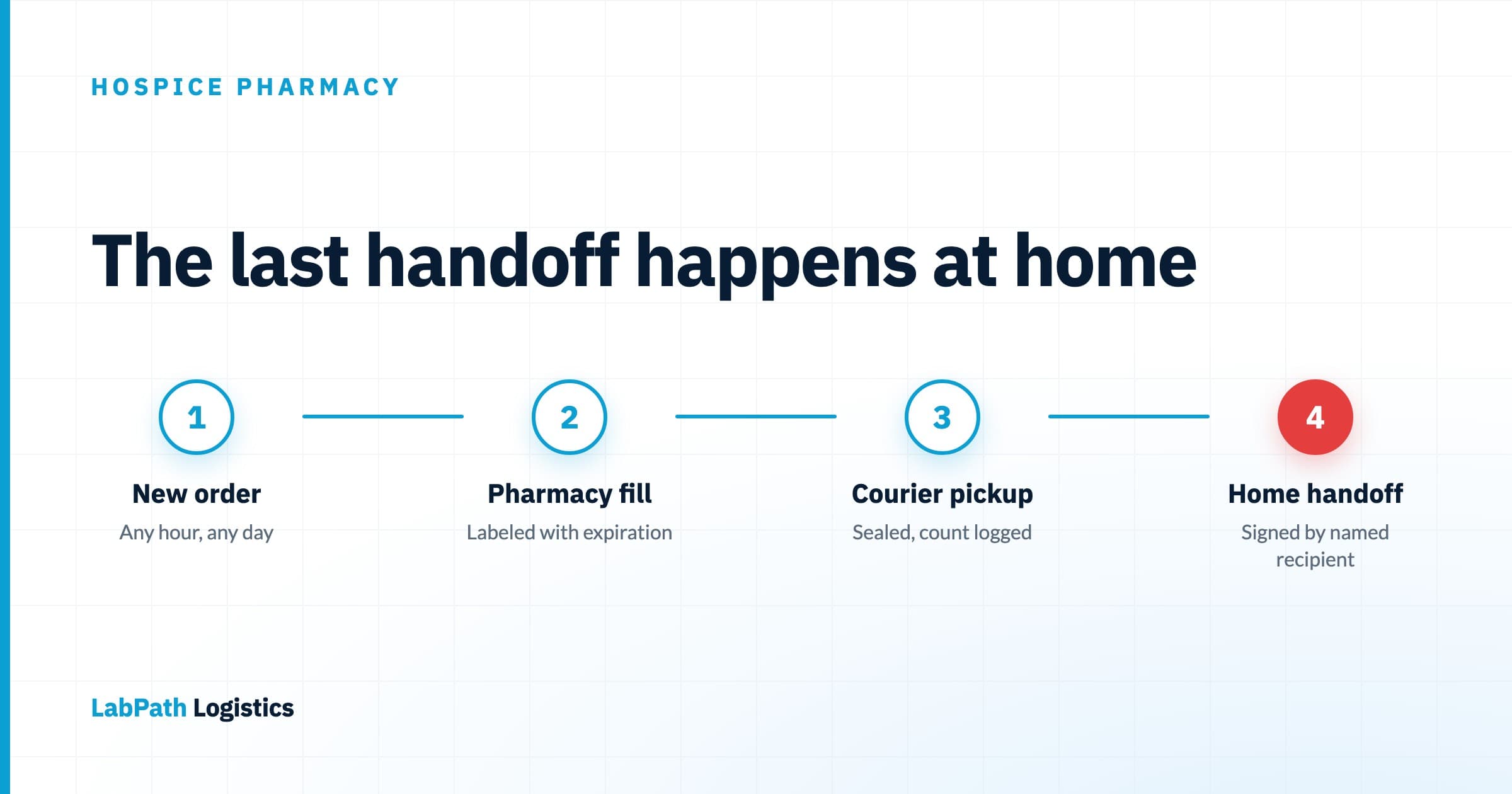
Most hospice pharmacies run two kinds of deliveries. Scheduled deliveries cover admissions, refills, and comfort kits. On-demand deliveries cover new orders, dose changes, and anything that happens overnight or on a weekend. The courier's job is the same in both cases: move a sealed package from the pharmacy to a verified person without a gap in the record.
Night and weekend coverage
A 24/7 medication requirement is only as good as the delivery behind it. Ask a courier how it staffs 2 a.m. calls on a Sunday and how long the dispatch confirmation takes. Our guide to after-hours medical courier coverage covers how to test that promise before you sign.
Controlled substance custody
Hospice orders often include Schedule II opioids. The package should be sealed at the pharmacy, with the item count recorded on the manifest, and the seal should be intact at delivery. Every transfer should carry a timestamp, a driver ID, and a signature. The controlled substance courier guide explains the DEA and Texas framework in more detail.
The home handoff
The home is where most hospice deliveries fail. Families are exhausted, several relatives may be present, and a caregiver may not be home at the scheduled time. A good protocol names who can receive the delivery, requires a signature from that person, and specifies what the driver does when nobody authorized answers the door. That usually means calling the hospice on-call line, not leaving the package.
What a courier should never do
Couriers should not pick up unused or leftover controlled substances from a patient's home. The DEA's [disposal Q&A](https://www.deadiversion.usdoj.gov/faq/disp-destr-faq.html) notes that carriers cannot accept controlled substances directly from ultimate users. Under [21 U.S.C. §822(g)(5)](https://www.law.cornell.edu/uscode/text/21/822), qualified hospice employees may handle controlled substances for onsite disposal in defined circumstances, such as after a patient's death. Disposal stays with the family and the hospice team.
A Houston Scenario
Picture a hospice pharmacy near the Texas Medical Center that serves patients from Sugar Land to Baytown. At 9:40 p.m. on a Friday, a nurse phones in a new order for a patient in northwest Harris County. The pharmacist fills and labels it, seals the bag, and logs the count. The courier is dispatched within minutes, drives the Beltway instead of a flooded feeder road, and calls the named caregiver 10 minutes out. At the door, the driver checks the recipient's name against the order, collects a signature, and photographs the sealed bag at handoff. The hospice has a full record before the nurse's next visit.
None of those steps is complicated. Each one is the kind of step that gets skipped when the delivery is handled by whichever driver is free.
A Vetting Checklist for Hospice Pharmacy Couriers
- Confirm true 24/7 dispatch with a named escalation contact, not a voicemail box.
- Require sealed, tamper-evident packaging with the item count on the manifest for controlled drugs.
- Require signature capture from a named, authorized recipient, with a written no-answer procedure.
- Confirm temperature control for refrigerated items, such as certain injectables. See our cold chain pharmacy delivery guide.
- Ask for timestamped custody records and live GPS tracking the hospice can access directly.
- Put in writing that drivers never accept returned or leftover medications from the home.
Key Takeaway
Medicare expects hospice drugs to be available around the clock and controlled drugs in the home to be managed under written policy. The courier does not own those policies, but it controls the part of the chain the hospice cannot see: the drive and the doorstep. Choose a partner that can prove each handoff, day or night.
Frequently Asked Questions
Do hospices have to deliver medications 24 hours a day?
Medicare's hospice Conditions of Participation require drugs and biologicals to be made routinely available on a 24-hour basis, 7 days a week, under 42 CFR §418.100(c)(2). Most hospices meet that through a contracted pharmacy with night and weekend delivery.
Can a courier pick up leftover opioids from a hospice patient's home?
No. The DEA notes that carriers cannot accept controlled substances directly from ultimate users. Federal law allows qualified hospice employees to handle controlled substances for onsite disposal in defined circumstances, such as after a patient's death, so disposal stays with the family and the hospice team.
What should a hospice require at the point of delivery?
A named, authorized recipient, a signature, an intact tamper-evident seal, and a timestamped record. The hospice should also give the courier a written procedure for when no authorized person is home, which usually means calling the on-call line rather than leaving the package.
How do Houston hospices handle deliveries across a large service area?
Most combine scheduled routes for admissions, refills, and comfort kits with on-demand dispatch for new orders and overnight changes. Live GPS tracking and a documented chain of custody let the hospice confirm each delivery without calling the driver.