TB and AFB Specimen Transport for Houston Labs
September 21, 2026 · By LabPath Logistics Editorial Team, Medical Logistics Desk
Quick Answer
TB and AFB specimens, most often sputum, should reach the laboratory as soon as possible, with delivery within 24 hours of collection optimal, according to the CDC. Specimens should not be batched for shipment, and any specimen that cannot leave the collection site immediately should be refrigerated to limit overgrowth of contaminating organisms. Packaging follows the DOT and IATA rules for UN 3373 Biological Substance, Category B. For a Houston clinic or lab, that means same-day pickup, a sealed and correctly labeled container, and a courier who does not hold your tubes to fill a route.
A sputum cup is one of the simplest specimens a clinic collects and one of the easiest to compromise in transit. For TB and acid-fast bacilli (AFB) testing, the lab is trying to grow slow organisms out of a sample that is full of faster-growing bacteria, so every hour a specimen sits warm, unlabeled, or waiting for a route to fill works against the result. TB specimen transport in Houston matters more than in most metros, because the disease burden here is higher than anywhere else in Texas.
Why This Is a Houston Problem, Not a Textbook One
Texas reported 1,295 TB cases in 2025, and Harris County accounted for 302 of them, the most of any county in the state, according to the Texas Department of State Health Services. Harris County Public Health's April 2026 report put the county's 2024 rate at 5.5 active cases per 100,000 residents, and Click2Houston's coverage noted that Houston leads the state.
302
TB cases reported in Harris County in 2025, the highest of any Texas county (Texas DSHS, TB Data and Statistics).
For the community health centers, urgent care clinics, correctional health units, and hospital outpatient sites that collect these specimens, that translates into steady volume. It also means the reference labs receiving them are running smear and culture workflows every day, and they depend on specimens arriving in a usable state.
What the CDC Says About Moving TB Specimens
The CDC's pre-analytic prevention practices for TB laboratories set out the transport expectations plainly. They matter to a courier because each one changes how a pickup should be run:
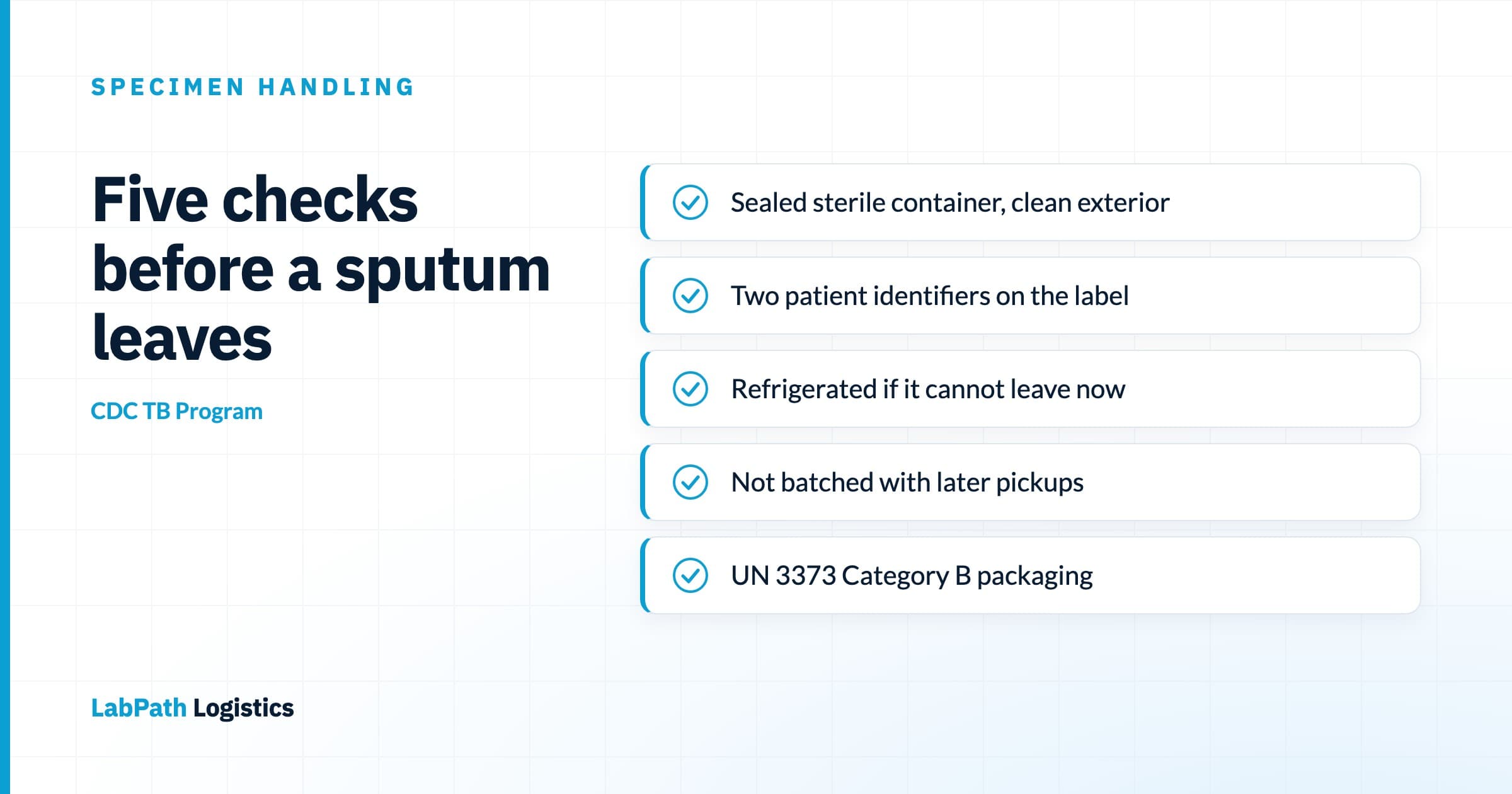
- Deliver as soon as possible. Within 24 hours of collection is described as optimal.
- Do not batch specimens for shipment if at all possible. Same-day transport beats holding tubes until a route fills.
- Refrigerate what cannot leave immediately. The purpose is to reduce overgrowth of contaminating organisms.
- Treat Friday and end-of-day collections deliberately. Store them in the site refrigerator and send them with a cold pack the next morning or after the weekend.
- Package as UN 3373 Biological Substance, Category B, following DOT and IATA requirements.
The same guidance addresses the container itself: sputum needs a 3 mL minimum volume, the specimen must be collected entirely inside a sterile container with nothing on the exterior, and the lid must be closed on its threads and sealed with laboratory film before transport. Containers should be labeled before collection with two patient identifiers, a name and a unique number, matching the requisition.
Where the Courier Fits in That Chain
Most of the CDC's checklist happens before the driver arrives: the container, the film seal, the labels. The courier controls three things that decide whether the rest holds up.
Pickup timing
A clinic that collects sputum at 8 a.m. and is on a 4 p.m. route has already spent most of the 24-hour window before the specimen leaves the building. A fixed afternoon route is fine for routine chemistry. For AFB work, a clinic is better served by a scheduled midday run plus an on-demand option. See how pickup schedules are sized for Houston clinics for a way to match run frequency to collection volume.
No batching across stops
Batching is a route-economics habit: hold everything until the truck is full. The CDC's guidance points the other way. A courier serving several clinics in one loop should move TB specimens through to the lab on that loop, not carry them into a second and third loop for efficiency.
Temperature and custody records
When a specimen has been refrigerated at the clinic, it should stay cold on the way. That requires a validated cooler with monitored temperature, not a cooler bag with a loose ice pack. It also requires a record showing who handled the specimen and when, the same chain of custody a lab expects for any diagnostic sample. If a smear comes back unusual, that record lets the lab and the clinic tell a collection problem from a transit problem.
Ask before you sign a courier contract
"If a TB specimen is collected at 3 p.m. on a Friday, what happens to it?" A good answer covers refrigeration guidance for the clinic, a Saturday or Monday-morning pickup, and a cold pack in the cooler. A vague answer means your specimens are being batched.
The Preventable Failures
Most rejected or compromised TB specimens trace back to a short list of handling errors, and a courier can prevent several of them:
- Leaking or contaminated exteriors. A cup that arrives with sputum on the outside risks the specimen and the people handling it. Secondary containment and absorbent material are part of proper Category B packaging.
- Label mismatches. Two identifiers that do not match the requisition trigger a call back to the clinic. Drivers should not accept an unlabeled cup, and a courier's intake checks should catch it at pickup. Our guide to specimen labeling errors covers the common patterns.
- Delay in a warm vehicle. A sample sitting in a parked car through a Houston afternoon is the opposite of the refrigerated hold the CDC describes.
- Mixed loads. TB specimens riding beside blood culture bottles and refrigerated chemistry tubes need separate, labeled compartments. The microbiology transport guide explains why different specimen types have different clocks.
A Practical Checklist for Clinic and Lab Managers
- Write the 24-hour target into your courier agreement and name TB and AFB specimens explicitly.
- Set a refrigeration protocol for late-day and Friday collections, and confirm the courier knows it.
- Require same-loop delivery for AFB specimens with no batching across routes.
- Confirm the courier's cooler, cold pack, and temperature-monitoring method for refrigerated specimens.
- Audit two or three recent pickups: labels, seals, and timestamps from collection to lab receipt.
Key Takeaway
TB testing is slow by nature, so the transport leg should be the fast part. The CDC's guidance is short: get specimens to the lab quickly, avoid batching, refrigerate anything that has to wait, and package to Category B rules. In a county with more TB cases than any other in Texas, a courier who treats an AFB cup like any other stop on the route is a risk the lab inherits.
Frequently Asked Questions
How quickly should a TB sputum specimen reach the lab?
The CDC describes delivery within 24 hours of collection as optimal and asks that specimens reach the laboratory as soon as possible. Specimens that cannot be transported immediately should be refrigerated at the collection site.
Can a courier batch TB specimens with other stops?
The CDC advises against batching specimens for shipment where possible. For a courier, that means AFB specimens should ride the same loop to the lab rather than being held for a later, fuller route.
How should TB specimens be packaged for transport?
Diagnostic TB specimens follow the DOT and IATA requirements for UN 3373 Biological Substance, Category B. The CDC also calls for a sterile container with a clean exterior, closed on its threads and sealed with laboratory film, labeled with two patient identifiers matching the requisition.
What should a clinic do with a TB specimen collected on a Friday afternoon?
Per the CDC, specimens collected at the end of the day or on a Friday, when transport may not be available, should be stored in the site refrigerator and then sent with a cold pack the following morning or after the weekend.