Specimen Labeling Errors: The Houston Transit Blind Spot
August 25, 2026 · By LabPath Logistics Editorial Team, Medical Logistics Desk
Quick Answer
Specimen labeling errors are made at the point of collection and discovered at the point of receipt, and the courier leg is the only stretch in between where anyone can still catch one cheaply. The College of American Pathologists' Q-Probes study of 147 clinical laboratories found labeling errors at a rate of 0.92 per 1,000 labels across more than 3.3 million labels reviewed, with the mislabeled specimen the single most common error type. Transport rarely creates an identity error, but it destroys legible ones: a refrigerated tube pulled into 95°F Houston air sweats, adhesive lifts, thermal print smears, and a barcode that scanned at the draw chair will not scan at accessioning. Under 42 CFR §493.1242, the receiving laboratory must document the date and time it received each specimen — which makes the handoff a regulated record, not a courtesy.
A tube reaches the accessioning bench with one edge of the label curled back and a barcode that will not scan. The collector is thirty minutes and eleven stops behind it. Somebody now has to decide whether this specimen belongs to the patient the requisition names, and the two people who could answer that — the phlebotomist and the patient — are both somewhere else.
Specimen labeling errors get counted as a collection problem, and at the point of origin that is exactly what they are. But they are almost always discovered at the point of receipt, and the leg in between belongs to a courier. That stretch is the last place an identity problem can be fixed for the price of a phone call instead of a recollection, a delayed result, or a chart entry under the wrong name.
What Actually Counts as a Labeling Error
The category is broader than most people assume. The CAP Q-Probes work sorts labeling errors into five kinds: mislabeled, unlabeled, partially labeled, incompletely labeled, and illegible. Only the first is a patient-identity mix-up. The other four are documentation and durability failures — and three of them can be created or worsened after the specimen leaves the room.
0.92 per 1,000
Specimen labeling error rate across 147 clinical laboratories and more than 3.3 million labels reviewed, per Wagar et al., "Specimen Labeling Errors: A Q-Probes Analysis of 147 Clinical Laboratories," Archives of Pathology & Laboratory Medicine, October 2008
That figure sits in the middle of three CAP studies summarized by the Association for Diagnostics & Laboratory Medicine: 0.39 per 1,000 across 120 institutions in 2006, 0.92 per 1,000 across 147 labs in 2008, and 1.12% of blood bank specimens across 122 labs in 2010. Run 0.92 per 1,000 against a mid-size Houston clinic sending 400 tubes a week and the arithmetic is roughly one labeling defect every three weeks — small enough to feel like bad luck each time, frequent enough to be a process.
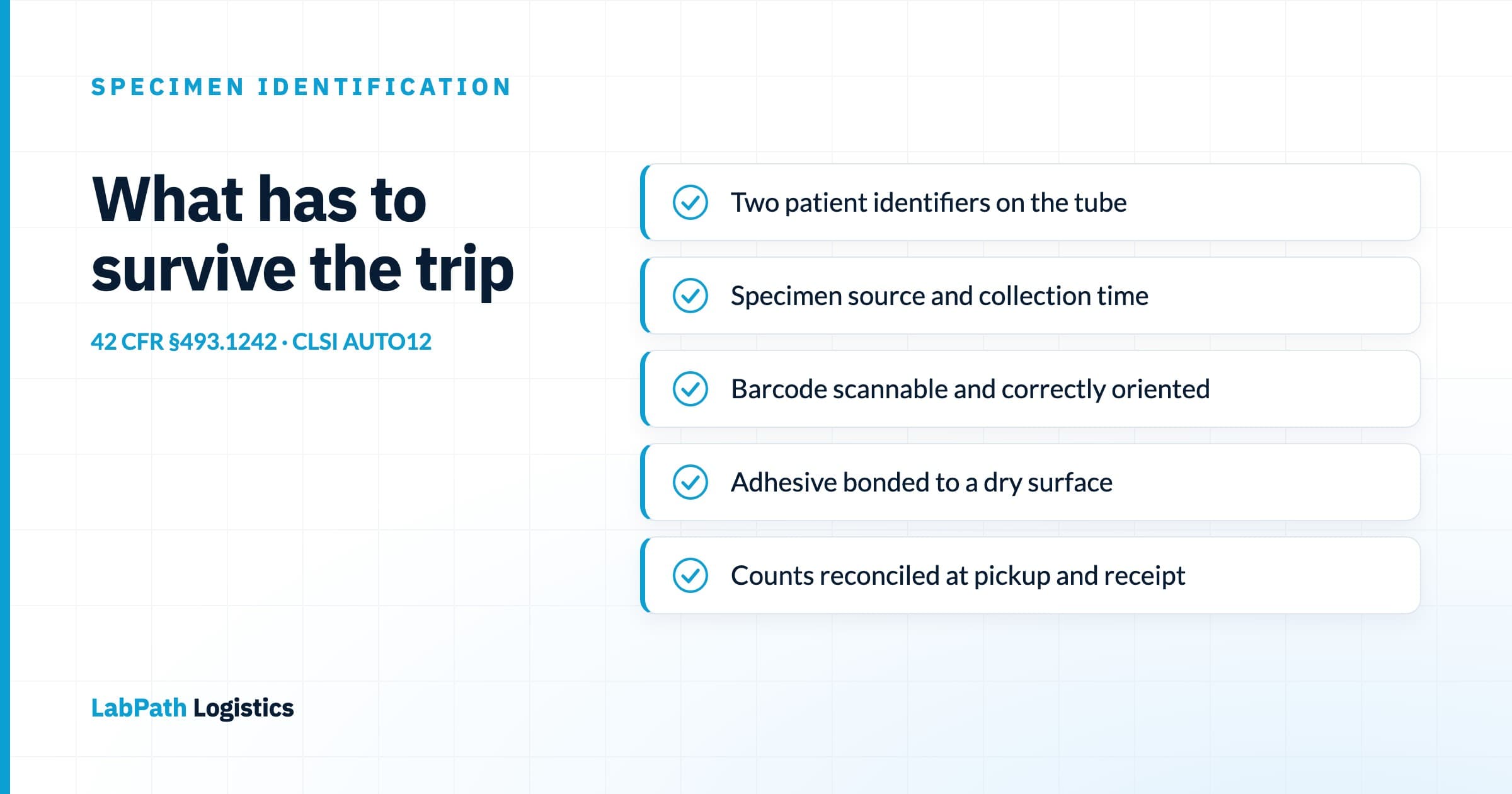
The baseline requirements are not ambiguous. 42 CFR §493.1242(a) requires every CLIA laboratory to maintain written policies covering specimen labeling with patient identifiers and specimen source, plus transportation conditions and criteria for acceptability and rejection. The Joint Commission's patient identification goal requires two patient-specific identifiers when specimens are collected. And CLSI's AUTO12 standard, developed in 2011, goes further than content — it specifies barcode location and sizing, name truncation rules, and required label orientation on the tube, precisely because a label that is technically complete can still be unreadable to the next machine that sees it.
Transit Is Where It Surfaces, Not Where It Starts
Section 493.1242(b) is one sentence long: the laboratory must document the date and time it receives a specimen. That single requirement turns the courier handoff into a regulated record. Whatever time the lab writes down is the time it will defend later, and everything that happened before it is either documented or assumed.
Between the draw chair and that timestamp, the specimen is in exactly one person's hands. A courier cannot verify a patient's identity and should never try. What a courier can do is notice the three things a lab will otherwise discover too late:
- A tube in the bag that is not on the manifest, or a manifest line with no tube behind it.
- A label that is already lifting, smeared, or missing its barcode at the moment of pickup.
- A container whose identifier does not resolve against the pickup record before the vehicle leaves the lot.
Each of those is a two-minute conversation at the clinic and a two-day problem at the lab. The difference between the two is whether anyone looked while the collector was still reachable — the same asymmetry we described in our guide to chain of custody in medical courier work.
Houston's Climate Attacks the Label Itself
Label adhesives are engineered to form their bond on a clean, dry, room-temperature surface and then hold it through whatever comes next. Houston routinely denies them the first condition. The National Weather Service's 1991–2020 normals for Houston Intercontinental put the August average high at 94.9°F and the average low at 75.4°F — meaning a 2–8°C tube that leaves a cooler on a loading dock is wet within seconds.
Three failure modes follow, and none of them are exotic:
- Condensation on a chilled tube forms a film the adhesive bonds to instead of the glass, so the label releases hours later inside a sealed bag.
- Frost on a frozen or dry-ice specimen does the same thing more aggressively — the adhesive grips the ice layer, not the container, and the label sheds during thaw.
- Direct thermal print darkens and blurs under heat and humidity, so a barcode printed at 7 a.m. can fail its scan by mid-afternoon even with the label still firmly attached.
The fix is upstream of the vehicle
None of this is solved by driving faster. It is solved by labeling before chilling rather than after, by thermal-transfer printing with a resin ribbon on synthetic stock for anything going cold, and by keeping tubes inside a stable temperature envelope instead of cycling them between a cooler and a Houston loading dock. A courier's job is to protect that envelope and to flag the labels already failing when the bag is picked up.
Reconciliation Beats Vigilance
The best evidence on fixing identification errors says the same thing repeatedly: systems beat attention. A ten-year study at a 3,800-bed academic medical center tracked specimen identification errors through four sequential interventions — a restrictive acceptance policy, then barcode positive patient identification in the emergency department, automated outpatient labeling, and barcode scanning at inpatient nursing stations.
97%
Relative reduction in specimen identification errors — from 1,023 errors among 2,000,345 specimens in 2005 to 58 among 3,761,238 in 2014 — after serial barcode and acceptance-policy interventions, per Ning et al., PLOS ONE, 2016
That result came from machine-checked identity at every handoff, not from asking staff to be more careful. The courier leg deserves the same treatment. Reconciliation on a route means a scan-based count at pickup, a scan-based count at delivery, and a discrepancy raised at the location where it can still be answered — not a signature on a clipboard confirming that a bag changed hands.
It also means the identifier on the outside of the container is a code, not a name. A specimen bag rides through parking garages, elevators, and front desks; the scannable identity should resolve inside the receiving system and mean nothing to anyone who reads it in a lobby. That is the same principle behind the opaque identifiers described on our compliance page — the record proves custody without carrying patient identity.
What to Require From a Courier
- Reconcile counts and codes at pickup, against the manifest, before the vehicle moves — not on arrival at the lab.
- Capture label condition as a pickup event: legible, adherent, barcode scannable, with a photo when it is not.
- Prohibit field relabeling outright. A courier who re-creates a label has severed the link between the tube and the collector, and most acceptance policies will reject it on that basis alone.
- Define the discrepancy path in writing: who is called, how long the driver waits, and who decides whether the specimen travels or stays.
- Deliver a receipt event the lab can use for its §493.1242(b) record — time-stamped at the point of transfer, not reconstructed from a route log.
- Keep patient identity off the exterior of every container, and keep the courier's own record free of clinical detail it has no reason to hold.
Items one and two are the ones that pay for themselves. A rejected specimen costs a redraw, a patient callback, and a turnaround-time miss that lands on the ordering physician's desk — the cost structure we broke down in our analysis of specimen rejection and courier handling.
Key Takeaway
Labeling errors are a collection-side defect with a transport-side discovery point. The lab that treats the courier leg as a black box between two accession events will keep finding identity problems at the bench, where every option is expensive. The lab that requires reconciliation at pickup, condition capture on the label itself, and a time-stamped receipt event has moved the discovery point back to where the problem is still cheap — and has a record to show for it either way.
Frequently Asked Questions
What is the most common specimen labeling error?
The mislabeled specimen — a tube carrying the wrong patient's identifiers — is the single most common type. In the CAP Q-Probes analysis of 147 clinical laboratories published in Archives of Pathology & Laboratory Medicine in 2008, mislabeled specimens accounted for 29.9% of reported labeling errors, out of an overall rate of 0.92 errors per 1,000 labels across more than 3.3 million labels reviewed. The remaining categories — unlabeled, partially labeled, incompletely labeled, and illegible — make up the balance, and several of those can be created or worsened after collection by heat, condensation, and handling.
Can a medical courier relabel or fix a mislabeled specimen?
No. Labeling is the collector's act, and a label applied by anyone who did not perform the collection breaks the link between the specimen and the patient it was drawn from. Under 42 CFR §493.1242(a), every CLIA laboratory maintains written criteria for specimen acceptability and rejection, and a field-relabeled specimen will generally fail them. The correct courier action is to stop, document the condition, and escalate to the collecting site while the collector is still reachable — not to make the label look correct.
What does CLIA require for specimen labeling and receipt?
42 CFR §493.1242(a) requires a laboratory to maintain written policies for specimen collection and labeling — including patient identifiers and specimen source — plus preservation, transportation conditions, processing, and criteria for acceptability and rejection. Section 493.1242(b) adds a separate requirement that the laboratory document the date and time it receives each specimen. That receipt timestamp is what makes the courier handoff a regulated record rather than an informal exchange.
Why do specimen labels fall off in Houston summer heat?
Usually because of condensation rather than heat alone. Label adhesives are designed to form their initial bond on a dry, room-temperature surface. When a refrigerated or frozen tube is exposed to warm, humid air — Houston's August normals at Intercontinental are a 94.9°F average high and 75.4°F average low — moisture or frost forms almost immediately, and the adhesive bonds to that film instead of the container. Separately, direct thermal print blurs under heat and humidity, so a barcode can fail to scan even while the label stays attached. Labeling before chilling and printing on synthetic stock with a thermal-transfer resin ribbon addresses both.