Mobile Phlebotomy Courier Houston: Home Draw to Lab
September 24, 2026 · By LabPath Logistics Editorial Team, Medical Logistics Desk
Quick Answer
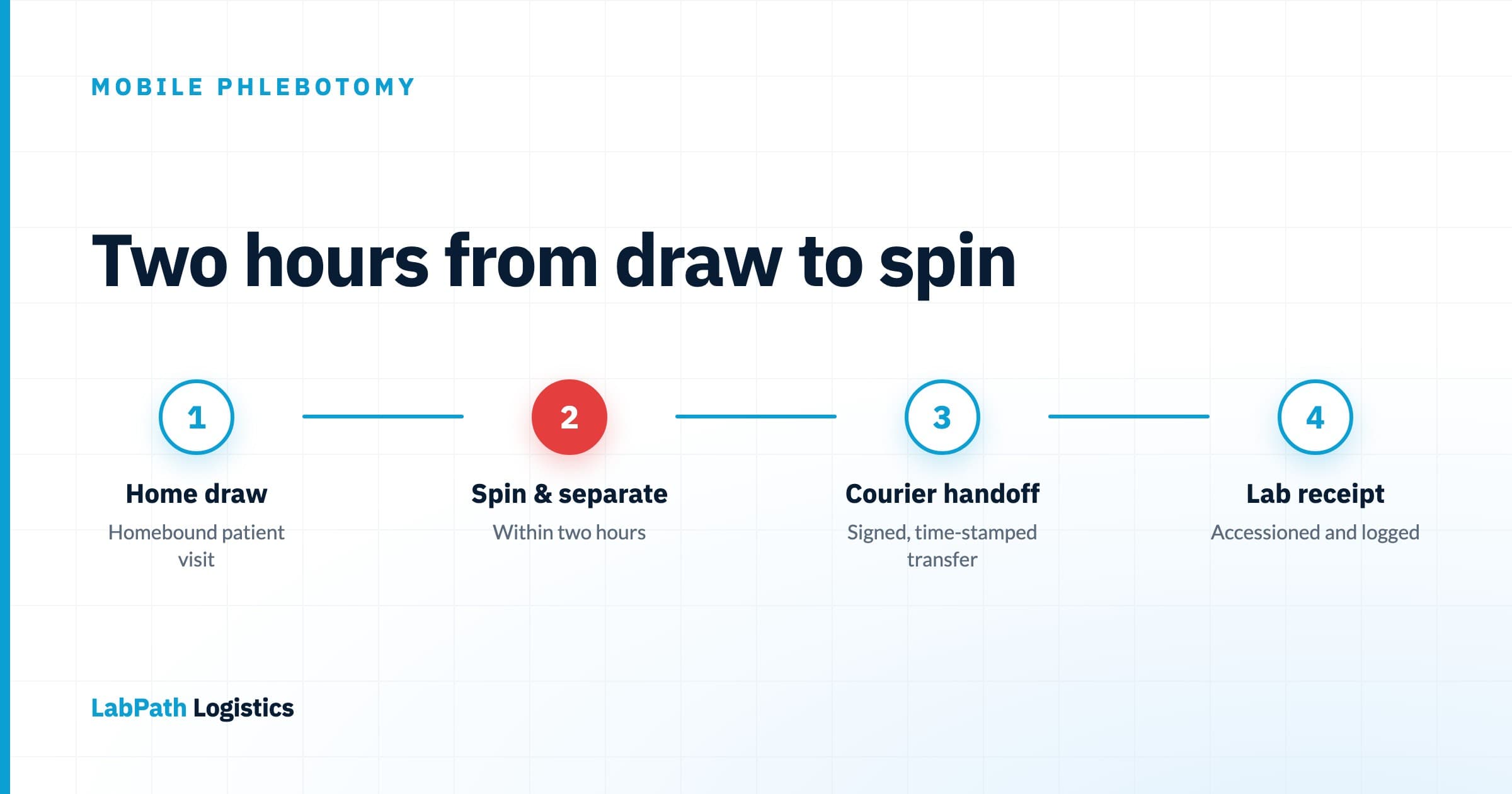
A mobile phlebotomy program in Houston needs a transport plan as much as a draw schedule. Most chemistry specimens must be spun and separated within two hours of collection under CLSI GP44-A4, so a phlebotomist who carries tubes through six more home visits before driving to the lab is running out the clock. The fix is to either process in the field or hand specimens to a courier at a midday meeting point, with a signed, time-stamped transfer and temperature control for the rest of the trip.
A mobile phlebotomy courier plan is the part of a home-draw program that rarely gets written down. The draw itself is well defined: a trained phlebotomist visits a homebound patient, collects the ordered tubes, labels them at the bedside, and moves on. What happens to those tubes over the next four hours, in a car, in Houston traffic, is usually left to the phlebotomist's judgment. That is where falsely high potassium results, warm specimens, and missing custody records come from.
This guide is for lab managers, home health agencies, and mobile phlebotomy operators in Greater Houston. It covers the timing math behind home draws, what Medicare actually pays for, and three transport models that keep specimens inside their stability window.
The Clock Starts at the Bedside
In a draw station, a tube is often in a centrifuge within minutes. In a home draw, it may ride along for the rest of the route. CLSI GP44-A4, the standard for handling and processing blood specimens, calls for serum or plasma to be separated from cells within two hours of collection unless the lab has data showing longer contact does not affect the result. Glucose and potassium are the classic casualties when that window is missed.
Now apply that to a real route. A phlebotomist covering Sugar Land, Missouri City, and Alief might complete six to eight visits in a morning, with 20 to 30 minutes of driving between stops. The first patient's tubes are well past two hours by the time the last patient is drawn, and the lab is still across the Beltway. The math does not work unless someone plans for it.
Heat is the second clock
Houston adds a second problem: the car. A tube rack on a passenger seat between visits sees whatever the cabin does while the phlebotomist is inside a patient's home. A validated insulated container with a temperature logger is the minimum. Our guides to summer heat and specimen integrity and specimen transport temperature ranges cover the packaging side in detail.
What Medicare Pays For (and What It Does Not)
The economics of home draws explain why transport often gets squeezed. Medicare pays a specimen collection fee and a travel allowance when a trained technician draws blood from a homebound patient or a nursing home resident, under 42 CFR 414.523. The amounts are small and are updated each year.
$9.34
CY 2026 Medicare general specimen collection fee; $11.34 for specimens collected from SNF patients or by a lab on behalf of a home health agency (CMS MLN MM14345).
- For 2026, the per-mile travel allowance (HCPCS P9603) is $1.25 per mile, according to CMS MLN MM14345.
- A flat-rate allowance (P9604) applies when the technician travels 20 eligible miles or less round trip to one location. The per-mile rate applies to longer single trips and to any trip with more than one stop.
- CMS also states that a pickup service is not medically necessary when a specimen only needs a messenger, not a skilled technician. Urine and sputum are the examples it gives.
The practical takeaway: the collection fee pays for the draw, not for moving the specimen. Every minute a trained phlebotomist spends driving tubes to the lab is time not spent on the next billable visit. That is the argument for separating the two jobs.
Three Transport Models for Home-Draw Programs
1. The phlebotomist drives everything to the lab
This works for short routes near the lab and for specimens with long stability. It breaks down on long routes, in afternoon traffic, and for any test that needs separation within two hours. It also ends the phlebotomist's productive day early.
2. Field processing
Some programs equip phlebotomists with a portable centrifuge and have them spin gel tubes between visits. This protects the two-hour window, but it adds equipment, validation, and training, and it still leaves the question of how processed specimens get to the lab at the right temperature.
3. Courier relay at a meeting point
The phlebotomist hands specimens to a courier at a planned point mid-route, such as a clinic parking lot, a patient service center, or a pharmacy, and keeps drawing. The courier takes the specimens straight to the lab in a temperature-controlled container. Each handoff is signed and time-stamped, so the lab can see collection time, transfer time, and receipt time for every tube. This is the same principle behind any documented chain of custody, applied to a moving route.
A Houston Scenario
Picture a home health agency in west Houston running two phlebotomists, each with eight homebound patients on a Tuesday morning between Katy and Westchase. Their reference lab is near the Texas Medical Center. Under the old model, each phlebotomist finished around noon and drove in, and the earliest tubes had been sitting for more than three hours. The lab flagged elevated potassium values often enough that physicians started asking for redraws, which meant another visit to the same homebound patient.
The agency moved to a relay: a courier meets both phlebotomists at a central location at 9:45 a.m. and again at 11:30 a.m., and delivers each batch directly to the lab. Phlebotomists no longer end their morning with a drive downtown, and the oldest tube at lab receipt is under two hours. The route is the same. The logistics are what changed.
Home-Draw Transport Checklist
- List every test your program draws and its stability window at room temperature, refrigerated, and after separation.
- Record the collection time on every tube and requisition at the bedside, not later in the car.
- Map each route and mark where the two-hour window runs out for the first draw.
- Choose a model for each route: phlebotomist delivery, field processing, or courier relay.
- Use validated insulated containers with temperature loggers, and keep them out of direct sun.
- Document every handoff with a signature, a timestamp, and the specimen count.
- Keep urine and other non-blood specimens on the same custody path, even though Medicare does not pay a separate pickup fee for them.
- Review rejection and redraw rates monthly, and adjust routes before they become a pattern.
Related reading
Serving facilities as well as homes? See our guides to [nursing home lab courier service](/blog/nursing-home-lab-courier-houston) and [hospital-at-home logistics](/blog/hospital-at-home-logistics-houston).
Key Takeaway
A home draw is only as good as the trip that follows it. The two-hour separation window, Houston heat, and long suburban routes mean most mobile phlebotomy programs need a transport plan, not just a draw schedule. Separating the draw from the delivery lets phlebotomists do billable work while specimens reach the lab on time with a custody record for every handoff.
Frequently Asked Questions
How long can a blood specimen sit before it reaches the lab after a home draw?
For many chemistry tests, CLSI GP44-A4 calls for serum or plasma to be separated from cells within two hours of collection unless the lab has data supporting a longer time. Check your lab's specimen requirements for each test, since stability varies.
Does Medicare pay for mobile phlebotomy travel?
Yes, when a trained technician draws a specimen from a homebound or nursing home patient. For 2026, CMS set the specimen collection fee at $9.34 ($11.34 for SNF patients or draws on behalf of a home health agency) and the per-mile travel allowance at $1.25.
Can a courier pick up specimens from a mobile phlebotomist mid-route?
Yes. A courier relay at a planned meeting point is common. The handoff should be signed and time-stamped, specimens should stay in a temperature-controlled container, and the courier should deliver directly to the lab.
Does Medicare pay to pick up urine specimens from a patient's home?
No. CMS does not consider a pickup medically necessary when a specimen only needs a messenger rather than a skilled technician, and it names urine and sputum as examples. Those specimens still need proper packaging and custody records.