Specimen Transport Temperature: When Cold Backfires
August 17, 2026 · By LabPath Logistics Editorial Team, Medical Logistics Desk
Quick Answer
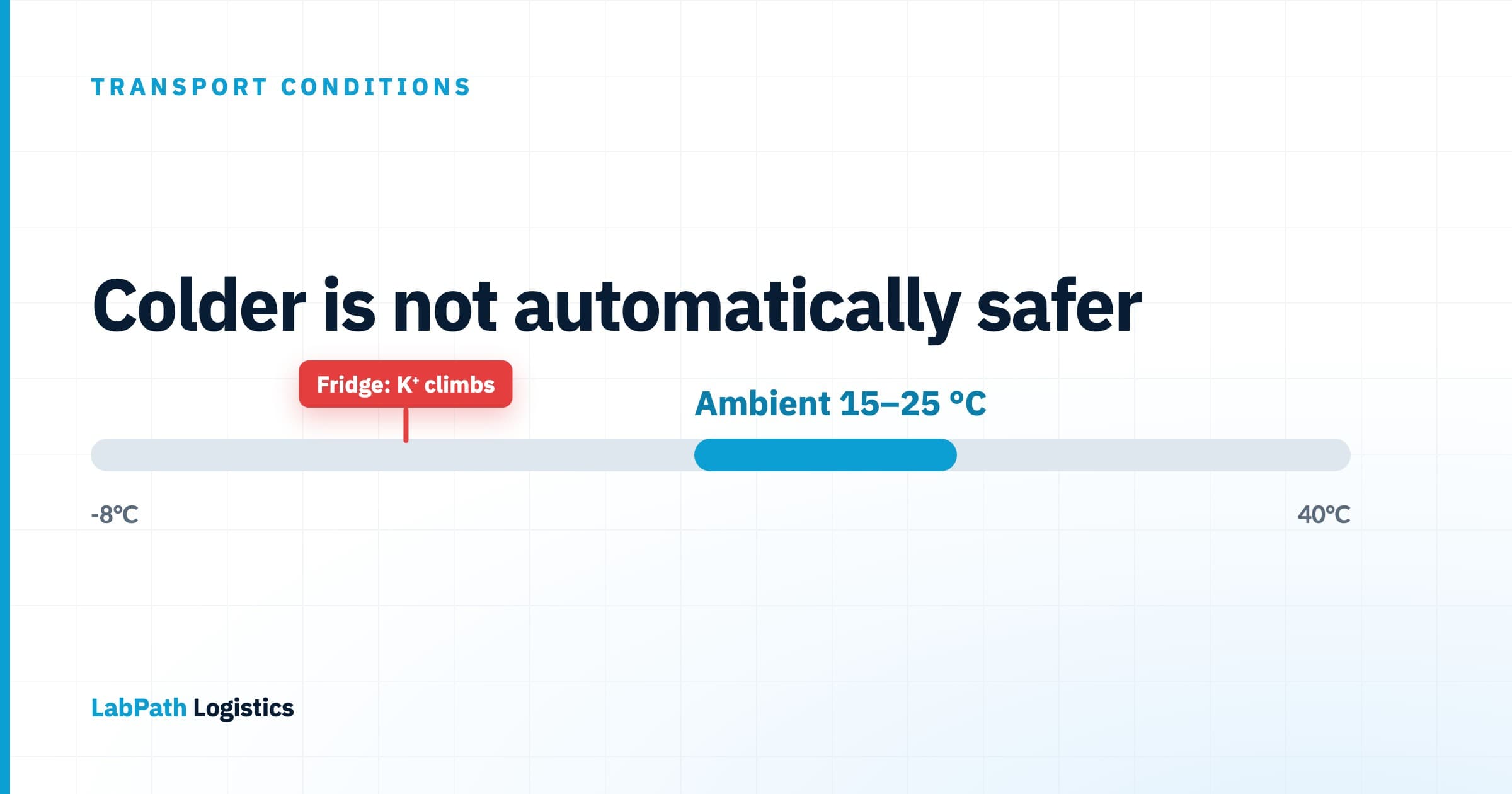
Specimen transport temperature is set by the performing laboratory's requirements for each assay, not by a default cooler. Most unseparated blood tubes should travel at controlled ambient temperature — roughly 15–25 °C — because chilling whole blood before the cells are removed slows the sodium-potassium pump and drives potassium out of the cells, producing falsely elevated results. Refrigerated (2–8 °C) and frozen transport apply only where the assay calls for them, and the clock on separating serum or plasma from the cells runs in every state.
Specimen transport temperature is the one preanalytical variable everybody thinks they already understand. It is hot in Houston, specimens are fragile, therefore more ice. That instinct is correct often enough to feel like a rule, and wrong often enough to generate results a physician will act on before anyone questions them.
The uncomfortable version: for a large share of routine chemistry, putting an unspun tube in a cold cooler does more damage than leaving it at room temperature would have. The damage is invisible — no hemolysis note, no rejection, no exception report. Just a potassium that comes back high enough to trigger a call, a repeat draw, and occasionally treatment for a condition the patient does not have.
Three Transport States, One Decision
Every specimen leaving a facility travels in one of three thermal states, and the correct one is a property of the assay, not of the weather:
- Ambient — controlled room temperature, roughly 15–25 °C. The default for most unseparated blood tubes and many microbiology specimens. "Ambient" means controlled, not uncontrolled.
- Refrigerated — 2–8 °C, for specimens whose analytes degrade at room temperature once separated, and for most pharmaceutical cold chain.
- Frozen — typically −20 °C or −70 °C on dry ice, for aliquots that must not thaw at any point in transit.
The decision belongs to the laboratory that will run the assay, published in its specimen requirements. The courier's job is to reproduce that state reliably and prove it did. Where facilities get into trouble is the gap in between: nobody translated the catalog's per-test conditions into a per-run packing instruction, so the driver applies one habit to every container on the seat.
The default is written, not assumed
If a specimen's required transport condition is not written on the packing instruction the tech works from, it is being chosen at the cooler by whoever packs it. That is the actual failure mode — not a courier who ignores instructions, but a courier who was never given any.
Why Chilling an Unspun Tube Backfires
Potassium sits about thirty times more concentrated inside red cells than in plasma, and that gradient is held by the sodium-potassium pump, which runs on ATP the cell makes by metabolizing glucose. Cool the blood and glycolysis slows, ATP production falls, the pump weakens, and potassium leaks out of the cells into the plasma around them. The result is pseudohyperkalemia — a high potassium that exists in the tube, not in the patient.
This is why the intuition inverts. As Chris Higgins summarizes the evidence in Acute Care Testing (2018), the tendency to pseudohyperkalemia is greater for samples stored in a refrigerator at 4 °C than for samples held at ambient room temperature around 20 °C, and blood should be kept at 15–25 °C in the interval between collection and separation of serum or plasma.
3–12 °C
Winter specimen transport temperatures associated with a rise in spurious hyperkalemia — "seasonal pseudohyperkalemia" — versus 18–25 °C in summer months (Higgins, Acute Care Testing, 2018)
Read that finding from a logistics chair rather than a bench chair and it says something specific: a transport leg cold enough to look responsible is cold enough to change a result. A cooler packed with frozen gel packs and a few tubes rattling against them is not a 15–25 °C environment. It is a small refrigerator with cold spots well under 4 °C, and the tubes touching the packs get the worst of it.
The Clock Runs in Every State
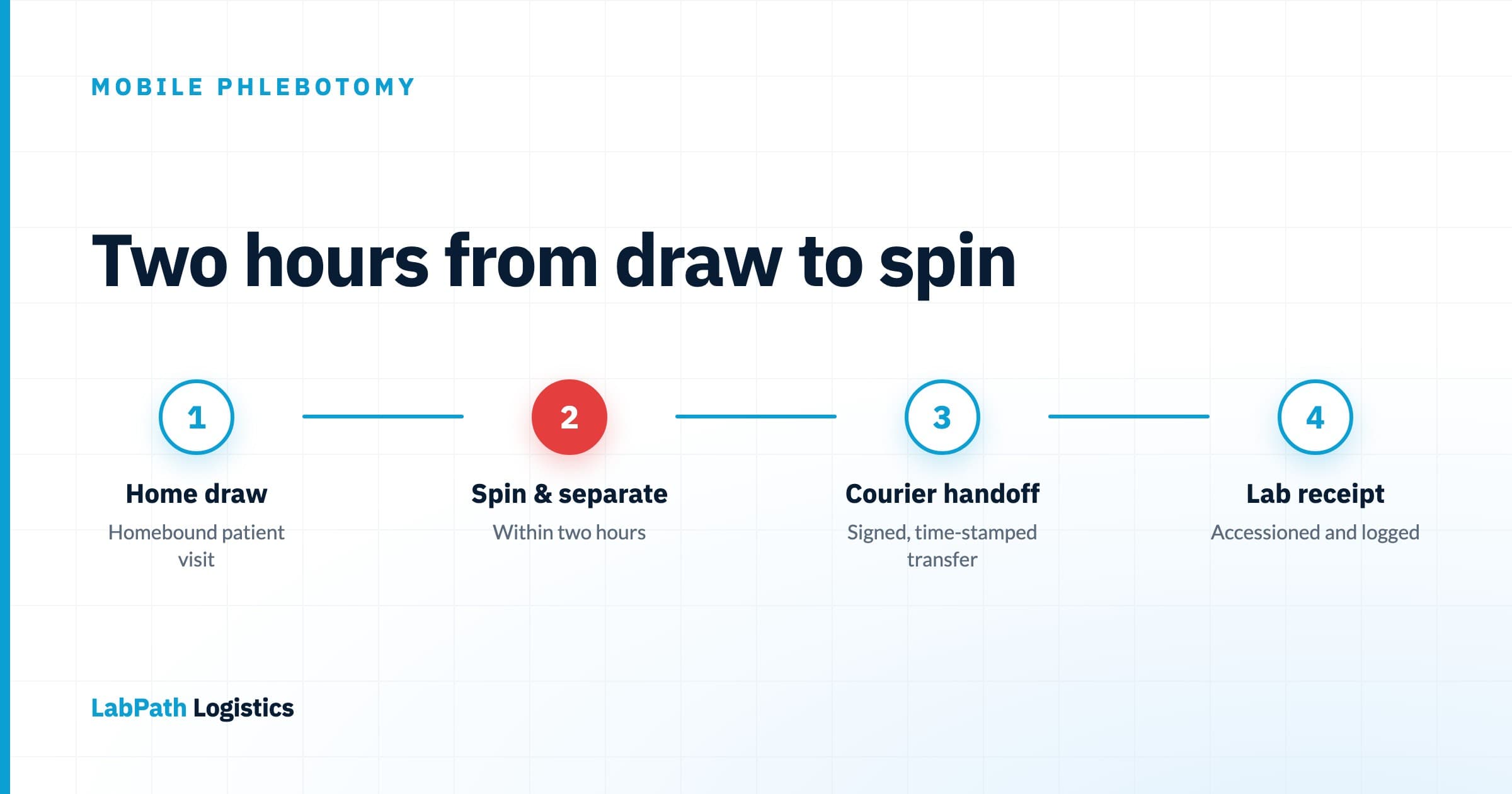
Temperature does not buy time. CLSI GP44-A4, the standard for handling and processing blood specimens for common laboratory tests, calls for serum or plasma to be separated from the cells within two hours of collection unless there is evidence that longer contact does not affect the specific analyte. Until that separation happens, the cells are still metabolizing, and every hour of contact moves the numbers.
Glucose shows the effect most plainly, because the cells consume it. In a 2022 PLOS One study of alternative pre-analytic handling techniques, glucose in uncentrifuged tubes fell sharply against the reference over six hours at room temperature.
64% of baseline
Glucose remaining in uncentrifuged serum after six hours at room temperature; uncentrifuged EDTA plasma retained 77% (Nakanga et al., PLOS One, 2022)
The two findings are the same mechanism seen from opposite ends. Cells burning glucose is what keeps potassium where it belongs; the glucose result decays because that metabolism continues, and the potassium result decays when it stops. Both clocks start at the draw, and neither one pauses because the tube is in a cooler. That is why the honest way to describe a transport requirement is a pair — a condition and a window — rather than a temperature alone.
In Houston, Ambient Is Not a Given
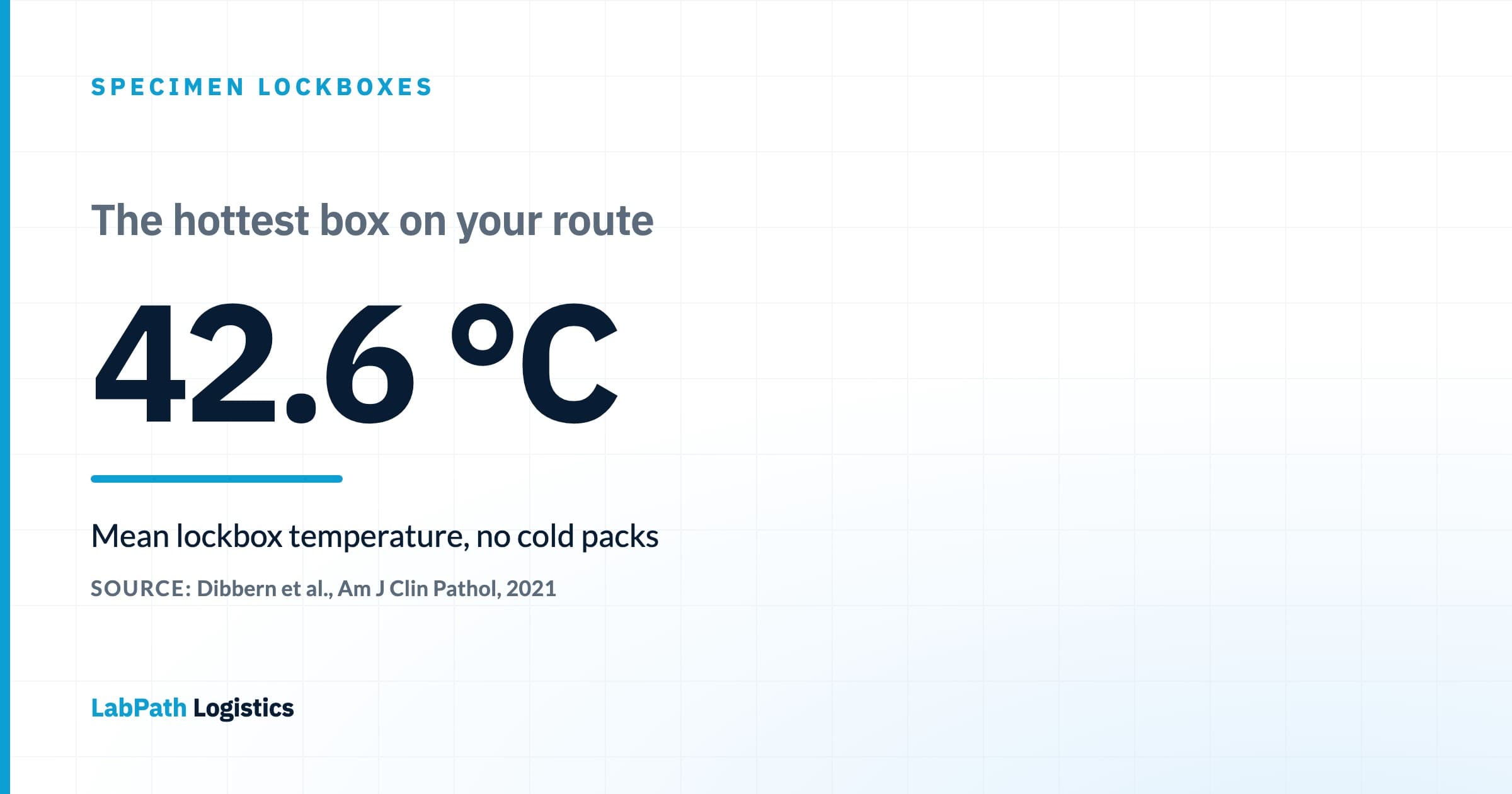
None of this argues for indifference to heat. It argues that both directions are excursions. A Houston afternoon puts a parked vehicle's interior far above any defensible definition of controlled room temperature, which is the failure mode we covered in detail in summer heat and specimen integrity. The point is that the corrective action is climate control, not maximum cold.
Consider a routine morning at a Houston-area clinic feeding a hospital lab across town. Chemistry tubes drawn at 8:00 a.m. sit until an 11:00 a.m. pickup. The packing tech, reasonably worried about the heat, buries them in frozen gel packs for a 40-minute run through the Texas Medical Center corridor. Two things have now gone wrong: separation is already past the two-hour mark, and the tubes spent the trip below the ambient band. The lab receives specimens that are neither hot nor spoiled by any visible measure, and reports a potassium nobody can reconcile.
The fix in that scenario is not a better cooler. It is spinning the tubes before the run and giving the vehicle a conditioned compartment — the same conclusion an inspector reaches from the documentation side, as we described in the CAP specimen transport requirements guide, where "ambient" only counts when there is a record proving what ambient meant that day.
Building the Rule Into the Route
- Group your test menu into ambient, refrigerated, and frozen lanes using the performing lab's published specimen requirements, and write the lane on the packing instruction — not only in the catalog.
- Separate serum and plasma before transport wherever the assay allows it. A spun, aliquoted tube is dramatically less sensitive to what happens on the road.
- Never let a specimen touch a frozen gel pack unless the requirement is frozen. Use conditioned packs, insulation, and a validated configuration for refrigerated work.
- Give ambient specimens a climate-controlled compartment, and treat cabin air conditioning as the control it actually is rather than a comfort setting.
- Log temperature per run, not per quarter, so an excursion in either direction is identifiable afterward instead of arguable.
- Handle frozen shipments as their own workflow, with dry ice quantity matched to transit duration — see our guide to frozen specimen transport on dry ice.
Key Takeaway
There is no universally safe transport temperature. There is a required condition per assay, a time window that runs alongside it, and a vehicle that either reproduces both or does not. For most unseparated blood tubes the required condition is controlled ambient — and the reflex to add ice, in the one American city where that reflex feels most justified, is the reflex most likely to produce a result the lab cannot explain.
Frequently Asked Questions
What temperature should blood specimens be transported at?
It depends on the assay, and the performing laboratory publishes the requirement. Most unseparated blood tubes travel at controlled ambient temperature, roughly 15–25 °C, because chilling whole blood before the serum or plasma is separated causes potassium to leak from the cells. Refrigerated transport at 2–8 °C and frozen transport at −20 °C or −70 °C apply only to specimens whose requirements specify them. The correct practice is to group the test menu into ambient, refrigerated, and frozen lanes and write the lane onto the packing instruction the courier and packing tech both work from.
Can you put lab specimens on ice for transport?
Only when the assay requires it. Ice or frozen gel packs against an unseparated blood tube drop it well below the 15–25 °C ambient range, slowing the sodium-potassium pump and producing falsely elevated potassium — pseudohyperkalemia. Assays that genuinely require chilling, such as certain blood gas, ammonia, and lactate protocols, are specified as such by the performing laboratory. Absent that instruction, ice is not a neutral precaution; it is an uncontrolled change to the specimen.
Why does potassium come back falsely high after transport?
Potassium is roughly thirty times more concentrated inside red cells than in plasma, and the gradient is maintained by the sodium-potassium pump running on ATP generated from glucose. Cooling the blood slows glycolysis, ATP falls, the pump weakens, and potassium diffuses out of the cells into the surrounding plasma. Hemolysis from rough handling produces the same direction of error by a different route. Both are transport-side causes, which is why an unexplained high potassium should prompt a review of the run before a repeat draw.
Does refrigerated transport buy extra time before processing?
No. CLSI GP44-A4 calls for serum or plasma to be separated from the cells within two hours of collection unless there is validated evidence that longer contact does not affect the analyte in question, and that window is not extended by cooling the specimen. Cooling changes which analytes drift and in which direction; it does not stop cellular metabolism. Transport requirements should always be expressed as a pair — a temperature condition and a time window — because meeting one while missing the other still produces an unreliable result.