
Frozen Specimen Transport: The Dry Ice Playbook
July 24, 2026 · By LabPath Logistics Editorial Team, Medical Logistics Desk
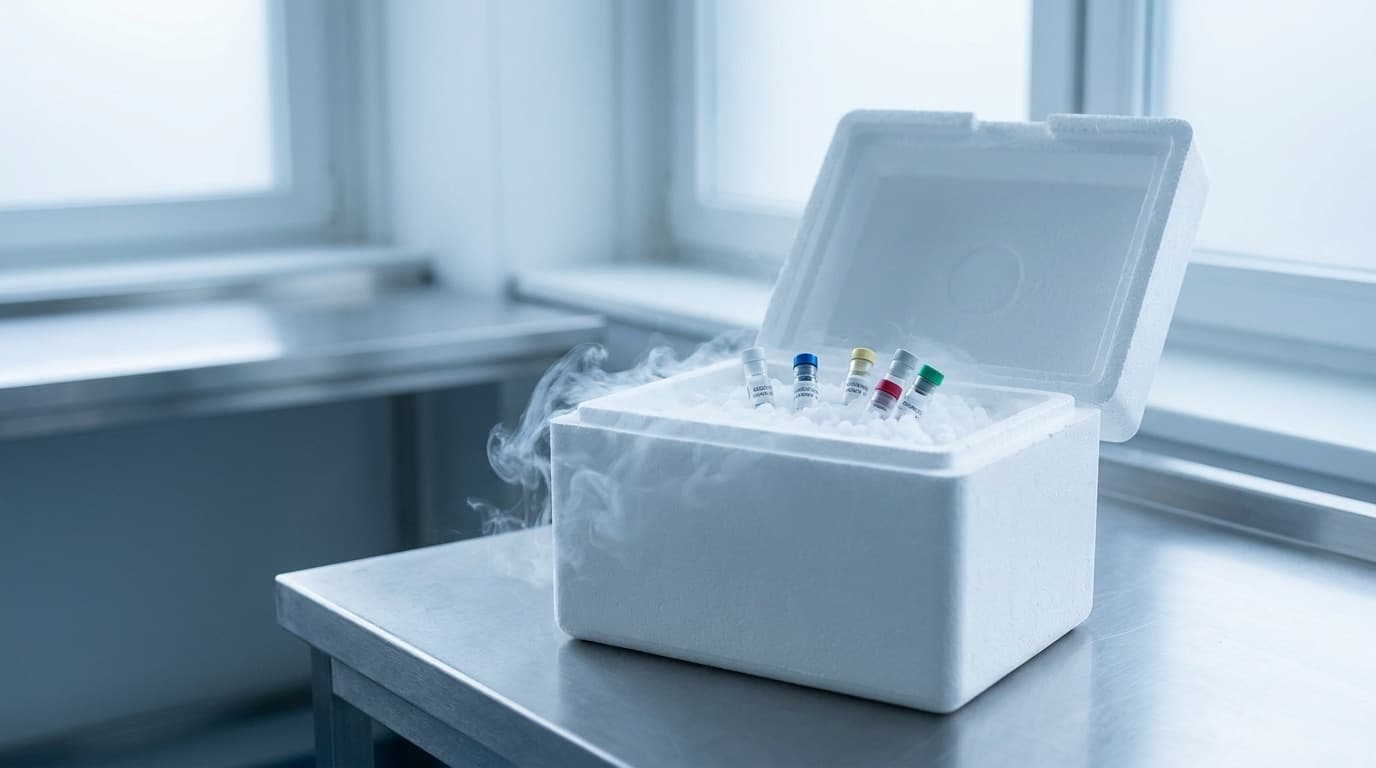
Quick Answer
Frozen specimen transport moves samples that must stay solidly frozen — commonly below −20 °C or below −70 °C — using dry ice, which sublimates at −78.5 °C. Dry ice is a regulated hazardous material: the U.S. DOT and IATA classify it as UN 1845, "Carbon Dioxide, Solid," Class 9, and it must ship in packaging designed to vent the CO2 gas it releases. The two failure modes to control are thermal (letting the specimen thaw because the dry ice ran out mid-route) and safety (letting CO2 gas build up in an enclosed vehicle). A properly loaded, vented, and time-bound run solves both.
Some specimens do not just prefer the cold — they are ruined the moment they thaw. Molecular assays, many send-out tests, biobanked samples, and certain plasma and tissue specimens have to arrive still frozen or they arrive worthless. Frozen specimen transport is how a Houston lab, hospital, or reference facility moves those samples across town or across the country without letting them warm, and it runs on dry ice. But dry ice is not just cold packaging — it is a federally regulated hazardous material with its own rules, its own paperwork, and its own way of failing. This guide covers what the frozen tier actually requires, why dry ice is treated as hazmat, and how the courier leg keeps a frozen specimen frozen and the vehicle safe.
The Frozen Tier Is Not the Same as Cold Chain
Refrigerated cold-chain transport keeps samples at a gentle 2–8 °C — the range covered in our cold-chain pharmacy delivery guide. Frozen transport is a different regime entirely. Specimens in this category are frozen before packing and must stay that way, and public-health guidance defines the tiers plainly: samples are typically held below −20 °C or, for the most sensitive analytes, below −70 °C.
Only one field-practical coolant reaches the deep-frozen tier without power: dry ice, solid carbon dioxide, which holds its surface at −78.5 °C. Because it is colder than a −70 °C requirement, dry ice is the standard for maintaining frozen specimens in transit. Water ice cannot do it. Gel packs cannot do it. That single physical fact — that the only practical way to hold −70 °C on the road is a hazardous material — is what makes frozen transport its own discipline.
−78.5 °C
Surface temperature of dry ice (−109.3 °F), colder than the −70 °C threshold used for the most temperature-sensitive frozen specimens
Why Dry Ice Is Regulated as Hazmat
Dry ice does not melt — it sublimates, converting directly from solid to gas and releasing a large volume of carbon dioxide as it goes. That is exactly why the U.S. Department of Transportation and the International Air Transport Association regulate it. It ships under the proper shipping name "Carbon Dioxide, Solid," as UN 1845, in hazard Class 9 (miscellaneous dangerous goods).
The regulation drives three hard packaging rules. First, the outer package must permit the release of CO2 gas so pressure cannot build up and rupture the container. Second, the package must be marked with the Class 9 label, the UN 1845 identifier, and the net weight of dry ice in kilograms. Third, air shipments cap the dry ice at a net 200 kg per package. These are the same document-and-label disciplines that govern infectious-substance shipping in our Category B (UN 3373) packaging guide — frozen shipments often carry both hazards at once.
UN 1845
The DOT/IATA identifier for dry ice — "Carbon Dioxide, Solid," Class 9 dangerous goods — with a net limit of 200 kg per package on aircraft
Sublimation Is a Countdown, Not a Constant
The defining risk of frozen transport is that the coolant is disappearing the entire time. Dry ice sublimates continuously, and public-health shipping guidance puts the working rate at roughly 5 to 10 pounds every 24 hours in an insulated shipper. Load too little, or let a route run too long, and the dry ice is gone before the specimen arrives — at which point the sample begins to thaw and the run has failed silently inside a still-cold-looking box.
5–10 lb / 24 hr
Typical rate at which dry ice sublimates away in an insulated shipper — the reason frozen runs are time-bound and quantity-calculated, not open-ended (CDC specimen shipping guidance)
This is why frozen transport is planned as a countdown. The amount of dry ice loaded has to cover the full transit time plus a margin, the specimen has to be secured so it stays in position after the dry ice dissipates, and the delivery window has to be short enough that the coolant never runs out. A frozen specimen that thaws is a rejected specimen — the same preventable, avoidable-redraw outcome covered in our specimen rejection guide, except here the failure hides behind a container that still feels cold to the touch.
The CO2 Hazard the Cargo Area Can't Ignore
The same sublimation that threatens the specimen also fills the vehicle with carbon dioxide gas. CO2 is heavier than air, so it pools in low, enclosed spaces — exactly the cargo area of a courier vehicle. In an unventilated van on a hot Houston afternoon, a few kilograms of dry ice can push CO2 well past safe levels.
The thresholds are not vague. OSHA sets the permissible exposure limit for carbon dioxide at 5,000 ppm as an 8-hour time-weighted average, and NIOSH lists 40,000 ppm as immediately dangerous to life or health. A driver cannot see or smell CO2 accumulating; headache, dizziness, and rapid breathing are the first warnings, and they arrive after the exposure, not before. Handling dry ice as hazmat means ventilating the vehicle, never storing it in a sealed sub-surface compartment, and treating the cargo area as a space that has to breathe.
5,000 ppm
OSHA permissible exposure limit for carbon dioxide (8-hour TWA); NIOSH flags 40,000 ppm as immediately dangerous to life or health
A Houston Scenario
Picture a Houston-area reference lab sending a batch of frozen molecular specimens to an out-of-state testing center. The samples leave at −70 °C, packed in an insulated shipper with dry ice, destined for an overnight flight out of the region. If the run is treated like any other courier stop — vehicle sealed against the July heat, dry ice under-loaded to save weight, hand-off delayed at the airport counter — two clocks run out at once: the coolant sublimates below the level needed to hold the specimen, and CO2 climbs in the cabin.
Handled as a frozen hazmat run instead, the same shipment is loaded with dry ice calculated for the full door-to-flight window plus margin, moved in a ventilated vehicle, labeled UN 1845 with net weight declared, and delivered on a tight, tracked timeline so the specimen makes its flight still solidly frozen. Nothing exotic changed. The difference is treating dry ice as what it is — a regulated coolant on a countdown — rather than as packaging.
What to Verify Before a Frozen Run
Frozen transport rewards planning and punishes improvisation. Before a temperature-critical frozen specimen leaves the building, confirm the courier controls these variables:
- Dry ice quantity is calculated for the full transit time plus a safety margin, not a fixed default — sublimation runs the whole way.
- Packaging vents CO2 and is marked with the Class 9 label, UN 1845, and net dry ice weight in kilograms.
- The specimen is secured so it holds position after the dry ice dissipates and the box settles.
- The vehicle cargo area is ventilated, and dry ice is never held in a sealed, sub-surface space.
- The delivery window is time-bound and tracked, so a frozen run cannot quietly outlast its coolant.
- Chain of custody is timestamped end to end, so a temperature excursion can be traced to a segment, not guessed at.
These are the controls worth writing into a service agreement rather than assuming. Our medical courier SLA evaluation guide covers turning transport promises into measurable commitments, and you can see how LabPath Logistics builds frozen and cold-chain handling into every run on our compliance page.
Key Takeaway
Frozen specimen transport is not deep cold chain — it is hazmat logistics. The only field-practical way to hold a specimen below −70 °C on the road is dry ice, and dry ice is a Class 9 regulated material (UN 1845) that sublimates on a countdown and fills enclosed vehicles with CO2. Getting a frozen specimen to its destination still frozen means loading enough dry ice for the whole window plus margin, venting both the package and the vehicle, labeling the shipment correctly, and keeping the run tight and tracked. Do that, and the sample arrives testable instead of thawed.
Frequently Asked Questions
What temperature is used for frozen specimen transport?
Frozen specimens are packed already frozen and held below the required threshold in transit — commonly below −20 °C, or below −70 °C for the most temperature-sensitive samples. Dry ice is the standard coolant because its surface sits at −78.5 °C, colder than the −70 °C tier, and it needs no power source on the road.
Is dry ice considered a hazardous material for shipping?
Yes. The U.S. DOT and IATA regulate dry ice as UN 1845, "Carbon Dioxide, Solid," a Class 9 dangerous good. Shipments must use packaging that vents CO2 gas, be marked with the Class 9 label, the UN 1845 identifier, and the net weight of dry ice in kilograms, and — for air transport — stay within a net limit of 200 kg per package.
How much dry ice do I need to keep a specimen frozen in transit?
Enough to cover the full transit time plus a safety margin, because dry ice sublimates continuously — public-health shipping guidance cites a working rate of roughly 5 to 10 pounds every 24 hours in an insulated shipper. Under-loading is the most common cause of a frozen specimen thawing mid-route inside a box that still feels cold.
Why is dry ice dangerous inside a courier vehicle?
As dry ice sublimates it releases carbon dioxide gas, which is heavier than air and pools in enclosed cargo areas. OSHA sets the permissible exposure limit for CO2 at 5,000 ppm over an 8-hour average, and NIOSH flags 40,000 ppm as immediately dangerous. A properly handled frozen run keeps the vehicle ventilated and never stores dry ice in a sealed, sub-surface compartment.