Courier Wait Time and Cancellation Fees in Houston
November 4, 2026 · By LabPath Logistics Editorial Team, Medical Logistics Desk
Quick Answer
Most medical courier quotes show a base rate and bury the rules that apply on a bad day. Before signing, get five fee rules in writing: free wait window, wait-time rate, cancellation cutoff, failed-pickup charge, and who owns the delay. Then price a scenario where your specimen is not ready when the driver arrives.
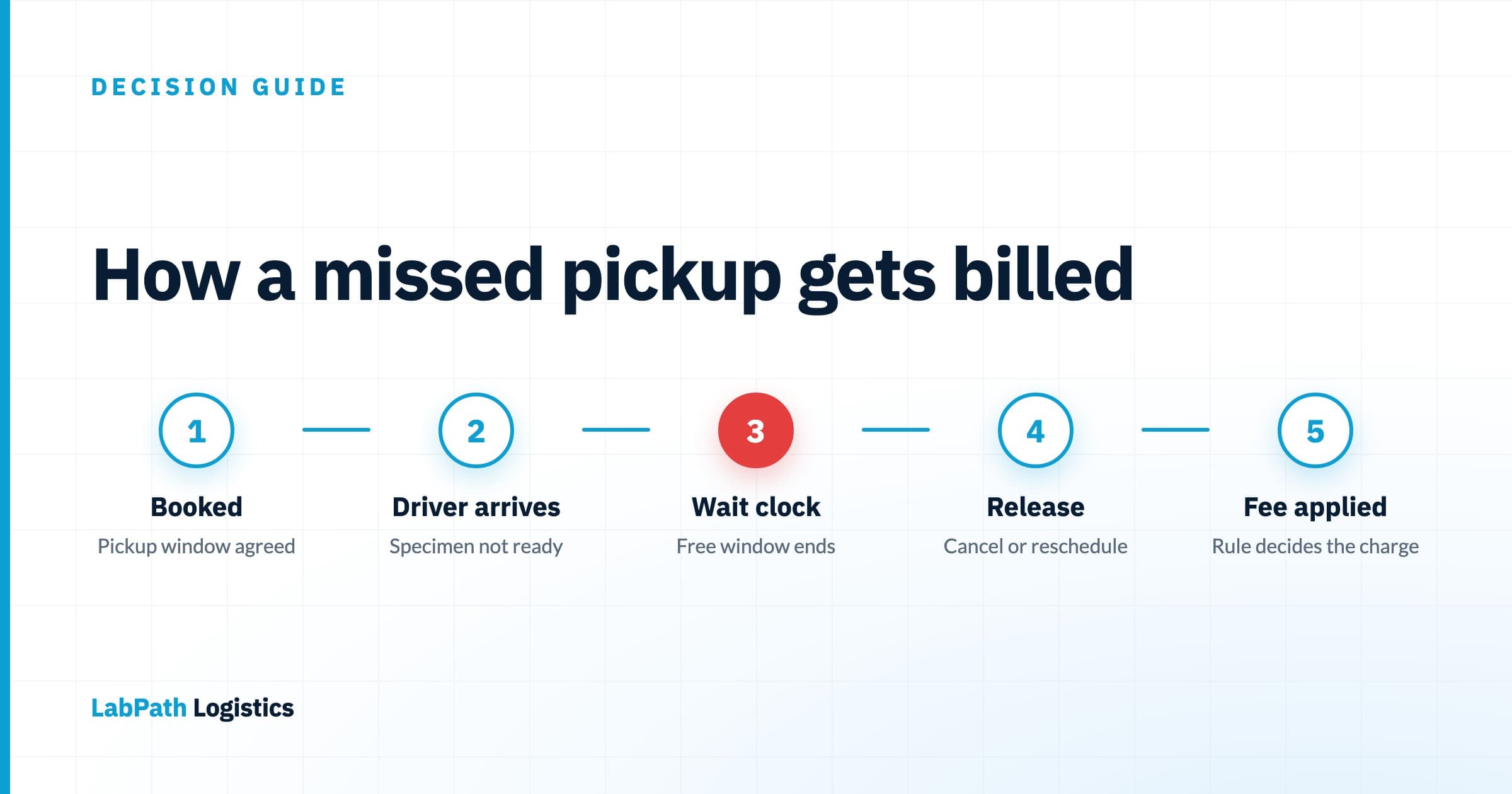
A Houston clinic books a 4:30 p.m. pickup. The driver arrives on time. The last specimen is still being labeled, the nurse is on the phone with a patient's family, and nobody told the front desk the driver was waiting. Fifteen minutes later the driver is released, the run is cancelled, and the next invoice carries two lines nobody budgeted for.
This guide is about medical courier wait time and cancellation fees in Houston, and it gives you one tool for reading them, the Five-Fee Test. It covers logistics and contract terms only. Your performing laboratory sets what a specimen can tolerate; this helps you understand what a delayed or cancelled pickup costs you before it happens.
What Do Medical Courier Wait and Cancellation Fees Cover?
They cover the courier's cost when a pickup does not go as booked: a driver who waits for a specimen that is not ready, a run cancelled after the driver is committed, or a stop that cannot be completed. Rules vary by provider and by contract. The only reliable way to know yours is to find the five rules in writing and price a bad-day scenario, not a clean one.
From $39 to $95, before the rules
LabPath's public, nonbinding rate card lists Same-Day from $39 and STAT from $95, with mileage and handling adjustments. It is an estimate, not a booking quote; the quote produced at booking is authoritative. Whatever the tier, the base rate is only the best-case line.
What Is the Five-Fee Test?
The Five-Fee Test: save this and send it to whoever signs your courier contract
Ask every courier to put five rules in writing. Fee 1, Free wait: how many minutes does the driver wait at no charge, and when does the clock start? Fee 2, Wait rate: what is charged after the free window, in what increments, and is there a cap? Fee 3, Cancellation cutoff: how long before the booked window can you cancel at no charge, and what happens after? Fee 4, Failed pickup: if the driver arrives and no specimen is released, what is billed? Fee 5, Fault: who decides whether the delay was yours or the courier's, and what evidence settles it? A courier that answers all five clearly has thought about your bad day. One that says "we'll work with you" has not priced it.
These five rules are rarely on the rate card. They live in the terms, in a fee schedule appendix, or in an email from a sales rep. Ask for them before the first booking, not after the first invoice.
Fees 1 and 2: How Long Will the Driver Wait, and What Does It Cost?
The free wait window is the grace period. Two details matter more than the number of minutes. First, when does the clock start: at the booked time, at the driver's arrival scan, or at the moment the driver reaches your door? Second, who records it? If the only record is the courier's, you cannot check the charge later.
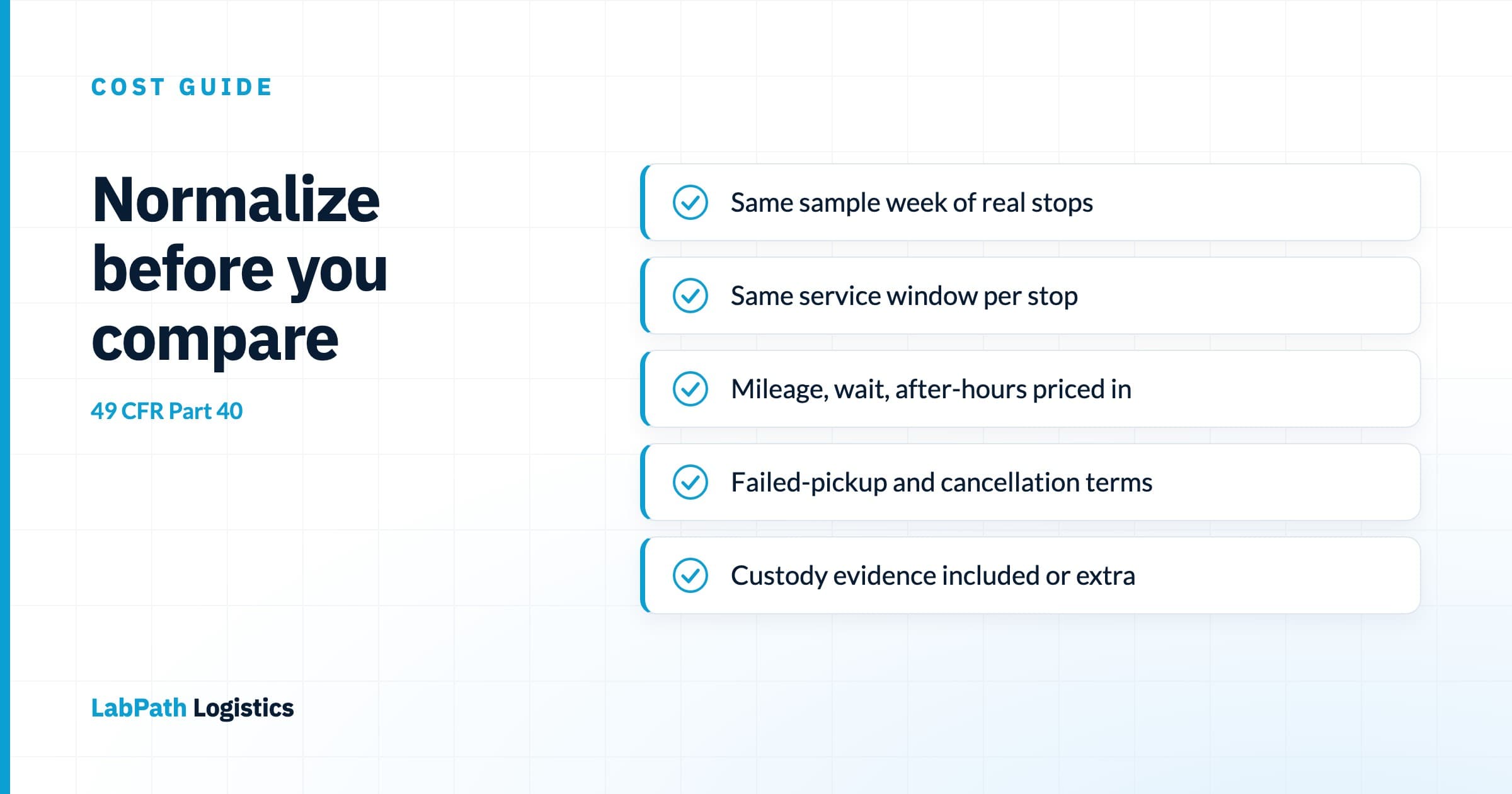
After the window, ask how waiting is billed: per minute, per block, or per hour, and whether there is a cap per stop. A per-block rule that rounds up can turn a three-minute overrun into a full block. Compare these rules across vendors the way you compare base rates, using our guide to comparing courier quotes like for like.
Fees 3 and 4: When Does a Cancellation Become a Charge?
A cancellation cutoff is the line between a free change and a billed one. Ask whether it is measured from the booked window or from dispatch, and whether a reschedule counts as a cancellation. A clinic that moves a pickup by thirty minutes should not discover that it was billed as two stops.
The failed-pickup rule covers the worst case: the driver arrives and leaves empty-handed. Some agreements bill the full base rate, some a reduced trip charge, some nothing for the first occurrence. None of those is wrong, but all of them should be written down. Our contract terms guide lists the other clauses worth redlining alongside these.
Fee 5: Who Decides Whose Fault the Delay Was?
Fault is where disputes start. A wait fee is fair if the driver arrived at the booked time and your specimen was not ready. It is not fair if the driver arrived late and the clock still ran from the booked time. The fix is evidence both sides can see: an arrival timestamp, a handoff timestamp, and the booked window, on the same record.
Timestamps also protect the specimen side of the story. Under 42 CFR 493.1242(b), the laboratory must document the date and time of specimen receipt, so your own paperwork already ends with a time. A courier timeline that begins with a driver arrival time lets you see where the minutes between those two stamps went. Our guide on which clock defines on-time goes deeper on this.
A Houston Scenario: The Same Missed Pickup, Two Contracts
A Houston-area urgent care books an end-of-day pickup. The courier arrives, and the last specimen is ten minutes from ready. Under Contract A, the free window runs ten minutes from the arrival scan, waiting is billed in small increments with a cap, and the timeline is visible to the clinic. Under Contract B, the clock started at the booked time, waiting is billed per started hour, and the only record is the driver's note. The base rate is identical. The bad-day bill is not.
That is the pattern behind the Five-Fee Test. Two quotes that look the same on the rate card can behave very differently when something goes wrong, and something always goes wrong eventually.
How Do You Avoid Paying These Fees in the First Place?
- Give the front desk a ready-by time that is earlier than the pickup window, so specimens are packed before the driver arrives. Our pickup schedule guide shows how to set one.
- Name one person who gets the arrival alert, so a waiting driver does not depend on who answers the door.
- Keep a standing release rule: if a specimen is not ready by the end of the free window, the driver leaves and the run is rebooked, so a wait never silently becomes a missed lab cutoff.
- Use a lockable drop point for routine, stable work where your lab allows it. See our specimen lockbox guide for the heat and timing limits.
- Review last month's invoice for wait and cancellation lines. If they cluster at one site or one hour, fix the cause rather than the vendor. Our invoice audit guide shows what to check.
How Do You Test This Before You Sign?
Ask each courier to price a written scenario: a driver arrives at the booked time, the specimen is eleven minutes from ready, and the clinic then releases the driver and rebooks the run for an hour later. Compare the answers line by line. Then run a short pilot at one site and read the first invoice with the Five-Fee Test beside it. If the run was urgent, the STAT vs same-day guide helps you decide whether a faster tier or an earlier ready-by time is the better fix.
LabPath Logistics is in early access for Greater Houston, and we make no fixed-minute pickup promise. Our booking model has no patient data fields, by design. The nonbinding estimator prices a pickup without signup; see our services for planned levels and the platform preview for what is verified today. We do not claim a staffed fleet or live tracking yet, and we would rather you ask these five questions of us as well.
Frequently Asked Questions
Do medical couriers charge for wait time?
Many do, but terms differ by provider. Typically a short free window applies, then waiting is billed in some increment. Ask for the free window, when the clock starts, the billing increment, and any cap in writing before your first booking.
What is a failed pickup charge?
It is what a courier bills when a driver arrives and no specimen is released. Some agreements charge the base rate, some a reduced trip fee, and some waive the first occurrence. The rule should appear in your contract or fee schedule, not be decided after the fact.
Can I cancel a medical courier pickup for free?
Usually only before a cutoff, which the provider defines. Ask whether the cutoff counts from the booked window or from dispatch, and whether rescheduling counts as a cancellation. If the answer is not written down, treat it as unknown.
How do I dispute a wait-time fee?
Ask for the arrival and handoff timestamps and the booked window for that stop, then compare them with your own front-desk record. Disputes are easier to settle when both sides can see the same timeline, so request that evidence as part of your contract terms.