Medical Courier SLA: Which Clock Defines On-Time?
October 29, 2026 · By LabPath Logistics Editorial Team, Medical Logistics Desk
Quick Answer
On-time has no standard definition in medical courier contracts. A vendor can measure from your request, from the driver's arrival, or from a scheduled stop, and can end the clock at pickup or at drop-off. Before signing, make the contract name the start stamp, the stop stamp, and the record that proves both.
Put three Houston medical courier proposals side by side and each will promise "on-time" service. The medical courier SLA language looks the same, and the numbers look comparable. They usually are not, because on-time is measured from different starting points and stopped at different finish lines.
This guide gives you the Four-Stamp Test: four timestamps that decide what on-time can mean, and a short way to make a vendor name its choice in writing. It covers contracts and operations only, not clinical handling.
What Does On-Time Mean in a Medical Courier Contract?
It means whatever the contract says, and many contracts say nothing. Public examples show how much the definition varies. A Colorado public health laboratory's courier vendor page requires arrival for an unscheduled on-demand pickup within two hours of the request, with delivery to the lab within 12 hours. That is two separate clocks with two separate limits, not one on-time percentage.
2 hours + 12 hours
Colorado's public health laboratory sets a two-hour pickup-response limit and a 12-hour delivery limit for on-demand courier pickups. Two clocks, written down. Source: CDPHE, Courier information for vendors.
Your Houston contract does not need those numbers. It needs the same discipline: say which event starts each clock, which event stops it, and what record settles a dispute.
What Is the Four-Stamp Test?
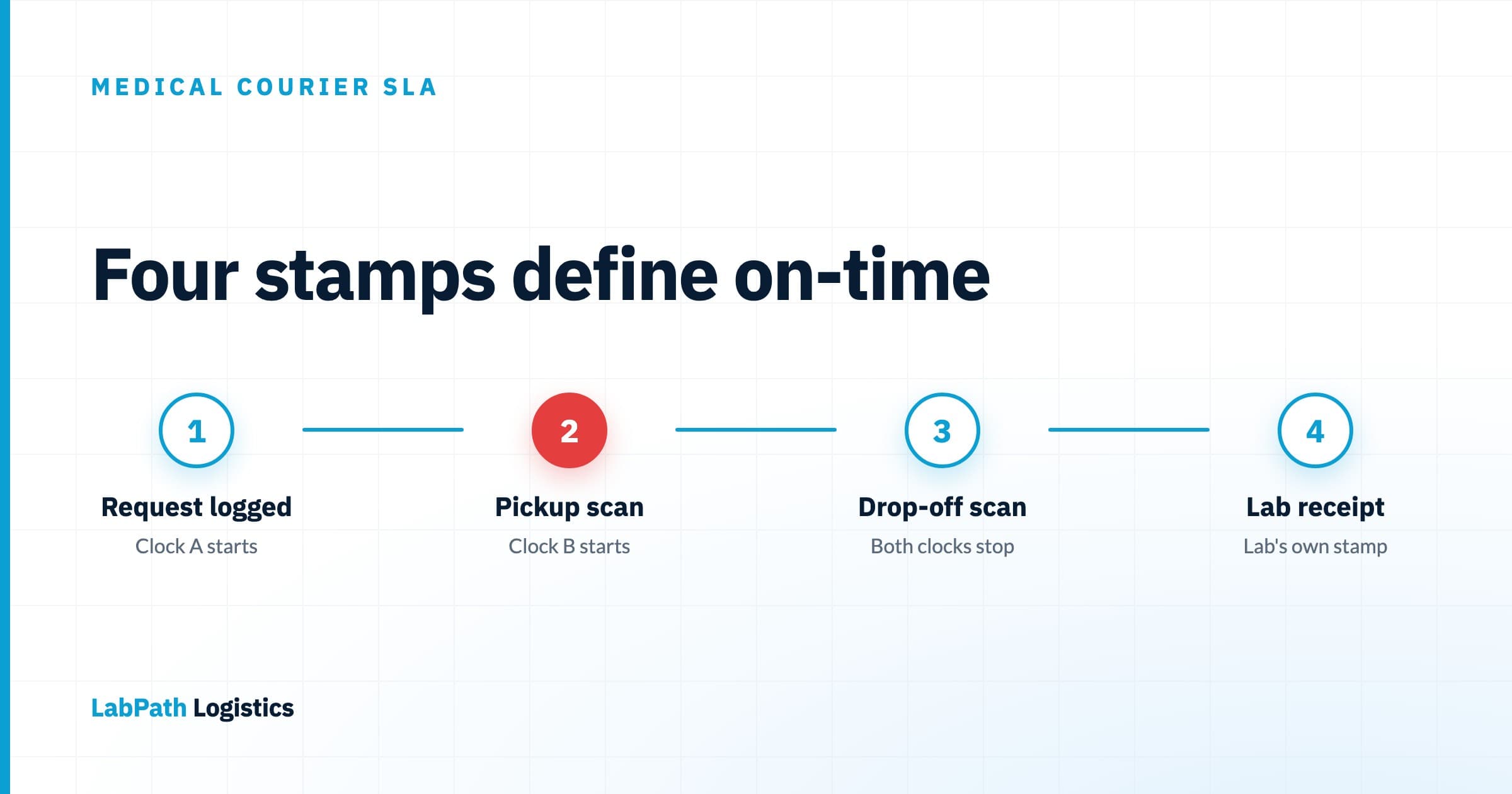
The Four-Stamp Test: save and send to whoever signs your courier contract
Stamp 1, request logged: the moment your order exists in the vendor's system. Stamp 2, pickup scan: the moment the driver takes custody at your door. Stamp 3, drop-off scan: the moment custody transfers at the lab. Stamp 4, lab receipt: the lab's own accession or received time. Ask every vendor two questions. Which stamp starts your on-time clock, and which stamp stops it? Then ask what record proves each stamp, because a percentage without a stamp behind it is a marketing claim.
The vendors' choices are usually one of three. Request-to-drop-off is the hardest on the vendor and the most honest for you. Pickup-to-drop-off is the common middle ground, and it ignores a late arrival entirely. Stop-window-to-drop-off, used for scheduled routes, only asks whether the driver reached your door inside a window.
Why Can Two 98% On-Time Rates Mean Opposite Things?
Because the denominator changes. A vendor that starts its clock at pickup scan never counts the 40 minutes you waited for the driver. A vendor that counts a pickup as on-time if it lands anywhere in a four-hour stop window can hit 98% while your specimens sit at the door through your lab's cutoff.
Your own risk sits with the lab's limits, not the vendor's average. Under 42 CFR 493.1242, CLIA-certified labs must follow written specimen submission and handling procedures, so the stability limit on the test is what an "on-time" claim has to protect. Our turnaround time guide shows how that limit becomes a latest-pickup time.
A Houston Scenario: The Four-Hour Window That Was On-Time
A Houston-area internal medicine group is renewing its courier contract. Vendor A reports 98% on-time and counts a pickup as on-time inside a 2 p.m. to 6 p.m. stop window. Vendor B reports 94% and counts from the moment the clinic requests a pickup to the lab drop-off.
The practice's lab cutoff is 5 p.m. Vendor A's 98% includes every pickup at 5:45 p.m. Vendor B's 94% would have flagged each of them. The lower number is the one that protects the lab cutoff. The Four-Stamp Test exposes that in one question, and our pickup schedule guide shows how to size windows against the cutoff.
What Should the Contract Say About Timestamps?
- Name the start stamp and the stop stamp for each service tier. STAT, routine, and scheduled stops can use different clocks.
- Require the raw timestamp log, not only a monthly percentage, so you can audit any single run. Our invoice audit guide covers what to pull each month.
- Define a late arrival separately from a late delivery, and say what each costs the vendor. Our contract terms guide lists the clauses to redline.
- Exclude only named events, such as a closed facility door or a facility-requested hold, and require the driver to record the reason at the time.
- Set a recorded-exception rule: if a stamp is missing, the run counts as late, not as excluded.
Run the same questions in a pilot before you commit volume. Our new courier evaluation guide and the original SLA guide cover the rest of the vetting. A shared route may suit a long lab limit, while a short one points to a dedicated run; the shared vs. dedicated guide compares them.
If a specimen does go missing, the same stamps are the first evidence you reach for. See our guide on lost specimens in transit for the response steps.
LabPath Logistics is in early access for Greater Houston. Our locally verified booking-to-receiver-attestation workflow records package-QR scans, pickup evidence, append-only custody events, and receiver signature; production dispatch, GPS, and temperature telemetry are not live yet, and we make no fixed-minute pickup promise. The booking model has no patient fields, by design. Ask us which timestamps an early-access booking records and compare the answer against your own Four-Stamp Test. See the platform preview and services, or price your lane in the nonbinding estimator.
Frequently Asked Questions
How should a medical courier SLA define on-time?
It should name the event that starts the clock, the event that stops it, and the record that proves each. Start stamps are usually the request time or the pickup scan; the stop stamp is usually the drop-off scan. Different service tiers can use different clocks.
What on-time percentage should a Houston lab expect from a medical courier?
No standard percentage exists, and a number means little without its definition. Ask the vendor how the percentage is calculated and what stamps feed it, then compare vendors on the same definition rather than on the headline figure.
Should pickup lateness and delivery lateness be measured separately?
Yes. A late arrival at your door and a late drop-off at the lab are different failures with different consequences. Colorado's public health laboratory, for example, sets a pickup-response limit and a separate delivery limit for on-demand pickups.
What records should a courier provide to prove on-time performance?
Ask for the timestamp log for each run, tied to a package or order identifier, not only a monthly summary. You should be able to audit any single run against the contract's start and stop stamps. A courier does not need patient information to provide this.