Audit Your Medical Courier Invoice: A Houston Guide
August 31, 2026 · By LabPath Logistics Editorial Team, Medical Logistics Desk
Quick Answer
Auditing a medical courier invoice means reconciling three things the contract already promised: the base rate against what was quoted, the accessorial charges against events that actually happened, and the billed stop count against the courier's own scan record. The fuel surcharge is the fastest line to check because it should track a public number — the U.S. Energy Information Administration's weekly on-highway diesel survey put Gulf Coast retail diesel at $5.481 per gallon for the week of August 24, 2026, up from $4.942 five weeks earlier. And one line item should never appear at all: a patient name, medical record number, or any other identifier. Invoices route through accounts payable, and HIPAA's minimum necessary standard applies to that disclosure like any other.
Most Houston facilities negotiate a courier rate carefully and then never audit a medical courier invoice again. The rate goes in a contract folder, the monthly bill goes to accounts payable, and the two documents never meet. That is where the money leaks — not in the per-stop number everyone argued about, but in the four or five line items underneath it that nobody at the clinic can map to anything that happened.
A courier invoice is auditable. Every charge on it is supposed to correspond to a timestamped event that the courier itself recorded, and the same scan data that protects a specimen is the evidence that proves or disproves a billing line. Here is what to reconcile, in the order that finds the most money the fastest.
What Is Actually on a Courier Invoice
Freight billing has a vocabulary that healthcare buyers rarely inherit. The base charge is the rate you negotiated. Everything else is an accessorial — a conditional charge triggered by a circumstance. Five show up on nearly every medical courier bill.
- Fuel surcharge — a percentage applied on top of the base, meant to track diesel or gasoline prices rather than being folded into the rate.
- Wait time or detention — charged when a driver is held at a facility beyond a free dwell window, usually billed in fixed increments.
- After-hours, weekend, or holiday differential — a premium tied to the pickup time rather than the distance.
- Attempted stop or redelivery — charged when a driver arrives and cannot complete the pickup or delivery, then returns.
- Minimums and rounding — trip minimums, minimum billing increments on mileage or time, and the rounding rule that turns 4.2 miles into 5.
None of these is illegitimate. A driver held forty minutes at a loading dock is a real cost, and someone pays it. The problem is that accessorials are frequently applied without the facility ever seeing the evidence, and the contract language governing them is often a single sentence when it needs to be a paragraph.
The Fuel Surcharge Is the Only Line You Can Check Against a Public Number
Start here, because it takes about four minutes. The U.S. Energy Information Administration publishes a weekly retail survey of on-highway diesel prices, broken out by region, and the Gulf Coast (PADD 3) series is the one that describes what a Houston courier actually pays at the pump. It is free, public, and updated every week — which makes it the natural peg for a surcharge clause.
The recent movement is real and worth knowing before a vendor explains it to you. Gulf Coast retail diesel averaged $4.942 per gallon for the week of July 20, 2026, and $5.481 for the week of August 24 — a rise of about 10.9 percent in five weeks. The national average for that same week was $5.652. A surcharge that jumped in that window has an explanation available; a surcharge that has not moved in two years is not tracking anything.
$5.481 / gal
EIA weekly retail on-highway diesel price, Gulf Coast (PADD 3), week of August 24, 2026 — up from $4.942 for the week of July 20, 2026. The national average that week was $5.652.
A defensible fuel surcharge clause names five things. Which published index it uses and which region of it. The base or peg price at which the surcharge is zero. The step — how many cents of index movement changes the surcharge by how much. The lag, meaning which week's published number governs which week's invoices. And the scope: whether the percentage applies only to base charges or also compounds on top of other accessorials.
The question to ask a courier
Not "why is fuel so high?" but "which published index, which region, what peg price, and what lag?" A surcharge that cannot be recomputed from public data by your own staff is not a surcharge. It is a rate increase with a friendlier name.
Reconcile Stop Counts Against Scans, Not Memory
The single most common billing discrepancy in scheduled courier work is a stop count that does not match reality — a site that was closed, a run that was consolidated, a second daily pickup that stopped happening in June and kept billing through August.
You do not have to reconstruct this from memory, because the record already exists on both sides. Under 42 CFR §493.1242, the receiving laboratory must document the date and time it receives each specimen. Your courier's scan log and the lab's accessioning record are two independent timestamp sets covering the same events. If an invoice claims twenty-two pickups at a site and the scan export shows nineteen, the conversation is short.
Ask for the scan export as a standing monthly deliverable rather than a special request during a dispute. A courier that can produce a timestamped stop-level export on demand is demonstrating the same custody discipline you are buying for the specimens, and one that cannot produce it is telling you something important about both.
Wait Time and Redelivery: The Two Disputed Accessorials
These two generate most billing disputes because both describe something that happened at your building, where the courier holds all the evidence and the facility holds none.
Fair wait-time language has four parts: a free dwell window measured from a recorded arrival scan rather than from a driver's assertion, a billing increment small enough to be proportionate, a stated hourly or per-minute rate, and a requirement that the charge appear on the invoice with the arrival and departure timestamps attached. If wait time is billed in thirty-minute blocks and a nine-minute hold costs a full block, that is a rounding policy, not a cost recovery.
Redelivery and attempted-stop charges need one more clause: cause. A driver who arrives at 4:55 p.m. for a 4:30 p.m. scheduled pickup and finds the specimen refrigerator locked has not earned an attempted-stop fee. The right contract language ties the charge to the party whose action caused the failure, and requires the timestamp that proves which one it was. This is the same evidentiary discipline that makes an SLA enforceable rather than decorative.
The Line Item That Should Never Appear
Open last month's invoice and read the description column. If it contains a patient name, a medical record number, an accession number tied to a person, or a home address on a residential delivery line, you have a privacy problem sitting in an accounts payable inbox.
Billing is a disclosure like any other. 45 CFR §164.502(b)(1) requires that a covered entity or business associate "make reasonable efforts to limit protected health information to the minimum necessary to accomplish the intended purpose of the use, disclosure, or request." The treatment exception does not rescue an invoice — payment and operations are exactly the categories the standard was written for. 45 CFR §164.514(d)(3) goes further for anything recurring: for disclosures made on a routine and recurring basis, the entity must implement policies or standard protocols limiting the information disclosed to what is reasonably necessary. A monthly invoice is the definition of routine and recurring.
The business associate agreement points the same direction. Under 45 CFR §164.504(e)(2)(i), a business associate contract must establish the permitted and required uses and disclosures of protected health information, and "may not authorize the business associate to use or further disclose the information in a manner that would violate the requirements of this subpart, if done by the covered entity." A courier cannot contract its way into putting patient names on a document that will be emailed, forwarded, and filed by people with no clinical role.
The fix is trivial and costs nothing: bill against opaque identifiers. A manifest number, a route ID, a facility stop code, and a timestamp fully describe a billable event without describing a person. That is the same principle behind a HIPAA-compliant courier's custody record — the chain of custody tracks the container, not the patient.
A Twenty-Minute Monthly Reconciliation
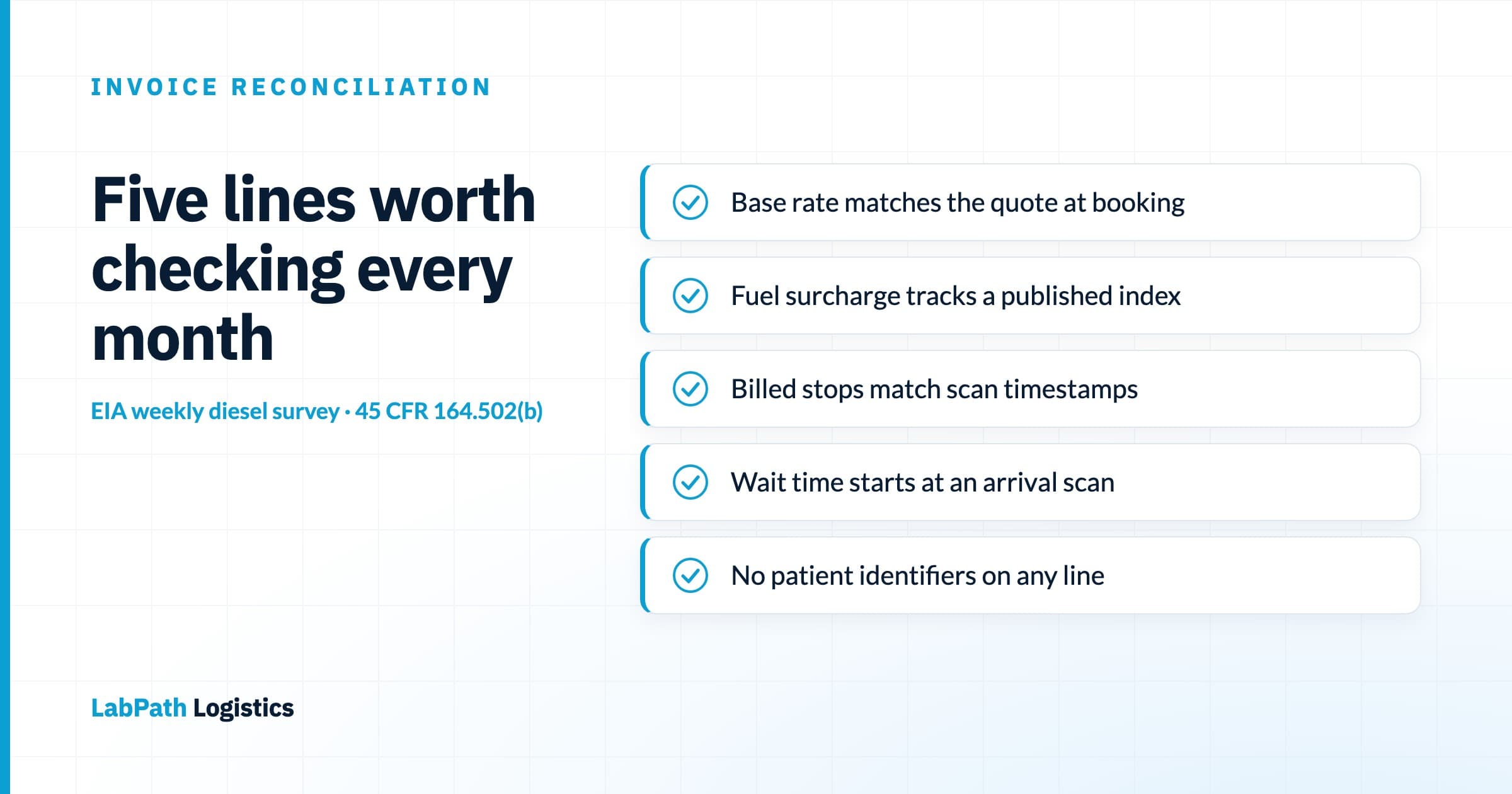
This does not need a consultant or a spend-analysis platform. It needs one recurring calendar block and five steps, run by whoever already approves the invoice.
- Pull the contract rate table and the invoice side by side, and confirm the base charges match the tier and mileage band you actually booked.
- Recompute the fuel surcharge from the EIA weekly Gulf Coast diesel number for the governing week, using the peg and step in your contract. If you cannot recompute it, that is the finding.
- Request the stop-level scan export and count billed stops against scanned stops, per site, for the month.
- Filter every accessorial line — wait time, attempted stops, after-hours — and require the arrival and departure timestamps for each one. Charges without evidence come off.
- Read the description column for patient identifiers, and if any appear, raise it under the business associate agreement rather than as a billing question.
Run it three months in a row and the pattern stabilizes. If the invoice reconciles cleanly each time, you have a vendor whose billing is a byproduct of its operating record. If it does not, you have quantified the gap — which is the number you need before deciding whether the relationship is worth renegotiating or replacing.
Key Takeaway
A medical courier invoice is not an opinion. Every line on it should be recomputable from a public index, a timestamp your vendor already recorded, or a contract clause you can point to — and any line that is not recomputable is a line you are funding on trust. Check the fuel surcharge against the EIA weekly Gulf Coast diesel series, check stop counts against scan exports, demand timestamps behind every accessorial, and make sure no patient identifier ever rides an invoice into accounts payable. The base rate is what you negotiated. The invoice is what you are actually paying, and the difference is worth twenty minutes a month.
Frequently Asked Questions
How is a medical courier fuel surcharge calculated?
There is no federally mandated formula for courier fuel surcharges, so the calculation lives entirely in your contract — which is why the clause needs to name five things: the published index, the region of that index, the peg or base price at which the surcharge equals zero, the step (how much index movement changes the surcharge), and the lag (which published week governs which invoice week). The usual public reference is the U.S. Energy Information Administration's weekly retail on-highway diesel survey; for a Houston courier the relevant series is Gulf Coast (PADD 3), which averaged $5.481 per gallon for the week of August 24, 2026. If your staff cannot recompute the surcharge from that public number and your contract terms, the surcharge is not indexed to anything.
Can a medical courier charge for wait time at my facility?
Yes, and it is a legitimate cost — a driver held at a dock is capacity you are consuming. What matters is how the charge is evidenced. Reasonable terms define a free dwell window that starts at a recorded arrival scan rather than a driver's claim, bill in increments proportionate to the delay rather than half-hour blocks, state the rate explicitly, and put the arrival and departure timestamps on the invoice line itself. A wait-time charge with no timestamps attached is an assertion, and you are entitled to ask for the underlying scan record before approving it.
Should a courier invoice include patient names or medical record numbers?
No. Invoices are routed to accounts payable, forwarded by email, and archived by staff with no clinical role, and HIPAA's minimum necessary standard at 45 CFR 164.502(b)(1) requires covered entities and business associates to limit protected health information to the minimum necessary for the purpose. For anything recurring, 45 CFR 164.514(d)(3) requires standard protocols limiting what is disclosed — and a monthly invoice is routine and recurring by definition. Billable events can be fully described with a manifest number, route ID, facility stop code, and timestamp. If patient identifiers are appearing on your invoices, raise it under the business associate agreement, since 45 CFR 164.504(e)(2)(i) bars a BAA from authorizing a business associate to disclose PHI in a way the covered entity itself could not.
How do I prove I was billed for stops that did not happen?
Use the timestamp records that already exist on both ends of the run. Ask the courier for a stop-level scan export covering the billing period, then compare it site by site against the invoice line count. On the receiving side, 42 CFR 493.1242 requires the laboratory to document the date and time each specimen was received, so the lab's accessioning data is an independent second record of the same events. Two independent timestamp sets against one invoice resolves nearly every stop-count dispute without argument — and a courier that cannot produce a stop-level export on request has a documentation problem larger than the billing question.