Switching Medical Couriers Without Breaking Your Lab
August 18, 2026 · By LabPath Logistics Editorial Team, Medical Logistics Desk
Quick Answer
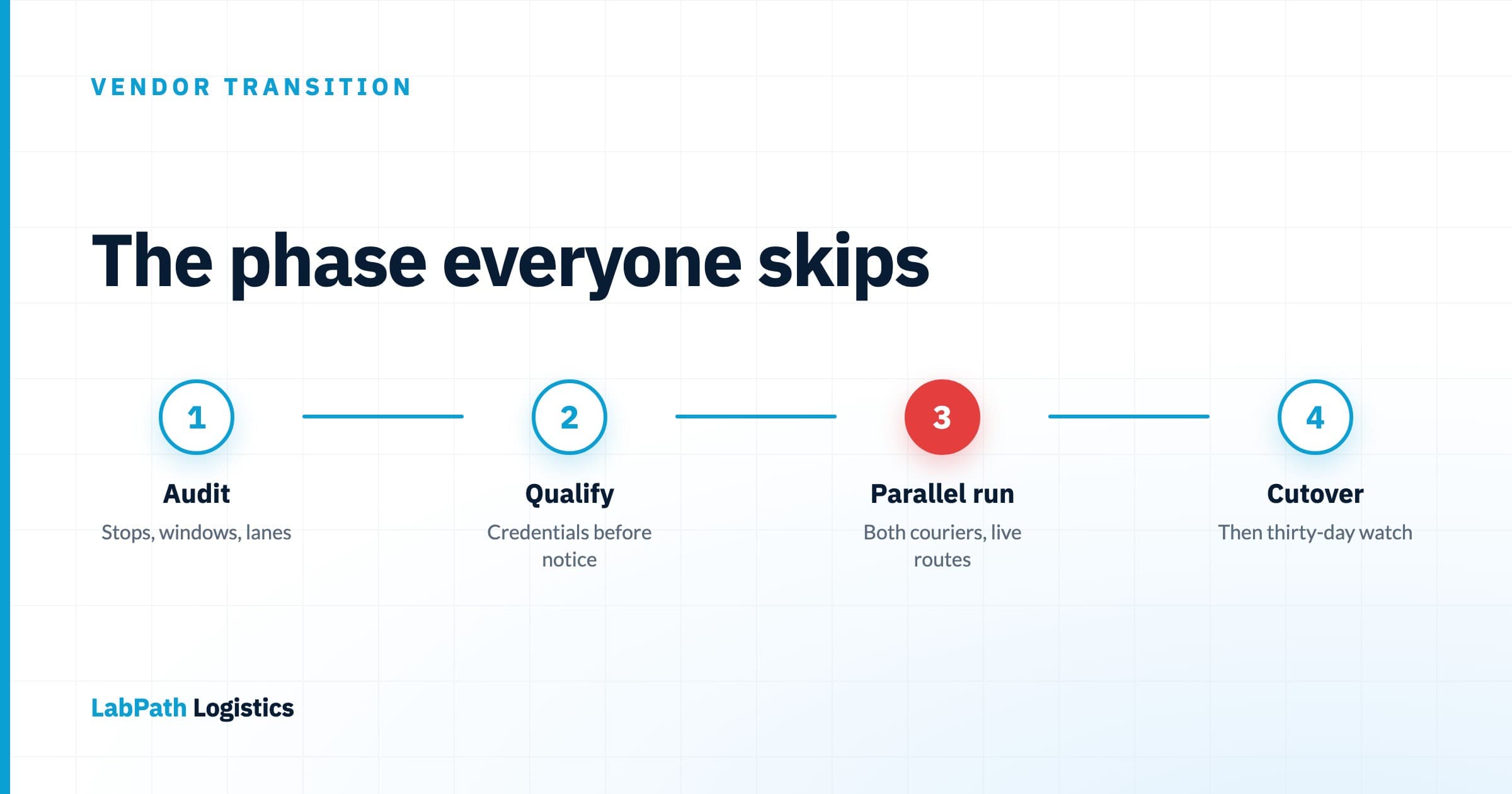
Switching medical couriers safely takes four phases: audit your current stops, windows, and transport conditions; qualify the new vendor's credentials before you give notice; run both couriers in parallel on live routes for two to four weeks; then cut over and watch closely for thirty days. The phase facilities skip is the parallel run, and it is the only one that tests whether the new courier can actually reproduce your performing laboratory's specimen requirements. Under CLIA, transportation conditions and specimen acceptability criteria are part of your written procedures — so changing couriers is a documented procedure change, not just a new invoice.
Switching medical couriers gets handled like a purchasing decision — three quotes, a rate comparison, a signature, a start date on the first of the month. It is actually a change to your laboratory's preanalytical process, and when it goes wrong the evidence arrives two weeks later as a cluster of specimens the performing lab cannot use, from stops nobody realized had special handling.
A transition done properly produces nothing at all: no rejected specimens, no missed STAT windows, no gap in the custody documentation an inspector will eventually ask for. Getting there is not complicated, but it does require overlapping the outgoing and incoming couriers on purpose, on live routes, before anyone sends a termination letter.
A Courier Change Is a Documented Procedure Change
CLIA is explicit about what a laboratory must have in writing. Under 42 CFR §493.1242(a), written policies and procedures must cover specimen labeling, storage and preservation, transportation conditions, processing, criteria for specimen acceptability and rejection, and referral. Section (b) adds that the laboratory must document the date and time it receives a specimen.
§493.1242
The CLIA standard covering specimen submission, handling, and referral — including transportation conditions and acceptability criteria (42 CFR §493.1242)
Read that list against a courier change and the implication is unavoidable. Transportation conditions are named in your procedures. The receipt record is named in your procedures. When the vendor reproducing those conditions changes, the packing instruction changes, the handoff record format changes, and the people executing them change. That is a procedure revision with retraining and evidence behind it — not a line item that swaps quietly at renewal.
The contract is not the route
Every courier relationship older than a year has accumulated undocumented exceptions: the clinic that moved its dock, the Thursday-only frozen pickup, the front-desk staffer who is the only person who knows where the after-hours lockbox is. None of that is in the contract. All of it fails on day one under a new vendor unless somebody writes it down first.
Why Houston's Contract Calendar Keeps Moving
Courier transitions are rarely voluntary. More often an ownership change forces one. At the beginning of August 2026, HCA Healthcare closed its acquisition of Texas MedClinic — 40 urgent care locations statewide, of which eight became part of HCA Houston Healthcare, all rebranded under HCA's CareNow division, according to Healthcare Dive. Acquisitions of that shape reassign vendor contracts, standing orders, and routing rules across every acquired site at once.
8
Houston-area Texas MedClinic sites folded into HCA Houston Healthcare when the deal closed in August 2026 (Healthcare Dive)
Construction moves the map too. Harris County commissioners approved the acquisition of 8.9 acres of Hermann Park on March 19, 2026 for a $410 million Ben Taub expansion adding roughly 100 patient rooms to a 402-bed hospital, as Community Impact reported. Multi-year work of that scale inside the Texas Medical Center corridor rearranges docks, entrances, and staging areas — the physical details a route is actually built on, and the ones that never make it into a rate sheet.
The Four-Phase Transition
Phase 1 — Audit What You Actually Have
Before you talk to a new vendor, document the running system. Not the contract — the system:
- Every stop, with the dock or entrance actually used and the access constraint attached to it.
- The pickup window per stop, and which windows are genuinely fixed versus historically convenient.
- The transport condition per stop and per specimen type — ambient, refrigerated, frozen — sourced from the performing lab's requirements, not from habit.
- Who is authorized to release at each origin and who is authorized to receive at each destination.
- The STAT trigger path: who calls, what number, what happens after hours and on weekends.
- What paperwork travels with the specimen, sealed, and what never leaves the building.
- Equipment owned by the incumbent — coolers, racks, scanners, lockboxes — that leaves when they do.
If your stop list has drifted from what the route really does, fix that first. Our guide to designing medical courier routes in Houston covers how those exceptions accumulate and how to fold them back into a documented schedule.
Phase 2 — Qualify Before You Give Notice
Vendor qualification belongs before termination, not after. Once notice is served you are negotiating against a clock, and the clock is the incumbent's leverage. What to verify in writing:
- A signed Business Associate Agreement executed before the first pickup — most medical couriers are business associates, not conduits, as we covered in the guide to HIPAA-compliant medical couriers.
- Certificates of insurance naming your facility, with limits you have actually read rather than filed.
- Driver training records and the vetting standard behind them, not a claim that drivers are trained.
- Demonstrated capability in every temperature lane on your list — ambient, refrigerated, and frozen are three different operational competencies.
- The custody record format, confirmation that you can export your own records from it, and how much patient data the vendor's software collects in the first place — see our HIPAA posture for the data-minimization standard to hold vendors to.
- A written escalation path with names and a defined response expectation, per the framework in our medical courier SLA guide.
Phase 3 — Run Both Couriers in Parallel
This is the phase that gets cut for budget reasons and the phase that determines whether the transition works. For two to four weeks, the incoming courier runs the real schedule on a subset of routes — non-STAT first — while the incumbent continues to carry the critical work. You are not testing whether the new vendor can drive. You are testing whether they can reproduce a documented condition and prove it afterward.
Measure, per run, on the routes under test:
- Arrival against the committed window, recorded as a time rather than a yes-or-no.
- Transport condition held, and whether the record proves it or merely asserts it.
- Custody completeness: release, transfer, and receipt each attributed and time-stamped.
- Rejections and near-misses at the performing lab, traced back to a specific run.
- Exception handling — what happened the first time a stop was locked, a specimen was not ready, or a route flooded.
- Whether your staff had to phone anyone to find out where a package was.
A Houston example makes the value obvious. A multi-site clinic group changes ownership in August; the new parent standardizes on a different courier across eight locations. Two of those clinics send frozen send-outs on a fixed weekly cadence, a detail that lives in one supervisor's head and appears nowhere in the contract being transferred. Under a parallel run, that surfaces in week one as a scheduling question. Under a hard cutover, it surfaces as a thawed shipment and a re-collection the patient has to come back for — the exact scenario our guide to send-out testing logistics exists to prevent.
Phase 4 — Cut Over, Then Watch for Thirty Days
- Pick a cutover date away from month-end, holidays, and the peak of hurricane season if the calendar allows it.
- Keep the incumbent's notice period alive past the cutover date where the contract permits, so a rollback exists.
- Retire the old workflow explicitly — old phone numbers, old lockbox codes, old paperwork — rather than letting both persist.
- Review custody records weekly for the first month, not quarterly. Patterns are cheap to fix in week two and expensive in month six.
Read the Termination Clause First
Read your existing agreement before you plan any of the above, because it sets the schedule. Three provisions decide your timeline: the notice period, typically 30 to 90 days; the auto-renewal window, which can quietly commit you to another year if notice lands a day late; and the disposition of equipment and records at termination.
That last one deserves attention. Custody records generated on your incumbent's platform are business records you may need long after the relationship ends — when a specimen is questioned, when an accreditation inspector asks, when a payer disputes a date. Export them, in a format you can actually open, before your access is switched off. The requirement to preserve them does not transfer to the vendor's convenience, and it is a direct extension of the documentation standard we covered in CAP specimen transport requirements.
Key Takeaway
Switching medical couriers fails for one reason far more often than any other: the change is scheduled as an event rather than a transition. Audit the route that actually runs, qualify the vendor before the clock starts, overlap both couriers on live work long enough to see the exceptions, and then cut over with a rollback still available. The cost of the parallel weeks is a rounding error against one re-collected specimen from a patient who has already gone home.
Frequently Asked Questions
How long does it take to switch medical couriers?
Plan for six to twelve weeks end to end, most of which is not the courier's work. The controlling variable is your existing contract's notice period, commonly 30 to 90 days. Inside that window, allow one to two weeks to audit your current stops and transport conditions, one to two weeks to qualify the new vendor's BAA, insurance, and training documentation, and two to four weeks of parallel running on live routes before cutover. Facilities that compress this to a start date on the first of the month are not moving faster; they are moving the risk to the specimens.
Do I need to tell my reference laboratory that I am changing couriers?
Yes, and early. The performing laboratory publishes the specimen requirements your transport has to satisfy, and under 42 CFR §493.1242 its own written procedures cover transportation conditions and acceptability criteria. Give the reference lab the cutover date, the new carrier's name, and the routes affected, and ask whether anything about its receiving process — dock, hours, delivery point, paperwork — changes with a different vendor. This is also the moment to reconcile your temperature lanes against its current catalog rather than an older copy.
What should I verify before signing with a new medical courier?
A signed Business Associate Agreement executed before the first pickup, current certificates of insurance with limits you have read, driver training and vetting records, demonstrated capability in every temperature lane you use, a custody record format you can export from, and a written escalation path with named contacts and a defined response expectation. Ask for evidence rather than assurances: a sample custody record and a sample temperature log from a real run tell you more about a vendor's operating discipline than any capability statement.
Can you switch medical couriers without any service interruption?
Yes, if the two vendors overlap rather than hand off. A parallel run puts the incoming courier on real, non-STAT routes while the incumbent continues carrying the critical work, so every failure mode surfaces while a working alternative is still in place. Interruptions cluster around hard cutovers — a single date on which every route, phone number, and lockbox code changes at once. Keeping the outgoing vendor's notice period alive past your cutover date, where the contract allows it, preserves a rollback for the two weeks you are most likely to need one.