Send-Out Testing Logistics for Houston Clinical Labs
August 16, 2026 · By LabPath Logistics Editorial Team, Medical Logistics Desk
Quick Answer
Send-out testing is when a laboratory refers a specimen it cannot run in house to a reference laboratory. CLIA requires the referring lab to have written policies covering specimen storage, transport conditions, acceptability, and referral, and to refer only to a CLIA-certified laboratory (42 CFR 493.1242). The binding logistics constraint is almost never courier speed — it is the reference laboratory's daily accession cutoff. A specimen that misses the cutoff by ten minutes loses a full day of turnaround, which is why send-out routes are built backward from that cutoff rather than forward from the draw.
Send-out testing logistics are the part of a laboratory's operation that almost nobody owns. In-house assays have a supervisor, a maintenance schedule, and a quality control log. Send-outs have a bench tech, a styrofoam shipper, and a courier who shows up sometime in the afternoon. Then a physician calls about a result that is four days old, and the investigation discovers the specimen sat in a refrigerator overnight because it missed a cutoff nobody had written down.
The fix is not more urgency. It is treating the send-out route as a scheduled clinical process with a defined deadline, the same way the lab treats a STAT panel. That starts with knowing which deadline actually binds.
What Counts as a Send-Out
A send-out — also called referral or reference testing — is any specimen a laboratory forwards to another laboratory because it does not perform that assay itself. In practice the category is dominated by low-volume, high-complexity work: molecular and genetic panels, specialized microbiology, unusual serologies, therapeutic drug levels, and confirmatory testing on an unexpected in-house result.
Two features make these specimens logistically different from routine work. They are usually irreplaceable — a repeat draw means recalling a patient, and sometimes the collection was procedural. And they frequently carry a stability requirement that the routine route was never designed to honor, whether that is a frozen aliquot, a strict refrigerated window, or an ambient-only restriction that a cold pack will quietly ruin.
Small Volume, Outsized Cost
Send-outs look negligible on a volume report, which is exactly why they get under-managed. The classic study of the problem — an eight-year analysis of reference laboratory testing at a large academic medical center, published in Clinical Leadership & Management Review in 2004 — found that referral tests were a rounding error by count and a budget line by dollar.
1.06% of volume, 12.4% of budget
Reference (send-out) testing share of total test volume versus share of the total laboratory budget in FY2002 — MacMillan, Lewandrowski & Lewandrowski, Clin Leadersh Manag Rev, 2004
The same analysis found the average unit cost of a reference laboratory test ran roughly 13 times the average unit cost of a test performed in house. The ratio has almost certainly moved since 2002 as molecular menus expanded, but the shape of the problem has not: a small number of specimens carry a large share of the cost, the longest turnaround times, and the most consequential clinical questions.
That asymmetry is the argument for spending real attention on the route. Losing a routine chemistry tube costs a redraw. Losing a send-out costs the redraw, the shipping, the contracted assay fee, and several days of a clinical decision.
What CLIA Actually Requires
Referral testing is not an informal arrangement between laboratories. 42 CFR 493.1242 requires the laboratory to establish policies covering specimen labeling, storage and preservation, conditions for transportation, processing, acceptability and rejection, and referral. It also requires the laboratory to document the date and time it receives a specimen, and to refer specimens only to a CLIA-certified laboratory or one meeting equivalent requirements as determined by CMS.
Read that list against how most send-out desks actually run and the gap is usually the same one: "conditions for specimen transportation" exists as a line in the reference lab's test catalog, not as a written instruction the courier and the packing tech both work from.
The reporting obligation follows the specimen
Under 42 CFR 493.1291, the authorized person who ordered the test must be notified by the referring laboratory of the name and address of each laboratory location where the test was performed. Referral does not transfer accountability for the result — it extends the referring lab's documentation chain. Custody records that stop at the loading dock leave a gap in that chain.
The Cutoff Is the Real Deadline
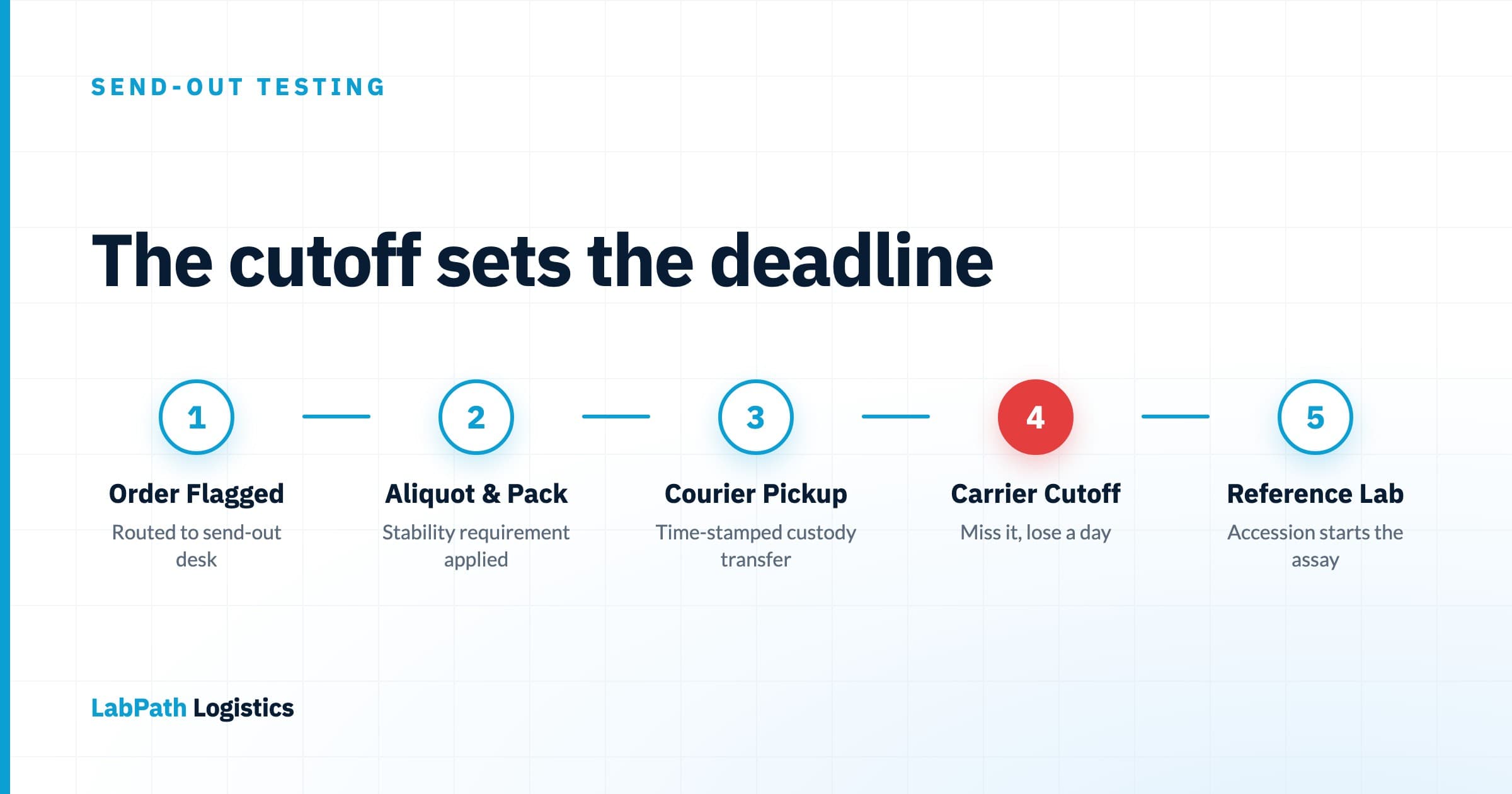
Here is the arithmetic that most send-out programs never do explicitly. A reference laboratory accessions arriving specimens up to a fixed daily cutoff; anything received after it is worked the next day. So the true deadline for the draw is not the assay's stability limit — it is the cutoff, minus transit, minus the courier's route time, minus packing, minus the time the order sits unflagged in the LIS queue.
Work that backward and the constraint moves upstream fast. If the reference lab's local hub cuts off at 5:00 p.m., transit is 45 minutes, the courier's route adds 30, and packing takes 15, then the specimen must be at the send-out bench by roughly 3:30 p.m. — and the phlebotomy schedule, not the courier contract, is what determines whether that happens.
- Order-to-bench lag: how long a flagged send-out waits in the LIS queue before anyone touches it. Usually the largest and least visible segment.
- Packing time: aliquoting, centrifugation, freezing, labeling, and building the shipper to the stability requirement.
- Pickup window: not the courier's arrival time, but the width of the window you can rely on every day.
- Transit: dock to reference lab hub, in real Houston traffic at the hour it actually happens.
- Cutoff buffer: the margin you keep. A route built to arrive at 4:58 p.m. is a route that fails weekly.
Every one of those is measurable and four of the five are controllable. Our guide to lab turnaround time breaks down how to instrument the segments; the send-out route is the case where the measurement pays for itself fastest, because a single missed cutoff costs a whole day rather than an hour.
Where Send-Outs Break in Houston
Houston concentrates the problem geographically. The Texas Medical Center reports roughly 10 million patient encounters a year across 54 million developed square feet, with about $4 billion in construction underway. That density is an advantage — reference laboratory hubs, courier networks, and airport access are all close — and a liability, because the last two miles of a send-out route run through the most congested and most actively torn-up part of the region at exactly the hours cutoffs fall.
The pattern we see repeatedly: a Houston-area clinic sends specimens to a hospital-based lab that then refers a subset onward. The clinic's courier is scheduled for a 4:00 p.m. pickup, which comfortably meets the hospital lab's needs for routine chemistry. Nobody notices that the same 4:00 p.m. pickup makes a same-day onward referral structurally impossible, so every send-out from that clinic starts a day behind. No SLA is breached. The patient waits an extra 24 hours anyway.
Multi-site outreach programs multiply this. A satellite draw site 25 miles out with a single afternoon pickup has a send-out deadline hours earlier than the main campus does — and if that is not published to the ordering providers, they will keep ordering send-outs at 2:00 p.m. and keep being surprised.
Building a Send-Out Route That Holds
None of this requires new software. It requires writing down decisions the lab is already making implicitly:
- Publish a per-site send-out cutoff, derived by working backward from the reference lab's accession cutoff with a real buffer, and put it where ordering providers see it.
- Separate the send-out pickup from the routine pickup wherever the two deadlines differ. One route serving two deadlines will serve the looser one.
- Write transport conditions per assay group — ambient, refrigerated, frozen — into the packing instruction itself, not just the catalog, and pack to the Category B requirements that apply to the shipment.
- Time-stamp custody at pickup and at reference lab receipt, so the segment that failed is identifiable rather than debatable.
- Define the exception path in advance: who is called when a specimen will miss the cutoff, and whether it holds at the correct temperature or moves on a dedicated run.
- Review rejected and delayed send-outs monthly against your specimen rejection criteria — the causes cluster, and most of them are schedule problems wearing a quality costume.
Key Takeaway
Send-out testing is a small fraction of specimens carrying a disproportionate share of laboratory cost and clinical weight, and CLIA already obligates the referring lab to control how those specimens are stored, transported, and referred. The single highest-leverage change is to stop scheduling send-outs forward from the draw and start scheduling them backward from the reference laboratory's cutoff — then hold a courier window tight enough that the buffer survives a bad afternoon on Main Street.
Frequently Asked Questions
What is send-out testing in a clinical laboratory?
Send-out testing, also called referral or reference testing, is when a laboratory forwards a specimen to another laboratory because it does not perform that assay in house. It typically covers low-volume, high-complexity work — molecular and genetic panels, specialized microbiology, unusual serologies, and confirmatory testing. Under 42 CFR 493.1242, the referring laboratory must have written policies for specimen storage, preservation, transport conditions, acceptability, and referral, and may refer only to a CLIA-certified laboratory or one meeting equivalent requirements as determined by CMS.
Why do send-out results take so long to come back?
Usually because of a missed cutoff, not a slow assay. Reference laboratories accession arriving specimens up to a fixed daily deadline and work anything later the next day, so a specimen that arrives minutes late loses a full day before testing begins. The delay is normally created upstream — an order sitting in the LIS queue, a single afternoon courier pickup shared with routine work, or a satellite site whose effective deadline is hours earlier than the main campus. Measuring each segment separately shows which one is actually costing the day.
Does the referring lab stay responsible after the specimen ships?
Yes, in the ways that matter operationally. CLIA requires the referring laboratory to document the date and time it receives a specimen and to control the conditions under which specimens are stored and transported. Under 42 CFR 493.1291, the referring laboratory must also notify the authorized person who ordered the test of the name and address of each laboratory location where the test was performed. Referral extends the referring lab's documentation chain rather than ending it, which is why custody records should cover the transport leg, not stop at the dock.
Should send-out specimens use the same courier route as routine pickups?
Only when both have the same deadline, which is uncommon. A routine route is built around the in-house lab's receiving schedule; a send-out route has to clear the reference laboratory's accession cutoff, which is often earlier and always less forgiving. When the two are merged, the route will reliably meet the looser deadline and intermittently miss the tighter one. Splitting the send-out pickup — or adding a dedicated later run for it — is usually cheaper than the redraws and lost days that the merged route produces.