CAP Specimen Transport Requirements for Houston Labs
August 3, 2026 · By LabPath Logistics Editorial Team, Medical Logistics Desk

Quick Answer
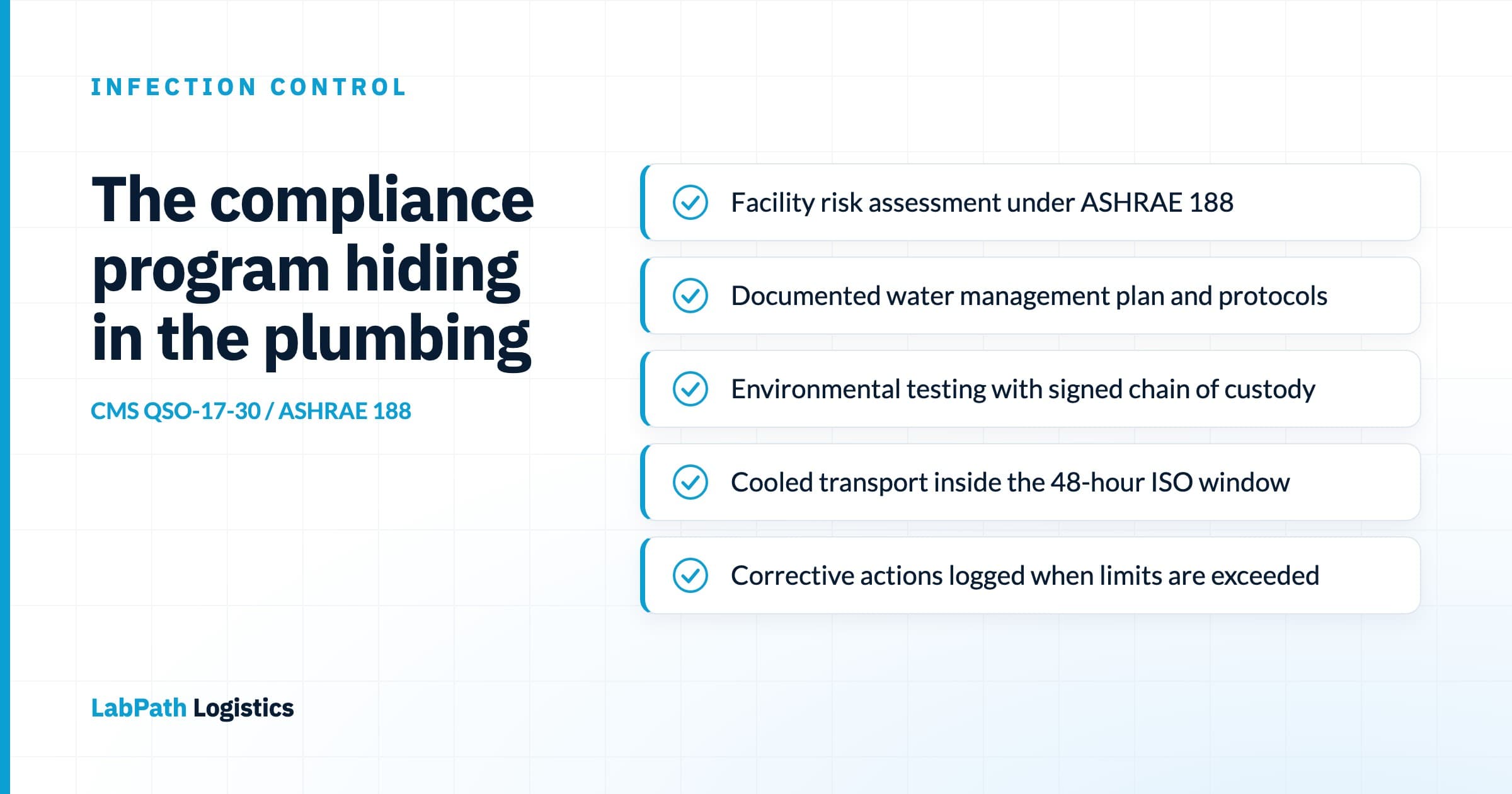
A CAP-accredited laboratory has to show that specimen transport was defined, controlled, and documented — not simply that specimens arrived. Under CLIA (42 CFR 493.1242), the lab's written policies must address transportation conditions along with storage and preservation, and the lab must document the date and time it receives each specimen. CAP's Laboratory General checklist extends that to contracted couriers: the tracking system is expected to capture temperature, time of pickup and delivery, and specimen identity, and transport personnel are expected to be trained in packaging, safe handling, temperature, and documentation.
Most Houston labs can produce a courier manifest on request. Far fewer can produce a temperature record tied to that manifest, for the right specimen, on the right leg of the route. That gap is where CAP specimen transport requirements stop being a vendor issue and become a laboratory deficiency — not because a specimen was damaged, but because the lab could not demonstrate that transport conditions were defined, followed, and recorded. The College of American Pathologists conducts on-site inspections every two years, and transport is one of the few areas where the evidence lives outside your building, in a system somebody else controls.
The CLIA Floor: Transport Conditions Are a Written Policy
Before CAP's checklist applies, federal law already does. 42 CFR 493.1242, the CLIA standard on specimen submission, handling, and referral, requires the laboratory to establish and follow written policies covering patient preparation, specimen collection, specimen labeling including patient name or unique patient identifier, storage and preservation, transportation conditions, processing, and acceptability and rejection criteria.
Two words in that list do most of the work in an inspection: transportation conditions. The regulation does not say the laboratory must transport specimens itself. It says the conditions have to be written down and followed, which means a courier contract is an extension of your policy, not a substitute for it. Subsection (b) adds the timestamp that anchors everything else — the laboratory must document the date and time it receives a specimen.
You cannot outsource the requirement, only the driving
When an inspector asks how the lab knows a 2–8 °C specimen stayed in range between a Sugar Land draw station and the main bench, the answer has to come from your records. "The courier handles that" is a description of the workflow, not evidence of compliance. Build the expectation into the service agreement before it has to be reconstructed under an inspector's timeline.
Three Checklist Items That Land on Your Courier
CAP's Laboratory General checklist addresses transport in more than one place, and the items that matter most for a contracted courier are narrow and specific. A review of CAP specimen requirements published on The Fritsma Factor summarizes them this way:
- GEN.40125 — handling of referred specimens: guidelines for the referring laboratory covering matters such as tube selection, storage temperature, time, and separation protocol.
- GEN.40515 — transport personnel training: training on packaging, safe handling, temperature, and documentation.
- GEN.40530 — specimen tracking: a tracking system that records temperature, time of specimen pickup and delivery, and specimen identity for laboratory-contracted couriers.
Read GEN.40530 slowly, because it is the one most transport programs partially satisfy. Temperature, pickup time, delivery time, and specimen identity are four separate data elements, and a proof-of-delivery signature captures exactly one of them by implication. A packing list submitted with each batch and checked against what the lab actually received is a recognized way to close the identity half of that requirement — but it still says nothing about temperature.
A signature is not a tracking system
Electronic proof of delivery tells you a stop was completed. It does not tell you which accessions were in the bag, what the container read at pickup, or how long the specimens sat in a vehicle between the third and fourth stop. If your transport evidence is a signature plus a manifest printed at dispatch, you have documentation of intent, not of conditions.
"Ambient" Is Not a Temperature Record
Room-temperature specimens are where transport documentation quietly collapses. Because no cooler is involved, nothing gets logged — and the assumption is that ambient means controlled. Measurement says otherwise. A prospective study published in the Journal of the American Pharmacists Association tracked 36 packages shipped between three U.S. regions using three carriers and two shipping methods across winter and summer, and found that packages spent an average of 68.3 percent of transit time outside the 68–77 °F controlled room temperature range, with recorded extremes from 5.1 °F to 102.3 °F.
68.3%
Average share of transit time that shipped packages spent outside the 68–77 °F controlled room temperature range, across 36 packages, three carriers, and two seasons (Journal of the American Pharmacists Association, 2023)
That study followed mailed pharmaceuticals rather than clinical specimens, and the point transfers cleanly: unmonitored transport at "room temperature" is not a controlled condition, it is an unmeasured one. In a Houston August, a cargo area on an uncovered lot at 2 p.m. is not 72 °F, and the same heat that degrades specimen integrity also degrades your ability to claim the specimen was handled per policy. If your written procedure specifies an ambient range, an inspector can reasonably ask what instrument confirms it.
Where Houston Routes Lose the Record
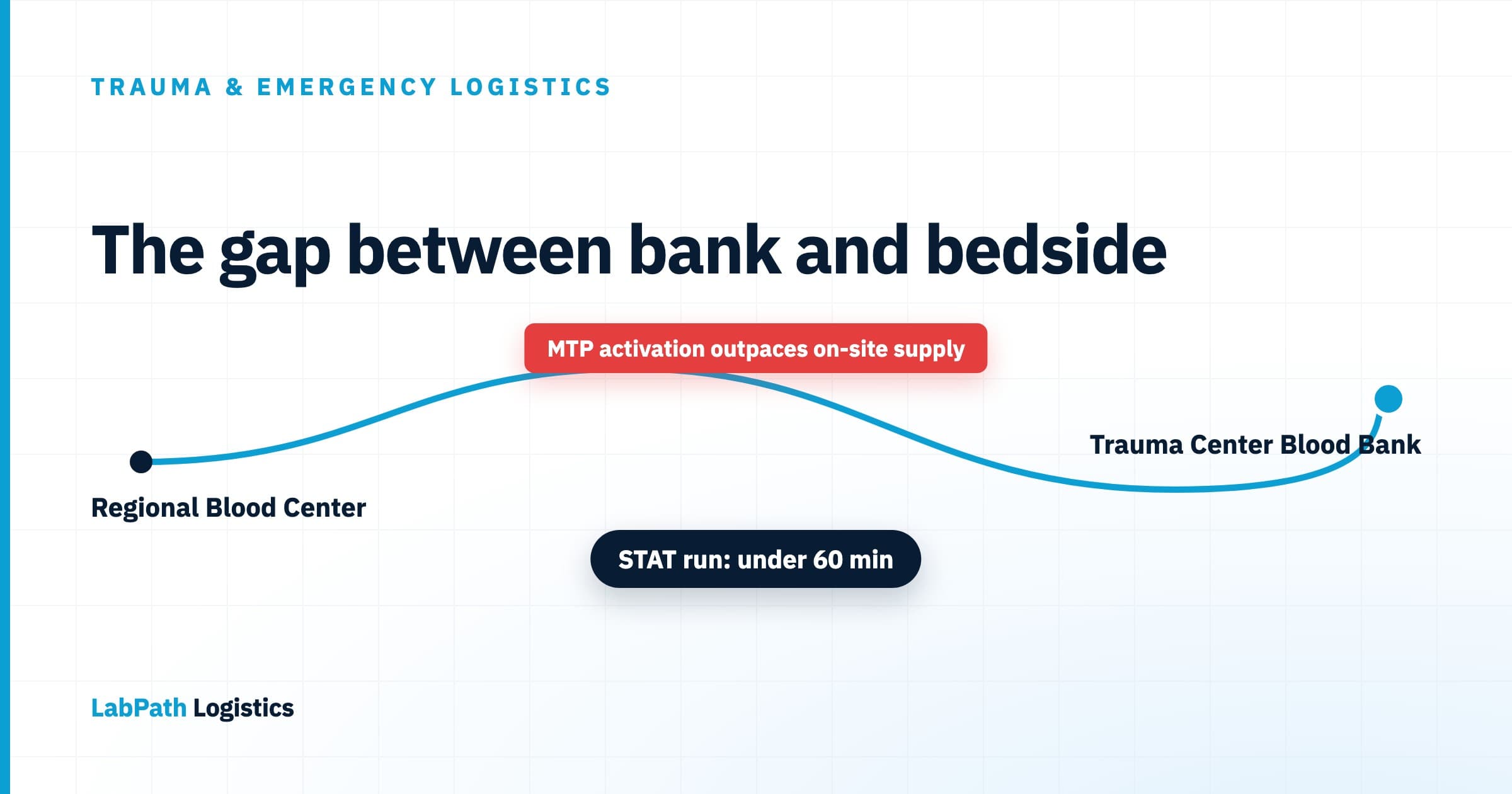
The documentation usually breaks in ordinary places, not dramatic ones. A routed run for a Houston-area reference lab picks up at four clinics along the Beltway, then works three buildings inside the Texas Medical Center. The courier parks once and walks the campus. The earliest specimens on that route have been in the vehicle for ninety minutes by the time the last stop is logged, and the record shows a single pickup time per stop with no interval readings.
Two more failure points show up repeatedly in Greater Houston operations:
- Driver-to-driver relays at shift change or at a consolidation point, where custody transfers but no entry is created — a break that a proper chain of custody record is designed to prevent.
- Satellite batches from Katy, Pearland, or The Woodlands that are re-bagged into a single delivery, so the receiving timestamp reflects the consolidation, not the original pickup.
Neither of these harms most specimens. Both of them make the transport file unreconstructable, and an unreconstructable file is what gets written up. They also blur the boundary between a transport problem and a specimen rejection problem — when a sample is rejected and the route data is thin, the lab cannot show whether transport was the cause or a coincidence.
What an Inspection-Ready Transport File Contains
For each specimen or batch that moves under your accreditation, you should be able to retrieve the following without calling a dispatcher — which is why live tracking and a written compliance posture matter more than a courier's promise to "keep good records":
- Specimen or accession identity linked to the transport event, not just to the stop
- Pickup timestamp and delivery timestamp, captured at the point of handling rather than keyed in later
- Temperature for the transport container over the leg, including the readings at departure and arrival
- Named custody holders for every leg, including relays and consolidation points
- Condition on receipt, recorded by the receiving lab and reconciled against the manifest
- Documented exceptions — delays, out-of-range readings, damaged containers — with the action taken
- Current training records for the personnel handling specimens, covering packaging, safe handling, temperature, and documentation
Two of those items are usually missing: interval or arrival temperature on room-temperature routes, and custody entries at relays. Fixing both is a configuration change in most modern courier systems, not a capital project.
What to Ask a Courier Before the Inspection Window Opens
- Can you export a per-specimen transport record — identity, times, temperature, custody — for any date in the past two years?
- Are temperature readings captured by a calibrated device with a current certificate, and can you produce that certificate?
- How is a driver-to-driver handoff recorded, and what does the record look like when it happens mid-route?
- What training do your personnel complete on packaging, handling, temperature, and documentation, and how is it documented?
- What is the defined process when a container reads out of range or a delivery misses its window — who is notified, and where is it logged?
- Will you support the laboratory during an inspection by producing records on request, within the timeframe an inspector allows?
Ask these before you sign, and put the answers in the agreement alongside the service levels you already negotiate on speed. A courier that cannot export a record is a courier that will cost you an inspection finding eventually — the only variable is when.
Key Takeaway
CAP and CLIA do not ask whether your specimens arrived. They ask whether transport conditions were written down, followed, and recorded — with temperature, times, identity, and custody attached to the specimen rather than to the stop. Choose transport that produces those four elements automatically, treat room-temperature routes as measured rather than assumed, and the transport section of your next inspection becomes a retrieval exercise instead of a reconstruction.
Frequently Asked Questions
What does CAP require for specimen transport temperature monitoring?
CAP's Laboratory General checklist expects a tracking system for laboratory-contracted couriers that records temperature along with time of specimen pickup and delivery and specimen identity (GEN.40530). Underneath it, CLIA at 42 CFR 493.1242 requires the laboratory's written policies to address transportation conditions and preservation. In practice that means a temperature record tied to the specimen and the leg it traveled, produced by a calibrated device — not an assurance that a cooler was used.
Is the laboratory or the courier responsible for CAP transport compliance?
The laboratory. CLIA places the written-policy obligation on the lab, and CAP inspects the lab, so a courier's practices become the lab's evidence. A courier can own the leg between two doors and generate the records for it, but the accreditation, the policy, and the deficiency all belong to the laboratory. Write the documentation requirements into the service agreement rather than assuming them.
What records should a medical courier provide for a CAP inspection?
At minimum: specimen or accession identity linked to the transport event, pickup and delivery timestamps captured at the point of handling, container temperature over the leg including departure and arrival readings, named custody holders for every leg including relays, condition on receipt, and documented exceptions with the action taken. Training records for personnel handling specimens should be available on the same request.
Does CLIA require documenting specimen pickup and receipt times?
42 CFR 493.1242(b) requires the laboratory to document the date and time it receives a specimen. Pickup time is not stated in that subsection, but CAP's checklist expectation for contracted couriers covers time of specimen pickup and delivery — and without a pickup timestamp, the lab cannot demonstrate how long a specimen was in transit or whether its stability window was met.