Arterial Blood Gas Specimen Transport in Houston
September 16, 2026 · By LabPath Logistics Editorial Team, Medical Logistics Desk
Quick Answer
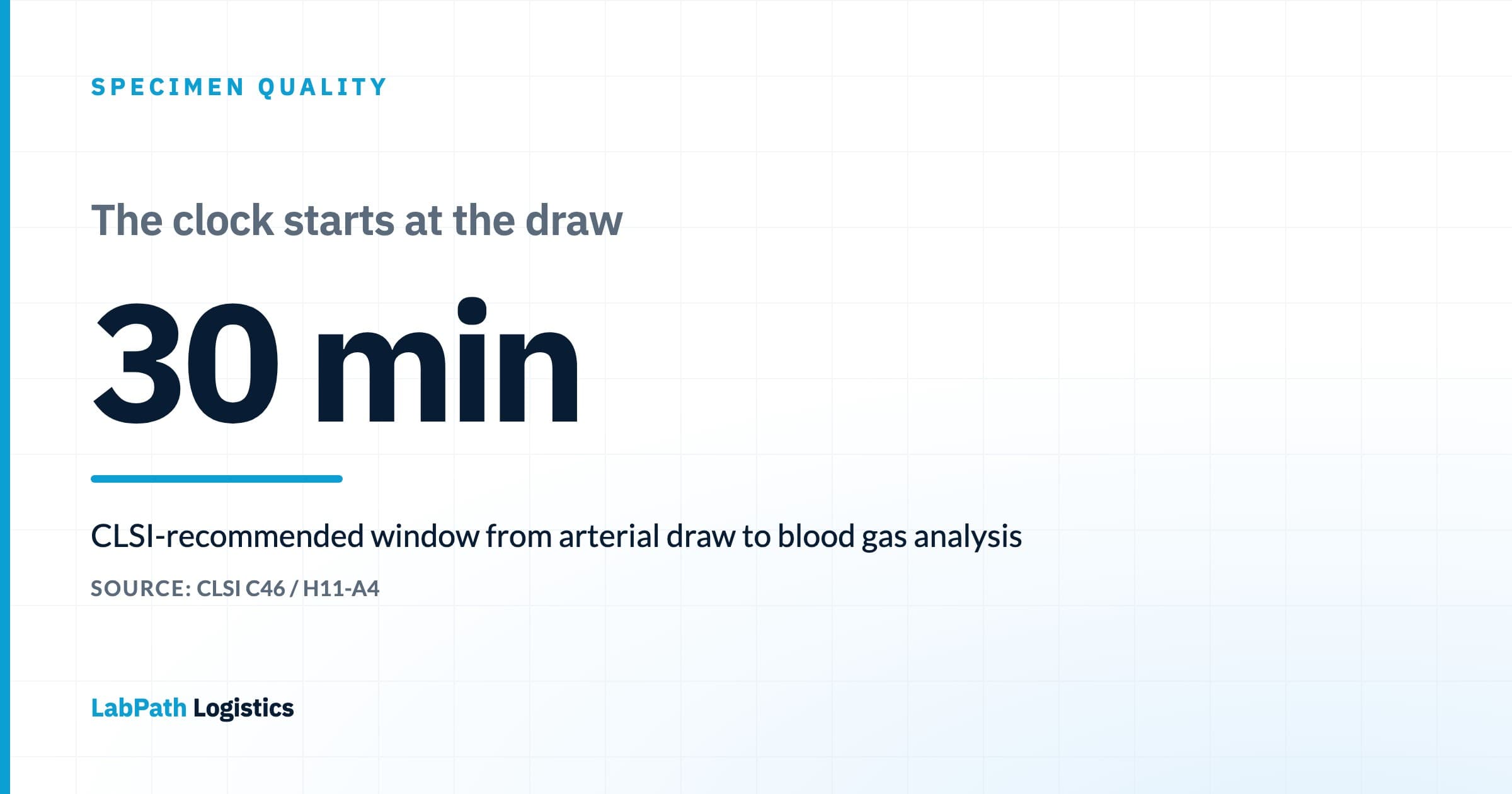
Arterial blood gas (ABG) specimens should reach the analyzer within 30 minutes of the draw, per CLSI guidance (documents C46 and H11-A4) — a tighter window than routine chemistry or hematology specimens because dissolved gases and lactate begin shifting immediately at room temperature. A December 2025 study of 240 ICU samples found that after a 60-minute delay, oxygen partial pressure (pO2) rose by an average of 33.74 mmHg and lactate climbed in 99.6% of samples, both far outside acceptable tolerance, while pH and carbon dioxide levels held up better but still drifted. For a Houston freestanding ER, urgent care, or outpatient clinic without an in-house blood gas analyzer, that means the courier run to a reference lab isn't a convenience — it's the deciding factor in whether the result reflects the patient's actual physiology.
A patient walks into a Houston freestanding ER with shortness of breath. The physician draws an arterial blood gas to check oxygenation and acid-base status before deciding whether to transfer to a hospital. The facility has no blood gas analyzer on site — most freestanding ERs and urgent cares don't carry one, because the equipment and calibration overhead only pencil out for high-volume sites. The sample goes into a courier bag instead. From that moment, the clock most people don't think about is already running, and it's shorter than the one on every other specimen leaving the building.
Why ABG Specimens Don't Follow the Usual Rules
Most send-out specimens — chemistry panels, CBCs, cultures — tolerate an hour or more in transit without materially changing. Blood gas specimens don't, because the values being measured are the ones most sensitive to what happens after the needle comes out: dissolved gas concentrations, ongoing cellular metabolism, and pH, all of which keep moving in a sealed syringe sitting at room temperature. CLSI's guidance for blood gas and pH analysis (document C46) and for arterial specimen collection (H11-A4) sets the outer limit at 30 minutes from draw to analysis at room temperature — not because that number is arbitrary, but because it's the point past which several key analytes are documented to drift outside clinically acceptable ranges.
A December 2025 study out of Erlangen University Hospital in Germany, published in PLoS One, put numbers on what happens beyond that window. Researchers analyzed 240 ICU arterial samples immediately after draw, then again after a 60-minute room-temperature delay combined with mechanical stress meant to simulate rough handling in transit.
+33.74 mmHg
Average increase in oxygen partial pressure (pO2) after a 60-minute delay at room temperature, with only 7.9% of samples staying within the acceptable ±10% tolerance (Gutermuth et al., PLoS One, Dec. 2025).
Lactate held up even worse — 99.6% of delayed samples showed measurable elevation, with only 0.4% remaining within acceptable limits. pH and carbon dioxide partial pressure (pCO2) fared better: pH dropped by an average of just 0.017 units and stayed within a ±10% margin in every sample, while pCO2 rose by an average of 1.2 mmHg with 80.4% meeting stricter regulatory tolerance. The pattern is consistent with the physiology: a sealed syringe isn't perfectly gas-impermeable, and ongoing cellular respiration inside the sample keeps consuming oxygen and producing lactate the longer it sits.
What a 33 mmHg Swing Actually Means at the Bedside
A pO2 reading that's off by more than 30 mmHg isn't a rounding error — it can be the difference between a physician deciding a patient's oxygenation is adequate and one deciding it isn't. For a patient being triaged at a freestanding ER on whether they need transfer to a hospital, or a pulmonology clinic titrating home oxygen, a falsely elevated pO2 from a delayed specimen can mask real hypoxemia. Lactate carries similar weight in sepsis and shock workups, where a delayed, falsely elevated result can trigger unnecessary escalation — or worse, a falsely low one on a different analyte can miss a deteriorating patient. Neither error originates at the bedside. Both trace back to how long the sample sat before the courier delivered it.
Should the Sample Be Iced?
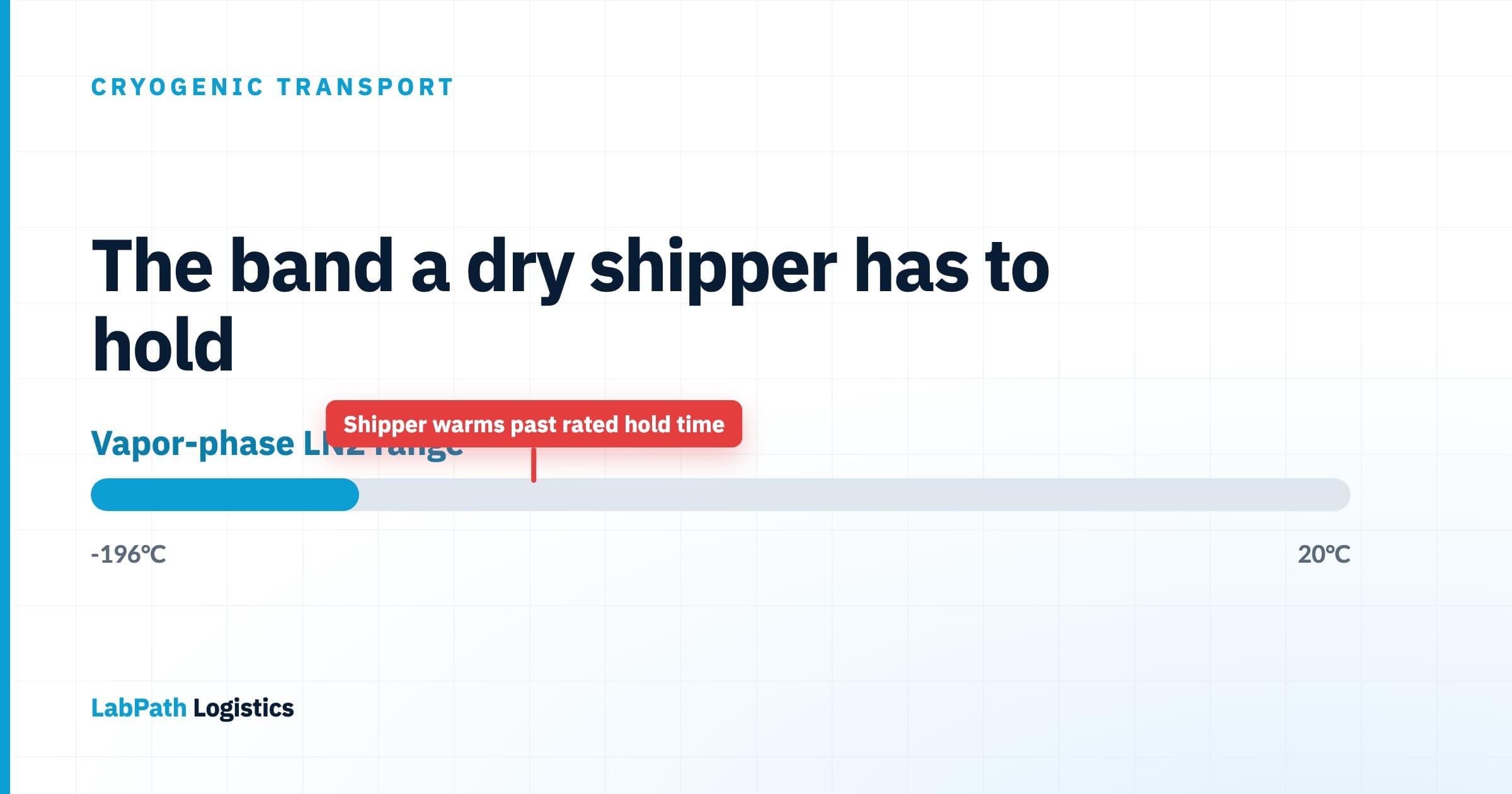
This is where ABG handling diverges from most cold-chain specimens, and it trips up couriers trained on a one-size-fits-all "ice everything" protocol. CLSI guidance recommends analyzing ABG specimens at room temperature within 30 minutes whenever that window is achievable — icing isn't required and can introduce its own error, since cold exposure can cause partial hemolysis that falsely elevates potassium readings. Icing becomes appropriate specifically when a longer transport delay is unavoidable, since cooling slows the metabolic drift described above at the cost of that hemolysis risk. The right call depends on the facility's actual distance from the analyzing lab — which is a routing question, not a checkbox.
- Facilities within a 30-minute courier run: room-temperature transport in a rigid syringe, capped and free of air bubbles, timed from draw to receipt.
- Facilities where transit routinely exceeds 30 minutes: icing extends the usable window but trades in a real risk of hemolysis-driven potassium error — the courier and receiving lab should agree on the protocol in advance, not decide it ad hoc per run.
- Every ABG run needs a documented draw time, not just a pickup time — the 30-minute clock starts at the needle, and a courier log that only tracks pickup-to-drop-off can't tell a lab how much of the window was already spent before the courier arrived.
Where This Shows Up Across Houston
Houston's freestanding ER model — dozens of standalone, hospital-adjacent-but-independent emergency departments spread across the Beltway 8 and Grand Parkway corridors — runs almost entirely on send-out ABG testing, since equipping every site with a full blood gas analyzer isn't financially realistic at typical volumes. The same constraint applies to outpatient pulmonology and sleep medicine clinics evaluating chronic hypoxemia, and to dialysis centers checking acid-base status in patients with metabolic complications. Each of these sends ABG specimens through general traffic and construction delay on routes that a courier scheduled for routine chemistry pickups was never built to absorb inside a 30-minute window. A courier optimizing routes for cost-per-stop rather than time-per-specimen will hit that window on a good day and miss it on a bad one — and a physician reading the result usually has no way to know which happened.
The question to ask before you need the answer
"What's your documented time from an ABG draw at our facility to delivery at the analyzing lab, and how do you handle it differently from a routine chemistry pickup?" A courier without a specific answer is treating a 30-minute specimen the same as a same-day one — see our [STAT specimen delivery checklist](/blog/stat-specimen-delivery-houston-checklist) for the broader vetting standard this sits inside.
Key Takeaway
Arterial blood gas specimens carry a stability window measured in minutes, not hours, and the analytes most likely to drift outside range — oxygen tension and lactate — are also the ones most likely to change a physician's next decision. For any Houston facility that sends ABG specimens out rather than analyzing on site, the courier relationship isn't a logistics afterthought to the lab workflow; it's inside the clinical accuracy of the result. A vendor that can't state a specific, documented draw-to-delivery time for ABG runs — separate from its general STAT service level — hasn't been asked the right question yet.
Frequently Asked Questions
How long can an arterial blood gas specimen sit before it needs to be analyzed?
CLSI guidance (documents C46 and H11-A4) recommends analyzing arterial blood gas specimens within 30 minutes of the draw at room temperature. Beyond that window, a December 2025 study of 240 ICU samples found oxygen partial pressure rising by an average of 33.74 mmHg after 60 minutes, with lactate elevated in 99.6% of delayed samples — both changes large enough to affect clinical decisions.
Should arterial blood gas samples be transported on ice?
Not automatically. CLSI guidance favors room-temperature transport and analysis within 30 minutes when that's achievable, since icing can cause partial hemolysis that falsely elevates potassium. Icing is appropriate when transport time will realistically exceed the 30-minute window, since it slows metabolic drift at the cost of that hemolysis risk — the choice should be a protocol the courier and lab agree on in advance, matched to actual transit distance.
Why do freestanding ERs and urgent care clinics need a courier for blood gas testing?
Most freestanding emergency rooms, urgent care clinics, and outpatient pulmonology or dialysis sites don't have an in-house blood gas analyzer on site, since the equipment and calibration cost typically doesn't pencil out below hospital-level testing volume. These facilities send arterial blood gas specimens to a reference or hospital lab by courier, which makes the courier's draw-to-delivery time a direct factor in whether the result still reflects the patient's actual condition.
Which blood gas values change the most when a specimen sits too long before analysis?
Oxygen partial pressure (pO2) and lactate degrade fastest and furthest — a 2025 study found pO2 rising by an average of 33.74 mmHg and lactate elevated in nearly every sample after a 60-minute delay. pH and carbon dioxide partial pressure (pCO2) drift more slowly and stayed closer to acceptable tolerance over the same delay, though CLSI's 30-minute recommendation applies to the specimen as a whole, not to individual analytes.