Medical Courier Logistics for Houston FQHCs
September 14, 2026 · By LabPath Logistics Editorial Team, Medical Logistics Desk
Quick Answer
A federally qualified health center runs specimen and pharmacy logistics under a constraint most private practices don't share: roughly 30% of its revenue comes from HRSA grants and the rest from Medicaid, sliding-fee patients, and uncompensated care, which makes a per-stop courier bill a bigger line item than it is for a fee-for-service clinic. The fix most Houston FQHC networks land on is hub-and-spoke routing — one or two central labs act as the hub, and satellite clinics get scheduled batch pickups instead of individual same-day dispatches — paired with a single consolidated invoice the board and grant auditors can actually reconcile. Done well, it keeps STAT capability available for the pickups that need it without paying STAT pricing on every routine draw.
A federally qualified health center rarely operates out of one building. A typical Houston FQHC network runs a main clinic plus a handful of satellite sites spread across the neighborhoods it was funded to serve — Acres Homes, Fifth Ward, Pasadena, Sunnyside — each drawing labs, each needing pharmacy deliveries, and each generating its own specimen pickup schedule if nobody consolidates it. Medical courier logistics for Houston FQHCs is fundamentally a routing and budgeting problem before it's a compliance problem, because the money behind every stop comes from a grant-and-safety-net funding model that a private specialty practice doesn't have to work around.
That distinction is worth taking seriously. A cash-pay dermatology clinic can absorb a courier rate increase into its fee schedule next quarter. An FQHC's rates are set by a sliding fee scale tied to federal poverty guidelines, and its board has to justify every recurring vendor line item against a budget where roughly 30% of revenue comes from HRSA Section 330 grants and most of the rest from Medicaid reimbursement and uncompensated care — a mix documented by the Texas Department of State Health Services, which counts 71 FQHCs operating more than 700 service delivery sites statewide.
1,859,052
Patients served by Texas health centers in 2024, per HRSA's Uniform Data System (data.hrsa.gov) — most through multi-site networks that each generate their own specimen and pharmacy logistics.
Why Multi-Site Networks Change the Courier Math
A single-location clinic negotiates one courier relationship for one address. An FQHC network negotiating site by site ends up with duplicate account setups, duplicate invoices, and — worse — inconsistent service levels, where the flagship clinic gets a reliable afternoon pickup and a satellite site three miles away gets whatever's left on the route. Houston's FQHC expansion has kept adding sites rather than consolidating them: Legacy Community Health opened a new Acres Homes clinic in 2026 as part of a broader buildout across the city, and networks like it keep adding delivery points faster than most vendor contracts get renegotiated to match.
The practical effect is that lab pickup scheduling, courier vendor selection, and invoice reconciliation get handled independently at each site unless someone at the network level owns it. That's how a clinic ends up paying five different STAT rates for the same reference lab, or discovers during an audit that three sites never signed a Business Associate Agreement with the courier moving their specimens. See our features overview for how multi-site tracking and reporting are meant to prevent exactly that gap.
The Hub-and-Spoke Fix
Most Houston health systems that manage multiple facilities land on a hub-and-spoke model: one or two central points — typically the reference lab or a main campus lab — act as the hub, and satellite clinics are connected to it through scheduled batch routes rather than individual same-day dispatches for every draw. Routine specimens ride the scheduled route; anything that needs to move faster gets flagged for a direct, dedicated run instead of waiting for the next batch.
- Scheduled batch pickups at every satellite site, timed to the clinic's actual draw volume rather than a generic once-a-day default.
- A clear escalation path for STAT specimens so a same-day urgent draw doesn't sit in a batch bin until the next scheduled run.
- One courier account and one invoice across the whole network, not a separate vendor relationship per site.
- Route consolidation that groups geographically close sites onto the same run instead of dispatching a separate driver to each.
Where FQHC Courier Logistics Actually Break
The failure pattern is consistent across grant-funded networks, and none of it is about the driver's competence.
- New sites get added to the funded service area faster than the courier contract gets updated, so a new satellite clinic runs on an ad hoc arrangement for months.
- Each site negotiates its own rate and schedule locally, which means the network is paying inconsistent per-stop pricing for functionally identical service.
- The BAA gets signed once, at the flagship location, and nobody confirms it covers every satellite address the courier actually visits.
- Grant reporting season arrives and finance can't produce a clean, single-source courier spend total because the invoices are scattered across site-level budgets.
The audit question that catches most networks off guard
"Show me the signed BAA covering every site this courier services." A BAA signed at the main clinic doesn't automatically extend to a satellite location added eighteen months later — see our guide on [medical courier invoice audits](/blog/medical-courier-invoice-audit-houston) for how to catch scattered vendor relationships before a reviewer does.
The Budget Reality Behind the Routing Decision
Route consolidation isn't just operationally cleaner — it's the lever an FQHC actually has over courier spend. A network can't negotiate reimbursement rates upward the way a fee-for-service group can, and it can't easily pass a courier rate increase on to patients under a sliding fee scale. What it can control is how many separate stops, separate contracts, and separate STAT premiums it's paying for. Consolidating five site-level courier relationships into one network contract with volume-based, per-stop pricing is one of the few concrete cost levers a health center's operations team has full authority over — the same discipline covered in our guide on switching medical couriers without disrupting service at a single site.
What a Houston FQHC Should Require From a Courier
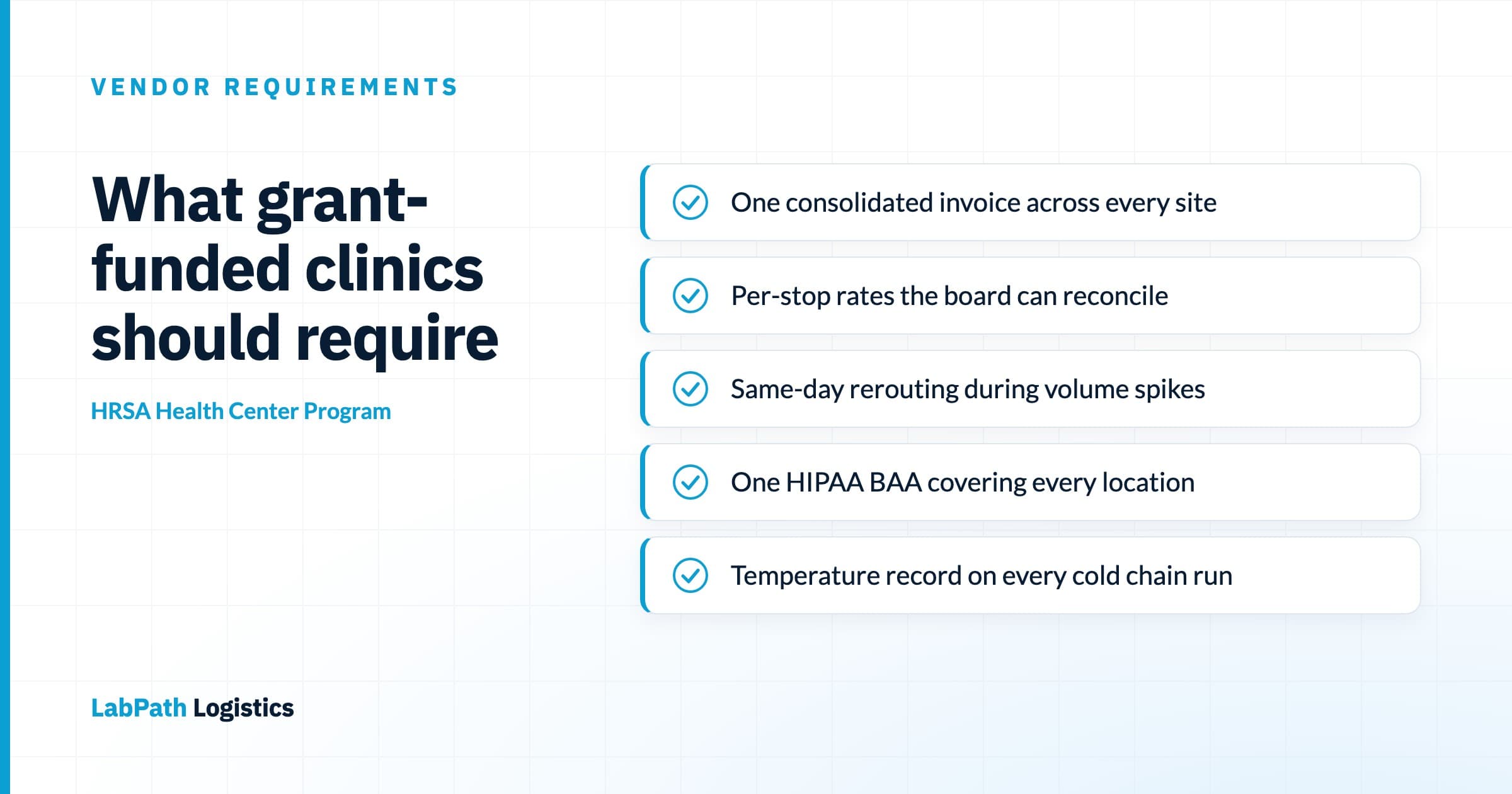
- A single Business Associate Agreement that names every current site by address and gets amended, not silently assumed to cover, each time a new site opens.
- One consolidated invoice broken out by site, so finance can report accurate per-location costs to the board without reconciling five separate bills.
- Documented per-stop and STAT pricing that doesn't vary by which site placed the order.
- A named escalation contact for same-day urgent pickups that doesn't require calling five different site-level relationships to find out who's covering the route.
- Cold-chain verification and a chain-of-custody record on every run, regardless of which satellite site originated it — a smaller clinic's specimens deserve the same documentation as the flagship location's, detailed further on our compliance page.
Key Takeaway
FQHC medical courier logistics in Houston is a multi-site consolidation problem wearing a compliance costume. The compliance requirements — a signed BAA, chain of custody, cold-chain documentation — are the same ones any medical courier should meet. What's different is the budget behind the decision: a grant-and-safety-net revenue model that makes scattered, site-by-site vendor relationships genuinely more expensive than a network could otherwise afford, and makes one consolidated hub-and-spoke contract one of the clearest wins available to a health center's operations team.
Frequently Asked Questions
How is FQHC medical courier logistics different from a regular clinic's?
The compliance bar is the same — chain of custody, cold-chain documentation, and a signed Business Associate Agreement — but the operational shape is different. An FQHC typically runs multiple satellite clinics under one funded network rather than a single location, and its revenue model (roughly 30% HRSA grants, the rest Medicaid and sliding-fee patient revenue per the Texas Department of State Health Services) means courier spend has to be consolidated and predictable rather than negotiated site by site.
What is hub-and-spoke courier routing and why does it fit FQHC networks?
Hub-and-spoke routing designates one or two central points — usually the reference lab or a main campus — as the hub, with satellite clinics connected through scheduled batch pickups instead of individual same-day dispatches for every draw. It fits multi-site FQHC networks because it consolidates what would otherwise be five or more separate site-level courier relationships into one predictable route and one invoice, while still allowing a direct, dedicated run for anything flagged STAT.
Does a single Business Associate Agreement cover every satellite clinic in a network?
Not automatically. A BAA signed when the courier relationship started at the flagship location doesn't extend on its own to a satellite site added later — the agreement needs to name every current address, and it needs to be amended each time a new site opens. This is one of the most common gaps found during a courier invoice or compliance audit at multi-site health centers.
Can a grant-funded clinic still get STAT specimen pickups without paying STAT pricing on every run?
Yes, and that's the point of consolidating around a hub-and-spoke model rather than treating every pickup as urgent by default. Routine specimens ride a scheduled batch route timed to each site's actual draw volume, while a clear escalation path flags anything that genuinely needs a same-day dedicated run. That keeps STAT capability available without pricing every routine draw at STAT rates.