Houston ASC Courier Needs After CMS's 2026 Rule
September 12, 2026 · By LabPath Logistics Editorial Team, Medical Logistics Desk
Quick Answer
CMS's finalized CY 2026 Hospital OPPS/ASC rule added 560 surgical procedures and 35 ancillary services to the ASC Covered Procedures List and is eliminating the inpatient-only list entirely by January 1, 2028, removing 285 procedures for 2026 alone. That regulatory expansion is pushing more complex, higher-acuity surgery out of hospital operating rooms and into freestanding ambulatory surgery centers (ASCs) — facilities that, unlike a hospital OR, typically have no in-house pathology lab and no internal specimen runner. Texas already has 801 ASCs, the second-most of any state, and Houston's outpatient surgery volume is growing inside that trend. An ASC that doesn't have a courier plan built for STAT frozen sections, routine pathology send-outs, and off-site instrument reprocessing before its case volume grows is building that plan during its first delayed result instead.
A growing share of surgery in Houston no longer happens inside a hospital. It happens in a single-specialty building with a parking lot, an OR suite, and a recovery bay — and none of the pathology lab, sterile processing department, or internal transport staff a hospital keeps down the hall. As federal payment rules push more and higher-acuity procedures into these freestanding facilities, ambulatory surgery center courier logistics in Houston is turning into a real operational gap, not a footnote in a facility's opening checklist.
Why More Surgery Is Moving to Freestanding ASCs
The shift isn't just market preference — it's regulatory. CMS's finalized CY 2026 Hospital Outpatient Prospective Payment System and Ambulatory Surgical Center rule substantially expanded which procedures Medicare will pay for in an ASC setting, and it's doing so on two tracks at once.
560 + 35
Surgical procedures and ancillary services CMS added to the ASC Covered Procedures List for CY 2026, under revised inclusion criteria covering cardiovascular, spine, and vascular procedures (CMS, CY 2026 Hospital OPPS/ASC Final Rule)
The second track is the phase-out of the inpatient-only (IPO) list — the set of procedures Medicare has historically required to happen in a hospital. CMS is eliminating that list entirely by January 1, 2028, and removed 285 mostly musculoskeletal procedures (plus 16 previously removed non-musculoskeletal ones) from it for CY 2026 alone. Every procedure that comes off the IPO list is a candidate to move to an outpatient department — or, increasingly, straight to a freestanding ASC.
285
Procedures removed from Medicare's inpatient-only list for CY 2026, ahead of the list's full elimination by January 1, 2028 (CMS, CY 2026 Hospital OPPS/ASC Final Rule)
What Changes When Surgery Leaves the Hospital Building
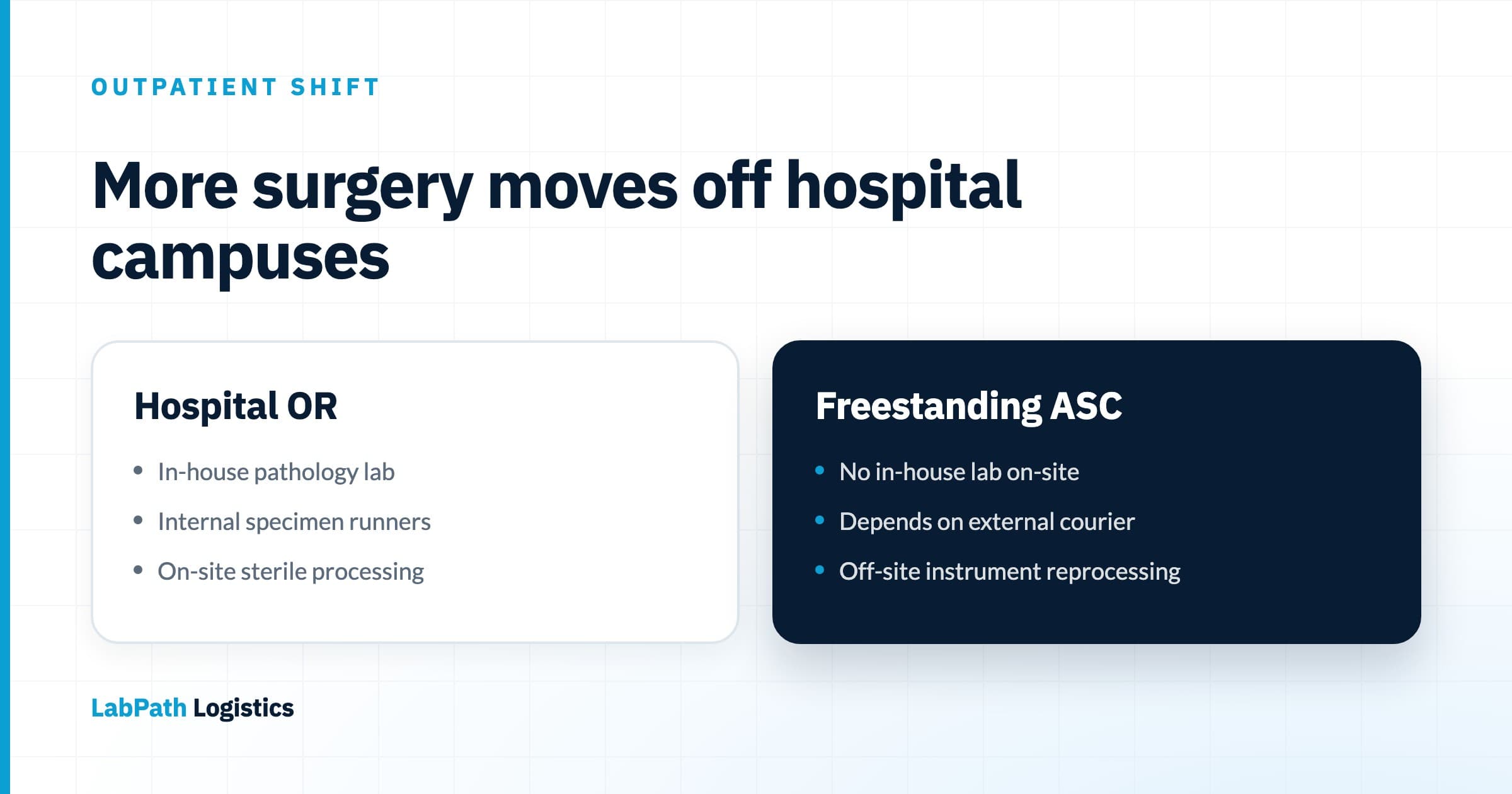
A hospital OR sits inside an institution that already solved specimen and instrument logistics decades ago. A frozen section goes to the path lab down the hall by a staff runner. A used instrument tray goes to central sterile processing on the same floor. None of that infrastructure exists inside a standalone ASC — it was never built to, because an ASC's entire design premise is a smaller footprint focused on the OR and recovery, not a full diagnostic and reprocessing campus.
- No in-house pathology lab, so every frozen section, permanent section, and biopsy has to leave the building by courier, often on a tighter clock than a routine send-out.
- No internal specimen runner, so a pickup that a hospital handles with its own staff has to be scheduled, tracked, and timed by an outside vendor.
- Instrument reprocessing is frequently outsourced to a central sterile processing facility off-site, adding a second recurring courier loop beyond specimens.
- Case volume at a new or growing ASC can outpace its courier plan quickly, since the facility's own staffing model has no slack for improvising transport.
- A delayed frozen section result during a live case has a direct clinical consequence — the surgeon is waiting in the room for the answer.
Houston's ASC Market Is Already Large — and Growing Inside This Trend
Texas isn't a marginal player in this shift. The state has 801 ambulatory surgery centers, the second-highest count of any state after California, according to Becker's ASC Review's 2025 state-by-state count. Houston, with its dense concentration of single-specialty orthopedic, GI, ophthalmology, and pain-management centers around the Texas Medical Center and its suburban satellites, sits inside a market that was already expanding before CMS's 2026 procedure list additions gave it another push.
801
Ambulatory surgery centers in Texas, the second-most of any state after California (Becker's ASC Review, 2025 state-by-state ASC count)
That density means more standalone facilities, more of them newly certified for procedures they couldn't perform a year ago, and more of them discovering — often mid-case — that their courier plan was built for a lower-acuity caseload than the one they're now running.
What Belongs in an ASC's Courier Plan
None of this requires an ASC to build lab or sterile-processing infrastructure it was never designed to hold. It requires treating courier logistics as a scheduled, tested part of opening or expanding a service line — not an assumption that gets tested for the first time on a real case.
- Confirm a named STAT pathway for frozen sections before adding a specialty that relies on them, with a courier who understands the surgeon-waiting-in-the-room clock a frozen section runs on.
- Separate the routine pathology send-out schedule from the STAT lane, so an urgent frozen section never queues behind a scheduled afternoon pickup.
- Build the instrument reprocessing loop into the same courier relationship as specimen pickup, rather than treating it as a separate, ad hoc arrangement.
- Review the courier plan every time a new CMS-eligible procedure or specialty is added to the center's case mix, not just at initial licensing.
- Confirm chain-of-custody documentation for both specimens and reprocessed instrument trays, since both are auditable business records for a facility that answers to accreditors and payers.
A Houston Example
A Houston-area orthopedic ASC adds spine procedures newly eligible for the outpatient setting under the 2026 covered-procedures expansion. The added case mix brings more frozen sections and a heavier instrument reprocessing load than the center's original courier arrangement — built around a lighter caseload of same-day discharges — was ever asked to handle. Without a STAT pathway built into the courier relationship before the first spine case, a delayed frozen section becomes a surgeon standing in the OR waiting on an answer that a hospital down the street would have had in minutes.
Key Takeaway
CMS's 2026 rule is accelerating a shift that was already underway: more complex surgery moving from hospital operating rooms into freestanding ASCs that were never built with an in-house pathology lab or internal transport staff. In a market as dense with ASCs as Houston's, that gap shows up fastest in specimen and instrument logistics — and it's cheapest to close before a growing case mix exposes it during a live case.
Frequently Asked Questions
Why are more surgical procedures moving to ambulatory surgery centers in 2026?
CMS's finalized CY 2026 Hospital OPPS/ASC rule added 560 surgical procedures and 35 ancillary services to the ASC Covered Procedures List and is phasing out Medicare's inpatient-only list entirely by January 1, 2028, removing 285 procedures for CY 2026 alone. Both changes make more, and more complex, procedures eligible for Medicare payment in an outpatient or ASC setting.
Why don't ambulatory surgery centers have their own pathology labs?
ASCs are designed around a focused footprint — an OR suite and recovery bay — not a full diagnostic and sterile-processing campus like a hospital. That design keeps the facility smaller and less costly to operate, but it means every specimen has to leave the building by courier and instrument reprocessing is frequently handled off-site as well.
How many ambulatory surgery centers are in Texas?
Texas has 801 ambulatory surgery centers, the second-highest count of any state after California, according to Becker's ASC Review's 2025 state-by-state count. Houston's dense concentration of single-specialty ASCs sits inside that total.
What should an ASC confirm with its courier before adding a new procedure type?
Confirm a named STAT pathway for frozen sections that's separate from the routine pathology send-out schedule, make sure instrument reprocessing runs through the same courier relationship as specimen pickup, and revisit the plan every time a newly eligible procedure or specialty is added to the case mix.