Proficiency Testing Referral Risk for Houston Labs
September 10, 2026 · By LabPath Logistics Editorial Team, Medical Logistics Desk
Quick Answer
A CLIA proficiency testing (PT) referral happens when a laboratory sends a PT sample to another lab for analysis instead of testing it on-site with its own routine method, which 42 CFR §493.801(b) prohibits outright. CMS treats an intentional referral as one of the few CLIA violations with no corrective-action path: the certificate is revoked for a minimum of one year and the owner or operator is barred from running any CLIA-certified lab for at least that long. The most common way this happens isn't fraud — it's a courier or logistics workflow that routes a PT kit into the same pickup manifest as ordinary reference-lab send-outs, and CMS holds the lab responsible for staff handling regardless of intent to deceive.
Most CLIA violations get a plan of correction. A proficiency testing referral does not. A Houston lab that sends a PT sample out to another laboratory — instead of testing it on-site, the same way it tests a routine patient specimen — is committing one of the small handful of CLIA violations that CMS treats as categorically serious rather than correctable. The trigger is rarely a deliberate attempt to cheat a proficiency score. Far more often, it's a logistics failure: a PT kit gets swept into the same courier pickup as the lab's ordinary send-out specimens, and nobody catches it before it leaves the building. This guide covers what counts as a referral under 42 CFR §493.801(b), what changed when CMS finalized its first major proficiency testing rule update since 1992, and how a lab's courier and routing workflow either prevents that mistake or manufactures it.
What Counts as a Prohibited PT Referral
Under 42 CFR §493.801(b), a laboratory must test proficiency testing samples using the same primary testing method it uses for routine patient specimens, the same number of times, and by personnel who ordinarily perform that testing — not routed to a reference laboratory, a sister facility, or any lab holding a separate CLIA certificate, even one under common ownership. CMS has been explicit that intent, for enforcement purposes, means intent to send the sample elsewhere for testing — not intent to defraud the PT program. A lab is responsible for what its own staff do with a PT kit once it arrives, which is exactly why a courier or specimen-routing process built around convenience rather than test-site awareness is a real exposure, not a theoretical one.
- Forwarding an intact PT sample to a reference lab because the ordering site doesn't perform that assay in-house.
- Sending a PT sample to a corporate sister lab or a different location within the same health system for testing.
- Reporting results that came back from another laboratory as if they were generated on-site.
- Any CLIA-certified lab that receives a referred PT sample from another lab is separately required to notify CMS — accepting one is not a safe harbor.
Reflex and confirmatory testing are not automatically a referral
CMS has clarified that legitimate reflex, distributive, or confirmatory testing performed in full conformance with the lab's written patient-testing procedures is generally not treated as an improper PT referral. The distinction is whether the routing decision follows the lab's documented routine method for that analyte — not whether a courier happened to be moving in that direction anyway.
The 2024 CLIA Proficiency Testing Final Rule
CMS finalized its first substantive update to CLIA's proficiency testing regulations since 1992 on July 11, 2024, with most provisions implemented January 1, 2025. The rule added 29 newly regulated analytes and removed five, tightened grading and acceptable-performance criteria, and left the core testing-frequency requirement in place: most regulated analytes require five specimens, three testing events per year, with mycobacteriology remaining at two events per year. More analytes under PT enforcement means more specimen types moving through a lab's normal courier and accessioning pipeline several times a year — each one a point where a PT kit can get mishandled the same way a routine specimen would be.
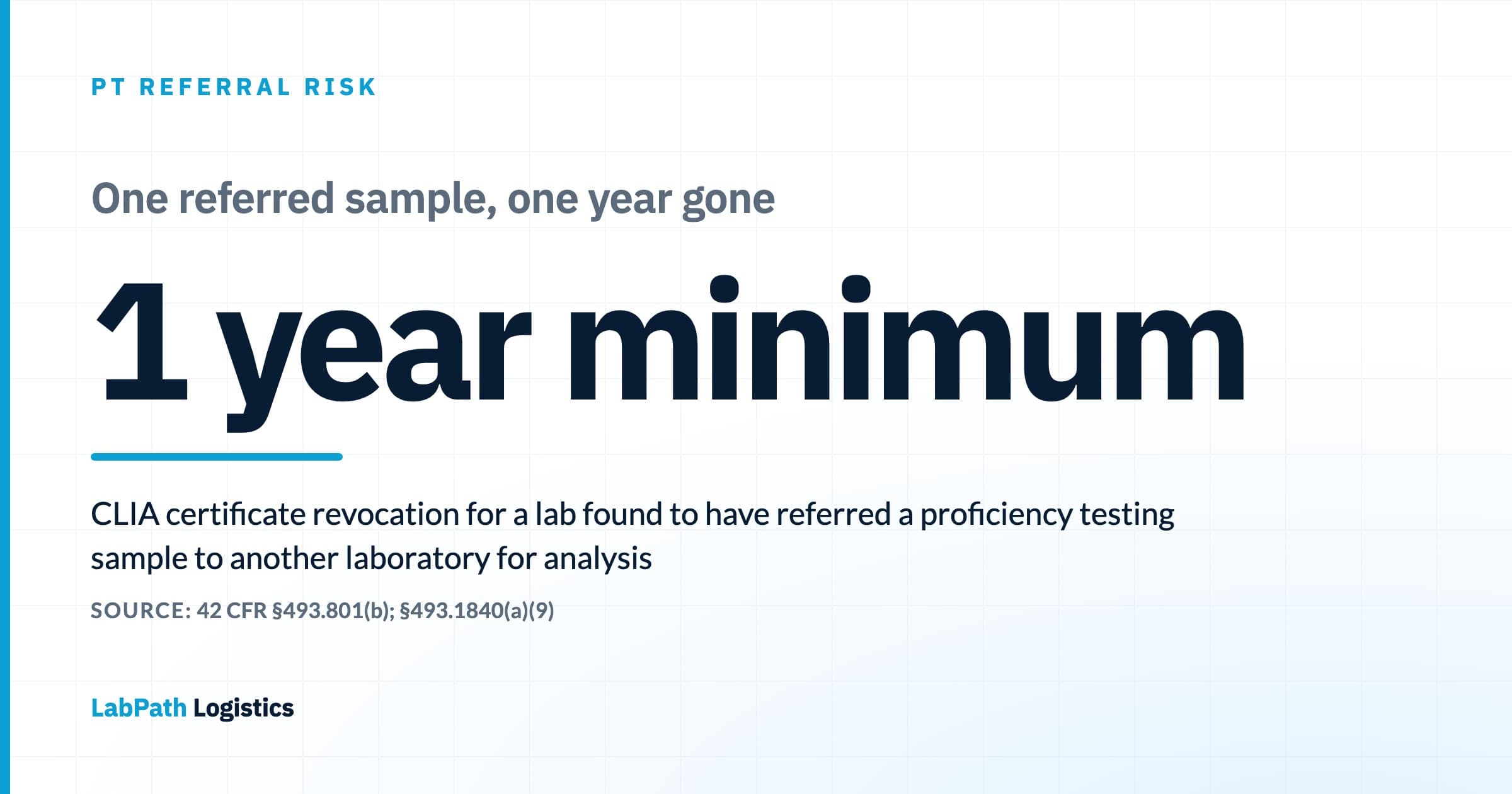
1-year minimum revocation
CMS revokes the CLIA certificate of a lab found to have intentionally referred a PT sample for at least one year, and bars the owner or operator from operating any CLIA-certified laboratory for the same period; a repeat or aggravated referral can add civil monetary penalties (42 CFR §493.1840; CMS CLIA enforcement guidance)
Where Courier Routing Creates the Risk
A PT referral violation is almost never a decision made at the bench. It's a routing default set weeks or months earlier, executed automatically by whoever happens to be running the pickup that day. The pattern shows up most in exactly the operational setups that are common in a metro as large and multi-site as Houston:
- A satellite draw site or physician office lab that runs some assays in-house but routes most send-outs to a central reference lab on a standing courier route.
- A hospital system with multiple CLIA certificates across campuses, where a courier moving between locations makes it easy for a PT kit addressed to one certificate to end up tested at another.
- A newly added PT-regulated analyte the lab doesn't perform often, so front-line staff default to the routine send-out workflow they already know instead of flagging it for on-site testing.
- Courier pickup logs and manifests that don't distinguish a PT kit from a routine specimen bag, so nothing forces a second look before the vehicle leaves.
None of these require bad faith. They require a courier and specimen-handling workflow that was designed around moving routine specimens efficiently, with no separate handling rule for the several days a year a PT kit is in the building. See our send-out testing logistics guide for how the same routine-referral pipeline that works fine for patient specimens becomes the exact mechanism that creates PT referral risk.
What a Compliant Courier Workflow Looks Like
The fix isn't complicated, but it has to be a standing procedure rather than something staff remember to do when a PT event happens to come up:
- PT kits are flagged at receipt as testing-site-only before they ever reach a courier pickup point, separate from the routine send-out queue.
- The courier or logistics staff handling routine specimen pickups have a documented rule: PT-marked materials never leave the building on a reference-lab route.
- Each PT event is logged against the lab's written testing-frequency procedure for that analyte, so a gap between routine method and PT method is caught before pickup, not after.
- Multi-site systems keep courier manifests keyed to a specific CLIA certificate number, not just a facility name, so a PT kit addressed to one certificate can't be swept into a shared inter-campus run.
- Staff training explicitly covers PT handling as distinct from routine specimen routing — most referral violations trace back to a courier or accessioning step nobody thought to train for.
A Houston Example
A hospital-affiliated reference lab in the Texas Medical Center runs a standing courier route that pulls specimens twice daily from three satellite draw sites and a physician office lab across the metro. One of the satellite sites performs a newly PT-regulated point-of-care analyte in-house but sends nearly everything else to the central lab for testing. When that site's next PT kit arrives, the front-desk staff who normally bag outgoing specimens for the courier don't have a reason to treat it differently — until the lab has a written rule that PT materials get set aside for on-site testing before the courier bag is sealed, and the courier's pickup log has a field confirming that check happened. The fix lives in the routing procedure, not in retraining the phlebotomist on CLIA regulations they'll rarely need to recite.
Key Takeaway
A proficiency testing referral is one of the few CLIA violations with no plan-of-correction off-ramp — a minimum one-year certificate revocation, with the owner or operator barred from the industry for the same period. It almost never starts as an attempt to game a PT score; it starts as a courier or routing default that doesn't distinguish a PT kit from a routine send-out. A specimen logistics workflow that flags PT materials at receipt and keeps them out of the standing courier manifest closes the exposure before it becomes an enforcement action.
Frequently Asked Questions
What exactly is a CLIA proficiency testing referral?
It's when a laboratory sends a proficiency testing sample to another laboratory — a reference lab, a sister facility, or any lab under a different CLIA certificate — for testing, instead of analyzing it on-site with the same method used for routine patient specimens. It is prohibited under 42 CFR §493.801(b) regardless of whether the intent was to affect the PT score.
What happens if a lab is found to have referred a PT sample?
CMS revokes the lab's CLIA certificate for a minimum of one year and bars the owner or operator from owning or operating any CLIA-certified laboratory for at least that period. A repeat referral, or reporting results obtained from another lab as the facility's own before the PT event closes, can add civil monetary penalties on top of the revocation.
Is it a violation if a courier accidentally routes a PT sample with regular send-outs?
CMS interprets intent as intent to send the sample elsewhere for testing, not intent to defraud the PT program — and a lab is responsible for its staff's handling of the sample. A courier workflow that doesn't distinguish PT kits from routine specimens creates real referral exposure even without anyone trying to cheat.
What changed with the 2024 CLIA proficiency testing rule?
CMS finalized its first major PT rule update since 1992, effective July 11, 2024 and implemented January 1, 2025, adding 29 newly regulated analytes, removing five, and revising grading and acceptable-performance criteria. The core testing-frequency requirement — five specimens, three events per year for most analytes, two for mycobacteriology — stayed the same.