Vendor Credentialing for Medical Couriers in Houston
September 8, 2026 · By LabPath Logistics Editorial Team, Medical Logistics Desk
Quick Answer
Hospital vendor credentialing is the badge-access screening — background check, drug screen, immunization and TB records, HIPAA and OSHA training, and a check against the HHS Office of Inspector General's exclusion list — that a facility requires before any outside vendor, including a medical courier's driver, can enter its buildings. Most Houston hospitals and Texas Medical Center member institutions manage this through a third-party platform such as symplr or Vendormate rather than a paper process, and an uncredentialed driver gets stopped at the badge-in kiosk, not waved through by a front-desk favor. A courier serving multiple facilities needs standing, current credentials at each one, tracked against that facility's own renewal cycle, so a routine pickup never turns into a security exception.
A lab manager who switches medical couriers rarely thinks about badge access until the new driver is standing at a hospital's vendor check-in kiosk with nothing in the system. Hospital vendor credentialing is the screening every outside vendor — sales reps, equipment technicians, and courier drivers alike — has to clear before a facility lets them past the lobby, and Houston's hospitals enforce it through software, not a signature at the front desk. A courier that hasn't built credentialing into its driver onboarding doesn't find out until a scheduled STAT pickup gets turned away at the door.
What Vendor Credentialing Actually Verifies
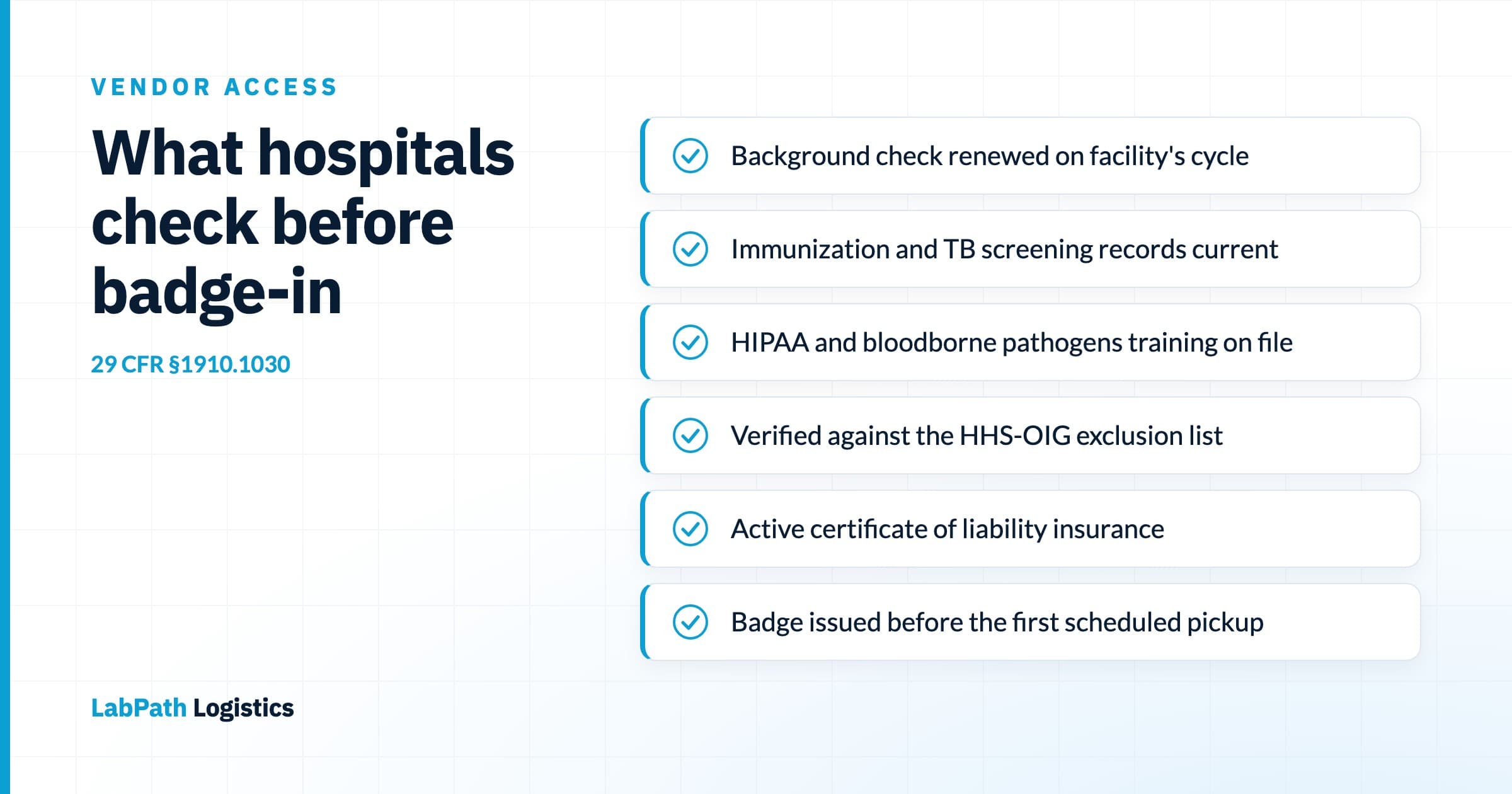
Credentialing isn't a single form. It's a standing file of documentation a facility requires before issuing a vendor badge, and it has to stay current or the badge stops working. Across the hospital vendor credentialing platforms in wide use — symplr and Vendormate chief among them — the standard requirements are consistent:
- A federal, state, and local criminal background check, typically re-run annually.
- Drug screening, also renewed on an annual cycle at most facilities.
- Immunization records: MMR, hepatitis B, Tdap, and annual influenza, plus current COVID-19 status where a facility still requires it.
- A TB test (PPD or equivalent) documented within the facility's lookback window.
- HIPAA compliance attestation and OSHA safety training, including bloodborne pathogens.
- Proof of active liability insurance carried by the vendor's employer, not the individual.
- Verification that the individual doesn't appear on the HHS Office of Inspector General's List of Excluded Individuals/Entities (LEIE).
None of this is unique to couriers — a copier technician or a pharmaceutical rep clears the same list. What's different for a courier is frequency. A sales rep might badge into one facility twice a month; a courier driver on a standing route might badge into six facilities a day, which means six separate credentialing files have to stay current at once, not one.
Why Hospitals Outsource This to symplr or Vendormate
Vendor credentialing became a near-universal hospital requirement because tracking it by hand doesn't scale. A facility running its own spreadsheet of vendor documents can't realistically verify an OIG exclusion check on every visit, so it hands the function to a vendor credentialing organization (VCO) that maintains the documentation, flags expirations, and gates badge issuance automatically. The facility sets the specific requirements; the platform enforces them at the door. That shift matters for a courier operating across the Texas Medical Center corridor, because different member institutions can run different platforms with different renewal windows — a driver credentialed at one hospital isn't automatically credentialed at the one next door.
$410 million
Size of Harris Health–Ben Taub Hospital's approved 2026 expansion, adding roughly 100 patient rooms and expanded surgical capacity in the Texas Medical Center. (Harris Health System; KHOU)
Growth like that isn't just more square footage — it's more vendor traffic through the same credentialing gate. As TMC campuses expand, the volume of outside vendors a hospital's security and supply chain teams have to screen grows with it, and a courier that already carries current, verifiable credentials clears that gate faster than one relearning the process at every new site.
Where a Courier Trips Up
The most common failure isn't a missing document — it's a lapsed one. Background checks and drug screens typically expire annually, and a courier running a large driver roster across a busy STAT schedule can lose track of which driver's file expires when. A second common failure is treating credentialing as a one-time hire-day task rather than a maintained record: a driver credentialed in January can be locked out in December if the facility's platform flags an expired TB test the courier's back office never renewed. Neither failure shows up until the badge-in kiosk rejects the scan — usually at the worst possible moment, mid-route on a STAT order.
OSHA's Bloodborne Pathogens Standard Sets the Training Floor
Beyond what a facility's credentialing platform tracks, federal law sets its own baseline for anyone with occupational exposure to blood or other potentially infectious materials — a category that includes courier drivers handling specimens. Under 29 CFR § 1910.1030, OSHA's Bloodborne Pathogens Standard requires an employer to offer hepatitis B vaccination at no cost to at-risk employees, provide annual bloodborne pathogens training, and maintain a written exposure control plan reviewed and updated at least once a year. This is a courier's own employer obligation, independent of any single hospital's credentialing requirement — the two overlap, but a hospital's badge check doesn't substitute for it, and neither does it substitute for the hospital's own facility-specific requirements. See our HIPAA-compliant medical courier guide for how this training layer connects to chain-of-custody discipline.
The exclusion list check isn't optional
The HHS-OIG's List of Excluded Individuals/Entities exists because federal healthcare programs can't knowingly do business — directly or through a vendor — with anyone excluded for fraud, patient abuse, or licensure loss. A facility that badges in an excluded individual, even unknowingly, carries the compliance exposure. That's why credentialing platforms check the LEIE automatically rather than trusting a vendor's self-attestation, and why a courier switching drivers needs the new hire cleared through that check before the first shift, not after.
What a Facility Should Require From a Courier Vendor
- A single point of contact who can confirm every assigned driver's credentialing status on request, not per-facility guesswork.
- Proof of active enrollment in the specific VCO platform each site uses — symplr, Vendormate, or another — before the first scheduled pickup.
- Documented OSHA bloodborne pathogens training and a current exposure control plan, independent of what the facility's own platform tracks.
- A process for immediately re-badging a replacement driver rather than sending an uncredentialed backup on a missed shift.
- Written confirmation that every driver has cleared the HHS-OIG exclusion list, refreshed on the facility's own cycle.
- A courier that treats credentialing renewal as a scheduled operations task, not a reactive scramble after a badge gets rejected.
Key Takeaway
Vendor credentialing is the access layer most facilities never discuss during a courier's sales pitch, and the one that determines whether a driver actually gets to the lab window on schedule. Houston's hospitals and Texas Medical Center institutions enforce it through platforms like symplr and Vendormate, backed by federal requirements under OSHA's bloodborne pathogens standard and the HHS-OIG exclusion list. As TMC campuses like Ben Taub expand, that gate isn't getting looser. A courier that maintains standing, current credentials at every facility it serves — rather than treating each site as a fresh negotiation — is the one that keeps a STAT schedule intact instead of explaining a badge-in failure after the fact.
Frequently Asked Questions
What is hospital vendor credentialing?
It's the standing screening process a hospital requires before letting any outside vendor — including a medical courier's driver — badge into its buildings. It typically covers a criminal background check, drug screen, immunization and TB records, HIPAA and OSHA training documentation, proof of liability insurance, and verification against the HHS Office of Inspector General's exclusion list. Most facilities manage it through a third-party platform such as symplr or Vendormate rather than a manual process.
Do medical courier drivers need to be credentialed at every hospital they visit?
Generally yes. Different facilities can use different vendor credentialing platforms with different specific requirements and renewal windows, so being credentialed at one Houston hospital doesn't automatically clear a driver at another. A courier running a multi-site route needs standing, current credentials tracked separately for each facility on that facility's own renewal cycle.
What happens if a courier driver's credentials lapse?
The badge-in kiosk rejects the scan and the driver is denied entry until the lapsed item — most often an expired background check, drug screen, or TB test — is renewed and re-verified in the facility's credentialing platform. For a STAT specimen pickup, that delay can mean a missed turnaround window, which is why credentialing renewal needs to be a scheduled task rather than something a courier discovers at the door.
How does OSHA's bloodborne pathogens standard relate to hospital vendor credentialing?
They're related but separate obligations. A hospital's credentialing platform checks facility-specific requirements for badge access. Separately, under 29 CFR § 1910.1030, a courier's own employer is required to offer hepatitis B vaccination at no cost, provide annual bloodborne pathogens training, and maintain a written exposure control plan for any employee with occupational exposure to blood or infectious materials. A courier needs to satisfy both — the facility's credentialing check and its own OSHA compliance program.