Donor Human Milk Transport: A Houston Cold Chain Guide
September 5, 2026 · By LabPath Logistics Editorial Team, Medical Logistics Desk
Quick Answer
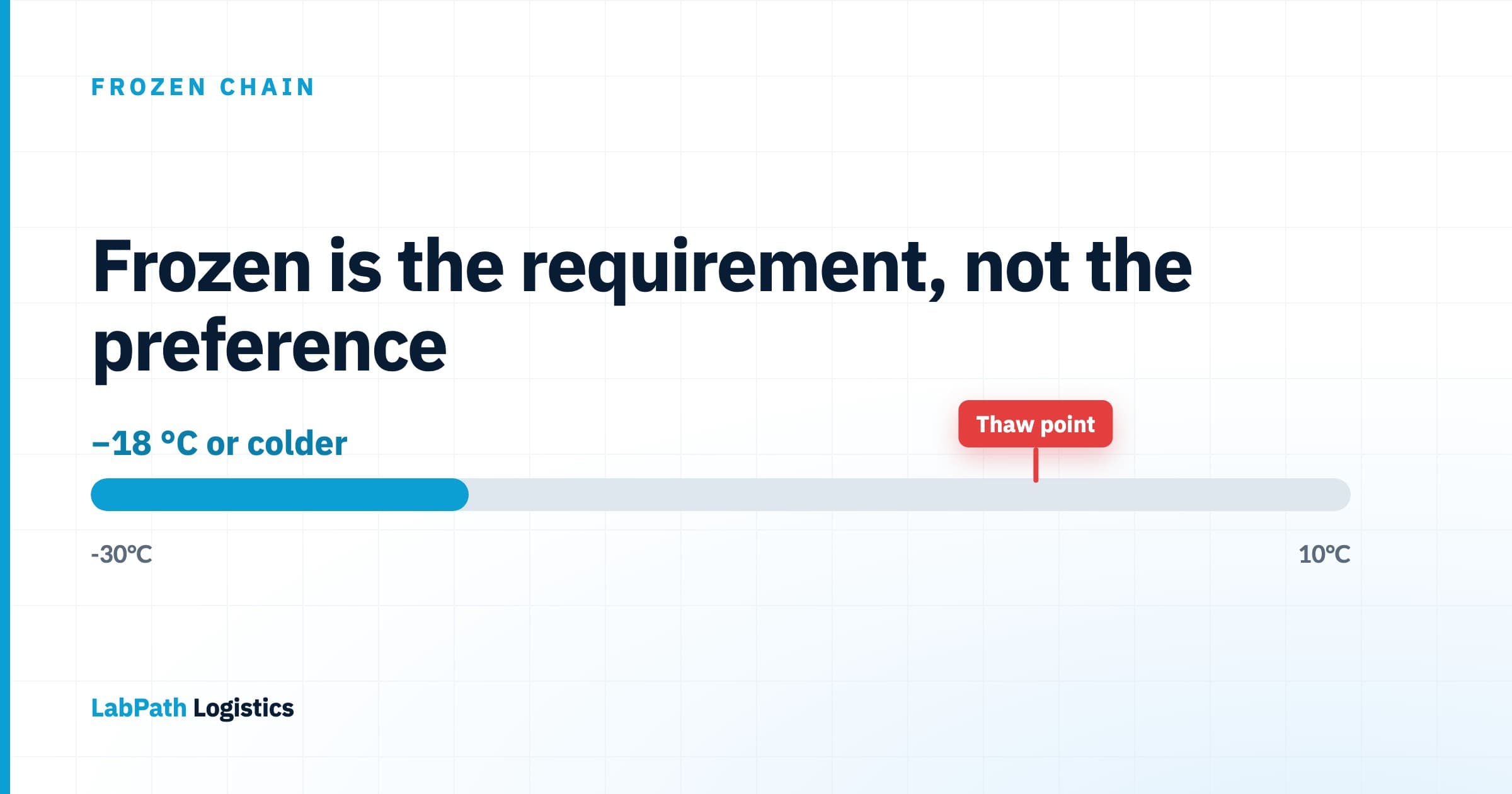
Donor human milk is transported frozen and must stay frozen end to end: HMBANA standards require milk bank freezers to hold at −18 °C (0 °F) or less, and specify that donor milk is shipped and received in a frozen state. Refrigeration is a separate, narrower state held between 1 °C and 4 °C, and it is a holding condition rather than a transport condition — milk may sit refrigerated for a maximum of 96 hours before it must move to the freezer. For a Houston facility the practical consequence is that donor milk is not a cooler-and-gel-pack product. It needs a validated frozen packout, a temperature record for each leg, and a courier who treats a partial thaw as a reportable event rather than a cosmetic one.
Donor human milk transport is one of the few cold chains in healthcare where the product is irreplaceable, the recipient is a premature infant, and the logistics network is almost entirely invisible to the facilities that depend on it. Milk is collected by screened donors, dropped at hospital collection sites, consolidated, pasteurized at an accredited milk bank, and shipped back out to NICUs — and every one of those legs is a frozen leg. This guide covers what the standards actually require, where the Houston route is longer than people assume, and what a facility should put in a courier agreement before the first cooler moves.
The failure mode here is not dramatic. It is a container that arrived soft at the edges, a receiving nurse who was not sure whether that counted, and no temperature record capable of settling the question. Because donor milk is a food product regulated through voluntary accreditation rather than a specimen with a rejection code, an ambiguous arrival tends to get resolved by judgment at the loading dock. That is exactly the decision a transport record is supposed to remove.
The Houston Route Is Longer Than It Looks
Most people picture donor milk as a hospital-internal process. In Texas it is a regional distribution network with a single processing hub, and Greater Houston sits at the collection end of it rather than the processing end.
Mothers' Milk Bank at Austin lists roughly fifteen Houston-area milk collection sites, spread from Baytown and Kingwood to Katy, Sugar Land, The Woodlands, and Cypress, alongside sites inside the Texas Medical Center corridor on Fannin Street. Those depots accept frozen milk from donors. They do not pasteurize it. Processing happens in Austin, roughly 165 miles up the road, and the finished pasteurized product travels back to Texas hospitals afterward.
~15 sites
Greater Houston milk collection sites listed by Mothers' Milk Bank at Austin — a distributed frozen-collection network feeding a single out-of-metro processing hub.
Read that as a logistics diagram and two things stand out. First, the geography is a many-to-one gather followed by a one-to-many distribution, which is a different routing problem from the point-to-point runs most medical couriers price by default. Second, the longest leg in the chain is an intercity leg in a state where a summer afternoon can put a vehicle interior far above any defensible holding temperature — the same ambient exposure problem we covered in Houston heat and specimen integrity, except the target here is roughly sixty degrees Celsius lower.
What the Standards Actually Require
The operative document is the HMBANA Standards for Donor Human Milk Banking, whose public overview was published in January 2024. Four requirements in it govern transport decisions directly.
- Freezer temperatures are held at −18 °C (0 °F) or less. That is the storage state donor milk lives in, and the state transport has to reproduce.
- Refrigerator temperatures are held between 1 °C and 4 °C (34–39 °F) — a narrow band, and a holding condition rather than a travel condition.
- Milk may be temporarily stored refrigerated for a maximum of 96 hours before being moved to the freezer for long-term storage.
- Donor milk is shipped and received in a frozen state, and expires one year from the date of collection.
That last item is the one to underline, because it is written as a property of shipping rather than a recommendation about it. A shipment that arrives thawed has not arrived in a degraded condition; it has arrived outside the standard the receiving milk bank or NICU operates under.
−18 °C is a threshold, not a target with slack above it
A 2–8 °C product has a floor and a ceiling, and a courier's job is to stay between them. Frozen donor milk has a ceiling only. There is no penalty for being colder, which means the correct packout is deliberately over-specified for the route length rather than tuned to just barely hold. Facilities used to negotiating refrigerated tolerances often carry the wrong instinct into this conversation.
Pasteurization is worth understanding even though it happens off the truck, because it explains why the frozen chain matters on both sides of it. Milk banks heat-treat bottled milk by Holder pasteurization at 62.5 °C (144.5 °F) for 30 minutes, then rapidly chill it and hold it for post-pasteurization bacteriological testing before release. Pasteurization is a kill step for what is present at that moment. It does not undo the bacterial growth that occurred while a container sat thawed in a warm vehicle beforehand, and it offers nothing at all to a finished, tested bottle that thaws on the way to the NICU.
Three Legs, Three Different Transport Products
Treating this as one service is the most common contracting mistake. The three legs carry different risk, different value density, and different consequences on failure.
- Donor to collection site. Short, high-frequency, and largely outside the courier's control — HMBANA has donors instructed in writing on handling containers during transit and on transporting milk safely to the milk bank or depot. The facility's job is receiving discipline, not transport.
- Collection site to milk bank. The long intercity leg, carrying unpasteurized milk that has not yet been tested. Volume is high, individual value is low, and a thaw here means loss of donated milk that cannot be recreated.
- Milk bank to NICU. Finished, pasteurized, tested, batch-traceable product moving to a named clinical destination. Volume is lower and the stakes per container are far higher, because this is the leg where a failure reaches a patient's feeding plan.
The third leg is where custody discipline earns its cost. A pasteurized batch is traceable to specific donors and a specific processing run, so a break in the record is not merely an administrative gap — it interrupts the recall path. HMBANA-accredited banks run mock recalls as part of quality assurance, and a recall exercise is only as good as the weakest custody handoff in the chain. The scan-level, named-individual transfer discipline we describe in the chain of custody guide is the mechanism that keeps that path intact across a courier leg.
Why the Clinical Side Is Strict About Sourcing
The reason this network exists in its formal, accredited shape is a clinical one, and it shapes what facilities will accept operationally. In its policy statement on donor human milk for the high-risk infant, published in Pediatrics in January 2017, the American Academy of Pediatrics recommends screening, pasteurization, and distribution through established donor milk banks, points to particular benefit for infants weighing less than 1,500 grams, and explicitly advises against internet-based or informal human milk sharing because of contamination and exposure risk.
HMBANA's own distribution rule reflects the same priority ordering: member milk banks follow prioritization guidelines so that the needs of small vulnerable newborns are met first. A courier working this chain is therefore moving an allocated, scarce clinical resource, not surplus inventory. That framing should show up in how deferrals are handled when a network is constrained — a point worth settling in writing, as we argue in the capacity planning guide.
What to Require From a Courier
Consider a Houston hospital serving as a collection site while also receiving pasteurized milk for its own NICU. It is at both ends of the same network, on two legs with opposite risk profiles, and one agreement has to cover both.
- A frozen packout specified for the actual worst-case leg duration, not the nominal one, with the qualification evidence on file.
- A per-shipment temperature record, retained and retrievable — not a driver's recollection that the packs still felt hard.
- A written definition of a thaw event and a standing instruction to report it on arrival rather than at invoice time.
- Custody capture by scan with a named individual at both ends, keyed to batch identifiers so the recall path survives the courier leg.
- Conditioned vehicle compartments, because a validated container in a 130 °F cargo area is spending its hold time on the vehicle instead of the route.
- A named escalation contact for the receiving NICU, reachable outside business hours, with authority to redirect a shipment in transit.
The second and third items are where most agreements are thin. A packout that has never been challenged against a stalled I-10 afternoon is an assumption, and a thaw that gets mentioned three weeks later in a billing dispute is a clinical question answered far too late. The same discipline applies to any frozen medical shipment; the mechanics overlap closely with what we cover on frozen specimen transport and dry ice, and the monitoring and documentation expectations mirror our compliance approach.
Key Takeaway
Donor human milk is a frozen product from collection through delivery, and the standard states it plainly: freezers at −18 °C or less, refrigeration at 1 °C to 4 °C as a 96-hour holding state rather than a travel state, and milk shipped and received frozen. In Greater Houston that chain runs across roughly fifteen collection sites, an intercity leg to an Austin processing hub, and a return leg carrying pasteurized, batch-traceable product to NICUs. Contract it as three legs rather than one, require a temperature record and a scan-level custody trail on each, and define a thaw event before you have one — because the infants at the end of this chain are the population the AAP identifies as benefiting most, and the milk is not replaceable.
Frequently Asked Questions
What temperature does donor breast milk need during transport?
Frozen. HMBANA standards require milk bank freezer temperatures to be held at −18 °C (0 °F) or less, and state that donor milk is shipped and received in a frozen state. Refrigeration between 1 °C and 4 °C exists in the standard as a temporary holding condition — milk may be stored refrigerated for a maximum of 96 hours before it must move to the freezer — rather than as an approved transport condition. The practical implication for a courier is that the packout must be specified to hold below the frozen threshold across the worst-case duration of the leg, including traffic and dwell time at the dock, and that there is no upper benefit to running colder than required.
Does pasteurization make a thaw during transport acceptable?
No, and the sequencing is what matters. Milk banks use Holder pasteurization at 62.5 °C for 30 minutes, then rapidly chill the milk and hold it for post-pasteurization bacteriological testing before it is released. That is a kill step applied to whatever is present at that moment — it does not reverse bacterial growth that occurred earlier while a container sat thawed in a warm vehicle, and the testing that follows can result in milk being rejected rather than salvaged. On the outbound leg the argument disappears entirely: milk traveling from the bank to a NICU has already been pasteurized and tested, so there is no downstream step left to compensate for a thaw.
Where do Houston facilities send and receive donor milk?
Greater Houston functions mainly as a collection region rather than a processing one. Mothers' Milk Bank at Austin lists roughly fifteen Houston-area collection sites, including hospital locations in Baytown, Kingwood, Katy, Sugar Land, The Woodlands, Cypress, Webster, and the Texas Medical Center corridor, plus community sites. Those depots receive frozen milk from screened donors but do not pasteurize it; processing happens in Austin, roughly 165 miles away, and pasteurized product is distributed back to hospitals afterward. That structure means a Houston hospital is often at both ends of the network at once — feeding unpasteurized milk outbound and receiving finished product inbound — which is why the two legs deserve separate handling terms in one agreement.
Is donor human milk transport regulated like a specimen or like a drug?
Neither, exactly, and that gap is the reason to be deliberate in contracting. Donor human milk in the United States is distributed under voluntary accreditation standards from HMBANA rather than the specimen-handling rules that govern clinical laboratory transport or the pedigree requirements that govern pharmaceutical distribution. There is no rejection code arriving from a laboratory information system to force the issue when a shipment looks marginal. What fills that gap is the agreement itself: a written thaw definition, a retained temperature record for every leg, and a custody trail keyed to batch identifiers so that an accredited milk bank's recall process still works after the product has changed hands.