Medical Courier Capacity for Houston Flu Season
September 4, 2026 · By LabPath Logistics Editorial Team, Medical Logistics Desk
Quick Answer
Plan courier capacity in September, because the constraint is trained drivers rather than vehicles and drivers cannot be added in the week you need them. Respiratory season demand is not a flat line: CDC reported that national weekly influenza positivity ranged from 0.4 percent to 31.6 percent during the 2024-25 season, peaking the week ending February 1, 2025. A contract sized for a median month will meet a month that is not the median, and the gap shows up as slipped pickups and turnaround time the laboratory has to absorb. The fix is contractual, not operational: agree on a surge tier, a notice window, weekend coverage by date, a STAT ceiling, and a written deferral order before the curve turns up.
Courier capacity gets contracted in the summer and consumed in the winter. From October through March, respiratory season pushes more specimens through Houston clinics, urgent cares, freestanding ERs, and reference labs than any other stretch of the year — and the courier network that absorbed September's volume without strain is the same network, with the same number of trained drivers, in January. Medical courier capacity planning is the work you do now so that the surge arrives as a scheduling problem instead of a turnaround-time problem.
Most facilities find the gap the same way. Routine afternoon pickups start slipping. STAT requests that were rare in August become daily in January. The laboratory's turnaround clock quietly starts absorbing minutes that used to belong to the courier. None of that is a carrier failing its service level. It is a contract sized for a median month meeting a month that is not the median.
The Demand Curve Is Not a Line
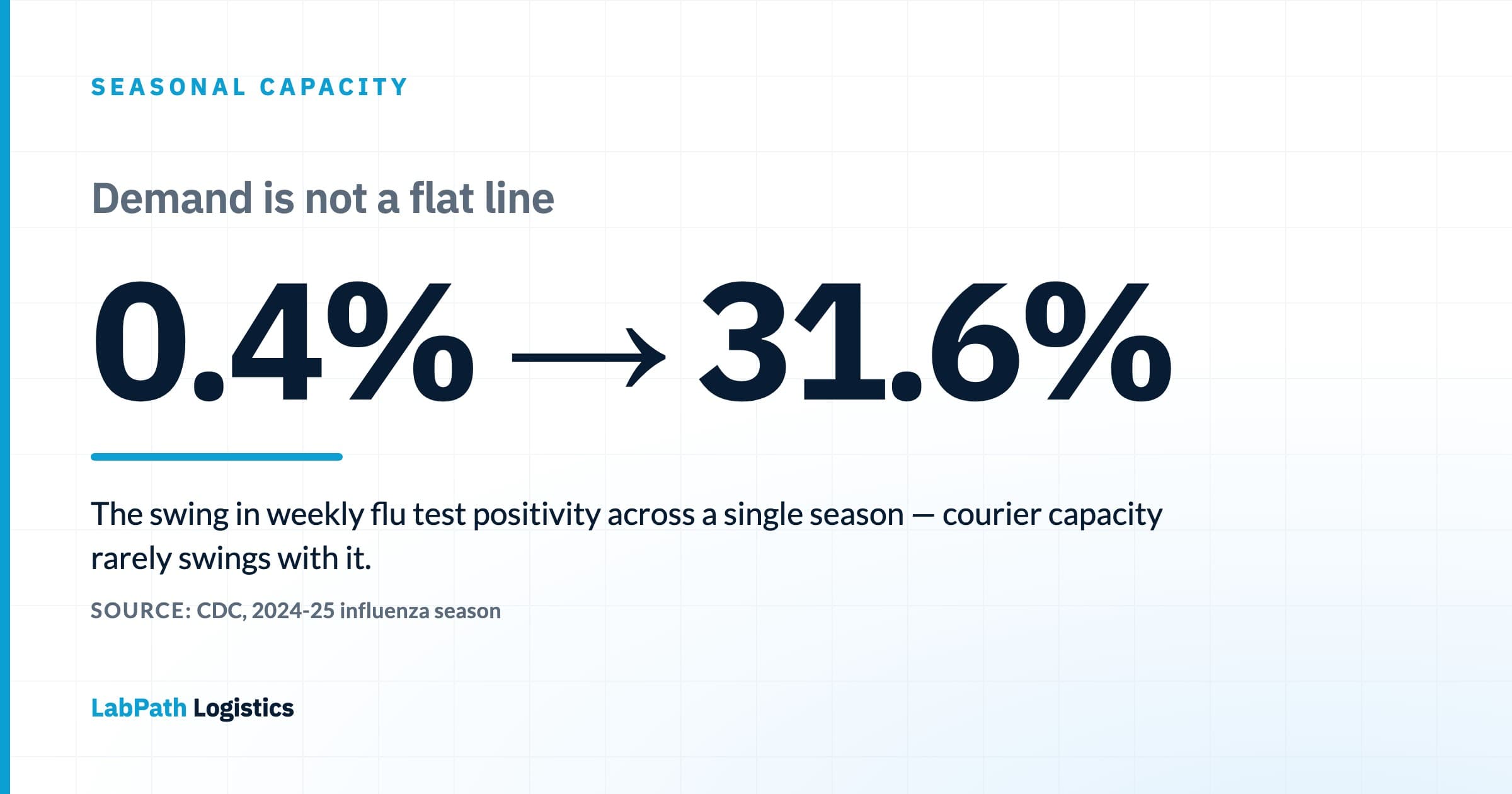
Clinical laboratories reporting to CDC tested 3,978,954 respiratory specimens for influenza during the 2024-25 season, of which 489,579 — 12.3 percent — were positive. The annual total is not the number worth planning against. The shape is. According to CDC's season summary, national weekly positivity ranged from 0.4 percent to 31.6 percent, with the peak in the week ending February 1, 2025, the highest peak reported in nine seasons.
0.4% → 31.6%
Range of national weekly influenza positivity across the 2024-25 season, per CDC — peaking the week ending February 1, 2025, the highest peak in nine seasons.
Positivity is a proxy, not a volume count. But the mechanism that drives it up — more symptomatic patients presenting at more collection points — is the same mechanism that drives order volume, which is why the courier's hardest weeks and the laboratory's hardest weeks arrive together rather than politely taking turns.
Timing is the second planning problem. The 2024-25 peak landed in the first week of February. Other seasons peak in December, and some run late into March. That variance is the argument for settling capacity terms in the fall: a contract renegotiated in December is being renegotiated from inside the surge, at the exact moment your leverage is lowest and every other facility in the market is asking the same carrier for the same thing.
Capacity Is Drivers, Not Vehicles
The intuitive model of courier capacity is a fleet: more volume, add a van. That model is wrong in medical logistics, because the binding constraint is qualified people. A driver moving clinical specimens needs HIPAA training, bloodborne pathogen and packaging competency, a background check, and enough route familiarity to find a loading dock at 5:40 a.m. None of that is a same-week hire.
CDC's own analysis of laboratory surge capacity reached the same conclusion about the bench. Writing in Emerging Infectious Diseases, Meltzer, McNeill and Miller concluded that the availability of suitably trained staff is probably the factor that most affects how fast a public health laboratory can expand capacity. Substitute the courier network for the laboratory and the finding transfers intact.
The same paper documents how steep the ceiling can be. A laboratory serving 15 hospitals and affiliated physician practices in the greater New York City area saw an approximately eightfold increase in respiratory virus testing during the 2009 H1N1 pandemic, reaching roughly 900 samples processed in a single day.
≈8×
Increase in respiratory virus testing at a laboratory serving 15 New York-area hospitals during the 2009 H1N1 pandemic (Meltzer, McNeill and Miller, Emerging Infectious Diseases, 2010) — a pandemic ceiling, not a seasonal forecast.
A pandemic figure is a ceiling, not a forecast
Do not budget a seasonal contract against eightfold growth. The reason that number belongs in a planning conversation is narrower: it establishes that the ratio between a quiet week and a hard week can be large enough that fixed capacity is a decision with consequences rather than a neutral default.
CDC took the problem seriously enough to build software for it. FluLabSurge, now archived, let laboratory directors forecast the daily number of specimens likely to arrive against how many their laboratory could actually process per shift. Very few facilities apply that same forecasting discipline to the leg that gets the specimen to the bench, which is the leg that fails first when both curves rise together.
What Actually Surges Is Not Just Stop Count
Facilities tend to model the surge as more pickups. In practice three separate things change shape, and each carries a different cost structure.
- STAT mix rises. Symptomatic patients present at hours when the routine route has already run, converting scheduled work into on-demand work.
- Coverage windows extend. Urgent cares and freestanding ERs lengthen their hours in season, which pushes the last viable pickup later than the contract contemplated.
- Unscheduled second pickups appear. A site that comfortably fed one afternoon run starts accumulating enough specimens by midday that holding them until 5 p.m. costs stability margin.
Only the first of those is usually priced in a standard agreement. The second and third are where surprise invoices come from, which is why the surge conversation belongs alongside the one about how to read a medical courier SLA and the one about after-hours coverage. Both terms get tested in January whether or not they were negotiated in September.
Six Things to Settle Before October
Consider a Houston urgent care group running six locations across the Katy, Cypress, and Pearland corridors into a reference laboratory in the Texas Medical Center corridor. In August that is one late-afternoon route and one driver. In January it is one driver, plus two unscheduled second pickups a week, plus a Saturday window nobody wrote down, plus a Christmas-week schedule negotiated by text message. Six terms convert that from improvisation into an operating plan.
- A named surge tier: a defined quantity of additional daily capacity, at an agreed price, that you can turn on for a stated period.
- A notice window: how many hours or days ahead the tier must be triggered, so escalation is a phone call rather than a negotiation.
- Weekend and holiday coverage fixed by date, not by 'as needed' — Thanksgiving through New Year is when volume and driver availability move in opposite directions.
- A written STAT definition and a STAT ceiling: how many on-demand runs the tier includes per day before overflow pricing applies.
- A deferral order naming which stops get pushed first if the network is constrained, decided by your clinical judgment in September.
- A named escalation contact with authority to commit capacity, reachable at 9 p.m. on a Saturday, plus the backup.
The fifth is the one most often skipped and the one that matters most. Under real constraint somebody triages, and the only question is whether that decision reflects your assessment of which specimens are time-critical or a dispatcher's best guess at 6 a.m. Facilities that have already mapped their pickup routes and stop density can usually write the deferral order in an afternoon, because the analysis is mostly done. Visibility helps on the same axis: when a facility can see where a run actually is on live GPS tracking, the escalation call starts from a fact rather than a suspicion.
One Houston-specific caution: respiratory season overlaps the tail of hurricane season through November, and the two contingencies compete for the same reserve drivers. A surge tier that assumes full network availability is a surge tier that has not been stress-tested against a Gulf storm in the same week.
Key Takeaway
Medical courier capacity is not elastic on demand, because the constraint is trained, credentialed drivers rather than vehicles — the same staffing constraint CDC identified as the limiting factor on laboratory surge capacity. Seasonal demand is genuinely steep: national weekly influenza positivity swung from 0.4 percent to 31.6 percent in the 2024-25 season, and peak timing moves year to year. September and early October are when a facility still has leverage. Settle a surge tier, a notice window, dated holiday coverage, a STAT ceiling, a deferral order, and a named escalation contact now, and the January surge becomes a scheduling exercise instead of a turnaround-time incident.
Frequently Asked Questions
When should a Houston facility plan courier capacity for flu season?
September through early October, before respiratory activity begins climbing. The reason is leverage and lead time rather than the calendar itself. Courier capacity expands by adding trained, background-checked drivers, which takes weeks, and by the time a facility feels the strain every comparable facility in the market is calling the same carriers with the same request. Peak timing also varies: CDC reported the 2024-25 national peak in the week ending February 1, 2025, while other seasons peak in December or run into March. Planning to a fixed peak date is unreliable; planning to be finished negotiating before the curve turns up is not.
Does specimen volume really increase during respiratory season?
Order volume for respiratory testing rises sharply, and the surveillance data shows how uneven the season is. Clinical laboratories reporting to CDC tested nearly 4 million respiratory specimens for influenza in the 2024-25 season, with weekly positivity ranging from 0.4 percent to 31.6 percent. Positivity is not a direct measure of volume, but it is driven by the same underlying event — more symptomatic patients presenting at more collection sites — so the busiest testing weeks and the busiest transport weeks coincide. How much any individual facility's total volume moves depends on its patient mix; an urgent care group and a dialysis center will see very different curves, which is why the planning conversation should start from your own historical monthly stop counts rather than a national average.
What should a surge clause in a medical courier contract include?
At minimum: a defined quantity of additional daily capacity at a stated price, the notice period required to trigger it, how long it stays active, and what happens when it is exhausted. Add a STAT ceiling so on-demand runs beyond a set daily count are priced in advance rather than invoiced as a surprise, and dated weekend and holiday coverage rather than an 'as needed' clause. The clause most often omitted is a deferral order — a written list of which stops get pushed first if the network is constrained. Writing that during contracting keeps the triage decision with the facility that understands which specimens are time-critical.
Can a medical courier add drivers in the middle of the season?
Sometimes, but not quickly, and that lag is the whole planning problem. A driver handling clinical specimens needs HIPAA and bloodborne pathogen training, packaging competency for the categories being moved, a completed background check, and enough route familiarity to work independently. That is weeks of lead time, and it competes with every other carrier hiring from the same pool at the same moment. This mirrors what CDC found on the laboratory side, where trained staff availability was identified as probably the largest single limit on how fast capacity can expand. The practical implication is that surge capacity is something you reserve ahead of time, not something you purchase on the day you discover you need it.