DSCSA Small Dispenser Exemption: Houston Next Steps
September 2, 2026 · By LabPath Logistics Editorial Team, Medical Logistics Desk
Quick Answer
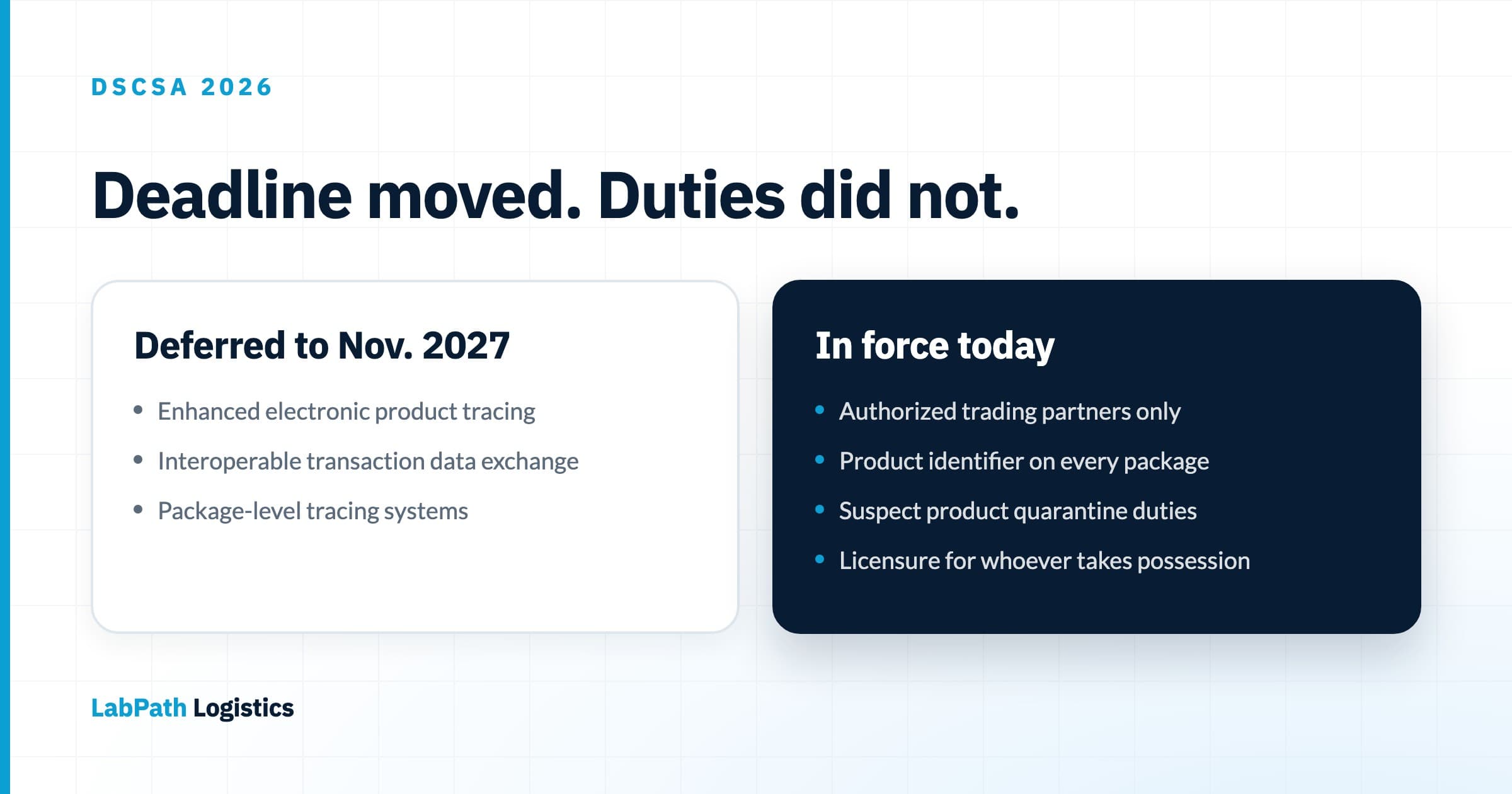
On August 6, 2026, the FDA extended its DSCSA small dispenser exemption from November 27, 2026 to November 27, 2027, giving smaller pharmacies another year before the enhanced, electronic, package-level tracing requirements apply. A dispenser qualifies as small if, as of November 27, 2026, the company that owns it has 25 or fewer full-time employees licensed as pharmacists or qualified as pharmacy technicians. The extension is narrow: it does not touch the longstanding duties that are already enforceable today — buying and selling only through authorized trading partners, transacting only in product bearing a product identifier, and quarantining and investigating suspect product. Those duties govern where your drugs come from and who is permitted to handle them, which makes them a logistics question as much as a recordkeeping one.
On August 6, 2026, the FDA extended the DSCSA small dispenser exemption by a full year, to November 27, 2027. If you run a pharmacy, clinic dispensary, or infusion suite in Greater Houston with a modest licensed headcount, you just got twelve more months before the electronic, interoperable, package-level tracing machinery applies to you. What you did not get is a pause on the DSCSA obligations that already bind you today.
That distinction is where operators get hurt. The extension is about data systems. The requirements still running are about provenance and possession — where a drug came from, whether it carries a valid identifier, and who is legally permitted to have it in a vehicle. The last of those is a logistics decision, and it is usually made by whoever books the courier rather than by whoever owns compliance.
What FDA Actually Extended
The exemption defers the enhanced drug distribution security requirements — the ones requiring trading partners to exchange transaction information electronically and in an interoperable format, and to trace product at the package level. FDA granted the original exemption in June 2024 and, per the ArentFox Schiff analysis of the August 2026 action, pushed the end date to November 27, 2027 so it can complete a small dispenser assessment, publish a report for public comment, and hold a public meeting.
Nov. 27, 2027
New end date for the FDA's DSCSA small dispenser exemption, extended from November 27, 2026 in an action announced August 6, 2026.
The threshold is worth reading precisely, because it is measured on a fixed date and it counts two job families. A dispenser is small if, as of November 27, 2026, the company that owns it has 25 or fewer full-time employees licensed as pharmacists or qualified as pharmacy technicians. That is a company-level count, not a location-level one — a three-store Houston group is measured as a group. Growth between now and that date can move you out of the category without anyone in the organization noticing.
There is a near-term date, too
FDA is running a small dispenser assessment survey and has encouraged responses by September 22, 2026. The extension exists in order to gather that input. If your pharmacy has an opinion about what full DSCSA implementation would actually cost a small operator, this is the window in which it counts.
The Duties That Never Paused
Three obligations sit outside the exemption and are enforceable right now. You may transact only with authorized trading partners — entities holding valid registration or licensure. You may transact only in product bearing a product identifier. And when product is suspect or illegitimate, you have quarantine, investigation, and notification duties that begin the moment you have reason to believe it.
FDA has shown it will enforce those independently of the tracing timeline, and the example landed in Texas. On April 1, 2026, the agency issued a DSCSA warning letter to a Texas medical spa over its handling of Botox. As reported by RAPS, investigators compared purchase records against treatment records, found the facility had administered substantially more product than its documented purchases accounted for, and recovered an unlabeled vial that was not an authentic manufacturer vial. The citations were the authorized trading partner requirement and the product identifier requirement — neither of which was deferred for anyone.
Note what that case turned on. Not a missing electronic file. A gap between what came in through a documented channel and what went out the door. Any facility that accepts drug product at a loading dock, a back door, or a front desk without a record tying it to an authorized source has the same exposure, regardless of headcount.
Where a Courier Sits in the DSCSA Structure
This is the part that rarely gets examined, and the statute is unusually clear about it. Under 21 U.S.C. §360eee, a "transaction" is "the transfer of product between persons in which a change of ownership occurs." Ownership is the trigger. A vehicle moving a box does not, by itself, create a transaction, and the same definition expressly excludes intracompany distribution.
So moving stock between two of your own Houston locations is not a DSCSA transaction and generates no transaction information or transaction statement. Operators often stop reading there and conclude the trip is unregulated. It is not that simple, for two reasons.
First, possession has its own definition. The same section defines a "third-party logistics provider" as an entity that "provides or coordinates warehousing, or other logistics services of a product in interstate commerce on behalf of a manufacturer, wholesale distributor, or dispenser of a product, but does not take ownership of the product." Not taking ownership is part of the definition rather than an escape from it. And the definition of "trading partner" reaches a 3PL from whom a dispenser "accepts direct possession of a product" — possession, not title.
Second, that status carries licensure. 21 U.S.C. §360eee-3 requires each facility of a third-party logistics provider to be licensed by the state from which the drug is distributed, and to report annually to the FDA its state license number along with the facility's name, address, and all trade names under which it does business. Texas layers its own definition on top: under Texas Health and Safety Code §431.401, a third-party logistics provider is defined as a person who holds a wholesale distributor license, and the wholesale distributor definition names third-party logistics providers explicitly.
Whether a particular courier arrangement makes anyone a 3PL is a facts-and-circumstances question for your regulatory counsel, and the answer differs between a common carrier hauling a sealed shipment and a vendor coordinating storage and distribution on your behalf. What is not a judgment call is that the question has an answer, that the answer determines a licensure obligation, and that no pharmacy should learn it during an inspection. The same principle that governs DEA registration in controlled substance transport applies here: ask what the vendor is licensed as before the product is in the vehicle, not after.
Four Houston Arrangements Worth a Second Look
- The multi-site shuffle. A Katy location is short on a drug and a Pearland location has it. The transfer is intracompany and outside the transaction definition — but if nobody logs what left, what arrived, and who carried it, your inventory reconciliation has an unexplained gap of exactly the kind FDA compared in the Texas case.
- The clinic that administers what it did not buy. Physician offices, med spas, and infusion suites that receive product through informal or sample channels are the highest-exposure category, because the authorized trading partner requirement applies to them as dispensers and nothing about it was deferred.
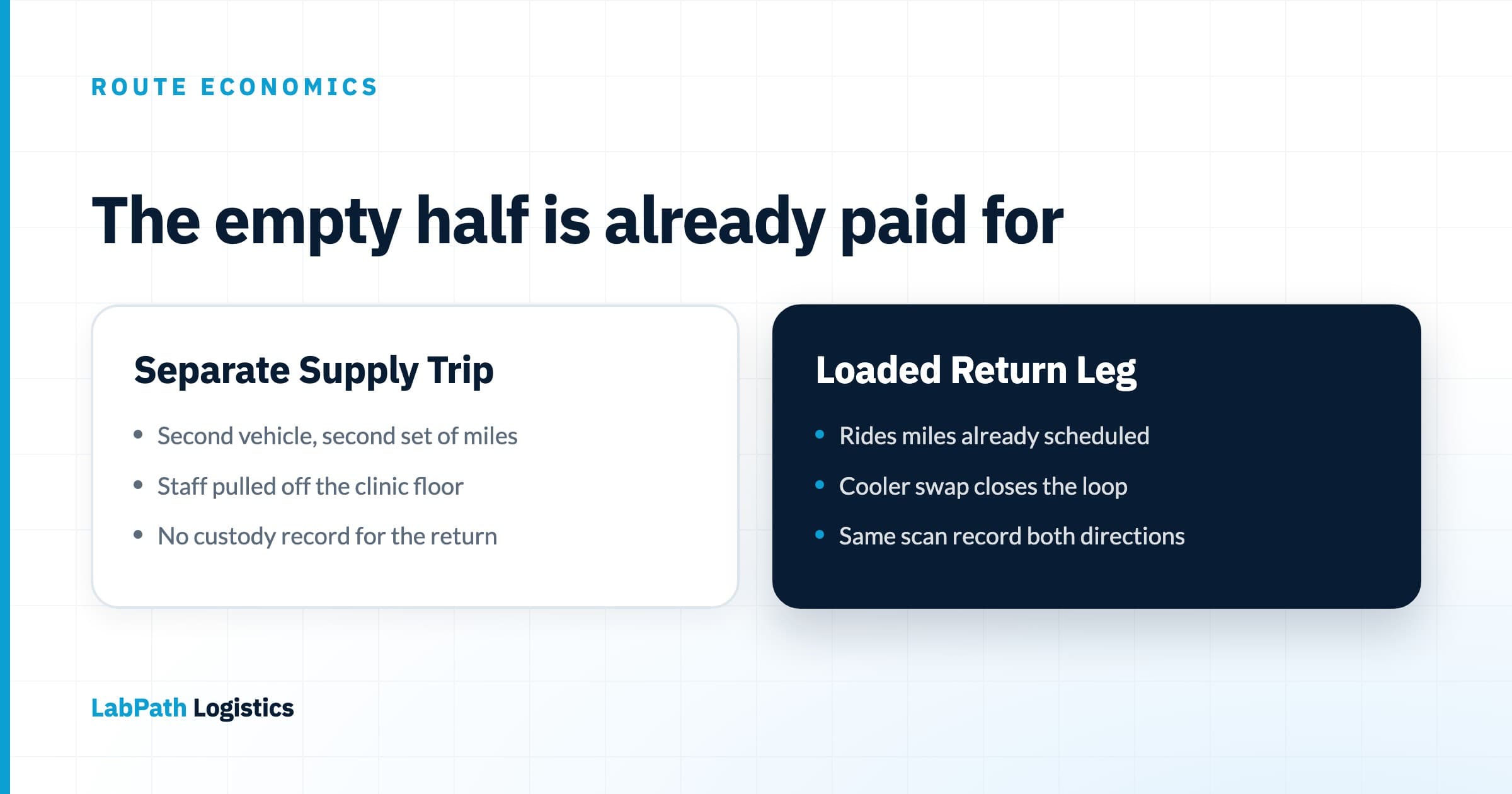
- The return leg. Product going back to a wholesaler travels under the same trading partner and identifier rules as product coming in, and a return that arrives without documentation is not a credit — it is a quarantine decision on someone else's dock.
- The unattended drop. A refrigerated delivery accepted after hours by staff with no authority to receive drug product creates a receipt timestamp nobody can defend. This is the same failure mode that breaks discharge medication handoffs, and it is solved the same way — a named recipient and a scan.
What to Do With the Extra Year
The population this affects is not small. The 2025 NCPA Digest, released in October 2025, counted 18,960 independent community pharmacy locations in the United States as of July 2025 — nearly 36 percent of all retail pharmacies. Most of them fall under the small dispenser threshold, and most of them will implement tracing once rather than twice. Five things are worth doing while the pressure is off.
- Run the headcount now against the November 27, 2026 measurement date, and re-run it if you hire or acquire.
- Inventory every channel through which drug product physically enters your facilities, including the informal ones nobody documented.
- Confirm the licensure status of every entity that takes possession of your product in transit, and keep the documentation on file.
- Write the suspect product procedure — quarantine location, investigation owner, notification path — because that duty is live today.
- Require a receipt record with a named recipient and a timestamp on every drug delivery, which is the artifact that closes the purchase-to-administration gap.
None of that requires the tracing platform you are deferring. All of it is the foundation that platform will sit on, and it is the part an inspector can ask about this quarter. Facilities evaluating vendors during this window should fold licensure and receipt documentation into the same review they would run when changing couriers.
Key Takeaway
The DSCSA small dispenser exemption now runs to November 27, 2027, and it buys time on electronic tracing only. Authorized trading partner status, product identifiers, and suspect product duties are enforceable today, as a Texas warning letter in April 2026 demonstrated. Because DSCSA turns on ownership for transactions and on possession for trading partner status, the courier question is a compliance question: know what your carrier is licensed as, and make every drug delivery produce a record with a name and a timestamp on it. Spend the extra year building that, and the 2027 deadline becomes a software project instead of an operations rebuild.
Frequently Asked Questions
When does the DSCSA small dispenser exemption expire?
November 27, 2027. The FDA announced the extension on August 6, 2026, moving the date out one year from the previous November 27, 2026 deadline. The agency granted the additional time so it could complete a small dispenser assessment, publish the resulting report for public comment, and hold a public meeting on it. The exemption applies to the enhanced drug distribution security requirements — electronic, interoperable, package-level product tracing — and not to DSCSA obligations that were already in force.
What counts as a small dispenser under the FDA exemption?
A dispenser qualifies if, as of November 27, 2026, the company that owns it has 25 or fewer full-time employees licensed as pharmacists or qualified as pharmacy technicians. Two details matter operationally. The count is at the company level, so a multi-location pharmacy group is assessed as a single organization rather than store by store. And the count includes qualified pharmacy technicians, not pharmacists alone, which puts some operators closer to the threshold than they assume. Because it is measured on a fixed future date, hiring or acquisition between now and then can change your status.
Does my courier need a DSCSA license to transport prescription drugs?
It depends on what the courier is doing, and the determination belongs to your regulatory counsel. DSCSA defines a transaction as a transfer of product in which a change of ownership occurs, so a carrier that only transports does not create a transaction. But the statute defines a third-party logistics provider as an entity providing or coordinating warehousing or other logistics services on behalf of a dispenser without taking ownership, and 21 U.S.C. 360eee-3 requires each 3PL facility to hold a state license and report annually to FDA. Texas Health and Safety Code 431.401 defines a third-party logistics provider as a person holding a wholesale distributor license. Ask any vendor that takes possession of drug product what it is licensed as, and keep the answer on file.
Do intracompany pharmacy transfers require DSCSA transaction documentation?
No. The definition of transaction in 21 U.S.C. 360eee expressly excludes intracompany distribution, so moving stock between locations under common ownership does not generate transaction information or a transaction statement. That is not the same as needing no record. Your own inventory accountability still has to explain what left one site and arrived at another, and the FDA enforcement action against a Texas facility in April 2026 turned precisely on a discrepancy between documented purchases and product administered. A dated transfer log with a named releaser and a named recipient is the minimum that keeps an intracompany move from reading as an unexplained gap.