Lab Supply Delivery in Houston: Use the Return Leg
August 30, 2026 · By LabPath Logistics Editorial Team, Medical Logistics Desk
Quick Answer
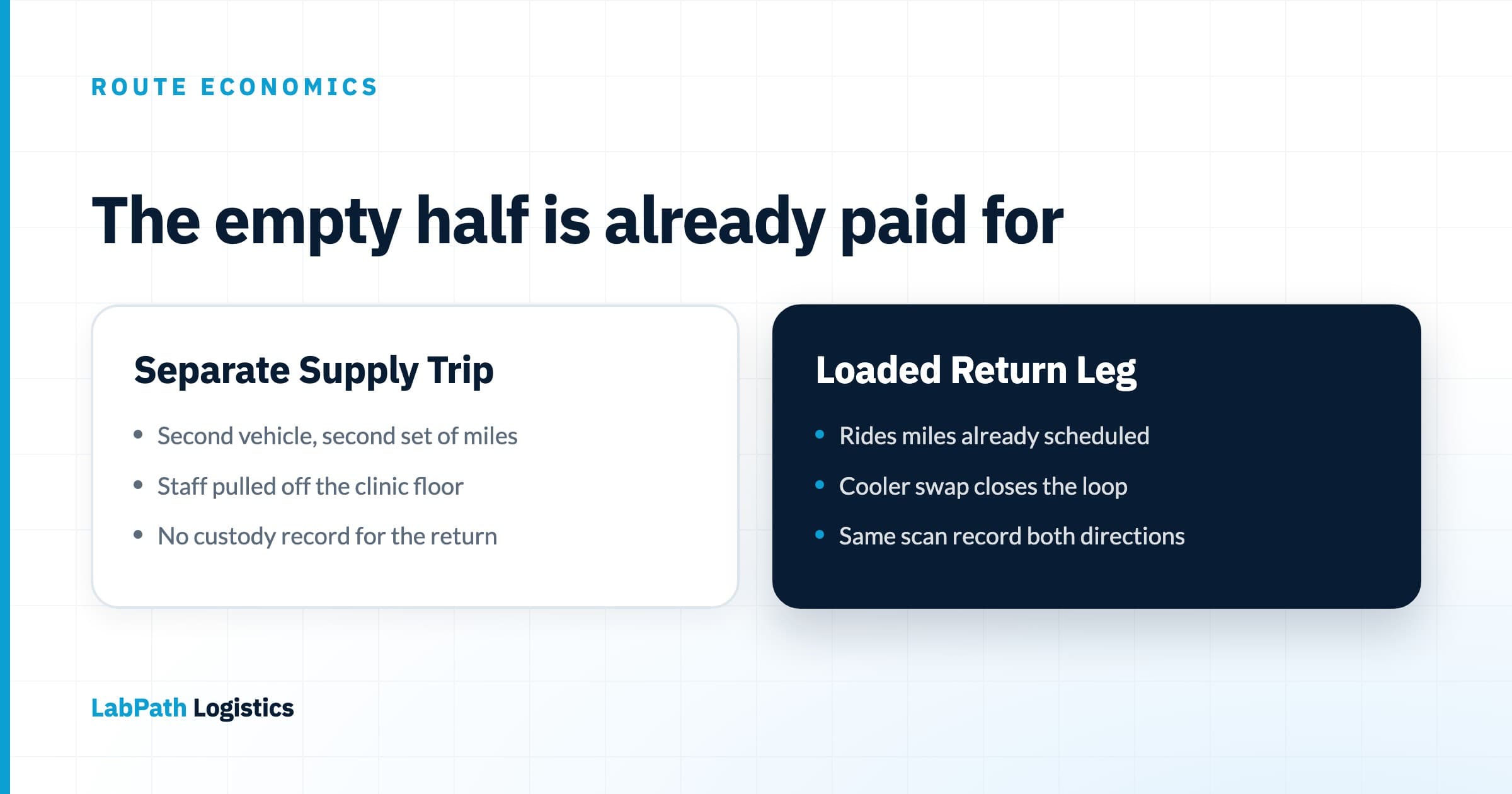
Lab supply delivery in Houston almost always belongs on the return leg of a run you are already paying for. A specimen route is loaded outbound and empty inbound, and that empty half is where tubes, requisitions, controls, and clean coolers move at close to zero marginal cost. Reuse is legal: 49 CFR 173.28(f) requires a Division 6.2 packaging to be disinfected before reuse, but a secondary or outer packaging conforming to §173.196 or §173.199 need not be disinfected if no leakage from the primary receptacle occurred. OSHA separately requires reusable bins and pails to be inspected and decontaminated on a regularly scheduled basis.
Lab supply delivery in Houston is usually treated as a separate errand, and that is why it costs what it costs. A courier leaves your clinic with the afternoon draws, drives to the reference lab, and comes back with nothing in the van. Meanwhile someone at the front desk is loading a personal car with tube boxes at five o'clock because the clinic ran short of gold-tops again. Two vehicles covered roughly the same geography an hour apart, and only one of them was on a schedule.
The fix is not a bigger supply contract. It is recognizing that a specimen route is a half-loaded asset — full outbound, empty inbound — and that the inbound half is the cheapest freight capacity a clinic will ever have access to. What follows is what can legally and safely ride it, what cannot, and the two federal rules that govern the container it rides in.
What Actually Rides the Return Leg
Reverse logistics in a clinical setting is less exotic than the term suggests. Four categories cover nearly all of it, and every one of them is already moving between the same two addresses on some other day of the week.
- Collection consumables — tubes, transfer devices, swabs, culture media, urine cups, fixative containers, and biohazard bags issued by the lab that receives the specimens.
- Transport hardware — insulated coolers, rigid totes, rack inserts, and reusable gel packs, swapped clean-for-dirty rather than accumulated in a back hallway.
- Paper and controls — requisition pads, printed manifests, quality-control material, proficiency-testing kits, and courier-scanned documents moving between sites in a group.
- Equipment going the other way — a failed centrifuge, a data logger due for calibration, or a rented analyzer heading back to the vendor.
The last category is the one clinics most often handle badly, because it feels like a facilities problem rather than a lab problem. It is neither. Under 29 CFR 1910.1030(d)(2)(xiv), equipment that may become contaminated with blood or other potentially infectious materials "shall be examined prior to servicing or shipping and shall be decontaminated as necessary." A centrifuge that leaves your building for repair is covered by that sentence whether it rides a courier van or a vendor's truck.
The Two Rules That Govern a Reused Cooler
Clinics get nervous about sending a cooler back because they assume single-use is the safe default. It is not the legal default, and treating it that way quietly generates waste and cost.
The transport rule sits in 49 CFR 173.28(f): "A Division 6.2 packaging to be reused must be disinfected prior to reuse by any means effective for neutralizing the infectious substance." The same paragraph then carves out the case that describes nearly every clinic run: "A secondary packaging or outer packaging conforming to the requirements of § 173.196 or § 173.199 need not be disinfected prior to reuse if no leakage from the primary receptacle has occurred." In plain terms, an intact triple-packaged shipment leaves its outer cooler clean, and that cooler can turn around.
The workplace rule is stricter about routine and does not have that exception. 29 CFR 1910.1030(d)(4)(ii)(C) requires that all bins, pails, cans, and similar receptacles intended for reuse "shall be inspected and decontaminated on a regularly scheduled basis and cleaned and decontaminated immediately or as soon as feasible upon visible contamination." Read the two together and the operating standard is obvious: a leak triggers immediate decontamination, and the absence of a leak still requires a schedule.
The question to ask a courier
Not "do you clean the coolers?" but "on what schedule, documented where, and who inspects them?" OSHA's requirement is a program, not an event. A vendor that cannot name the interval does not have one.
Reuse also has a condition limit. Under 49 CFR 173.28(b)(1), a non-bulk packaging that "upon inspection, shows evidence of a reduction in integrity may not be reused unless it is reconditioned." That matters more than it sounds, because Category B packaging earns its authorization by performance: 49 CFR 173.199(a)(4) requires the packaging to pass a drop test "at a drop height of at least 1.2 meters (3.9 feet)" and requires at least one surface of the outer packaging to have a minimum dimension of 100 mm by 100 mm. A cooler with a cracked hinge or a crushed corner no longer demonstrably meets the standard it was certified against.
1.2 meters
Minimum drop-test height a Category B outer packaging must survive without leakage from the primary receptacle, per 49 CFR 173.199(a)(4). Damaged coolers fail the premise, which is why 173.28(b)(1) bars reuse of packaging showing reduced integrity.
Why the Separate Supply Trip Is the Expensive Option
Most clinics never price the supply errand because it never appears on an invoice. It appears in mileage reimbursement, in overtime, and in the twenty minutes a medical assistant was not rooming patients.
The vehicle half of that has a defensible public benchmark. The IRS standard mileage rate for business use of an automobile is 76 cents per mile for July 1 through December 31, 2026, up from 72.5 cents for the first half of the year and 70 cents in 2025. That rate is an optional figure for computing deductible costs, not an operating-cost study, but it is the number the federal government considers reasonable for running a car one mile — and it excludes the driver entirely.
76¢ / mile
IRS business standard mileage rate for July 1 – December 31, 2026, up from 72.5¢ in the first half of 2026. Vehicle cost only; the value of the staff member's time is on top of it.
Run the arithmetic on a real Houston shape. A clinic in the Texas Medical Center corridor sends a staff member to a partner site in Katy and back — call it 40 miles round trip — twice a week to shuttle supplies and retrieve coolers. At 76 cents, that is $30.40 per trip in vehicle cost alone, about $3,160 a year, before a single minute of paid time. The same 40 miles were already being driven by a courier who returned empty.
Designing the Return Leg Into the Schedule
A return leg that works is a par-level system with a vehicle attached, not an ad-hoc favor from a driver. Five decisions make it durable.
- Set par levels per site. Every consumable gets a reorder point and a standard replenishment quantity, so the return leg carries a known load rather than whatever someone remembered to ask for.
- Make the cooler swap one-for-one. Clean units in, used units out, counted at both ends. Accumulation in a hallway is the failure mode that turns a reusable fleet into a purchase order.
- Scan the return like a pickup. The same barcode and timestamp discipline that protects a specimen protects a $400 cooler and a calibration-due data logger.
- Separate the loads physically. Supplies ride in their own containment, never inside a specimen cooler and never in contact with a used transport container. Containment is at the package under Category B triple packaging, but segregation is what keeps that true in practice.
- Publish a cutoff. The return leg has a departure time like any other stop. Requests after cutoff go on the next scheduled run, not into an unscheduled trip that recreates the problem.
Sizing follows the same arithmetic as the outbound side. If the supply volume changes what a stop needs — a bigger vehicle, a longer dwell, a second driver at peak — it belongs in the schedule model rather than in a driver's goodwill, which is the exercise we walk through in sizing a specimen pickup schedule.
What Should Not Ride the Return Leg
The empty half of a van is capacity, not permission. Three categories carry their own regulatory apparatus and do not become simpler by riding along.
- Vaccine stock. Transfers between Texas sites are governed by their own program rules, container standards, and monitoring requirements — the details are in vaccine transport rules for Houston clinics.
- Regulated medical waste. Waste moves under a separate registration, manifest, and container regime, and mixing it with a clean supply load contaminates both — see medical waste transport in Houston.
- Hazardous drugs and compounded preparations. USP <800> handling and containment obligations follow the product, not the vehicle, and they are covered in hazardous drug transport under USP <800>.
The fourth exclusion is temperature. A return leg carrying room-temperature consumables is trivial; a return leg carrying refrigerated reagents alongside them requires a declared, monitored temperature state for the whole compartment or physically separate conditioned containment. Consumables do not get to compromise a controlled load, and a controlled load does not get to be assumed.
Key Takeaway
Every specimen run in Houston is a round trip that gets billed like a round trip and used like a one-way. Loading the return leg with consumables, clean coolers, paper, and outbound equipment converts a cost you are already absorbing into capacity, and it retires the five o'clock supply errand that no schedule, custody record, or insurance policy ever covered. The rules to satisfy are narrow and public: disinfect a Division 6.2 packaging before reuse unless the outer packaging stayed clean under 173.28(f), retire any container showing reduced integrity, and run a documented inspection and decontamination schedule for reusable bins. Ask a courier for those three things in writing, then ask why the van is coming back empty.
Frequently Asked Questions
Can specimen coolers be reused, or do they have to be discarded?
They can be reused. Under 49 CFR 173.28(f), a Division 6.2 packaging must be disinfected before reuse by any means effective for neutralizing the infectious substance it contained — but a secondary or outer packaging conforming to 49 CFR 173.196 or 173.199 need not be disinfected before reuse if no leakage from the primary receptacle occurred. Separately, 49 CFR 173.28(b)(1) bars reuse of a non-bulk packaging that on inspection shows evidence of reduced integrity unless it is reconditioned, so cracked, crushed, or degraded coolers come out of service regardless of contamination.
Who is responsible for cleaning courier coolers and totes?
Whoever employs the people handling them, which in practice means both parties have obligations. OSHA's bloodborne pathogens standard at 29 CFR 1910.1030(d)(4)(ii)(C) requires that bins, pails, cans, and similar receptacles intended for reuse be inspected and decontaminated on a regularly scheduled basis, and cleaned and decontaminated immediately or as soon as feasible upon visible contamination. A courier should own the scheduled program for its own fleet and be able to state the interval and where it is documented; the clinic remains responsible for its own staff's handling and for reporting any leak it observes at pickup or delivery.
Can a medical courier deliver supplies on the same run that picks up specimens?
Yes, and it is the normal configuration for a well-designed route. Category B specimens travel in triple packaging under 49 CFR 173.199, so containment is achieved at the package rather than at the vehicle. The practical requirements are segregation — supplies in their own containment, never inside a specimen cooler or in contact with a used transport container — plus separate temperature handling for anything conditioned, and the same scanned custody record on the return that the outbound leg gets.
What should never ride on a courier's return leg?
Vaccine stock, regulated medical waste, and hazardous drugs or compounded sterile preparations. Each moves under its own registration, container, monitoring, and documentation regime that a general supply load does not satisfy, and mixing them with clean consumables creates a compliance problem in both directions. Refrigerated reagents are the fourth caution: they can ride, but only in a declared and monitored temperature state or in separate conditioned containment, never assumed to be fine because the trip is short.