Medical Waste Transport Houston: What Couriers Can't Take
August 21, 2026 · By LabPath Logistics Editorial Team, Medical Logistics Desk
Quick Answer
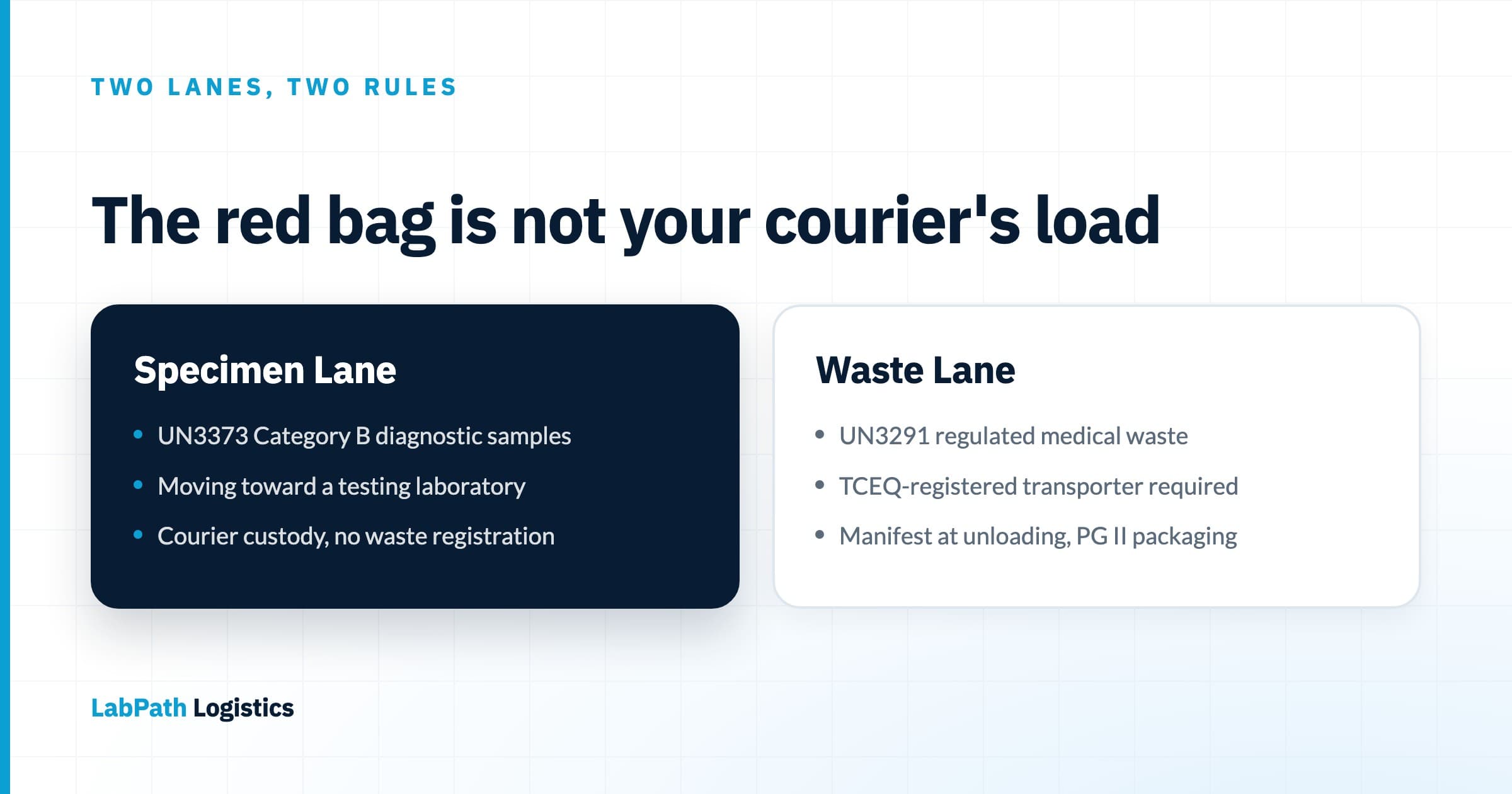
In Texas, transporting another facility's untreated medical waste requires a TCEQ medical waste transporter registration under 30 TAC §326.53. The small-quantity-generator exemption in §326.31(b) lets a clinic producing 50 pounds or less per month move its own waste, but that exemption belongs to the generator and does not transfer to a third party. A diagnostic specimen courier and a medical waste hauler are two different authorizations moving two different hazard classes — UN3373 Category B specimens versus UN3291 regulated medical waste — so handing a full sharps container to your specimen driver puts the shipment out of compliance, not just the driver.
Every medical courier serving Greater Houston gets the same question at the back door, usually on a Friday: can you take this red bag with you? It is a reasonable-sounding request. The driver is already there, already gowned in the same workflow, already carrying biohazard-labeled containers to a vehicle. But medical waste transport in Houston is governed by a separate rule set with a separate registration, and the answer from a specimen courier should be no — every time, without improvising.
This post is the operational version of why. It matters because the exposure does not land on the courier alone. A generator that releases untreated medical waste to an unregistered transporter has created a compliance problem of its own, and the paperwork trail points back to the facility that handed it over.
Two Lanes, Two Authorizations
The clean mental model is that a specimen and a red bag are not the same cargo, even when they contain physically similar material. A diagnostic specimen is moving toward a laboratory to be examined. Regulated medical waste is moving toward treatment and disposal. Federal hazardous materials rules split them accordingly: Category B infectious substances ship as UN3373, while regulated medical waste ships as UN3291, Hazard Class 6.2, Packing Group II.
That distinction drives everything downstream — packaging standard, who may carry it, what documentation rides along, and what happens at the receiving end. It is also why "it is all biohazard" is the wrong instinct. The World Health Organization notes that about 85 percent of the waste generated by health-care activities is general, non-hazardous waste, with the remaining 15 percent considered hazardous. Sorting is the whole job, and it starts at the container, not at the curb.
What Texas Actually Counts as Medical Waste
Texas medical waste management now sits with the Texas Commission on Environmental Quality under 30 TAC Chapter 326. The definition in §326.3 is narrower than most clinic staff assume. Medical waste is treated and untreated special waste from health-care-related facilities comprised of:
- Animal waste
- Bulk blood and bulk human blood
- Bulk human body fluids
- Microbiological waste
- Pathological waste
- Sharps
A transporter, in the same section, is any person that collects, conveys, or transports medical waste. There is no carve-out for someone who is only doing it as a favor, only doing it occasionally, or only carrying one container. If your courier picks up a used sharps container, your courier is a transporter of medical waste for that trip.
The 50-Pound Line — And Why It Doesn't Transfer
50 lb / month
The threshold separating a small quantity generator from a large quantity generator under TCEQ's medical waste rules
This is where most of the confusion originates. Under 30 TAC §326.31(b), a permit, registration, notification, or other authorization is not required for a generator of less than 50 pounds per month of untreated medical waste that transports its own waste to an authorized medical waste storage or processing facility. Small practices hear that and reasonably conclude the volume is too small to be regulated.
Read the subject of the sentence. The exemption applies to a generator moving its own waste. TCEQ states the registration requirement plainly on the other side: generators of greater than 50 pounds of untreated medical waste who intend to self-transport, and transporters of other generators' untreated medical waste, must obtain a registration. Your courier is, by definition, transporting another generator's waste. The volume exemption never reaches them.
The practical test
Ask a prospective vendor for their TCEQ medical waste transporter registration number, not a policy statement. Registration under §326.53 is an annual instrument that expires each September 30 and is renewed through the annual summary report, so a registration is either current or it is not — there is no partial credit.
The administrative machinery behind that registration is real: Form 00426 to apply for registration by rule as a transporter of medical waste, Form 10537 for the annual summary report, fees scaled to reported volume under §326.87, and reporting under §326.89. A registered transporter also has to give the receiving treatment facility a copy of the manifest at the time of unloading. None of that exists inside a specimen courier's operating model, and none of it can be improvised at a loading dock.
Why the Hospital Drop-Off Route Doesn't Work in Houston
There is a provision that sounds like a clean solution for a small clinic: a licensed hospital may operate as a medical waste collection and transfer facility, accepting untreated medical waste from small generators who self-transport it. Practices in rural Texas use it. Practices in Houston generally cannot.
The eligibility test in 30 TAC §326.43 is geographic. The hospital must be located in an incorporated area with a population of less than 25,000 and in a county with a population of less than one million — or in an unincorporated area outside the extraterritorial jurisdiction of a city over 25,000 and outside a county over one million. Harris County's population is several million, which forecloses the option across the entire Texas Medical Center corridor and effectively every hospital a Houston clinic would drive to.
The same section is instructive even where it does not apply, because it shows what TCEQ expects of anyone holding untreated waste. Putrescible or biohazardous untreated medical waste stored longer than 72 hours during the post-collection period must be maintained at 45 degrees Fahrenheit or less. Storage must be secure against theft, vandalism, inadvertent human or animal exposure, rain, water, and wind. And waste may be released only to a registered medical waste transporter — the same rule, restated from the generator's side.
Packaging Is a Different Standard, Not a Stricter One
Facilities that already run compliant specimen shipping sometimes assume their packaging competence carries over. It does not, because the two hazard classes sit under different sections of the federal rules. Non-bulk packagings for regulated medical waste must be UN standard packagings meeting the Packing Group II performance level under 49 CFR §173.197, and a non-bulk packaging used as a sharps container must be puncture-resistant for sharps and sharps with residual fluid, demonstrated through the performance tests in 49 CFR Part 178, Subpart M.
Category B diagnostic specimens follow a different path entirely — the triple-packaging construction in §173.199, which is what your courier program should already be built around. We covered that build in detail in our guide to Category B specimen packaging for Houston facilities. The point is not that one is harder. The point is that competence in one does not license the other.
Where a Specimen Courier Still Helps
Declining the red bag does not mean the courier is irrelevant to your waste problem. Most of what goes wrong with medical waste at a busy Houston clinic is a scheduling and staging problem, and those are adjacent to work a courier already does well.
- Supply legs. Unused collection supplies, transport media, requisition stock, and empty containers move on a specimen route without touching the waste rules at all.
- Cadence design. If your waste hauler comes twice a month and your draw volume spikes on Mondays, the storage window is where you get exposed. Mapping both schedules against actual volume is the same exercise as designing pickup cadence.
- Staging discipline. A courier that time-stamps custody at collection is already enforcing a single pickup point. Extending that discipline to a physically separate waste staging area costs nothing and removes the wrong-container failure mode.
- Documentation habits. The retention instinct behind a clean custody record is the same instinct that keeps waste manifests matched to volume rather than filed unread.
Our own scope boundary is published rather than negotiated at the dock — see how we document handling and custody on the compliance page, and what the platform records at each leg on the features page.
What to Put in Writing With Both Vendors
Most facilities in Greater Houston end up with two vendors — a specimen courier and a registered waste hauler — and the failures happen in the seam between them. Close it explicitly:
- A written scope line in the courier agreement stating that no regulated medical waste, sharps containers, or red-bag material will be tendered or accepted on specimen routes.
- The waste vendor's current TCEQ transporter registration number on file, re-verified after each September 30 renewal cycle.
- A named staging location for waste that is physically separate from specimen staging, so a driver cannot pick up the wrong container in a hurry.
- Manifest copies retained from the waste vendor, matched against your own volume records rather than filed unread.
- A refusal script for front-desk and back-office staff, so the answer to the Friday question is consistent across every shift.
- Escalation contacts for both vendors in one document, since the failure mode is usually a missed waste pickup followed by improvisation.
Key Takeaway
A specimen courier declining your red bag is not being unhelpful — it is the only correct answer under Texas rules. The 50-pound small-quantity-generator exemption is a self-transport allowance that belongs to your facility and evaporates the moment a third party touches the container. Keep the two lanes physically and contractually separate, verify the waste hauler's registration on the annual cycle, and treat any courier willing to bend on this as a signal about how they handle the rules you cannot see.
Frequently Asked Questions
Can a medical courier pick up sharps containers in Houston?
Not without a TCEQ medical waste transporter registration. Under 30 TAC §326.3, a transporter is any person that collects, conveys, or transports medical waste, and sharps are expressly within the medical waste definition. TCEQ requires transporters of other generators' untreated medical waste to register under §326.53. A specimen courier operating without that registration should decline sharps containers and red-bag waste on every route, regardless of quantity.
Does the 50-pound exemption cover my clinic's courier?
No. 30 TAC §326.31(b) exempts a generator producing less than 50 pounds per month of untreated medical waste when that generator transports its own waste to an authorized storage or processing facility. The exemption is written around self-transport by the generator. A courier moving your waste is transporting another generator's waste, which triggers the registration requirement in §326.53 with no volume floor.
What is the difference between UN3373 and UN3291?
UN3373 covers Category B infectious substances — diagnostic and clinical specimens moving to a laboratory — packaged under 49 CFR §173.199. UN3291 covers regulated medical waste moving to treatment or disposal, classified as Hazard Class 6.2, Packing Group II, with non-bulk packagings required to meet the Packing Group II performance level under 49 CFR §173.197. Sharps containers used as non-bulk packagings must additionally be puncture-resistant per the Part 178, Subpart M tests.
Can a Houston clinic drop medical waste at a nearby hospital?
Generally no. 30 TAC §326.43 lets a licensed hospital act as a medical waste collection and transfer facility only when it sits in an incorporated area under 25,000 population within a county under one million, or in an unincorporated area outside the extraterritorial jurisdiction of a city over 25,000 and outside a county over one million. Harris County exceeds the one-million threshold, so hospitals across Greater Houston do not qualify. Waste must go to a registered transporter or an authorized facility instead.