Discharge Medication Delivery Houston: Courier Rules
August 12, 2026 · By LabPath Logistics Editorial Team, Medical Logistics Desk
Quick Answer
Under 22 TAC §291.12(c), a Texas pharmacy that delivers discharge medications through its own employee or a same-day courier service remains responsible for problems with the delivery and must maintain proper storage temperature until the delivery has been received by the patient. Hiring a courier moves the driving, not the duty. Every delivery also requires patient counseling compliance, a way for the patient to report a delivery irregularity, replacement of any compromised drug, and records of what was sent and delivered kept for two years.
Discharge medication delivery in Houston succeeds or fails inside a window most hospitals never measure: the stretch between the discharge order and the moment the patient is actually home with the bottles in hand. Bedside pharmacy programs close that window during business hours. Evenings, weekends, holidays, and every discharge where the prescription is not ready when transport arrives get handled by a different system — or by nothing at all, which in practice means the patient is told to stop at a pharmacy on the way home.
That second system is a courier leg, and Texas regulates it more specifically than most pharmacy directors expect. Here is what the rule actually says, where the liability sits after you outsource the drive, and what belongs in the transport agreement before the first run.
Texas Draws a Hard Line at Same-Day Courier
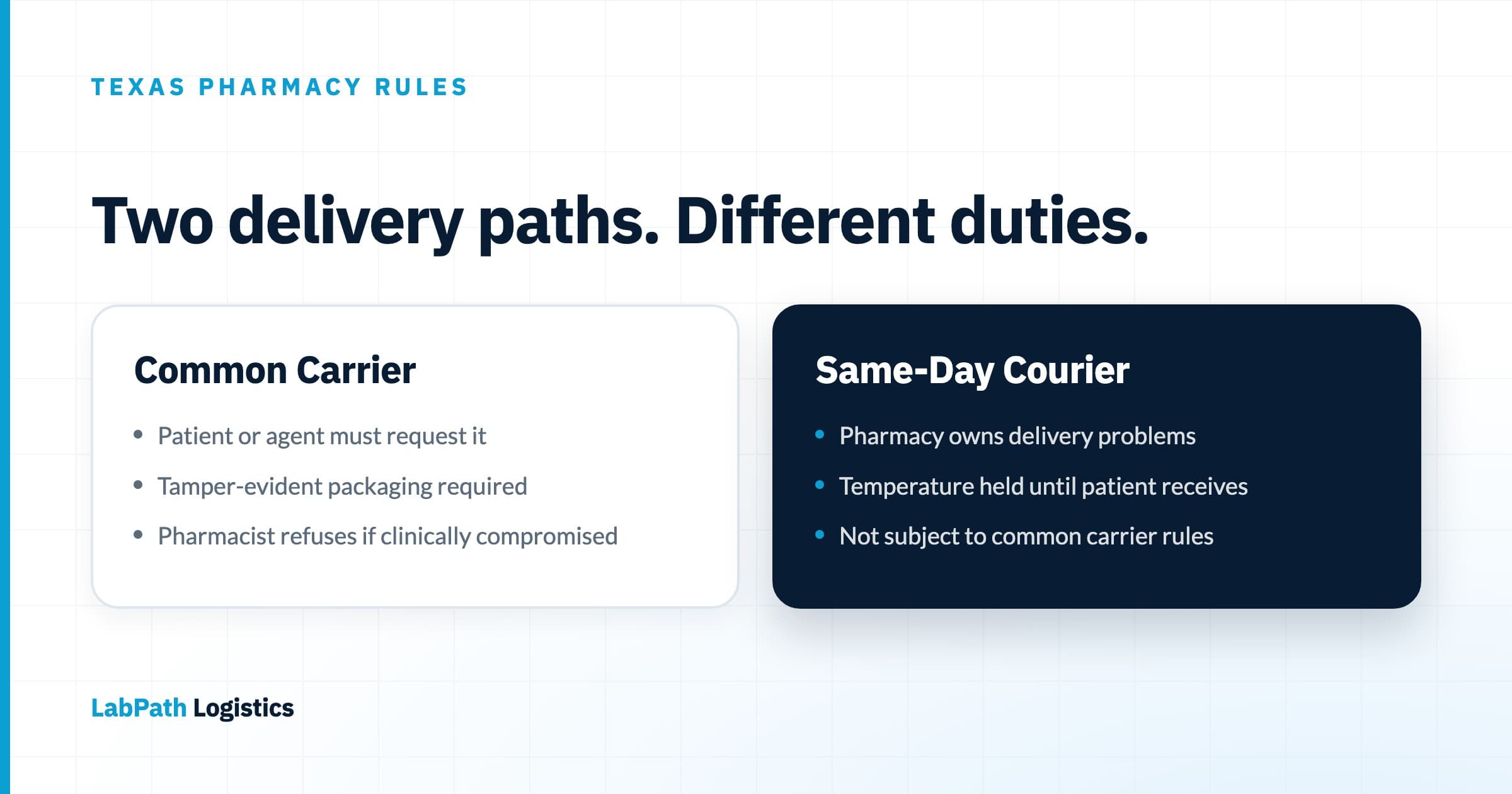
22 TAC §291.12 governs delivery of prescription drugs by pharmacies licensed as Class A, Class A-S, Class E, or Class E-S. It splits delivery into two regulatory paths, and the split is not cosmetic.
Subsection (b) covers delivery by common carrier — the U.S. Mail and comparable services. It requires the patient or the patient's agent to request that method, requires commercially available tamper-evident packaging and temperature maintenance appropriate to the drug, and requires the pharmacy to give the patient a way to report a delivery irregularity. It also obligates the dispensing pharmacist to refuse common carrier delivery of any drug that, in their professional opinion, may be clinically compromised by it.
Subsection (c) covers delivery by a pharmacy employee or by a common carrier providing a same-day courier service. The rule states plainly that a pharmacy delivering through a same-day courier is not subject to subsection (b). In exchange for that relief, the pharmacy accepts two obligations that do not travel with the package: it is responsible for problems with the delivery, and it must maintain proper storage temperature until the delivery has been received.
Outsourcing the drive is not outsourcing the duty
The regulated party is the pharmacy, not the courier. When a same-day delivery arrives late, warm, or at the wrong address, the deficiency lands on the pharmacy's license — the courier contract is a commercial remedy, not a regulatory one. That is exactly why the vetting standard for a discharge delivery vendor should look like the standard you apply to your own staff.
What the Rule Requires on Every Delivery
Subsection (d) applies regardless of which path the pharmacy chooses. Four duties matter operationally:
- Patient counseling requirements still apply — delivery does not waive the counseling obligation, it relocates it.
- The patient must have a method to report that a delivery was compromised or never arrived.
- A compromised drug must be replaced, which means someone has to be able to tell whether it was compromised.
- Records showing when the drug was sent and when it was delivered, plus any patient complaint about a compromised delivery, must be kept for two years.
Read that last item as a system requirement rather than a filing requirement. A two-year record of send and delivery times is only producible if the courier captures timestamps at both ends and hands the data back in a form the pharmacy controls. A driver's text message to a nurse is not a record. Neither is a delivery confirmation that lives permanently inside a vendor's app with no export.
Where Meds-to-Beds Stops
Houston health systems have invested seriously in bedside programs. Harris Health's Meds-to-Beds program sends a pharmacist to the bedside with the discharge prescriptions and the counseling, and pairs it with a home delivery option. Memorial Hermann runs a comparable service across its Texas Medical Center campus. The model has evidence behind it.
32 of 45
studies in a 2026 AJHP scoping review measured readmissions after a Meds-to-Beds program; 56% of those reported a statistically significant reduction in 30-day all-cause readmissions
A rapid scoping review published in the American Journal of Health-System Pharmacy examined 45 studies of the model. The direction of the evidence is favorable, and the operational reason is not mysterious: a medication in the patient's hands before they leave the building cannot be abandoned at a pharmacy counter.
But bedside coverage is bounded by two conditions — the outpatient pharmacy has to be open, and the patient has to still be in the bed. Both fail routinely:
- Discharge orders written after the outpatient pharmacy closes, or on a weekend, with the patient waiting on a ride that has already arrived.
- Prior authorization or a benefits problem resolved hours after the patient has gone home.
- Refrigerated products — insulins, certain biologics — that the family is asked to pick up later and often does not.
- Discharges to a skilled nursing facility or group home, where the receiving site rather than the patient needs the drugs on arrival.
- Patients discharged without transportation of their own, for whom a pharmacy stop is a second trip they will not make.
Every item on that list is a delivery problem wearing a clinical costume. None of them is solved by adding pharmacist hours at the bedside; all of them are solved by a delivery leg that runs when the pharmacy window has closed.
The Unfilled Prescription Is a Readmission Input
28%
of discharged general medicine patients had at least one new prescription still unfilled seven days later (Fallis et al., PLoS One, 2013)
Fallis and colleagues followed 232 patients discharged from a general internal medicine service and found 28% had not filled at least one new prescription at seven days, and 24% still had not at 30 days. Patients discharged to nursing homes fared worse than those discharged home. The study is Canadian and modest in size, but the failure mode it describes is universal and structural: the prescription was written correctly, transmitted correctly, and never converted into a drug the patient possessed.
The financial exposure sits downstream. Medicare's Hospital Readmissions Reduction Program can reduce a hospital's payments by as much as 3 percent, and the reduction applies across all Medicare admissions rather than only the measured conditions. A delivery leg does not fix a readmission problem by itself. It removes one of the few contributing causes that logistics can actually control.
Cold Chain and Controlled Substances in the Discharge Bag
Two categories deserve named handling in the courier agreement rather than general assurances. The first is refrigerated product. Subsection (c)'s temperature duty runs until the delivery has been received — not until dispatch, and not until the vehicle leaves the dock. In a Houston August, a discharge bag containing insulin that sits on a passenger seat through a Loop 610 backup is a documented compliance failure, not bad luck. The packaging, monitoring, and verification practices are the same ones we cover in our cold chain pharmacy delivery guide.
The second is controlled substances, which appear in discharge regimens far more often than in routine outpatient delivery — post-surgical analgesia in particular. Those runs carry recordkeeping and custody expectations of their own, covered in our guide to controlled substance courier compliance. At minimum, the delivery should require identity verification at the door and a signature captured against the specific prescription rather than a generic package drop.
What to Require From a Discharge Delivery Courier
Because the pharmacy keeps the obligation, the contract has to buy back the evidence. These are the terms worth insisting on, and they map closely to the controls described on our compliance page and the tracking and custody records described under platform features:
- Coverage that matches discharge patterns, not business hours — evenings, weekends, and holidays with a committed response window rather than best-effort dispatch.
- Timestamped proof of pickup and delivery, exportable to the pharmacy, sufficient to satisfy the two-year record requirement without a vendor support ticket.
- Validated temperature control for refrigerated items, with the monitoring record attached to the delivery rather than kept separately.
- Recipient identity verification and signature capture tied to the prescription, with a defined rule for what happens when no one answers the door.
- A documented exception path — who is notified, and who decides — when an address is wrong, a patient is unreachable, or a route is disrupted.
- Driver training and HIPAA obligations in writing, since the delivery exposes patient name, address, and medication in a single package.
A Houston Routing Reality
Consider a common scenario: a Texas Medical Center hospital discharges a patient to Katy at 4:45 p.m. on a Friday. The outpatient pharmacy closes at 5. The prescription includes one refrigerated item. The family is already in the loading zone. The realistic options are to delay the discharge, send the family to a retail pharmacy near home that may not stock the product, or run a same-day delivery that reaches Katy through westbound I-10 at peak.
Only the third option ends with the patient holding the medication that evening, and it is a routing problem before it is a clinical one. The distance is not the constraint — the departure time is. A courier that dispatches on a fixed loop will quote a window that assumes the run starts when the next loop begins, which is precisely the assumption that breaks a Friday discharge. The same after-hours coverage question shapes home-based care programs generally, as we discuss in our hospital-at-home logistics guide.
Key Takeaway
Discharge medication delivery is one of the few care-transition interventions that is entirely a logistics problem. Texas has already decided who owns it: under §291.12(c), the pharmacy remains responsible for the delivery and for the temperature until the patient has it. Build the courier relationship around that fact — coverage that matches when discharges actually happen, exportable timestamped records, verified cold chain to the door, and identity verification on receipt. Then measure the one number that matters: how many discharge prescriptions were in the patient's hands the same day they left.
Frequently Asked Questions
Can a Texas pharmacy use a courier to deliver discharge prescriptions?
Yes. 22 TAC §291.12(c) expressly permits a Class A, A-S, E, or E-S pharmacy to deliver prescription drugs using its own employee or a common carrier providing a same-day courier service. That path is not subject to the common carrier requirements in subsection (b), but the pharmacy remains responsible for problems with the delivery and must maintain proper storage temperature until the delivery has been received.
Who is liable if a courier delivers a discharge medication late or warm?
The pharmacy. Texas regulates the pharmacy, not the transport vendor, and subsection (c) places responsibility for delivery problems on the pharmacy that arranged the delivery. A courier contract can allocate commercial risk between the parties, but it does not move the regulatory obligation. That asymmetry is the reason to vet a discharge delivery courier the way you would vet your own staffing.
How long must a pharmacy keep records of a prescription delivery in Texas?
Two years. Under 22 TAC §291.12(d), the pharmacy must maintain records documenting when a prescription drug was sent and when it was delivered to the patient or the patient's agent, along with any patient complaint about a compromised delivery. In practice this means the courier's timestamps need to be exportable into records the pharmacy controls rather than living only inside a vendor platform.
Does courier delivery replace a Meds-to-Beds program?
No — it extends one. Bedside programs work when the outpatient pharmacy is open and the patient is still admitted. A same-day delivery leg covers the discharges that fall outside those two conditions: after-hours and weekend orders, prescriptions cleared after the patient has gone home, refrigerated items the family cannot return for, and transfers to a skilled nursing facility. The two models cover different halves of the same problem.