Hospital-at-Home Logistics: A Houston Courier Guide
July 27, 2026 · By LabPath Logistics Editorial Team, Medical Logistics Desk

Quick Answer
Hospital-at-home and mobile phlebotomy programs move the collection point from a clinic with a loading dock to a private residence with a gate code. The courier requirements change accordingly: single-unit pickups instead of batched routes, a stability clock that starts at a kitchen table, chain of custody that begins outside your building, and full DOT Category B packaging compliance — because the materials-of-trade exception a visiting clinician may rely on is written around a principal business other than transportation, which is exactly what a courier is.
Acute care keeps moving into houses, and the logistics have not caught up. A hospital-at-home census, a mobile phlebotomy contract, or a home infusion line all produce the same operational fact: the collection point is now a private residence with a gate code, a dog, and no receiving desk. For a Houston health system or reference lab, that shifts real risk onto the courier leg — the specimen was drawn correctly, then spent an unaccounted hour in a neighborhood forty minutes from the Texas Medical Center. This guide covers what changed in federal policy, what the outcome data actually shows about home-collected samples, and what to require from a medical courier before the first at-home pickup.
The Waiver Turned a Pilot Into a Plan
Hospital-at-home spent five years as a temporary program that could lapse on a budget deadline, which is why so few systems built permanent logistics around it. That changed. The Acute Hospital Care at Home waiver was extended through 2030 as part of the Consolidated Appropriations Act, 2026, and the American Medical Association reports that 366 programs across 139 health systems in 37 states have been approved to deliver acute hospital care at home.
366 programs
Approved to provide acute hospital care at home across 139 health systems in 37 states, under a waiver now extended through 2030 (American Medical Association)
A five-year runway changes procurement. A program running on a six-month extension improvises transport; a program funded through 2030 signs a service agreement. The workforce trend points the same direction — the Bureau of Labor Statistics projects employment of home health and personal care aides to grow 17 percent from 2024 to 2034, adding roughly 739,800 jobs, the largest increase of any occupation in the economy.
+739,800 jobs
Projected growth in home health and personal care aides from 2024 to 2034 — a 17% increase and the largest gain of any U.S. occupation (BLS)
More care in homes means more specimens, more medications, and more supplies moving in the one direction most medical logistics networks were never designed for: outbound to a residence, then inbound from it.
Home Collection Holds Up — If the Transport Leg Does
The common objection to at-home collection is sample quality: a draw in a living room must be worse than a draw in a clinic. The published data does not support that assumption, provided the program is engineered rather than improvised.
A study in JNCI Cancer Spectrum evaluated a home phlebotomy service for cancer patients and found that 345 patients completed 1,464 home laboratory collection visits producing 5,104 samples, with one clotted specimen (0.02% against a 2% benchmark), zero hemolyzed specimens, zero mislabeled samples, and no cancellations attributable to sample stability, contamination, or collection deficiencies.
0.02%
Clotted-specimen rate across 5,104 home-collected samples, against a 2% institutional benchmark — with zero hemolysis (JNCI Cancer Spectrum, 2024)
One number in that study is the courier's number: 245 specimens, or 4.80%, had a turnaround time greater than 120 minutes. In this program that delay did not degrade quality, because the assay mix and handling were built around it. In a program that has not done that work, a two-hour-plus transit is where a clean draw quietly becomes an unusable one — the same preanalytical exposure we break down in our lab turnaround time guide. Home collection does not create sample-quality risk. Unmanaged transport does.
Every Home Is a Micro-Site Without a Loading Dock
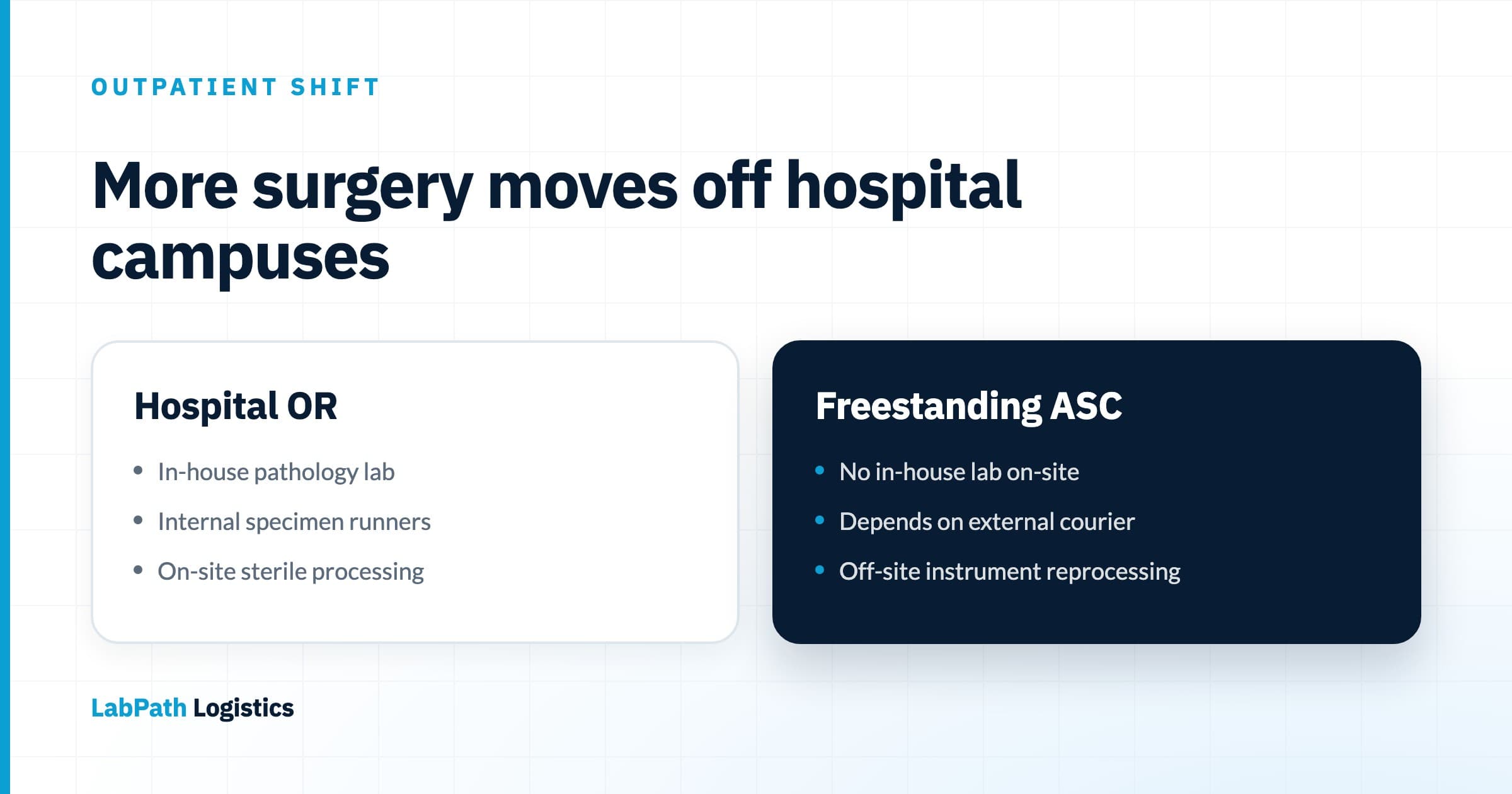
A clinic stop is a solved logistics problem: fixed address, known hours, a person whose job includes handing off the cooler. A residential stop removes every one of those assumptions.
- Access is variable — gated communities, apartment towers with a single loading zone, and no-answer doors that turn a five-minute stop into twenty.
- There is no batching. A clinic yields fifteen specimens per stop; a home yields one, so route economics and driver time per sample change completely.
- Custody starts outside your walls. The first documented handoff happens on a porch, not at a specimen receiving window.
- PHI is exposed in a public setting — a manifest visible on a doorstep or a labeled bag left with a neighbor is a disclosure, not a delivery detail.
- The stability clock starts wherever the patient was sitting, and nobody in the building saw it start.
- Return legs matter too: kit delivery, medication drop-off, and sharps or regulated waste retrieval often ride the same schedule.
The practical consequence is that timestamped, per-stop custody stops being a nice-to-have. When a specimen is questioned, the only way to locate the failure is a record that shows when the courier arrived, when the sample was accepted, and what the container held between those points — the discipline we cover in our chain of custody guide.
The Exception Your Clinician May Have and Your Courier Does Not
There is a regulatory detail in home-based programs that surprises people who assume a courier and a visiting nurse are held to the same standard. They are not, and the difference cuts against the courier.
Federal hazmat rules include a "materials of trade" exception with relaxed packaging and documentation requirements. Under 49 CFR 171.8, a material of trade is a hazardous material carried on a motor vehicle for operator safety, for vehicle operation or maintenance, or "by a private motor carrier … in direct support of a principal business that is other than transportation by motor vehicle."
Read that last clause carefully
The exception is written for a business whose principal activity is something other than transportation — a home health agency, a clinic, a mobile phlebotomy provider. A courier company's principal business is transportation by motor vehicle. The relief is structurally unavailable to it, which means a dedicated courier must meet Category B requirements in full, not a lighter version of them.
For a facility, that is a vetting question with a clean answer: ask the courier to show its UN 3373 triple-packaging procedure and its driver training records rather than asking whether it "has an exception." Our Category B packaging guide walks through what each layer has to do. Treat this as an operational starting point and confirm the specifics with your own compliance officer — hazmat classification depends on what is actually in the container.
What This Looks Like Across Greater Houston
Houston makes the geography problem concrete. Rice University's Kinder Institute, working from Census estimates, reports that Greater Houston added an estimated 126,720 people between mid-2024 and mid-2025, with the fastest growth in the nine suburban counties surrounding Harris rather than inside it.
126,720
Residents added to the 10-county Houston metro between mid-2024 and mid-2025, with the sharpest growth outside Harris County (Kinder Institute, Census estimates)
That is the at-home logistics problem in one statistic. The patients enrolling in home-based programs increasingly live in Katy, Kingwood, Pearland, and Conroe, while the reference labs and hospital cores that process their samples sit in and around the Texas Medical Center. A clinic-to-lab route is a short, repeatable line. A home-to-lab network is a scatter plot across ten counties, rebuilt every morning.
Picture a Houston-area health system running an at-home acute care census on a weekday: a 7:00 a.m. draw in Fort Bend County, a second in far northeast Harris County, an infusion supply drop in between, and a central lab that wants everything on the bench before the afternoon run. Add a July afternoon on the Grand Parkway and the transport window is the whole program. Storm season compounds it — our hurricane preparedness guide covers research showing how badly home health visit schedules degraded during Harvey even at agencies that had written plans.
What to Verify Before You Launch At-Home Collection
Before the first residential pickup, confirm the transport partner can document all of the following:
- A committed pickup window per residence, not a daily route that arrives "sometime in the morning" — the stability clock is already running when the courier is dispatched.
- Timestamped custody capture at the door, including who released the specimen and what condition the packaging was in.
- Full UN 3373 Category B packaging and driver hazmat training, documented rather than asserted.
- A defined exception path for no-answer doors, refused handoffs, and inaccessible addresses — including who is notified and how fast.
- Temperature control appropriate to the assay mix, with a recorded profile for anything that leaves ambient.
- A signed business associate agreement and a doorstep PHI protocol covering labels, manifests, and what is never left unattended.
- Coverage across the counties your census actually reaches, not just the inner loop.
These belong in a written agreement with measurable terms. Our SLA evaluation guide covers turning transport promises into commitments you can audit, our compliance page documents how LabPath Logistics handles custody, packaging, and temperature evidence, and our features page shows what the tracking record looks like on a live run.
Key Takeaway
Hospital-at-home is no longer a pilot — the waiver runs through 2030 and 366 approved programs are building around it. The published evidence says home-collected samples can match clinic quality, but only where the transport leg is designed rather than assumed. In Greater Houston, where growth is concentrated in the suburban counties and the labs are not, that design problem is a ten-county routing problem with a stability clock attached. Facilities launching at-home collection should be buying documented custody, compliant packaging, and committed windows from the first pickup — because the residence is now part of your preanalytical process, whether or not anyone has written it down.
Frequently Asked Questions
Is hospital-at-home still covered by Medicare in 2026?
Yes. The Acute Hospital Care at Home waiver was extended through 2030 as part of the Consolidated Appropriations Act, 2026. The American Medical Association reports that 366 programs across 139 health systems in 37 states have been approved to provide acute hospital care at home under the model.
Are specimens collected at home lower quality than clinic draws?
Not inherently. A JNCI Cancer Spectrum study of a home phlebotomy service reported 5,104 samples from 1,464 home visits with a 0.02% clotted rate against a 2% benchmark, zero hemolysis, and no cancellations for stability, contamination, or collection deficiency. The variable that matters is the transport leg — 4.80% of those specimens still exceeded a 120-minute turnaround, which is where an unmanaged courier route creates preanalytical risk.
Does a courier picking up specimens from homes need UN 3373 packaging?
Yes. The DOT materials-of-trade relief in 49 CFR 171.8 is defined around a private motor carrier supporting a principal business other than transportation by motor vehicle, so a dedicated courier company generally cannot rely on it. Category B specimens moved by a courier should travel in compliant triple packaging with trained drivers. Confirm classification for your specific materials with your compliance officer.
What should a home health agency require from a medical courier in Houston?
Committed per-residence pickup windows rather than open-ended route days, timestamped chain of custody captured at the door, documented UN 3373 packaging and driver training, temperature evidence for anything outside ambient, a signed business associate agreement with a doorstep PHI protocol, a defined exception path for no-answer stops, and coverage across every county the patient census reaches.