Pathology Slide and Block Transport in Houston
September 3, 2026 · By LabPath Logistics Editorial Team, Medical Logistics Desk
Quick Answer
Pathology slide and block transport is a loan, not a delivery. Glass slides and paraffin blocks sent out for second-opinion consultation, tumor board, or molecular testing are archival materials the originating laboratory is legally required to keep — under 42 CFR 493.1105, histopathology slides must be retained at least 10 years from the date of examination and specimen blocks at least 2 years — and they are the only physical evidence of a diagnosis that exists. Unlike a tube of blood, they cannot be recollected. That makes the return leg, not the outbound leg, the part of the trip most worth engineering, and it makes identity documentation at every handoff a retention obligation rather than a courtesy.
Every laboratory has a courier process for specimens. Far fewer have one for pathology slide and block transport — the glass and paraffin that leaves the building for a second opinion, a subspecialty consultation, a tumor board, or a molecular send-out. It moves in an interoffice envelope, in a pathologist's car, or on a general parcel account, and it is treated as paperwork. It is not paperwork. It is the only physical record of a diagnosis, it is on loan from an archive you are legally required to maintain, and if it does not come back, nothing can replace it.
The distinction matters most in a market like Greater Houston, where community hospitals, freestanding pathology groups, and ambulatory surgery centers routinely route difficult cases to subspecialty readers inside the Texas Medical Center corridor. That referral pattern is good medicine. The logistics underneath it are usually improvised.
These Are Not Specimens. They Are Records.
A specimen has a stability window and, in some cases, a second chance — an unusable tube can occasionally be redrawn. Archival pathology materials have neither property. The tissue was excised once. It was processed once. The block that came out of that processing is the source of every additional slide anyone will ever cut, including the ones a future oncologist will need for a biomarker that has not been invented yet.
That is why CLIA sets retention floors on the physical materials themselves, not merely on the reports. Under 42 CFR 493.1105, a laboratory must retain histopathology slides for at least 10 years from the date of examination, cytology slide preparations for at least 5 years, and pathology specimen blocks for at least 2 years, while preserving remnant tissue until a diagnosis is made. Pathology test reports carry their own 10-year floor.
10 years
Minimum retention period for histopathology slides from the date of examination under 42 CFR 493.1105(a)(7). Specimen blocks carry a 2-year floor; cytology slides, 5 years.
Read that as a logistics requirement and it changes the job. A slide on loan to an outside reviewer is still your slide, still inside its retention window, and still subject to production if the case is ever reviewed. A courier leg that cannot say where it is has put a regulatory record into an undocumented gap.
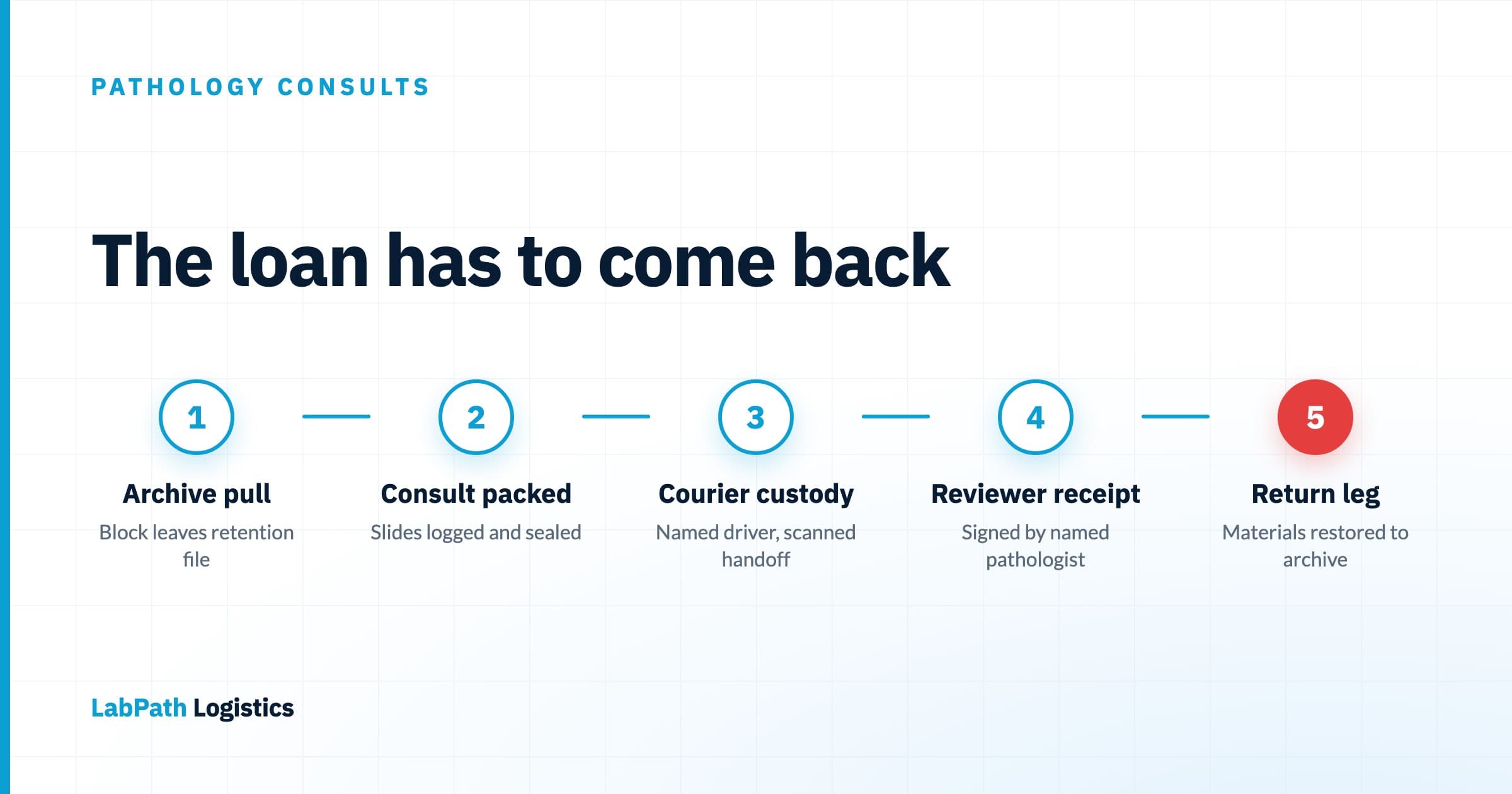
The Return Leg Is the One That Fails
Outbound consult shipments usually get attention because someone is waiting on an answer. The return leg has no clinical urgency attached to it — the diagnosis has already been rendered and the report has already gone out — so it inherits whatever priority the receiving institution's mailroom assigns it, which is often none.
This is where the round trip quietly breaks. The consulting pathologist signs out the case, the report reaches the referring clinician, everyone considers the episode closed, and the borrowed materials sit in a drawer at the reviewing institution for months. The originating lab discovers the loss during an accreditation inspection or, worse, when a patient recurs three years later and the oncologist requests the block for genomic profiling.
Molecular testing consumes the asset
A consultation that ends in next-generation sequencing or another tissue-consuming assay may return less material than it borrowed, or none at all. Decide before the block leaves whether it may be sectioned or exhausted, record that decision, and require the reviewing site to document what it consumed. A block that comes back thinner is a legitimate outcome. A block that comes back thinner with no record of why is a retention problem.
What the Error Data Actually Shows
Identity is the failure mode, not breakage. The College of American Pathologists quantified this in a Q-Probes study of 136 institutions published in Archives of Pathology & Laboratory Medicine. Across 1,811 mislabeling occurrences, Nakhleh and colleagues measured rates per 1,000 of 1.1 cases, 1.0 specimens, 1.7 blocks, and 1.1 slides — with blocks the most frequently mislabeled item of the four.
1.7 per 1,000
Block mislabeling rate across 136 institutions in the CAP Q-Probes study (Nakhleh et al., Arch Pathol Lab Med, 2011) — the highest rate of the four item types measured.
Two findings from that study travel directly into courier design. Errors were typically caught in the first or second step immediately following the error, which means every additional handoff without a check is a step where a defect can pass through unexamined. And in 1.3 percent of occurrences, participants judged that patient care was affected. Mislabeling inside a controlled histology workflow is uncommon; the point is that it happens at all in the environment with the most checks, which is not the environment a consult shipment travels through.
A courier cannot prevent a labeling error made at the block bench. It can prevent an inventory error in transit — the wrong case pulled, two consults merged into one envelope, a returned tray filed against the wrong accession — by requiring that the item count and the case identifiers be verified against a manifest by a named person at both ends. That is the same discipline described in our guide to chain of custody for medical couriers, applied to items that cannot be recollected.
Consultation Volume Is Not Marginal
Second-opinion review is a routine quality mechanism, not an exception process, and it produces real diagnostic change. In a one-year review of 4,239 second-opinion cases at the Medical College of Wisconsin, published in the International Journal for Quality in Health Care, 3.7 percent showed major discordance without a change in management and 1 percent — 42 cases — showed major discordance that did change clinical management. Discordance varied sharply by specialty, reaching 15.3 percent for thyroid fine needle aspiration.
One percent of a single institution's annual consult volume is 42 patients whose treatment changed because glass moved between buildings. Every one of those cases depended on the materials arriving intact, correctly identified, and attributable to the right person. The transport leg is not administrative overhead attached to the diagnosis. For those patients it is part of the diagnosis.
What to Require From a Pathology Courier
Consider a Houston-area community hospital sending twelve breast core biopsy slides and two blocks to a subspecialty reader in the TMC corridor. The materials leave a retention archive, cross the city, get handled by a receiving laboratory that did not create them, and must return complete. Six controls make that trip defensible.
- A manifest listing every accession number and item count, verified and signed by a named person at release and again at receipt.
- A custody record that timestamps each transfer and names the individual — never an unattended drop, and never a shared front-desk signature.
- A rigid, cushioned slide carrier with the case identifiers on the outer container as well as on each item, so a miscount is visible before the container is opened.
- An explicit written decision on whether blocks may be sectioned or consumed, and a requirement that the reviewer document what was used.
- A scheduled, tracked return leg booked at the same time as the outbound leg, rather than left for the receiving site to arrange later.
- A reconciliation step that closes the loan in the laboratory information system when the materials are physically back in the archive.
The sixth control is the one most often missing. A consult is not complete when the report is signed; it is complete when the materials are back on the shelf and the record says so. Facilities that already run structured send-out testing logistics can extend the same reconciliation discipline to consult loans with very little new process.
Ambient transport is normally appropriate for stained slides and paraffin blocks, which is why this work is often treated casually. Houston summer conditions still argue for a climate-controlled vehicle compartment rather than a closed trunk, since paraffin softens well below the temperature a parked vehicle reaches on a July afternoon. Fresh tissue is a different problem entirely, addressed in our guide to surgical pathology specimen transport.
Key Takeaway
Pathology slide and block transport should be governed as a documented loan of regulated records, not as an errand. CLIA requires histopathology slides to be retained 10 years and blocks 2 years, and that obligation does not pause while the materials sit in another institution's building. CAP data shows blocks are the most frequently mislabeled item in the pathology workflow, and second-opinion review changes management in roughly 1 percent of cases — so the stakes on both identity and return are concrete. Book the return leg with the outbound leg, require a named signature and a verified item count at both ends, and close the loan in the system when the glass is physically back in the archive.
Frequently Asked Questions
How long must a lab keep pathology slides and blocks?
Under 42 CFR 493.1105, a CLIA-certified laboratory must retain histopathology slides for at least 10 years from the date of examination, cytology slide preparations for at least 5 years, and pathology specimen blocks for at least 2 years. Remnant tissue must be preserved until a diagnosis is made on the specimen, and pathology test reports carry their own 10-year retention floor. These are federal minimums, not targets — accrediting organizations and institutional policies frequently set longer periods, and many laboratories hold blocks well beyond two years because of their value for later molecular testing. Materials on loan to an outside consultant remain within the originating laboratory's retention obligation for the entire time they are gone.
Can pathology slides and blocks be shipped at room temperature?
Yes, in normal circumstances. Stained glass slides and formalin-fixed, paraffin-embedded blocks are stable at ambient temperature and do not require refrigeration, which is why they are often sent through ordinary mail or interoffice channels. The practical caution is heat rather than cold: paraffin softens at temperatures a closed vehicle readily reaches during a Houston summer, so a climate-controlled compartment is the safer default from roughly May through October. Physical protection matters more than temperature for slides — a rigid, cushioned carrier prevents the cracking and chipping that a padded envelope does not.
Who is responsible if consultation slides are lost in transit?
Responsibility for the retention obligation stays with the originating laboratory regardless of who lost the materials, which is the core reason to control the transport leg rather than delegate it informally. The laboratory that performed the original examination is the one that must be able to produce slides within the CLIA retention window and the one an inspector will ask. A carrier may bear contractual liability, but no contractual remedy reproduces a paraffin block. The practical protection is documentary: a signed manifest with item counts at release and receipt establishes exactly where custody transferred, which both narrows the search when something goes missing and demonstrates that the sending laboratory exercised control.
Should a pathology consult use a courier or standard shipping?
Use a courier when the materials are irreplaceable, which for archival slides and blocks is essentially always. The operational difference is not speed but custody: a parcel service documents that a package moved between addresses, while a medical courier documents that named individuals transferred a verified set of items at recorded times. That distinction is what lets you reconstruct a loan later. Standard shipping is defensible for recut slides produced specifically for the consult and not required for retention, where the original block stays home. For any shipment that empties a retention file, the round trip should be booked, tracked, and reconciled as a single job.