Surgical Pathology Specimen Transport: A Houston Guide
July 27, 2026 · By LabPath Logistics Editorial Team, Medical Logistics Desk
Quick Answer
Surgical pathology specimen transport is governed by a clock that starts the moment tissue leaves the patient. ASCO/CAP guidance calls for cold ischemia time under one hour and fixation in 10% neutral buffered formalin for 6 to 72 hours, which means every minute a specimen spends in a vehicle is spent inside a biomarker-testing window. The courier leg therefore has two jobs: move fixed containers without leaks or vapor exposure, and move unfixed tissue fast enough that the receiving lab can still get it into fixative on time.
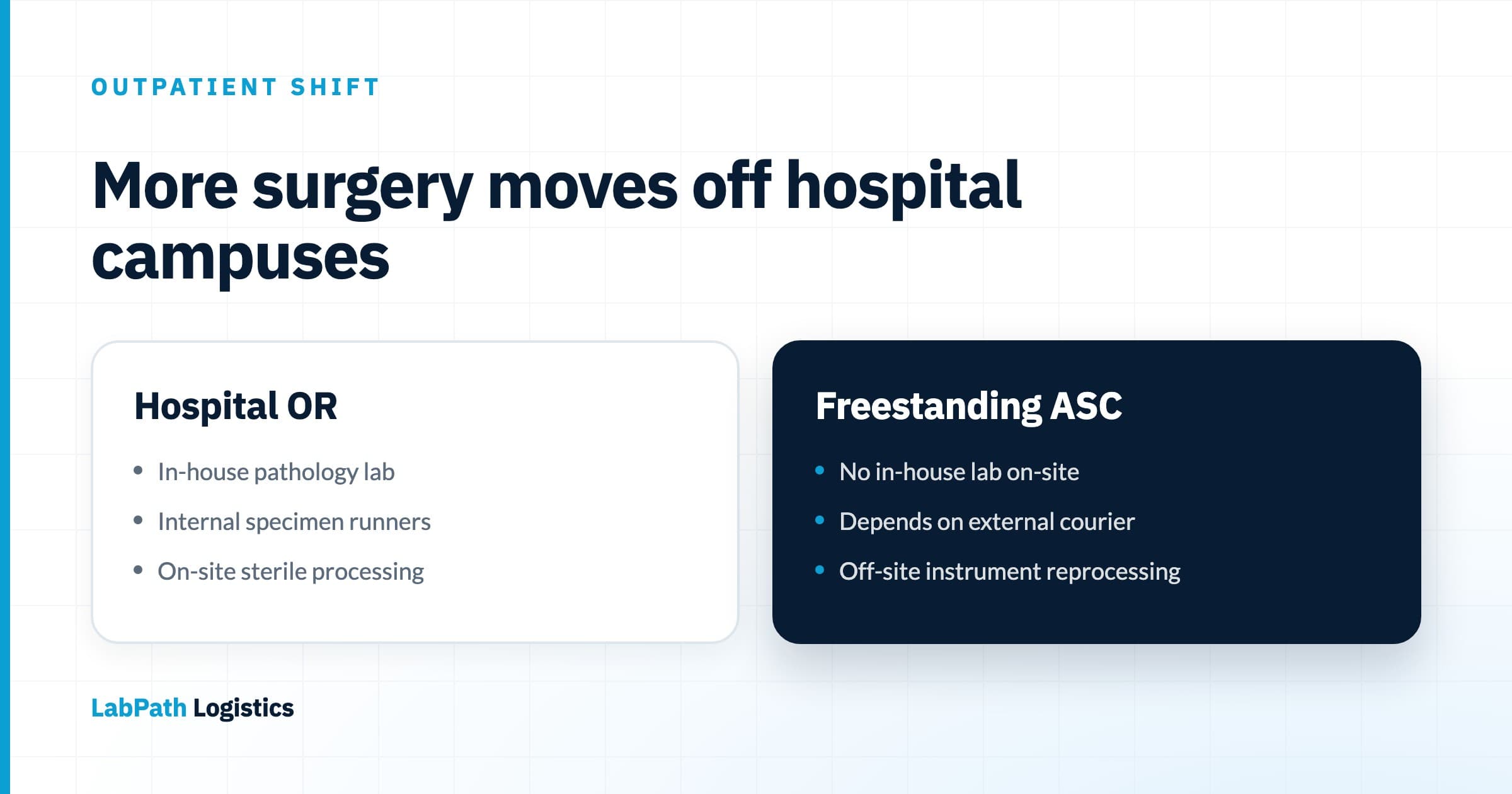
Most transport conversations in a hospital revolve around blood tubes and STAT chemistry. Surgical pathology gets less attention and carries more consequence: a single breast resection or lung wedge is unrepeatable, and the test that determines a treatment plan runs on tissue whose quality was decided hours before the pathologist saw it. Surgical pathology specimen transport is where that decision gets made. This guide covers the clock that governs it, what the evidence says about delay, why formalin is a transport problem and not only a lab problem, and what a Houston facility should require from a courier before the next OR case.
The Clock Starts in the Operating Room
Cold ischemia time is the interval between the moment tissue loses its blood supply and the moment it enters fixative. It is the one preanalytic variable that transport can wreck and no downstream process can repair.
The ASCO/CAP recommendations for hormone receptor testing set the parameters directly: time from tissue acquisition to fixation should be as short as possible, samples are fixed for a minimum of 6 hours in 10% neutral buffered formalin and for no longer than 72 hours, and specimens should be sliced at 5 mm intervals after gross inspection so fixative can actually penetrate. A cold ischemia time under one hour is the widely applied working limit.
6 to 72 hours
Required fixation window in 10% neutral buffered formalin for ER and PgR testing — with cold ischemia time kept as short as possible (ASCO/CAP guideline recommendations)
The documentation burden is just as explicit. The College of American Pathologists states that the time the tissue is removed from the patient, the time it is placed in fixative, the cold ischemia time, the duration of fixation, and the fixative type must all be recorded. If a specimen crossed town between those two timestamps and nobody logged the transit, the record has a hole in it exactly where a reviewer will look.
What the Evidence Actually Shows About Delay
It is worth being precise here rather than alarmist, because the one-hour figure is a safety margin and not a cliff edge. Controlled work published in Modern Pathology subjected breast resection specimens to cold ischemic intervals of 0.5, 1, 2, 3, 4, 24, and 48 hours, both refrigerated and at room temperature.
The finding: significant reduction in immunohistochemical staining for hormone receptors and HER2 generally did not appear until 4 hours for refrigerated samples and 2 hours for non-refrigerated samples, with non-refrigerated tissue affected more by prolonged delay. The same work noted that an interval as short as half an hour could occasionally affect progesterone receptor staining.
2 h vs. 4 h
Cold ischemic interval at which significant IHC staining loss appeared for non-refrigerated versus refrigerated breast specimens (Yildiz-Aktas et al., Modern Pathology)
Two operational conclusions follow. First, temperature during transit is not a nicety for unfixed tissue — it is the difference between a two-hour tolerance and a four-hour one. Second, a courier route that routinely burns 90 minutes on unfixed tissue is not safely inside the guideline even though it has not yet reached the point where the literature shows consistent damage. Facilities do not get to spend the safety margin; the margin exists because gross rooms get backed up and OR schedules run late.
Formalin Is a Transport Problem, Not Just a Lab Problem
Once tissue is in fixative, the biology risk drops and a chemical handling risk replaces it. Formalin containers ride in a vehicle with a driver for hours, and the exposure standard does not stop at the loading dock.
OSHA's formaldehyde standard, 29 CFR 1910.1048, sets a permissible exposure limit of 0.75 ppm as an 8-hour time-weighted average, a 15-minute short-term exposure limit of 2 ppm, and an action level of 0.5 ppm as an 8-hour TWA. A driver spending a full shift in a cabin with poorly sealed containers is an exposed employee under that standard, not a bystander.
0.75 ppm
OSHA 8-hour TWA permissible exposure limit for formaldehyde, with a 2 ppm 15-minute STEL and a 0.5 ppm action level (29 CFR 1910.1048)
Hazmat classification is a separate question from exposure control, and concentration decides it. The DOT entry most people picture, UN 2209, is defined as "formaldehyde solutions, with not less than 25 percent formaldehyde" and carries a Class 8 corrosive assignment. Standard 10% neutral buffered formalin sits well below that threshold, which is why routine fixed-tissue transport usually looks nothing like a corrosive shipment.
Confirm this against your own SDS
Concentration, methanol content, and container size all affect how a formaldehyde solution is classified and shipped, and bulk fixative resupply is a different shipment from a patient specimen in a prefilled container. Treat the thresholds above as orientation, then verify the classification for the exact product and package you move with your safety officer and the supplier's safety data sheet.
Whatever the classification, the practical controls are the same ones we cover in our DOT and OSHA compliance guide: sealed primary containers, absorbent secondary containment sized to the volume carried, upright and restrained transport, a spill kit the driver has actually been trained on, and a standing rule that nobody opens or tops off a fixative container inside a vehicle.
Fresh and Fixed Are Two Different Transport Products
The most common failure in anatomic pathology logistics is treating one courier service as adequate for both states of tissue. They have opposite risk profiles.
- Unfixed tissue is a clock problem. Lymphoma workups, tumor banking, cytogenetics, flow cytometry, and specimens where margins must be assessed fresh all require speed and controlled temperature, because the cold ischemia interval is still running.
- Fixed tissue is a containment problem. The biology is stable; the hazard is a leaking container, a vapor exposure, or a bucket that tipped over on the Southwest Freeway.
- Volume and geometry differ. A gross room hands over buckets and oversized containers, not a rack of tubes, and a courier sized for phlebotomy routes will improvise a solution you do not want to see.
- Documentation differs. For unfixed tissue the record must support a cold ischemia calculation; for fixed tissue it must support custody and container integrity.
- Frozen section support is its own category — a specimen moving to a pathologist for an intraoperative read while the patient is still on the table has no tolerance for a routine route at all.
This is also why per-container custody capture matters more here than almost anywhere else. A surgical specimen cannot be redrawn, so the only recoverable evidence when something goes wrong is the transit record itself — the discipline we break down in our chain of custody guide.
The Houston Geometry
Houston concentrates this problem more than most metros. The Texas Medical Center reports more than 180,000 annual surgeries and one surgery beginning every three minutes across its member institutions — a continuous stream of tissue that has to reach a gross room inside a defined window.
180,000+
Annual surgeries performed across Texas Medical Center institutions — roughly one beginning every three minutes (Texas Medical Center)
The oncology volume behind those cases is growing too. The American Cancer Society's 2026 projections estimate 161,330 new cancer cases in Texas this year, including 24,270 new female breast cancers — the tumor type whose receptor testing is most tightly bound to cold ischemia and fixation timing.
Now picture the routing problem. An ambulatory surgery center in Sugar Land finishes a lumpectomy at 4:40 p.m. The specimen is unfixed, the reading pathology lab is inside the Loop, and the pickup is scheduled against a route that also serves three clinics. Between the ASC and the gross room sit US 59 and a Houston rush hour. If the courier is running a general medical route, that specimen's cold ischemia time is decided by traffic. If the courier is running a dedicated OR-to-lab leg with a committed window and temperature control, it is decided by a contract. Add a July afternoon and the ambient exposure we cover in our Houston heat and specimen integrity guide stacks on top of it.
What to Require From a Surgical Specimen Courier
Before adding anatomic pathology to a transport agreement, confirm the partner can document all of the following:
- A committed pickup-to-delivery window for unfixed tissue, expressed in minutes, not a place on a daily route.
- Timestamps at surgical release and at lab receipt, so the receiving lab can compute cold ischemia time rather than estimate it.
- Temperature control and recorded evidence for unfixed specimens — refrigerated transit measurably widens the tolerance.
- Secondary containment and absorbent capacity rated for the fixative volume actually carried, plus a documented spill procedure.
- Formaldehyde awareness and hazard communication training on file for every driver who handles fixed specimens.
- Container-level custody records, not batch-level manifests — one bucket, one line item.
- A defined escalation path for a delayed, damaged, or leaking container, including who at the lab gets called and how fast.
- A signed business associate agreement, since requisitions and container labels on a surgical specimen carry protected health information.
Turn those into measurable commitments rather than assurances — our SLA evaluation guide covers how to write transport terms you can actually audit, and our specimen rejection guide covers what happens downstream when they are missing. The compliance page documents how LabPath Logistics handles custody, packaging, and temperature evidence, and the features page shows what the tracking record looks like on a live run.
Key Takeaway
Surgical pathology is the one specimen category where transport failure is unrecoverable. The guideline framework is clear — cold ischemia time as short as possible, 6 to 72 hours in 10% neutral buffered formalin, and every one of those timestamps recorded. The published data says refrigerated tissue tolerates roughly twice the delay of room-temperature tissue, which makes transit temperature a clinical control rather than a comfort feature. And once tissue is fixed, the risk shifts to a driver, a container, and a formaldehyde exposure standard that applies inside the vehicle. For Houston facilities moving tissue between an ambulatory surgery center and a reading lab across the metro, that is a contract question long before it is a pathology question.
Frequently Asked Questions
What is cold ischemia time in surgical pathology?
Cold ischemia time is the interval between when tissue is removed from the patient and when it is placed in fixative. ASCO/CAP guidance directs that this interval be kept as short as possible, with under one hour applied as the working limit for breast biomarker testing, and requires that the removal time, the time placed in fixative, the cold ischemia time, the fixation duration, and the fixative type all be recorded.
How long can a surgical specimen sit in formalin before testing?
For estrogen and progesterone receptor testing, ASCO/CAP recommendations specify fixation in 10% neutral buffered formalin for a minimum of 6 hours and no longer than 72 hours. Specimens should be sliced at roughly 5 mm intervals after gross inspection so the fixative can penetrate adequately.
Is formalin a DOT hazardous material for ground transport?
It depends on concentration. The corrosive entry UN 2209 covers formaldehyde solutions with not less than 25 percent formaldehyde, and standard 10% neutral buffered formalin falls well below that threshold. Separately, OSHA's formaldehyde standard at 29 CFR 1910.1048 applies to driver exposure regardless of DOT classification, with a 0.75 ppm 8-hour TWA limit and a 2 ppm 15-minute STEL. Confirm the classification for your specific product and package size with your safety officer and the supplier's SDS.
Does refrigerating an unfixed specimen during transport help?
The published evidence says yes. A Modern Pathology study of breast resection specimens found that significant loss of hormone receptor and HER2 immunohistochemical staining generally did not appear until about 4 hours in refrigerated samples versus about 2 hours in non-refrigerated ones. Refrigerated transit widens the tolerance; it does not remove the requirement to keep cold ischemia time short.