After-Hours Medical Courier Houston: Night Coverage
August 19, 2026 · By LabPath Logistics Editorial Team, Medical Logistics Desk
Quick Answer
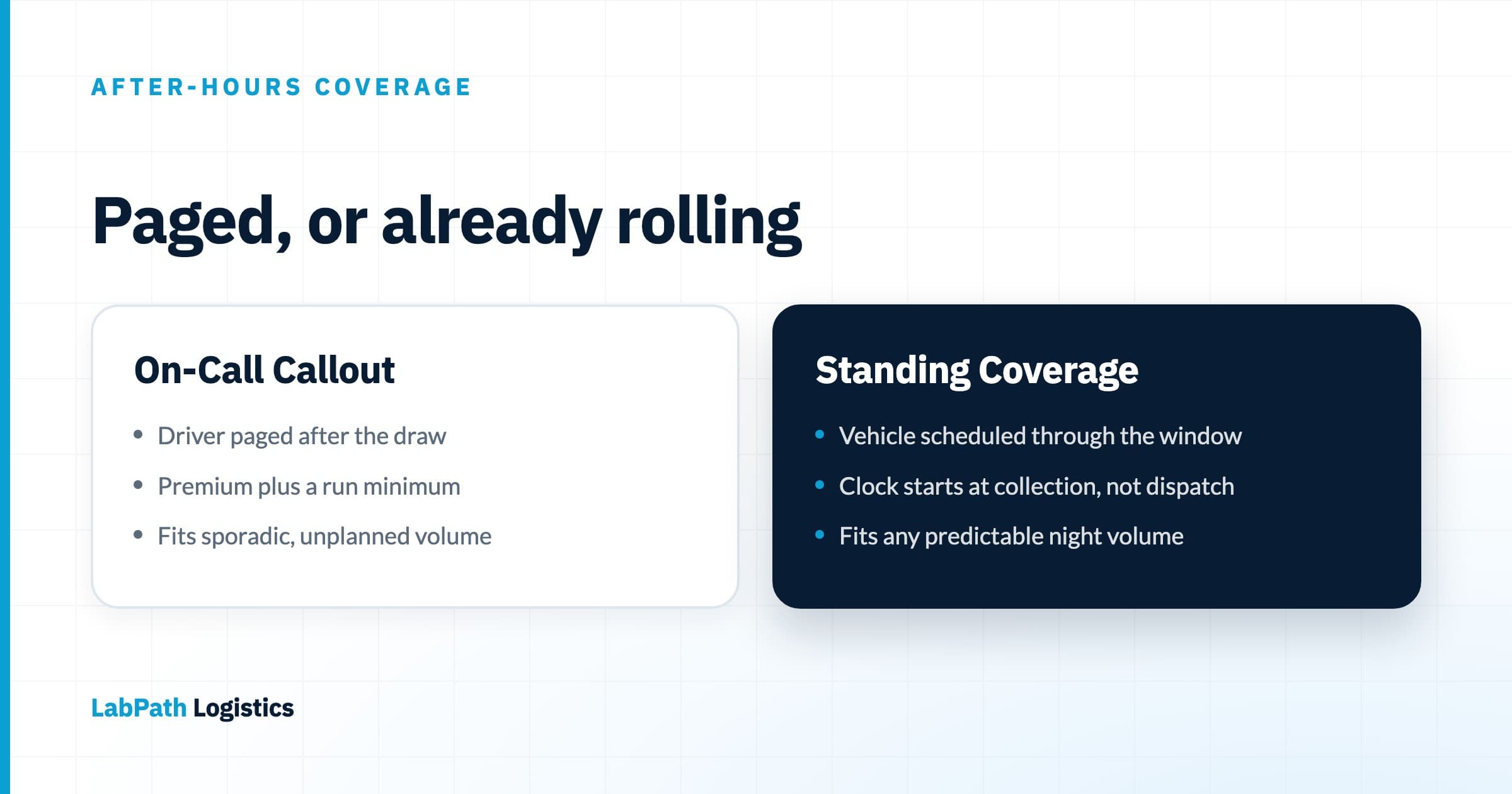
After-hours medical courier coverage is a defined, staffed path for specimens and medications between the last scheduled pickup of the day and the first one the next morning — nights, weekends, and holidays. You can buy it two ways: on-call callout, where you page a driver and pay a premium plus a minimum per run, or standing coverage, where a vehicle is already scheduled through the window. The deciding question is not the price per run. It is whether the receiving laboratory is open and staffed to accession what you send, because a specimen delivered to a dark dock at 2 a.m. has moved without progressing.
An after-hours medical courier is the line item nobody budgets for and everybody eventually needs. Day routes get designed, priced, and audited. The window between the last scheduled pickup and the first one tomorrow morning is usually improvised — a phone number, a supervisor's cell, and the hope that whoever answers can find a vehicle. That improvisation holds until the night it does not, and the specimen that pays for it was drawn from a patient who has already gone home.
Emergency departments, dialysis units, skilled nursing facilities, and freestanding ERs do not close at five o'clock, and neither do the stability windows on what they collect. Below is how the after-hours gap forms, where it actually fails, and how to buy coverage that survives a Houston holiday weekend.
Why the After-Hours Gap Forms
Demand is continuous. There were 155 million emergency department visits in the United States in 2022, according to the CDC's National Center for Health Statistics — a volume distributed across every hour of the clock, not compressed into business hours. Collection does not stop at night. Transport capacity usually does.
The counterintuitive part is what happens to the test menu. After hours, on-site capability shrinks. Hospital labs run a reduced night menu, physician office labs and clinics are closed outright, and specialty assays that a day shift would batch and run in-house become send-outs. A larger share of what gets collected overnight has to physically move to a performing laboratory — exactly when the fewest vehicles are on the road.
The gap is structural, not accidental
After-hours volume is lower in absolute terms and higher in proportion of specimens requiring transport. Facilities that size night coverage off raw specimen counts consistently undersize it.
Meanwhile, the clocks that matter keep running. The CMS SEP-1 sepsis measure expects lactate measurement, blood cultures drawn before antibiotics, and broad-spectrum antibiotics inside a three-hour window from time zero, with a repeat lactate within six hours when the first is elevated — a structure summarized in this peer-reviewed review of the measure. Nothing in that clock pauses at 11 p.m. because the day route ended.
Two Ways to Buy After-Hours Coverage
On-Call Callout
You page dispatch, a driver is activated, and a vehicle is sent for your run. Billing is typically a premium rate plus a minimum charge, because the vehicle is dedicated to you for the entire trip.
- The response clock starts at your call, not at collection — activation time is added to drive time, and it is the part vendors quote least precisely.
- Unit cost is high, but you pay only for nights that actually generate work.
- Reliability depends on who is genuinely on call versus who is merely listed. Ask how the on-call roster is staffed and what happens when the first driver does not answer.
- Best fit: facilities with sporadic, unpredictable after-hours events — a few runs a month, no pattern.
Standing Coverage
A vehicle is already scheduled through the window, whether or not you have volume that night. It behaves like a day route that happens to run in the dark.
- The clock starts at collection, because there is no activation step to absorb.
- Cost per stop falls as volume rises, and the run can be shared across several facilities in the same corridor.
- Coverage is verifiable in advance — you know a vehicle exists before you need it, rather than discovering otherwise at 2 a.m.
- Best fit: any facility with predictable nightly or weekend volume, and any facility where a single missed window is more expensive than a month of coverage.
Choosing between them is an evidence question, not a preference. Log every after-hours transport event for thirty days — the time it was requested, what it was, and what it cost you when it was late. Facilities almost always find more events than they assumed, clustered on predictable nights. That log is also the input for the cadence math in our guide to scheduled versus on-demand routes.
The Failure Point Is the Receiving End
After-hours transport rarely fails at the pickup. It fails at the destination, where the assumptions built for daytime quietly stop being true. The dock is closed. The badge that works at 3 p.m. does not work at 3 a.m. The specimen processing window has moved to a different entrance. There is no accessioning technologist on the floor to receive anything.
That last one matters more than it sounds, because receipt is a regulated event. Under 42 CFR §493.1242, the laboratory must establish and follow written policies for specimen handling — including conditions for transportation — and must document the date and time it receives a specimen. A drop box does not sign for anything. If your after-hours path ends in an unmanned refrigerator, you have moved the specimen without closing the custody record, and the receipt timestamp will reflect whenever someone opened the box in the morning.
Work each after-hours destination out in advance, in writing:
- Which entrance is open at that hour, and does the driver have credentialed access to it?
- Is there a staffed receiving point, or an approved unmanned drop with defined temperature control?
- Who signs, and if nobody signs, how is the custody record closed and by whom?
- Does the performing laboratory's after-hours receipt process change the accession time in a way that affects turnaround expectations?
- What is the escalation path when the driver arrives and cannot get in — a named contact, not a general voicemail?
What Night Actually Looks Like in Greater Houston
One thing improves after dark: the drive. The corridors that punish a 4 p.m. run through the Texas Medical Center are open at midnight, and a route that is unpredictable at rush hour becomes one of the most reliable transit times of the day. Night coverage is not slower than day coverage. It is thinner.
What replaces traffic as the variable is access and weather. Flooding closes underpasses on short notice, overnight construction reroutes surface streets without warning, and a building that is staffed at noon may be locked and dark at 2 a.m. with a single security desk between your driver and the lab.
The demand side is also growing. Houston Methodist's Centennial Tower, a $1.4 billion, 26-story project in the Texas Medical Center slated to open in 2027, includes an emergency department nearly double the size of the current one. Emergency capacity added in the TMC corridor is, by definition, capacity that runs at 3 a.m. — and every facility that feeds specimens into or out of that corridor should assume after-hours transport demand goes up, not down, over the next few years.
Holidays Break More Routes Than Nights Do
Nights are at least predictable. Holidays require reconciling three separate calendars that are almost never the same document: your courier's observed holidays, your performing laboratory's holiday schedule and adjusted cutoff times, and the overnight carriers' service suspensions for anything shipped rather than driven.
A Thursday holiday plus a Friday skeleton crew is a four-day gap for anything with a short stability window, and it is the single most common cause of holiday specimen loss. The fix is calendar work, not heroics — and it belongs in the same planning cycle as your send-out testing logistics.
- Thirty days out, request written holiday schedules from both the courier and every performing laboratory you use.
- Identify which assays cannot survive the longest gap on that calendar, and decide in advance whether they get held, rerouted, or collected on a different day.
- Confirm in writing whether after-hours or holiday runs are billed differently, and whether coverage is standing or callout on those specific dates.
- Tell clinical staff the actual cutoff before the holiday, not the usual one. Most holiday losses are collections made after a cutoff nobody communicated.
Put the After-Hours Terms in the Agreement
Most courier agreements describe day service in detail and after-hours service in a sentence. That sentence is where disputes live. Specify the following, or expect to negotiate them during an incident:
- The precise window — start time, end time, days of the week, and the named holidays included or excluded.
- How coverage is activated, by whom, and through what channel, with a documented fallback when the primary channel does not answer.
- A response expectation you can measure, stated from a defined starting event, plus what happens when it is missed.
- Which temperature lanes are actually available after hours. Refrigerated and frozen capability on a night vehicle is a staffing and equipment question, not an assumption.
- The custody record standard at unmanned sites, matching the documentation expectations covered on our compliance page.
- A named escalation contact with a real phone number, and a second one behind it.
If you are drafting or renegotiating these terms, the structure and vocabulary in our medical courier SLA guide applies directly — the difference after hours is simply that fewer people are available to absorb an error, so the written terms carry more weight.
Key Takeaway
After-hours coverage is not a premium version of day service. It is a different operating problem: proportionally more specimens need to move, fewer vehicles are available to move them, and the receiving end is likely to be closed. Log your real after-hours events for a month, decide between callout and standing coverage on that evidence, and solve the destination before you solve the pickup. The specimen that fails overnight is the one nobody planned a landing for.
Frequently Asked Questions
What is an after-hours medical courier?
An after-hours medical courier provides specimen, pharmaceutical, and medical materials transport outside standard scheduled route hours — nights, weekends, and holidays. It is bought in one of two forms. On-call callout means a driver is paged when you have a run, typically billed at a premium rate plus a minimum. Standing coverage means a vehicle is already scheduled through the window regardless of volume. The practical difference is where the clock starts: callout adds activation time on top of drive time, while standing coverage begins measuring at collection.
Do medical couriers run on nights, weekends, and holidays in Houston?
Coverage varies widely by vendor, and the word most agreements use is not the word facilities hear. Ask three specific questions rather than accepting a general answer: which exact hours are covered on each day of the week, which named holidays are observed as non-service days, and whether the coverage is standing or activated by callout. Also confirm which temperature lanes are available after hours — a night vehicle without refrigerated capability cannot carry what your day route carries.
How much more does after-hours courier service cost?
Expect a structural premium rather than a fixed multiplier, because the cost drivers change. After hours, a vehicle is usually dedicated to your run instead of shared across a route, so you are buying the whole trip rather than a stop on it. Callout pricing typically combines a premium rate with a minimum charge, while standing coverage is priced as scheduled service and falls per stop as volume rises. Ask for the billing structure in writing — the rate, the minimum, what triggers it, and how holidays are treated — and compare it against the cost of the recollections and delayed results the coverage prevents.
What happens if the receiving laboratory is closed when the courier arrives?
That depends entirely on what was arranged in advance, which is why the destination deserves more planning than the pickup. If the laboratory has an approved unmanned receiving point with defined temperature control, the specimen can be secured, but the receipt timestamp will generally reflect when staff processed it rather than when it arrived. Under 42 CFR §493.1242 the laboratory must document the date and time it receives a specimen, so an unmanned drop shifts that documented time. If no approved receiving point exists, the driver has nowhere to complete the handoff, and the specimen either returns or sits — both bad outcomes that a fifteen-minute conversation during onboarding would have prevented.