Liquid Biopsy Specimen Transport for Houston Labs
September 6, 2026 · By LabPath Logistics Editorial Team, Medical Logistics Desk
Quick Answer
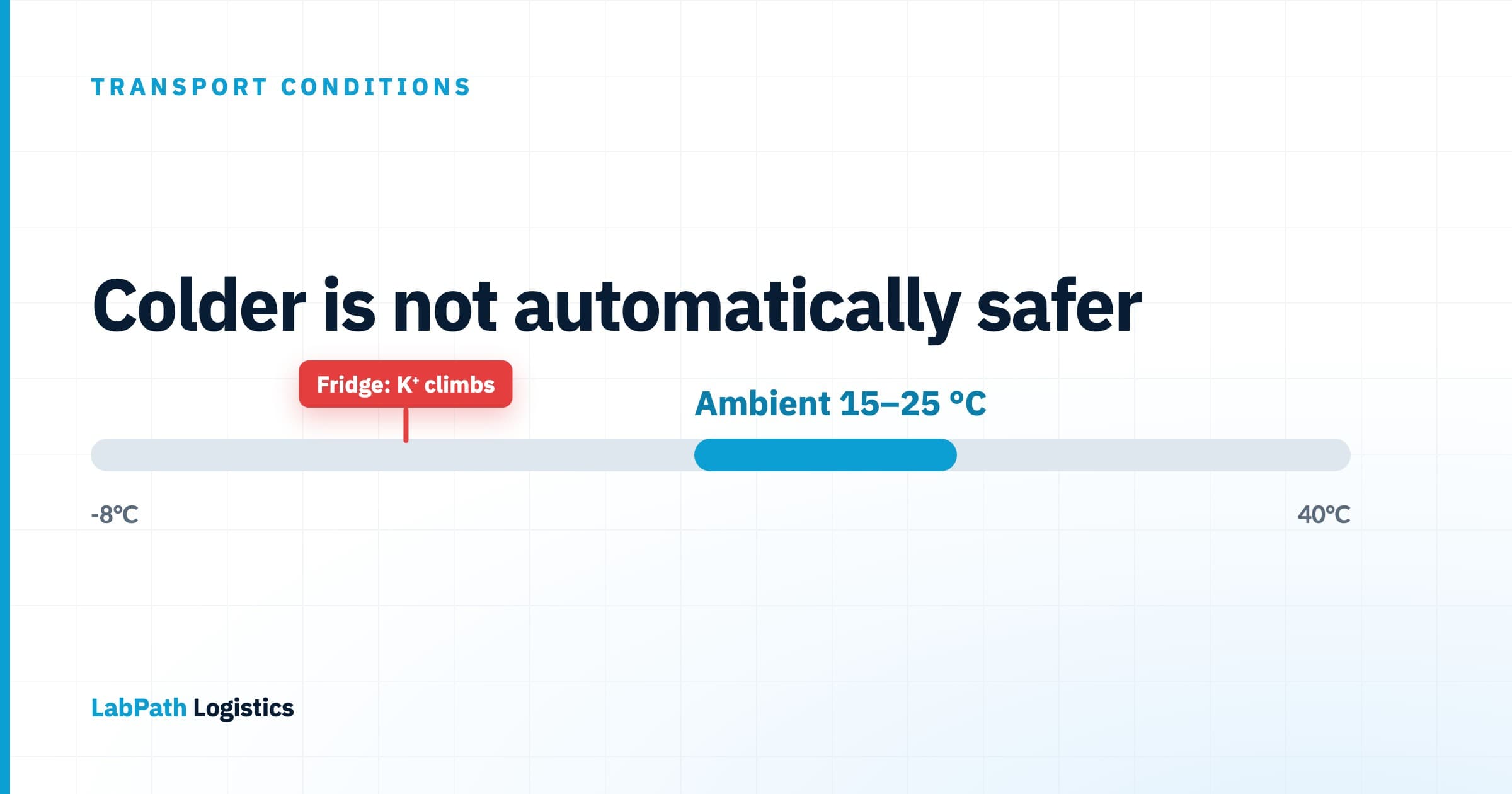
Liquid biopsy specimen transport is governed by the stabilization tube, not by habit. The FDA-cleared Streck Cell-Free DNA BCT holds whole blood at 18°C to 25°C for up to seven days before it must be processed to plasma — no refrigeration, no dry ice. But that ambient window is a validated band with a floor and a ceiling, not an instruction to skip protocol. A courier bag left in a Houston vehicle in July can push a tube's temperature above the validated range in minutes, and a cold pack meant for a routine chemistry specimen can push it below that same range just as easily. Either excursion moves the sample outside the conditions the assay manufacturer actually tested.
Liquid biopsy specimen transport gets treated like an afterthought at a lot of Houston practices, precisely because the sales pitch for these tubes is that cold chain isn't required. That's true, and it's also the reason the specimens go wrong. When a courier hears "no refrigeration needed," the instinct is to relax the handling rather than to swap one protocol for another. A cell-free DNA tube sitting on a car seat in July hasn't avoided a temperature requirement — it's drifting out of a different one, in the opposite direction from the cold-chain failures most courier training is built around.
Ambient Doesn't Mean Unmanaged
The whole commercial appeal of a stabilizing blood collection tube is that a reference lab in another city can accept a same-week specimen without a cold-chain courier, dry ice, or a narrow same-day pickup window. That's a real advantage for a lab menu that's expanded fast across oncology, prenatal screening, and pharmacogenomics send-outs. But "stable at room temperature" is a specific, tested claim about a specific temperature range and a specific number of days — not a statement that the specimen is now indifferent to its environment. Treating an ambient-stabilized tube like ordinary mail is the most common way Houston practices lose a liquid biopsy draw before it ever reaches the lab.
What the Stabilization Tubes Actually Require
Streck's Cell-Free DNA BCT is the FDA-cleared reference point here, and its instructions for use are specific rather than aspirational. Whole blood collected into the tube should be stored at 18°C to 25°C for up to seven days prior to processing to plasma — a validated window that lets a specimen travel by ground courier instead of overnight cold-chain freight. Streck's own stability data was generated under both summer and winter shipping conditions, which is exactly why the claim holds up outside a climate-controlled lab. It does not mean the claim holds up outside a temperature-controlled vehicle.
18–25 °C
FDA-cleared validated window for the Streck Cell-Free DNA BCT — up to seven days, no refrigeration and no dry ice, but a band with both a floor and a ceiling.
Cleared performance for that tube has only been established with specific downstream NGS assays, which is a detail that matters for a lab evaluating a new send-out menu: the stabilization claim travels with the tube, but the analytical claim travels with the assay it was validated against. A courier doesn't need to know the assay. A courier does need to know which tube is in the bag, because a molecular order and a routine chemistry order riding in the same pickup can have opposite temperature instructions.
In Houston, the Heat Problem Runs the Wrong Direction
Most of what gets written about Houston and specimen transport is a cold-chain story: a 2-8°C blood tube or a frozen aliquot losing ground to summer heat, as we've covered in Houston summer heat and specimen integrity, where asphalt temperatures regularly exceed 140°F (60°C) in July. That same heat is still the threat here — the ambient band's ceiling is 25°C, and a courier bag on a hot seat clears that number fast. What's different is the other side of the band. A routine impulse to be careful with a lab specimen is to add a cold pack. For a cell-free DNA tube, an over-eager cold pack that drops the tube below 18°C is just as far outside the validated range as the heat is.
Two ways to fail the same specimen
A liquid biopsy tube left in a hot vehicle fails high. The same tube packed next to an ice pack meant for a cold-chain draw fails low. Both outcomes leave the sample outside the manufacturer's tested conditions — the fix isn't "treat it like cold chain" or "treat it like nothing." It's knowing which band applies and holding it deliberately in both directions.
The Privacy Layer That Doesn't Apply to a Chemistry Panel
A liquid biopsy specimen carries a compliance dimension that a basic metabolic panel doesn't: it's genetic information, and federal law treats that as a distinct category. The Genetic Information Nondiscrimination Act of 2008 bars health insurers and employers from using genetic information for coverage or employment decisions, and the 2013 HIPAA Omnibus Rule folded genetic information explicitly into the definition of protected health information for covered entities and their business associates. That doesn't change how a courier packs a tube, but it raises the stakes on the custody side — a misdirected or unlogged genetic specimen isn't just a redraw, it's protected health information that moved without an accountable trail. The scan-level, named-individual handoff discipline in our chain of custody guide is the mechanism that keeps that trail intact for a molecular order the same way it does for any other specimen.
What to Require From a Courier
- Written confirmation of which collection tube is in each order — a molecular send-out menu mixes ambient-stabilized draws with genuinely frozen ones, and they cannot travel under one assumption.
- Ambient specimens carried in their own compartment, not co-mingled inside a cold-chain tote where an ice pack can pull them below the validated floor.
- No dashboard, no trunk, and no direct sun during transit — a parked vehicle in Houston clears the ceiling of an 18-25°C band well before it clears a 2-8°C one.
- A time-stamped chain-of-custody scan at pickup and drop-off, keyed to the accession number, with a named individual at both ends.
- Courier staff trained to tell an ambient molecular order apart from a cold-chain or frozen one on sight — the packaging looks similar, and the handling instructions are opposite.
- A written escalation path if a pickup slips, since the seven-day window is generous but not infinite, and a delay compounds with whatever time already passed at the collection site.
Key Takeaway
Liquid biopsy specimen transport isn't a lighter version of cold chain — it's a different, equally specific requirement. The FDA-cleared Cell-Free DNA BCT holds whole blood at 18°C to 25°C for up to seven days, which is a real operational advantage for a Houston reference-lab menu that keeps expanding into oncology and prenatal molecular testing. That advantage only holds if the courier treats the ambient band as a band — protected from Houston heat on one side and from a well-meaning cold pack on the other — and logs custody with the same discipline genetic information demands under GINA and HIPAA's 2013 Omnibus Rule.
Frequently Asked Questions
Does liquid biopsy specimen transport need to be refrigerated?
No — that's the point of the stabilization chemistry. The FDA-cleared Streck Cell-Free DNA BCT is validated to hold whole blood at 18°C to 25°C for up to seven days before it needs to be processed to plasma, which is why these draws travel by ground courier rather than overnight cold-chain freight. That said, ambient does not mean unmanaged: the validated range has a ceiling as well as a floor, and a courier still has to keep the specimen inside it rather than assuming room temperature will happen on its own in a Houston vehicle.
What happens if a cell-free DNA tube gets too hot or too cold in transit?
Either direction takes the specimen outside the conditions the manufacturer actually tested. The tube's stabilization chemistry and the downstream sequencing assay's clearance are both tied to the validated 18-25°C window, so a specimen that ran hotter in a parked vehicle or colder next to a cold-chain ice pack has left that tested envelope. In practice this shows up as a lab flagging the specimen for the deviation, requesting information about the transport conditions, or in some cases requesting a redraw — the same kind of outcome a warm chemistry specimen produces, just triggered from the opposite temperature direction.
Is genetic test information handled differently for privacy than a routine lab specimen?
Yes, at the federal level. The Genetic Information Nondiscrimination Act of 2008 restricts how health insurers and employers can use genetic information, and the 2013 HIPAA Omnibus Rule explicitly added genetic information to the definition of protected health information for HIPAA-covered entities and their business associates. That means a liquid biopsy specimen carries the same custody obligations as any other PHI in transit, with the added weight that a lost or unlogged genetic sample raises discrimination exposure beyond a typical specimen. A courier's chain-of-custody discipline should not vary by specimen type — it should be the baseline for all of them.
How is ambient molecular specimen transport different from routine same-day courier work?
A routine chemistry or hematology panel usually has a short stability window and a single, well-understood risk: it degrades if it isn't kept in range for a few hours. An ambient-stabilized molecular specimen has a longer runway — up to seven days for the FDA-cleared cell-free DNA tube — but a narrower, more specific temperature band, and it needs to be identifiable to the courier as a distinct category so it isn't packed next to a cold-chain ice pack by default. The stakes on the custody side are also higher, since genetic information carries privacy obligations that a routine metabolic panel does not.