Correctional Facility Medical Courier Service in Houston
September 7, 2026 · By LabPath Logistics Editorial Team, Medical Logistics Desk
Quick Answer
A correctional facility medical courier serves a detention health clinic's lab and pharmacy needs under access rules a standard clinic pickup never encounters — security clearance for every driver, no unattended drop boxes, and custody handoffs at a sally port rather than a front desk. Texas county jails operate under a Commission-approved Health Services Plan (37 Tex. Admin. Code § 273.2) that requires prompt access to medical, mental, and dental care, which depends on a courier that can reliably clear intake without becoming the bottleneck. HIPAA still applies, but a specific exception (45 CFR § 164.512(k)(5)) governs how protected health information moves between a covered entity and a correctional institution while a person remains in lawful custody — a distinction a courier vendor needs to understand, not improvise.
A correctional facility medical courier has to solve a problem most medical courier contracts never mention: the clinic isn't reachable the normal way. There's no front desk to hand a cooler to, no unattended drop box, and no assumption that a driver can walk in, scan a barcode, and walk out. Every pickup at a detention facility health unit runs through security first — badge verification, a search, an escort, a controlled corridor — and a courier that hasn't built that into its routing either shows up late, gets turned away, or becomes the reason a specimen misses its window.
Why This Isn't a Standard Clinic Pickup
A jail or detention facility's medical unit functions like any other clinic on the inside — sick call, chronic disease management, send-out labs, pharmacy refills — but everything about getting to it is different. A courier can't pre-stage a badge for a facility they don't already have clearance at, can't leave a cooler unattended past a checkpoint, and can't treat a missed pickup window the way they would a private practice that's simply running behind. The clinic doesn't control the facility's security posture, and neither does the courier. Both are operating inside constraints set by the detention side, which means the courier's reliability has to be built around those constraints rather than around a generic same-day route.
The Access Problem: Sally Ports, Not Drop Boxes
Most STAT courier training assumes a badge-in lobby, a lab window, or at worst a locked drop box for after-hours pickups. None of that exists at a secure facility. Custody transfers happen at a sally port or a controlled intake point, under staff supervision, on the facility's schedule — not the courier's. A driver who hasn't been cleared in advance, who shows up without the right identification, or who doesn't know the facility's specific procedure for handing off a specimen cooler isn't a minor inconvenience; they're a security exception that detention staff have to manage, which is exactly the kind of friction that gets a courier's access privileges pulled.
3rd largest
Harris County Jail is the third-largest jail in the United States by average daily population — roughly 9,000 to 10,000 people held on any given day, according to the Harris County Sheriff's Office and comparative jail-population data. (WorldAtlas; Harris County Sheriff's Office)
Scale changes what "reliable" means. A facility of that size runs a medical unit with real clinical volume — sick call, chronic care, intake screening, mental health referrals — and a courier serving it needs standing clearance, a known point of contact, and a pickup routine the facility's staff can plan around, not a one-off vendor relationship re-negotiated at the gate every visit.
What Texas Requires of the Clinic — and Indirectly, the Courier
Texas county jails don't set their own medical policy from scratch. Under 37 Tex. Admin. Code § 273.2, each facility must have a written Health Services Plan, approved by the Texas Commission on Jail Standards, that covers regularly scheduled sick calls, referral for medical, mental, and dental services, and prompt care for acute and emergency situations, including obstetrical and nutritional care for pregnant individuals in custody. None of that rule mentions couriers directly — but a plan built around "prompt care" and "referral for services" depends on the logistics behind it actually working, the same dependency we cover in our medical courier SLA guide. A send-out lab result that's delayed because a courier missed a cleared pickup window doesn't just inconvenience a clinic; it's a gap against a standard the facility is required to meet.
The HIPAA Exception That Cuts Both Ways
HIPAA doesn't stop applying inside a detention facility, but it applies through a specific carve-out. Under 45 CFR § 164.512(k)(5), a covered entity may disclose protected health information to a correctional institution or law enforcement official with lawful custody of an individual when it's necessary for that person's health care, for the safety of other inmates or staff, or for the security and good order of the facility. A correctional institution that is itself a covered entity can use that same information for any purpose it could otherwise disclose it for. It's a real exception, not a suspension of the rule — and it comes with a hard edge. Our HIPAA-compliant medical courier guide covers the baseline custody discipline this exception sits on top of; see also our compliance page for how we structure Business Associate Agreements across facility types.
The exception ends at release
45 CFR § 164.512(k)(5) applies only while a person is in lawful custody. The moment someone is released — including to parole, probation, or supervised release — they're no longer an "inmate" for purposes of the rule, and the facility's normal HIPAA authorization requirements apply going forward. A courier moving lab results or records tied to a correctional health encounter needs a workflow that recognizes that boundary, not one that treats every record from that facility as permanently covered by the same exception.
NCCHC Accreditation: A Signal Worth Checking
Many correctional health programs pursue accreditation from the National Commission on Correctional Health Care, which publishes the leading standards for jail and prison health services and evaluates facilities across nine areas — including governance, health records, and medical-legal issues — through external peer review. Accredited facilities are re-inspected roughly every three years. A facility carrying that accreditation has already documented its expectations for outside vendors touching health information and specimen logistics; a courier that can speak to those expectations in a vendor review — rather than treating the facility like any other clinic stop — clears that review faster and keeps the relationship, the same vendor-vetting posture we outline on our features page.
What a Facility Should Require From a Courier
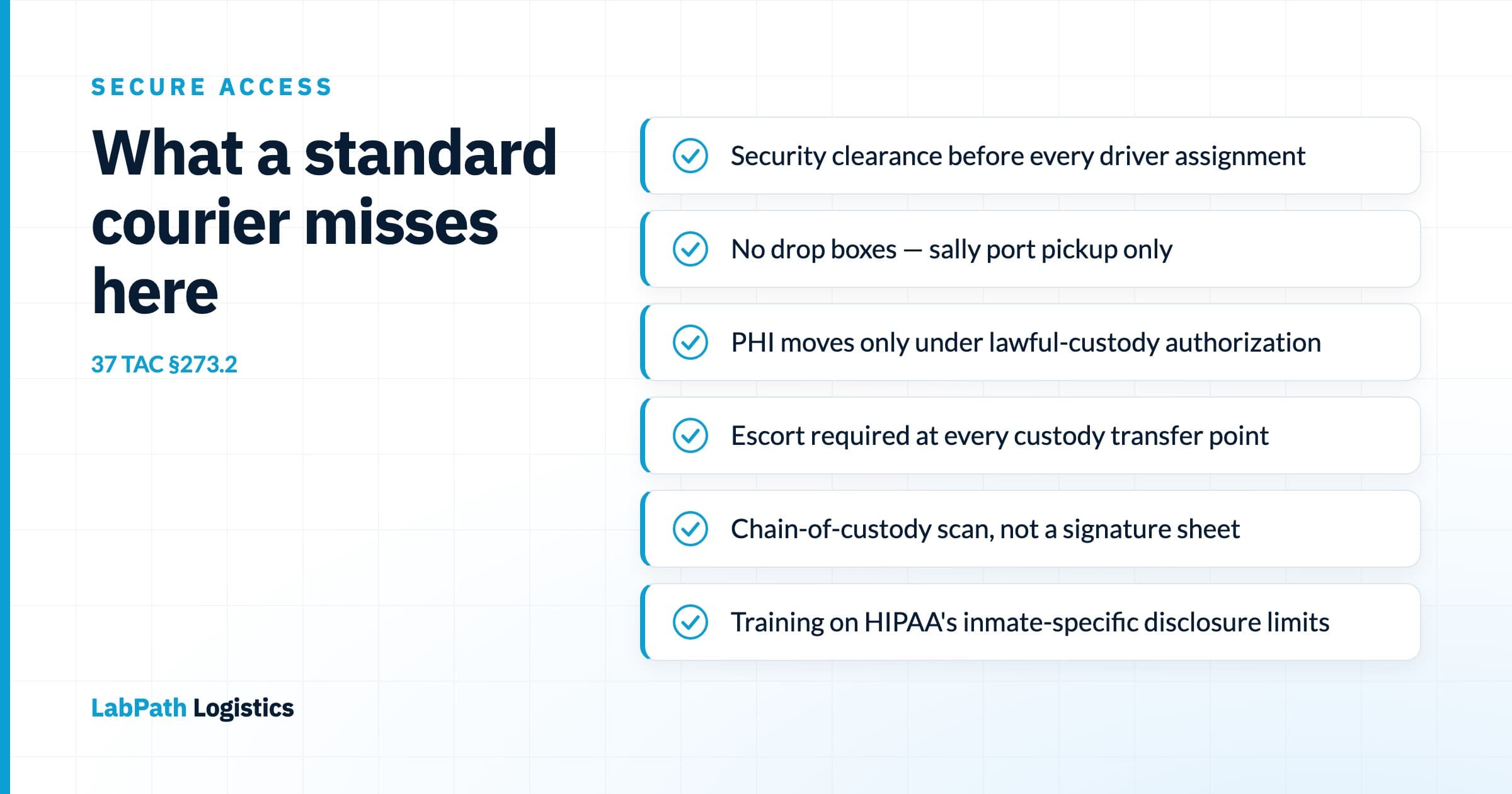
- Standing security clearance for every driver who may be assigned to the route, verified before the first pickup, not negotiated at the gate.
- A named point of contact on both sides for scheduling, escort coordination, and handling a missed or delayed window.
- No unattended drop-box handling — every transfer happens custody-to-custody, at the facility's designated sally port or intake point, under staff supervision.
- A written understanding of 45 CFR § 164.512(k)(5), including its limits, so PHI tied to a correctional health encounter isn't handled the same way after someone is released.
- A time-stamped chain-of-custody scan at every handoff, keyed to an order or specimen reference rather than a patient name.
- Driver training that covers facility-specific security procedures — what can and can't be carried past a checkpoint, and how to respond if a pickup window is denied.
Key Takeaway
A correctional facility's medical unit runs on the same clinical clock as any other clinic, but the courier serving it has to work inside a security perimeter that a standard same-day pickup was never designed for. Texas's Health Services Plan requirement under 37 TAC § 273.2 puts "prompt care" on the facility, and the courier is part of what makes that promise real. HIPAA's correctional exception under 45 CFR § 164.512(k)(5) gives the arrangement a legal footing — but only while custody lasts, and only for the purposes the rule actually lists. A courier that understands both, and that treats the sally port as a fixed point rather than an inconvenience, is the one a facility can build a real medical logistics relationship with.
Frequently Asked Questions
Does HIPAA still apply to medical records inside a jail or detention facility?
Yes, with a specific exception. Under 45 CFR § 164.512(k)(5), a covered entity may disclose protected health information to a correctional institution or law enforcement official with lawful custody of a person when it's necessary for that person's health care, for the safety of other inmates or staff, or for the facility's security. A correctional institution that is itself a covered entity can use that information for the same purposes. The exception applies only during lawful custody — once someone is released, standard HIPAA authorization rules apply again.
What makes a correctional facility medical courier different from a standard clinic pickup?
Access. A standard clinic pickup assumes a front desk, a lab window, or an after-hours drop box. A detention facility has none of those — every pickup runs through a security checkpoint and a supervised custody transfer, typically at a sally port, on the facility's schedule rather than the courier's. Drivers need standing security clearance, and the courier needs a workflow built around escorted handoffs rather than unattended access.
Does the Texas Commission on Jail Standards regulate medical logistics directly?
Not the courier specifically, but it regulates the outcome the courier supports. Under 37 Tex. Admin. Code § 273.2, every Texas county jail must have a Commission-approved Health Services Plan covering sick calls, referral for medical, mental, and dental services, and prompt care for acute and emergency situations. A courier that reliably moves specimens and pharmacy items on schedule is part of how a facility actually meets that standard, even though the rule itself is written for the facility, not the vendor.
How large is the population a correctional health clinic in Houston might serve?
It varies by facility, but scale matters for logistics planning. Harris County Jail is the third-largest jail in the United States by average daily population, holding roughly 9,000 to 10,000 people on any given day according to the Harris County Sheriff's Office. A medical unit serving a population at that scale runs real day-to-day clinical volume, which is why a courier relationship needs to be a standing arrangement with a known point of contact rather than a one-off vendor call.