Medical Imaging Courier Houston: When PACS Isn't Enough
September 9, 2026 · By LabPath Logistics Editorial Team, Medical Logistics Desk
Quick Answer
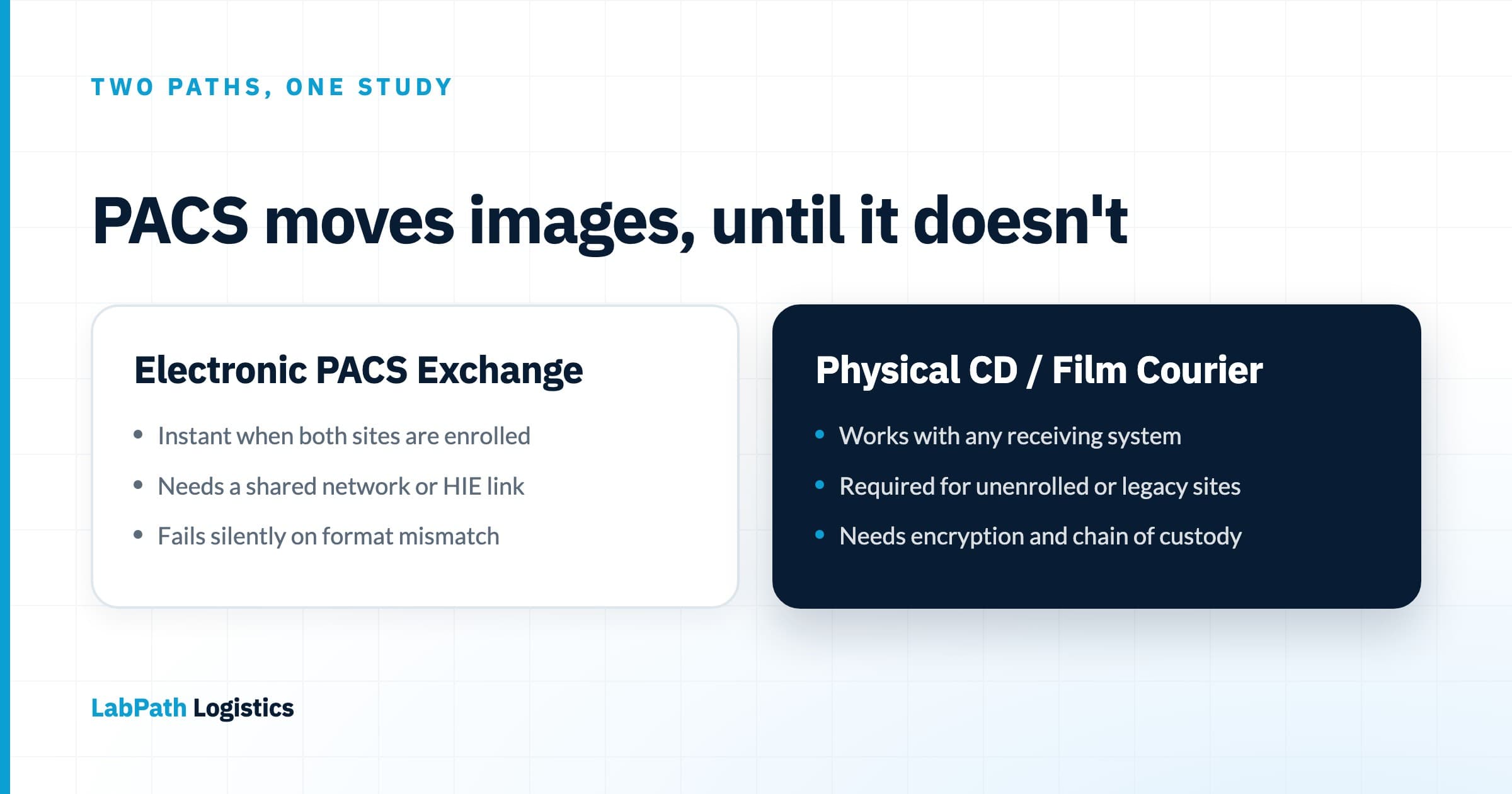
A medical imaging courier physically transports radiology studies — CDs, DVDs, and legacy film — between Houston facilities when electronic PACS or health information exchange can't move the images itself: unenrolled referring offices, incompatible formats, network outages, or a receiving system that simply isn't on the same network. The published evidence shows electronic import still fails around one time in five even at academic centers, which is why a courier leg with HIPAA-compliant chain of custody remains a required part of image logistics, not a legacy habit. The federal Information Blocking Rule now treats a delayed or refused image handoff as a compliance event, not just an operational inconvenience.
Most radiology departments assume the image problem is solved: PACS talks to PACS, and a study ordered in one building shows up in another without anyone touching a disc. A Houston medical imaging courier exists because that assumption is wrong more often than referral coordinators admit. A freestanding imaging center that hasn't enrolled in a health information exchange, a smaller regional hospital transferring a trauma patient into the Texas Medical Center, or a referring physician's office running software that predates DICOM networking — all of them still produce a study that has to leave the building on a disc, in someone's hands, with a documented chain of custody. This guide covers what the published evidence actually shows about electronic image exchange failure rates, what changed in federal enforcement this year, and what a courier has to get right when the physical handoff is the only path.
The Real Numbers Behind "Just Use PACS"
The clearest evidence on this comes from Brigham and Women's Hospital, where Sodickson and colleagues tracked what happened when emergency department transfer patients arrived with outside imaging on CD. Out of 1,487 patients with an outside CD, 1,161 — 78 percent — imported successfully into the receiving PACS. The other 22 percent didn't, for the same reasons that still cause failures today: format incompatibility, disc damage, or a study that simply wouldn't reconcile against the patient record. That gap is why a courier relationship for imaging isn't a fallback for facilities that haven't modernized — it's a standing requirement for every facility, because even a well-resourced academic center couldn't get electronic import above four in five.
78% import success
Share of outside CD studies that successfully imported into PACS at a Brigham and Women's Hospital emergency department, leaving 22% requiring manual or repeat workarounds (Sodickson et al., Radiology, 2011)
The same study found that a successful import mattered clinically, not just administratively: patients with successfully imported CDs had a 17 percent reduction in all subsequent imaging in the following 24 hours — 2.7 exams per patient instead of 3.3 — and a comparable drop in repeat CT scans. Every failed import is a probable repeat scan, which means the courier leg that gets a physical study to the right building, intact and on time, is doing more than clearing a logistics checkbox. It's the difference between one CT and two.
Information Blocking Enforcement Just Got Real
The regulatory backdrop changed this year in a way most referral coordinators haven't caught up to. The 21st Century Cures Act's Information Blocking Rule has applied since April 2021, but its scope expanded on October 6, 2022 to cover virtually all electronic health information in a HIPAA Designated Record Set — a scope the Office of the National Coordinator for Health IT confirms is not limited to radiology reports and generally includes the underlying imaging data a radiologist relies on. Refusing or unreasonably delaying an image transfer a patient or a treating provider is entitled to is now, on paper, the same category of violation as refusing a lab result.
What changed in 2026 is that enforcement stopped being theoretical. Providers have faced Medicare payment penalties under MIPS, the Promoting Interoperability program, and ACO participation rules since July 1, 2024, and health IT developers and information networks have faced civil monetary penalties of up to $1 million per violation since September 2023. In February 2026, HHS confirmed it is now issuing formal notices of investigation against health IT developers for information blocking — the first real enforcement action after roughly 1,600 complaints accumulated through the federal complaint portal since 2021 with no penalties attached. A facility that treats a stuck image transfer as "IT will get to it" is treating a compliance exposure as a help-desk ticket.
~1,600 complaints
Information blocking complaints filed through HealthIT.gov's portal since 2021, ahead of HHS confirming active enforcement investigations in February 2026 (HHS; Holland & Knight)
Where Electronic Exchange Breaks Down in Practice
Houston's imaging landscape makes the gap concrete. The Texas Medical Center concentrates major systems that run their own enrolled image-sharing networks — but a referral into TMC can originate from anywhere in a much larger metro, and not every source is on that network:
- A freestanding imaging center or urgent care that hasn't enrolled in the receiving hospital's image-sharing platform.
- A smaller regional or rural hospital transferring a trauma or stroke patient where minutes matter and network enrollment wasn't set up in advance.
- A referring physician's private office still running legacy PACS that exports to disc rather than DICOM push.
- A patient-carried CD from an out-of-state facility or a prior encounter years earlier, with no active network relationship at all.
- A network or platform outage on either end — electronic exchange has no manual fallback until someone burns a disc.
- Litigation, insurance, or second-opinion requests, where the Information Blocking Rule's exclusions for records prepared for legal proceedings can complicate an automated electronic release.
None of these are edge cases in a metro area this size — they're the routine reason a courier still has a job in radiology logistics. See our STAT specimen delivery checklist for how the same time-pressure logic applies when the payload is a specimen instead of a disc.
What a Physical Imaging Courier Must Get Right
A CD or film jacket doesn't look like protected health information the way a labeled specimen tube does, which is exactly why it gets handled carelessly. It is PHI, and it's covered by the same HIPAA Security Rule technical and physical safeguards as any other patient record:
- A signed Business Associate Agreement with every facility, naming imaging media explicitly rather than assuming a specimen BAA covers it.
- Encryption or password protection on any disc containing unencrypted PHI, consistent with the HIPAA Security Rule's addressable safeguards under 45 CFR §164.312.
- Locked, non-transparent transport compartments — a visible disc jacket with a patient name on the passenger seat is a physical safeguard failure.
- A documented chain of custody with a timestamp at pickup and confirmed receipt, not just a delivery estimate.
- Verification that the receiving site confirmed successful import before the original disc or film is discarded or returned.
- A STAT fallback lane for image transfers when a facility discovers, mid-encounter, that electronic enrollment doesn't cover the sending site.
An unlabeled disc is still a HIPAA event
Radiology staff sometimes treat a CD without a printed label as "anonymous" because a name isn't visible from across the room. It isn't. The DICOM header embedded in the file still carries the patient's name, date of birth, and MRN, and a lost or misdirected disc is a reportable disclosure regardless of what's printed on the case. Courier handling has to assume every disc is fully identified, because it is.
A Houston Example
A patient presents at a freestanding ER in the suburbs with a head CT already completed there, and the on-call neurosurgeon at a Texas Medical Center hospital needs the images before accepting transfer. If the freestanding ER's imaging vendor isn't enrolled in that hospital's image-sharing network — a common gap, since freestanding ERs proliferated faster than network enrollment did — the study has to move as a disc, not a network push. A courier already staged for STAT runs into the TMC corridor turns that into a 20-to-30-minute problem instead of a multi-hour one, and a documented chain of custody means the receiving radiologist can confirm what arrived matches what was ordered before the transfer decision gets made on it.
Key Takeaway
PACS-to-PACS exchange is the default path for a reason, but the published evidence — a 78 percent import success rate even at a well-resourced academic center — shows it isn't the only path a Houston facility can rely on. The Information Blocking Rule now treats a stalled image handoff as a federal compliance question, with active HHS enforcement as of 2026, not just a scheduling headache. A medical imaging courier that treats a disc or film jacket with the same chain-of-custody discipline as a specimen closes the gap electronic exchange leaves open, and does it fast enough that a transfer decision doesn't wait on it.
Frequently Asked Questions
Is a CD or DVD of radiology images considered protected health information?
Yes. The DICOM file format embeds the patient's name, date of birth, and medical record number directly in the image header, regardless of whether the disc itself is labeled. A lost or misdirected imaging disc is treated as a HIPAA disclosure event the same as a paper chart or a specimen label.
Why doesn't PACS-to-PACS exchange work for every imaging transfer?
Electronic exchange requires both the sending and receiving facility to be enrolled on a compatible network or health information exchange. Published research on emergency department transfer patients found outside CD imports succeeded only 78% of the time even at a major academic center, with failures driven by format incompatibility, disc damage, or unreconciled patient records — not just missing technology.
What is the Information Blocking Rule and does it apply to imaging?
It's a 21st Century Cures Act provision, enforced by HHS, that prohibits healthcare providers, health IT developers, and health information exchanges from unreasonably interfering with access to a patient's electronic health information. Since October 2022 its scope covers virtually all electronic health information in a HIPAA Designated Record Set, which the Office of the National Coordinator confirms includes imaging data used in radiologist decision-making, not just written reports.
What should a Houston facility require from an imaging courier?
A Business Associate Agreement that explicitly names imaging media, encryption or password protection on any disc carrying unencrypted PHI, locked non-transparent transport, a documented chain of custody with timestamped pickup and confirmed receipt, and a STAT fallback lane for the common case where a sending facility isn't enrolled in the receiving hospital's electronic image-sharing network.