Cord Blood & Stem Cell Courier: Houston Cold Chain
September 13, 2026 · By LabPath Logistics Editorial Team, Medical Logistics Desk
Quick Answer
Cryopreserved cord blood and stem cell units are not a refrigerated specimen — they ship inside a liquid-nitrogen dry shipper that holds a vapor-phase temperature below -150°C, and most validated shippers only hold that range for 7 to 20 days before the absorbed nitrogen depletes. The transport leg has two separate jobs: keep the unit inside its rated hold time with a data logger recording the actual temperature, and preserve the two-directional donor-to-consignee tracking that 21 CFR Part 1271 requires for any human cell or tissue product. A courier that cannot hand over a temperature record and a custody record keyed to a distinct identification code — never a patient name — has not completed a cryogenic transfer, regardless of how fast the drive was.
A cord blood or peripheral blood stem cell unit that leaves a Houston cryobank does not travel like anything else a courier carries. It is not chilled, it is not on dry ice, and it is not refrigerated at 2–8 °C. It is cryopreserved in liquid nitrogen vapor at a temperature colder than anywhere naturally occurring on Earth, sealed inside a specialized vessel called a dry shipper, and given a fixed number of days before that vessel starts to warm. Cord blood transport in Houston is therefore less like a specimen run and more like moving a small, time-limited cryogenic system across town.
That distinction matters because the Texas Medical Center runs one of the largest transplant programs in the world. Getting the cold chain and the custody record right on this specific product type is not a theoretical compliance exercise — it is a routine Tuesday for any courier serving TMC-area cell therapy and transplant logistics.
Why This Is a Different Cold Chain Problem
Liquid nitrogen sits at -196°C. For long-term viability of hematopoietic stem cells, accredited cord blood banks store units in the vapor phase of cryogenic nitrogen — the gas above the liquid pool rather than direct immersion — at a constant temperature below -180°C, a practice that also reduces the cross-contamination risk that comes with liquid-phase storage. A unit that warms into the -80°C to -130°C range for any meaningful stretch is not merely "a little warm." It is a documented deviation that a transplant center's cellular therapy lab has to evaluate before infusing the product.
-196°C
Liquid nitrogen's boiling temperature. Accredited cord blood banks hold cryopreserved units in vapor phase below -180°C for long-term storage.
The Dry Shipper Is the Whole Cold Chain
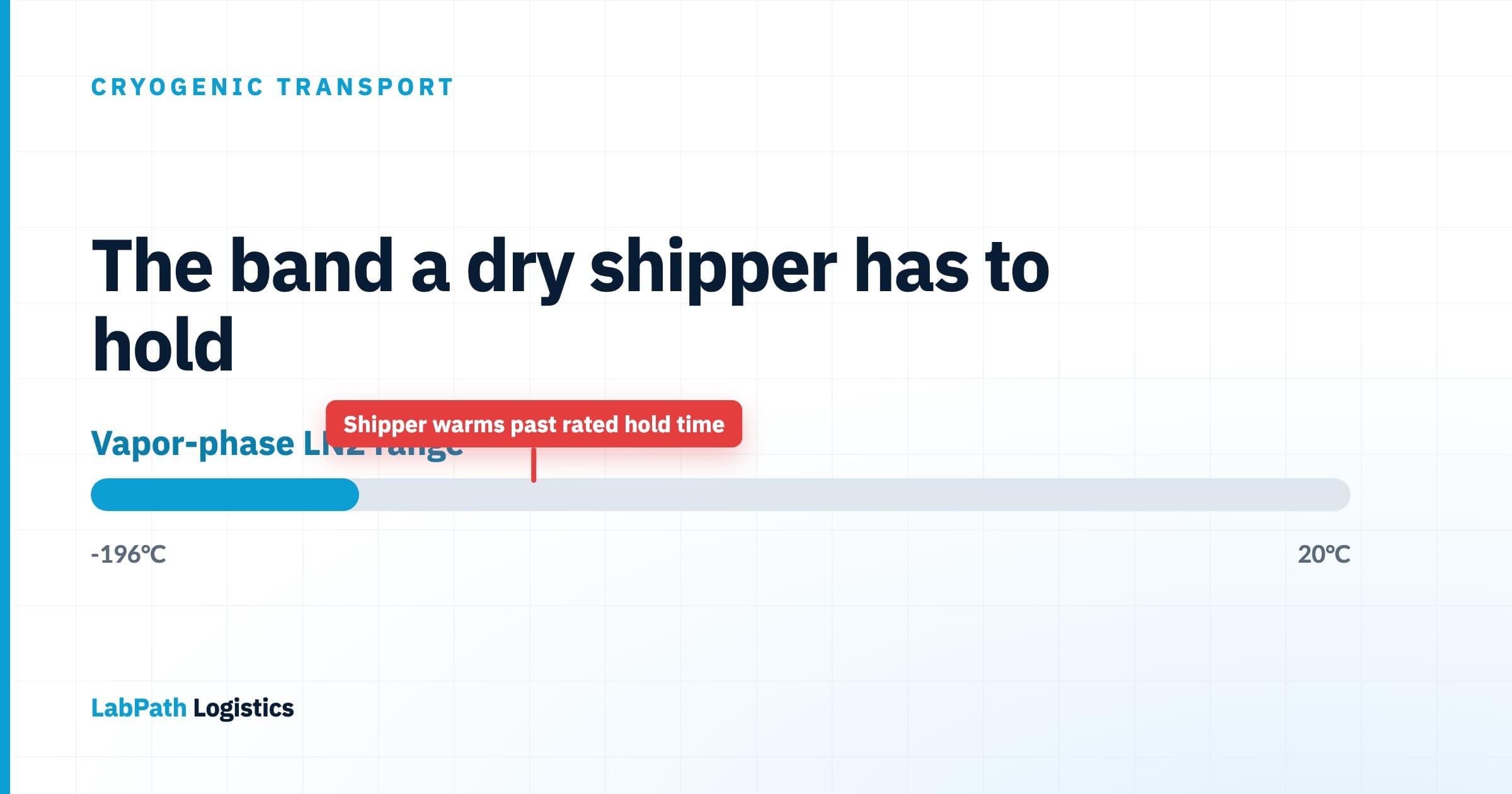
A dry shipper is not a cooler with a fancier name. An absorbent inner material is saturated with liquid nitrogen and left to sit — typically for about 24 hours — until it holds all the nitrogen it can. Any nitrogen that has not been absorbed is then poured out, because a dry shipper has to travel as vapor-only, with no free liquid sloshing inside it. What remains is a saturated matrix that slowly releases cold vapor, holding the interior chamber in that -150°C to -190°C band without external power.
That holding capacity is finite and shipper-specific. Depending on size and model, a validated dry shipper maintains vapor-phase temperature for roughly 7 to 20 days — smaller models on the shorter end, larger clinical-grade units on the longer end. A shipper that was charged four days ago and is now sitting in a multi-stop delivery queue is not a stable cold chain indefinitely; it is a countdown that the courier is responsible for tracking, not the recipient.
- A shipper carrying free liquid nitrogen is not ready to ship — it is a hazmat and pressure risk, and the bank's prep protocol exists specifically to prevent it.
- Tipping a dry shipper on its side or upside down during transport can affect vapor retention depending on the model; the bank's handling instructions for that specific shipper govern orientation, not driver judgment.
- A shipper nearing the end of its rated hold time has no business on a consolidated, multi-stop route — it needs a direct run.
- A data logger inside or attached to the shipper is the only objective record of what the unit actually experienced, and it has to be handed over at delivery, not summarized from memory.
21 CFR Part 1271 Still Applies — And It's About Identity, Not Just Temperature
Cord blood and unrelated donor stem cell units are regulated by the FDA as human cells, tissues, and cellular and tissue-based products (HCT/Ps) under 21 CFR Part 1271, the same framework covered in more depth in our tissue allograft transport guide. The temperature obligation and the tracking obligation are separate requirements, and a courier that nails one while ignoring the other has only done half the job.
21 CFR §1271.290(b) requires a tracking system that runs from the donor to the consignee and back from the consignee to the donor — two-directional by design, so a positive donor test result can trace forward to every unit it touched, and a post-transplant complication can trace backward to the donor. The code that carries this identity is deliberately not a patient identifier: it may not include a name, Social Security number, or medical record number. Every custody scan on the transport leg has to key to that distinct identification code, not to the recipient's chart.
21 CFR §1271.265 adds the recordkeeping requirement for receipt, predistribution shipment, and distribution, and requires that packaging and shipping containers be designed and constructed to protect the product from contamination. For a cryopreserved unit, that container is the dry shipper the bank validated and prepped — not a courier's own cooler, and not a swap made mid-route because the original shipper would not fit alongside other cargo.
The two records a transplant center actually needs
A temperature record covering the entire transit interval, proving the unit stayed within its rated hold time, and a custody record keyed to the distinct identification code showing who released it, who accepted it, and when. Neither one substitutes for the other, and a fast delivery with neither is not a documented delivery.
The Scale This Runs At in Houston
The Texas Medical Center is not a peripheral market for this work. UT MD Anderson's Stem Cell Transplantation and Cellular Therapy Center is one of the largest programs of its kind in the world, performing more than 850 transplant procedures a year for adult and pediatric patients. Texas Children's Hospital runs its own Cell Therapy and Bone Marrow Transplant program in collaboration with Baylor College of Medicine, and both institutions draw referrals from across the region — which means cryopreserved units move not just within TMC but between outlying Houston-area facilities and these two centers on a routine basis.
850+
Stem cell transplant and cellular therapy procedures performed annually at UT MD Anderson's Houston program, one of the largest in the world.
Where Houston Cryogenic Transfers Actually Break
Four failure modes account for most problems, and none of them require a driving error — they are logistics and handoff failures.
- An improperly prepped shipper. A dry shipper that still contains free liquid nitrogen, or that was not given the full absorption window before excess liquid was poured off, is not ready to travel — and the failure is invisible from the outside until it either leaks or runs out of hold time early.
- No independent temperature record. A courier relies on the shipper's rated hold time as a proxy for actual condition instead of a data logger. Rated hold time is a manufacturer estimate under ideal prep; it is not a substitute for measurement.
- The near-end-of-window multi-stop route. A shipper charged on day one of a 10-day rated hold sits on a route with unrelated stops on day nine, and the last leg pushes it past the point anyone can vouch for.
- The unattended or delayed dock handoff. A cryopreserved unit arrives at a receiving dock with no cellular therapy lab staff immediately available, and it sits at ambient loading-dock temperature rather than going straight into a monitored liquid nitrogen storage tank.
What to Require Before a Courier Touches a Cryopreserved Unit
Whether a given transport arrangement independently pulls the carrier into Part 1271's obligations depends on the specifics and is a question for the bank's or transplant center's regulatory counsel — but the receiving institution is the one that has to produce the record when a unit is questioned, so it is the one asking these questions of a courier in advance.
- Confirmation the dry shipper was prepped and inspected by the distributing bank, sealed, and never opened or repacked in transit.
- A continuous data logger reading handed over at delivery, not a verbal assurance that the shipper "felt cold."
- A dedicated, direct run rather than a multi-stop route for any shipper within its final days of rated hold time — the same principle behind not co-mingling regulated cargo with unrelated loads.
- Custody scans keyed to the distinct identification code on the shipper, consistent with the opaque order-reference approach that keeps patient data out of transport records entirely.
- Named, trained handlers who understand cryogenic vessel handling — driver training that covers dry shippers specifically, not just Category B specimen packaging.
- A direct dock-to-tank handoff protocol to a named cellular therapy lab contact, with a written exception path for after-hours or delayed receiving.
Key Takeaway
Cord blood and stem cell transport is a countdown problem layered on top of an identity-tracking problem. The dry shipper holds its vapor-phase range for a fixed, model-specific window measured in days, and the only way to know a unit stayed inside that window is a temperature record produced during transit — not inferred afterward. Underneath that, 21 CFR Part 1271 still requires two-directional custody tracking keyed to a code that is never a patient identifier. A courier who can produce both records, for every cryogenic transfer, has done the job. One who can produce neither has moved a vessel, not a cell therapy product.
Frequently Asked Questions
How long does a liquid nitrogen dry shipper keep a cord blood unit cold?
It depends on the specific model and size, but validated clinical dry shippers typically hold a vapor-phase temperature in the -150°C to -190°C range for roughly 7 to 20 days once properly prepped, with smaller units on the shorter end and larger clinical-grade shippers on the longer end. That figure assumes correct preparation — full saturation of the absorbent material, all free liquid nitrogen poured off before sealing, and no tipping outside the manufacturer's handling instructions. A courier should always confirm the specific shipper's rated hold time and how many days remain before pickup, since a shipper charged a week ago has meaningfully less runway than one charged that morning.
Is cord blood transport regulated differently from a routine specimen delivery?
Yes. A diagnostic specimen travels under CLIA handling rules and DOT packaging requirements for Category B infectious substances. A cord blood or stem cell unit is regulated by the FDA as a human cell, tissue, or cellular and tissue-based product under 21 CFR Part 1271, which requires two-directional tracking from donor to consignee and back under 21 CFR 1271.290(b), a distinct identification code that excludes patient identifiers, and recordkeeping for receipt, predistribution shipment, and distribution under 21 CFR 1271.265. On top of that regulatory layer, the product itself is cryopreserved rather than refrigerated, which adds the separate operational problem of a dry shipper's finite hold time.
Does the temperature record matter more than the delivery speed for a cryopreserved unit?
For this product type, yes. A specimen that degrades from delay is a turnaround-time problem; a cryopreserved unit that warms past its safe range during transport is a viability problem the transplant center's cellular therapy lab has to evaluate before infusing it into a patient. A fast delivery with no data logger record proves nothing about what the unit actually experienced in transit. The record — not the timestamp alone — is what lets the receiving lab release the unit for use without an additional deviation review.
Can a cryogenic unit be added to a multi-stop courier route?
It depends entirely on how much of the dry shipper's rated hold time remains. A shipper freshly charged with days of margin can reasonably sit within a planned route. A shipper approaching the end of its rated window should move on a dedicated, direct run, because a multi-stop route with unpredictable dwell time at each stop is exactly the scenario that turns a marginal shipper into a documented temperature excursion. The decision belongs to the courier's dispatch process, informed by the shipper's charge date and rated duration — not left to be discovered after the fact.