Medical Courier Driver Training: A Houston Vetting Guide
August 15, 2026 · By LabPath Logistics Editorial Team, Medical Logistics Desk
Quick Answer
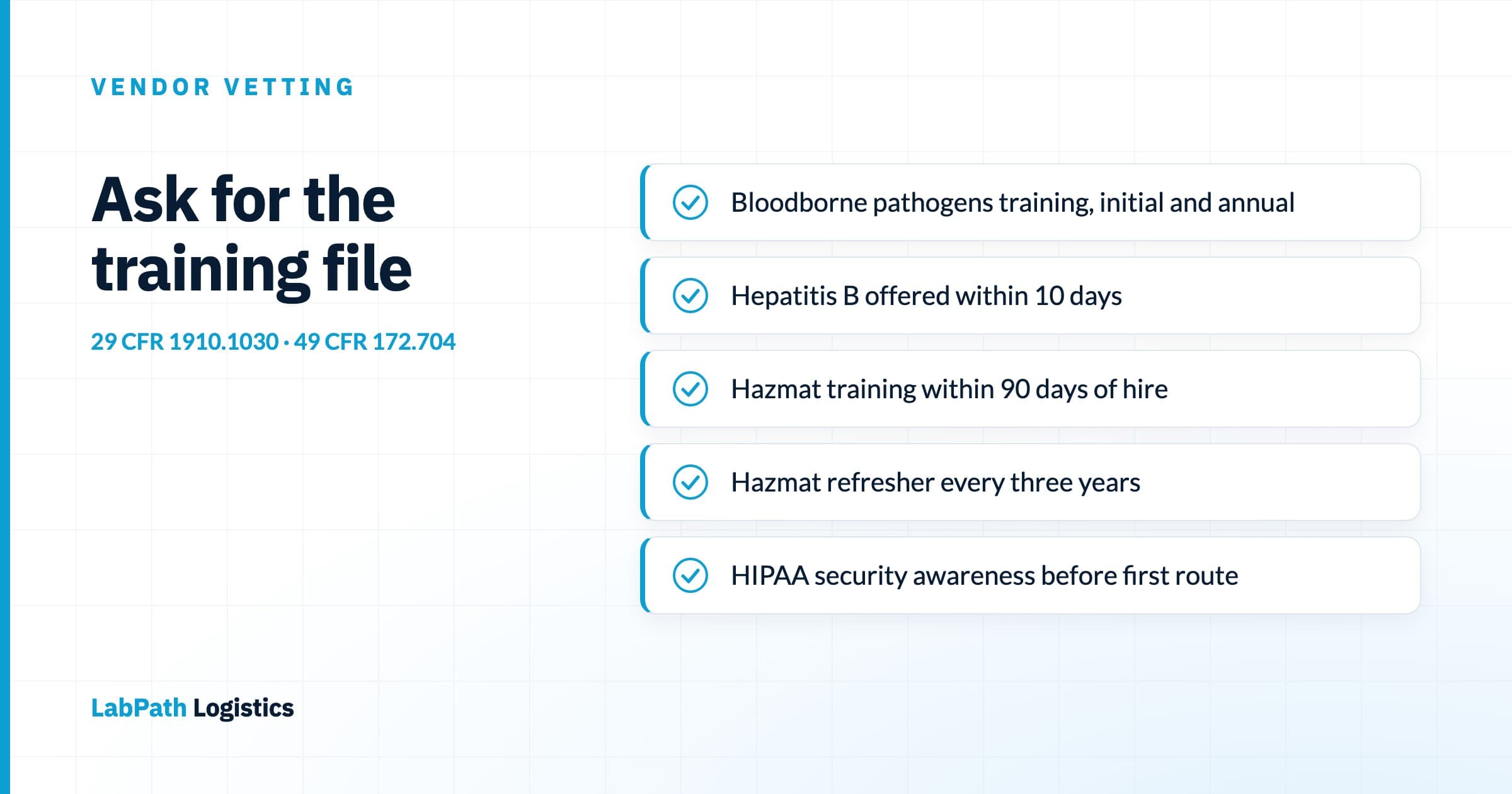
A medical courier driver is covered by three separate training rules, not one. OSHA requires bloodborne pathogens training at initial assignment and at least annually after that (29 CFR 1910.1030). DOT requires hazardous materials training completed within 90 days of hire and repeated at least once every three years (49 CFR 172.704). HIPAA requires the courier to run a security awareness and training program for its whole workforce (45 CFR 164.308(a)(5)). Each rule produces a dated record — so vet the vendor by asking for the records, not the badge on the website.
Medical courier driver training is the part of vendor selection that almost never makes it into the RFP. Facilities compare price per stop, on-time percentages, and tracking screenshots, then hand a stranger a rack of primary specimen containers with patient identifiers printed on the labels. The driver is the entire compliance perimeter for that trip, and the driver's training file is the only evidence that the perimeter exists.
The useful part is that almost none of this is a matter of opinion. Three federal rules already say what training the driver needs, when it expires, and what the courier has to keep on file. Here is what each one requires, and the five documents that let you check a vendor in an afternoon.
Three Rulebooks, Not One
Vendors often answer the training question with a single word — "certified" — as if one credential covered the job. It does not. A driver moving specimens is simultaneously an exposed worker under OSHA, a hazmat employee under DOT, and a workforce member touching protected health information under HIPAA. The three regimes run on different clocks, are enforced by different agencies, and generate different records.
- OSHA, 29 CFR 1910.1030 — bloodborne pathogens: protects the driver from what is in the tube.
- DOT, 49 CFR 172.704 — hazardous materials: protects the public from what is in the vehicle.
- HIPAA, 45 CFR 164.308(a)(5) — security awareness: protects the patient from what is on the label and the manifest.
A courier can be fully compliant with one and exposed on the other two. Check them separately.
OSHA: The Annual Clock
OSHA defines occupational exposure as "reasonably anticipated skin, eye, mucous membrane, or parenteral contact with blood or other potentially infectious materials" arising from an employee's duties, and it puts the burden on the employer to determine which jobs qualify. A driver who handles primary containers, loads racks, and would be the one cleaning up a leak in a parking garage is the ordinary case, not the edge case.
Once a courier makes that determination, the bloodborne pathogens standard sets a firm schedule. Training happens at the time of initial assignment and at least annually thereafter. It cannot be a video played at an empty room: the standard requires an opportunity for interactive questions and answers with a person knowledgeable in the subject matter.
10 working days
Deadline for a courier to make the hepatitis B vaccination series available to a newly assigned exposed driver, at no cost — 29 CFR 1910.1030(f)(2)(i)
That vaccination window is one of the fastest ways to tell a real program from a paper one. A courier running a genuine exposure control plan can tell you when the offer was made and can produce the signed declination form for drivers who turned it down. A courier that has never thought about it will change the subject to insurance.
The records are specified too. Training records must include the dates, the contents or a summary of the session, the names and qualifications of the people who conducted it, and the names and job titles of everyone who attended — kept for three years from the date of training.
DOT: The Three-Year Clock
Patient specimens shipped as UN 3373 Category B are regulated hazardous materials, which makes the person driving them a hazmat employee under 49 CFR 171.8 — the definition explicitly reaches anyone who operates a vehicle used to transport hazardous materials. That triggers 49 CFR 172.704, which is a broader curriculum than most facilities expect.
- General awareness and familiarization — what the material is and how it is classified.
- Function-specific training — the tasks this driver actually performs, including packaging and marking under our Category B specimen packaging rules.
- Safety training — the hazards, protective measures, and emergency response for what is in the vehicle.
- Security awareness training — recognizing and responding to a security risk in transport.
3 years
Maximum interval between recurrent hazmat training sessions for a courier driver — 49 CFR 172.704(c)(2)
New hires get a grace period with a condition attached. A new hazmat employee may perform the functions before training is complete only while under the direct supervision of a properly trained and knowledgeable hazmat employee, and the training has to be finished within 90 days of employment or a change in job function. "He is riding with someone" is a legitimate answer for the first three months and an alarming one in month five.
DOT recordkeeping is stricter than OSHA's in one respect worth remembering: the record must be retained for as long as the person is employed as a hazmat employee and for 90 days afterward, and it has to name the trainer and certify that the employee was trained and tested.
Two clocks, two failure modes
A courier that trains everyone once at onboarding will pass a DOT audit for almost three years while quietly failing OSHA on day 366. A courier that runs a solid annual safety refresher may still have no hazmat function-specific training on file at all. Ask for both dates, per driver — not a company-wide policy statement.
HIPAA: The Vendor's Obligation, Not Yours
A courier handling labeled specimens and manifests is a business associate, and the HIPAA Security Rule obligates it directly. Under 45 CFR 164.308(a)(5), the courier must implement a security awareness and training program for all members of its workforce — dispatchers reading manifests and supervisors reviewing custody records included, not just the people logging into a system.
Signing a business associate agreement does not discharge that duty; it documents it. The BAA is the contract, the training program is the control, and only one of them changes what happens when a driver leaves a requisition on a passenger seat. Our HIPAA-compliant medical courier guide covers the operational controls that sit alongside the training requirement, and our compliance page sets out how we handle custody documentation on our own runs.
What the Regulations Do Not Cover
Federal training rules set a floor, not a hiring standard. Nothing in OSHA or DOT requires a courier to check whether a driver can actually drive. These are the questions that separate vendors, and every one of them is answerable with a document:
- Motor vehicle record pulled at hire and re-pulled on a stated cadence, with a written disqualification threshold.
- Criminal background screening, with a defined look-back period and who reviews the results.
- Documented competency on spill response — not just training attendance, but a demonstrated clean-up with the kit that is actually in the vehicle.
- Supervised ride-alongs before solo routes, with a sign-off naming the supervising driver.
- A named person accountable for the training calendar, so expirations are caught before an auditor catches them.
Why This Is Getting Harder in Houston
Houston's clinical footprint is still expanding. MD Anderson received approval in 2026 for a $2.9 billion patient care expansion including a 25-floor clinical tower in the Texas Medical Center, and Harris Health's Ben Taub expansion adds roughly 100 patient rooms. More clinical volume means more outreach sites, more send-out testing, and more courier onboarding decisions made under time pressure.
The pattern to avoid is familiar: a Houston-area reference lab adds three outreach draw sites in a quarter, the incumbent courier subcontracts the overflow to fill the routes, and the subcontracted drivers are outside the vendor's training program entirely. Nothing in the service level agreement breaks. The compliance perimeter does. If a vendor uses subcontractors or independent contractors, the training questions apply to those drivers identically — ask specifically whether the answer you were given covers them.
The Five Documents to Request
You do not need an auditor to run this check. Ask for these, for the specific drivers assigned to your sites:
- The written exposure control plan, with the exposure determination showing that drivers are listed as having occupational exposure.
- Bloodborne pathogens training records showing the initial date, the most recent date, the trainer's qualifications, and the session contents.
- Hepatitis B vaccination offer documentation, including signed declinations where applicable.
- Hazmat training records naming the trainer and certifying testing, with the most recent completion date inside three years.
- The HIPAA security awareness training roster and the executed business associate agreement, together.
A courier with a working program produces these in a day or two. A courier that needs a week is assembling them. Either way, put the request in the contract as an annual obligation with the service level terms rather than treating it as a one-time procurement exercise, because both clocks keep running after the ink dries.
Key Takeaway
Driver training is the cheapest part of a courier relationship to verify and the most expensive part to get wrong. Three rules govern it, on three separate schedules: annual for bloodborne pathogens, every three years for hazmat, and continuously for HIPAA security awareness. Each generates records the vendor is already required to keep. Ask for them by name, ask whether they cover subcontracted drivers, and make the request repeat every year — a training file is a snapshot, and the only meaningful question is whether it is current today.
Frequently Asked Questions
What training is required for a medical courier driver?
Three programs, on three schedules. OSHA's bloodborne pathogens standard (29 CFR 1910.1030) requires training at initial assignment and at least annually thereafter, with an interactive question-and-answer opportunity. DOT requires hazardous materials training — general awareness, function-specific, safety, and security awareness — completed within 90 days of hire and repeated at least every three years (49 CFR 172.704). HIPAA requires the courier to run a security awareness and training program covering its whole workforce (45 CFR 164.308(a)(5)).
Does a medical courier driver need a hazmat endorsement or a CDL?
Usually no, and that is a separate question from training. A commercial driver's license and hazmat endorsement turn on vehicle weight class and placarding thresholds, which routine specimen courier vehicles do not typically hit. The hazmat employee training obligation under 49 CFR 172.704 applies regardless — it attaches to the function of transporting regulated material, not to the class of license. Do not accept "no CDL required" as an answer to "what hazmat training does the driver have?"
How often does bloodborne pathogens training have to be repeated?
At least annually — meaning within 12 months of the previous session, not simply once per calendar year. OSHA also requires additional training when changes in tasks or procedures affect a worker's occupational exposure. Training records must document the dates, contents, the trainer's qualifications, and attendee names and job titles, and must be kept for three years from the date of training.
Does a business associate agreement cover courier driver training?
No. A BAA is a contract that allocates responsibility; it is not a control. Under 45 CFR 164.308(a)(5) the courier is directly obligated to implement a security awareness and training program for its workforce, and that obligation exists whether or not the BAA mentions it. Ask for the training roster alongside the signed agreement, and confirm it includes dispatchers and any subcontracted drivers who see manifests or labeled specimens.