Legionella Water Sample Transport for Houston Hospitals
September 17, 2026 · By LabPath Logistics Editorial Team, Medical Logistics Desk
Quick Answer
Legionella water samples collected under a hospital's CMS-mandated water management program need to reach the testing lab within 48 hours — the maximum acceptable holding time set by ISO 19458:2006(E), with 24 hours recommended and results flagged as noncompliant with the standard if the outer limit is missed. The bacteria themselves are forgiving: a 2014 Water Research study found holding time added only 3-8% to measurement error, with just 1 of 159 sample sets shifting by a full log. What isn't forgiving is the paperwork trail. CMS's 2017 directive (QSO-17-30) requires every Medicare-certified hospital to document a water management program built around ASHRAE Standard 188, and a courier that misses the transport window turns a clean environmental result into a flagged one the facility has to explain during survey.
Every Medicare-certified hospital in Houston has been required to run a Legionella water management program since 2017 — a facilities and infection-control obligation, not strictly a lab one, and one that rarely gets logistics attention until a routine environmental sample sits on a loading dock longer than it should. Legionella water sample courier transport is the unglamorous link between that program and a CMS survey that goes smoothly. It's not that the bacteria are unusually fragile in transit — they're not — it's that the compliance clock keeps running whether or not the sample moves, and every hour it sits is an hour the facility can't yet account for.
Why This Sits Outside the Lab's Usual Compliance Lane
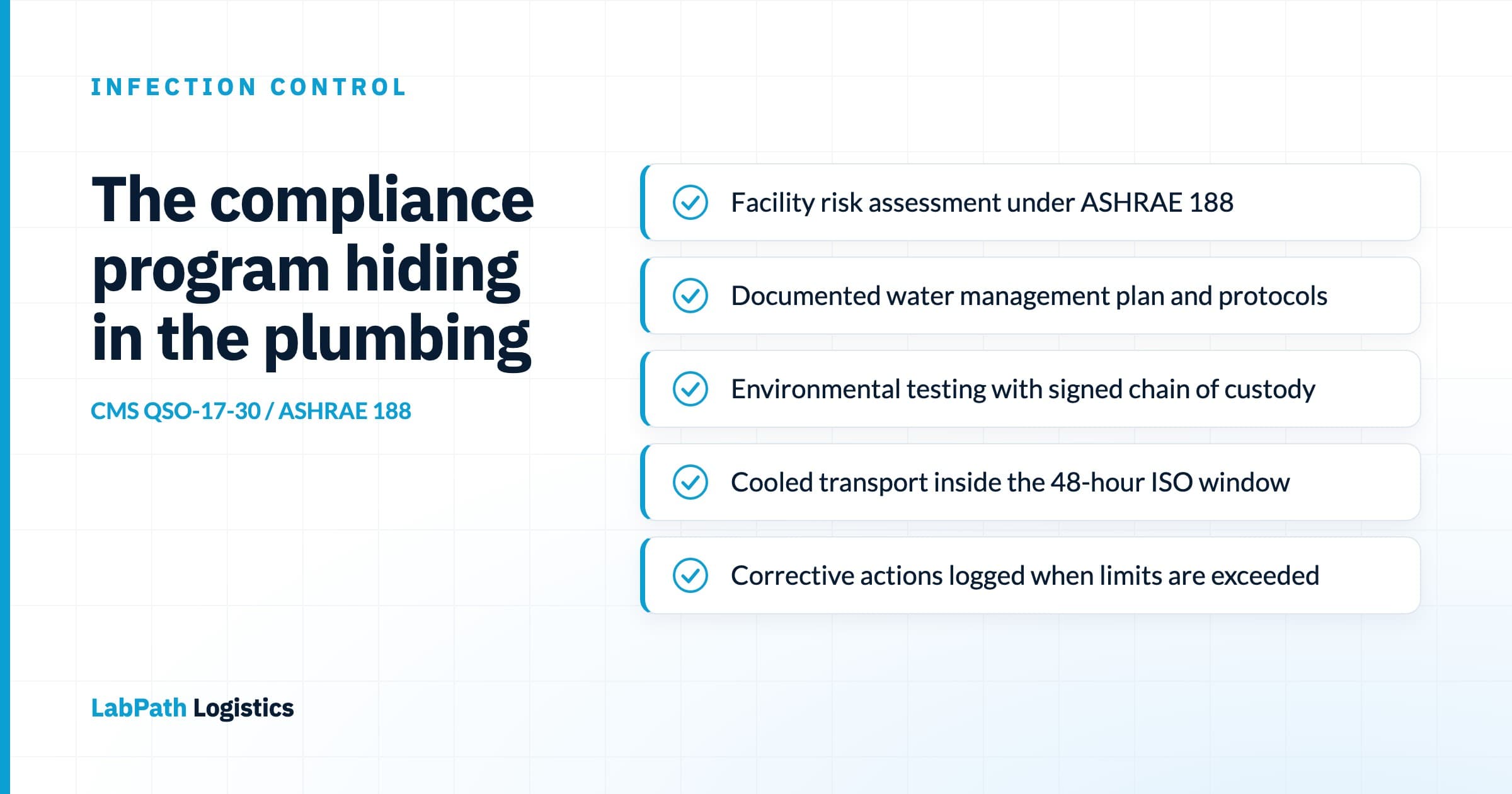
In June 2017, CMS issued QSO-17-30, directing that Medicare-certified hospitals, critical access hospitals, and nursing homes maintain water management policies to reduce the risk of Legionella and other opportunistic pathogens growing in building water systems. The memo expects facilities to build that program around ASHRAE Standard 188 and the CDC's Legionella toolkit, and it isn't optional guidance — survey teams check for it under the hospital Conditions of Participation.
In practice, that means a documented facility risk assessment identifying where Legionella could grow (cooling towers, hot water tanks, decorative fountains, low-flow branch lines), a written water management plan with control measure ranges, routine environmental testing to confirm the plan is working, and a documented corrective-action process when a test comes back out of range. The sample collection and testing piece is one control measure among several — but it's the one that produces a lab report a surveyor can pull and check against the facility's own protocol.
The Sample Itself Is More Forgiving Than You'd Expect
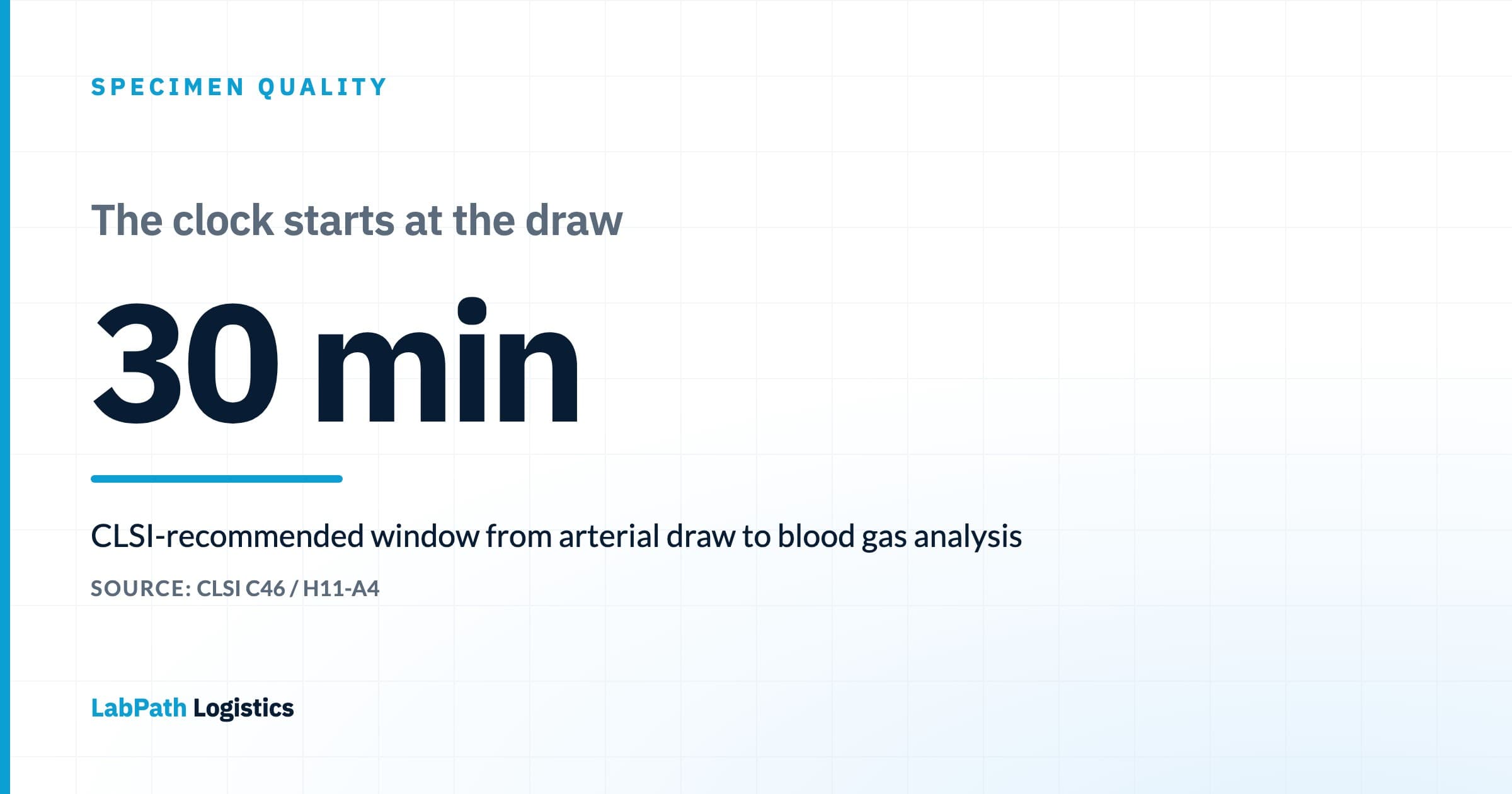
Compare this to the courier's usual cargo. An arterial blood gas specimen has a 30-minute clock. A Legionella water sample, by contrast, follows ISO 19458:2006(E), Annex B, which sets 24 hours as the recommended maximum holding time from collection to plating and 48 hours as the outer acceptable limit — past which the testing lab is required to qualify the result as not meeting the standard's holding-time criterion, rather than reject it outright. Samples should be kept cool during that window, at roughly 5°C ± 3°C, and collection bottles typically carry a sodium thiosulfate tablet to neutralize residual chlorine before the sample reaches the lab.
3-8%
Additional measurement error attributable to holding time in a 2014 Water Research study of environmental Legionella samples — only 1 of 159 sample sets shifted by a full log, and the authors concluded holding time has no practical impact on result interpretation (Flanders, Kirkland & Shelton, Water Research, Vol. 62, 2014).
A separate evaluation of healthcare building water systems found essentially no difference in recovered Legionella between samples plated immediately and those held 1 or 24 hours, with only a slight reduction at the 48-hour mark — smaller than the variability already caused by which tap or fixture was sampled that day. The science backs a wide, workable window. The 48-hour ceiling isn't there because the bacteria die off fast; it's there because ISO drew a line, and a lab report that crosses it gets an asterisk.
Where a Courier Gap Actually Costs You
The real risk isn't degraded bacteriology — it's a documentation gap inside a program that's built entirely on documentation. A water management program lives or dies on its paper trail: risk assessment, control measure logs, testing results, corrective actions, all tied together into one file a surveyor reviews as a whole. A courier that can't produce a timestamped pickup and delivery record, or that routinely blows past the 48-hour ISO window without anyone noticing, hands the facility a flagged result with no clean explanation — during exactly the kind of review where CMS is checking whether the program is actually being run, not just written down.
This shows up differently across a large campus than it does at a single-building clinic. A Texas Medical Center hospital system running quarterly point-of-use testing across multiple towers, wings, and mechanical rooms has dozens of collection sites feeding one environmental lab, often on a scheduled cadence set months in advance by the facilities team. A courier optimized for one-off STAT clinical runs isn't necessarily built for a recurring, multi-site environmental pickup with its own chain-of-custody paperwork — and a missed or late pickup on one wing can leave a gap in that quarter's testing record that's awkward to explain after the fact.
What a Reliable Environmental Sample Pickup Looks Like
- A signed chain-of-custody record at pickup and drop-off, separate from and in addition to any clinical specimen manifest the courier already runs.
- Cooled transport that holds the ISO-recommended 5°C ± 3°C range without freezing the sample, which can also affect recovery.
- A scheduled, recurring pickup route matched to the facility's testing cadence — monthly or quarterly, per the water management plan — rather than an ad hoc request each time.
- A single point of contact who can confirm collection-to-delivery elapsed time on request, since the facilities or infection-control team may need that number for the survey file, not just the lab result.
The question to ask before you need the answer
"Can you show me a timestamped chain-of-custody record for our last environmental water pickup?" If a vendor can only speak to clinical specimen tracking, they haven't set up a lane for the paperwork your water management program actually needs. See our [vendor credentialing guide](/blog/vendor-credentialing-medical-courier-houston) for the broader questions worth asking before signing with any courier.
Key Takeaway
Legionella water samples tolerate transport far better than most specimens a Houston hospital ships out — a 24-to-48-hour window with a documented, small effect on results. The exposure isn't in the biology; it's in whether the courier who moves those samples can produce the same kind of timestamped, auditable record the rest of a CMS water management program is already built on. A vendor who treats an environmental water pickup as a favor tacked onto a clinical route, with no chain-of-custody trail of its own, is the reason a facility ends up explaining a flagged result instead of just filing a clean one.
Frequently Asked Questions
How fast do Legionella water samples need to reach the lab?
ISO 19458:2006(E), Annex B sets 24 hours as the recommended maximum holding time from collection to lab processing and 48 hours as the outer acceptable limit. Samples exceeding 48 hours are qualified by the lab as not meeting the standard's holding-time criterion rather than rejected outright, and should be kept cool — roughly 5°C ± 3°C — during transport.
Are hospitals required to test for Legionella in their water systems?
CMS directive QSO-17-30, issued June 2, 2017, requires Medicare-certified hospitals, critical access hospitals, and nursing homes to maintain a water management program that considers ASHRAE Standard 188 and the CDC's Legionella toolkit, including a facility risk assessment, a documented plan, environmental testing, and corrective actions when results fall outside acceptable ranges. Surveyors check for this under the hospital Conditions of Participation.
Does holding time actually affect Legionella test accuracy?
Modestly, and less than most people assume. A 2014 Water Research study (Flanders, Kirkland & Shelton) found holding time added only 3-8% to measurement error across environmental water samples, with just 1 of 159 sample sets shifting by a full log — the authors concluded it has no practical effect on how results should be interpreted.
What's different about transporting environmental water samples versus clinical specimens?
Environmental water samples for Legionella testing carry a much wider transport window — 24 to 48 hours — than clinical specimens like blood or tissue, which can require delivery within minutes to a few hours. The compliance risk isn't specimen degradation; it's whether the courier can produce a timestamped chain-of-custody record that fits into the facility's broader CMS water management program documentation.