STAT Blood Delivery for Houston Trauma Centers
September 18, 2026 · By LabPath Logistics Editorial Team, Medical Logistics Desk
Quick Answer
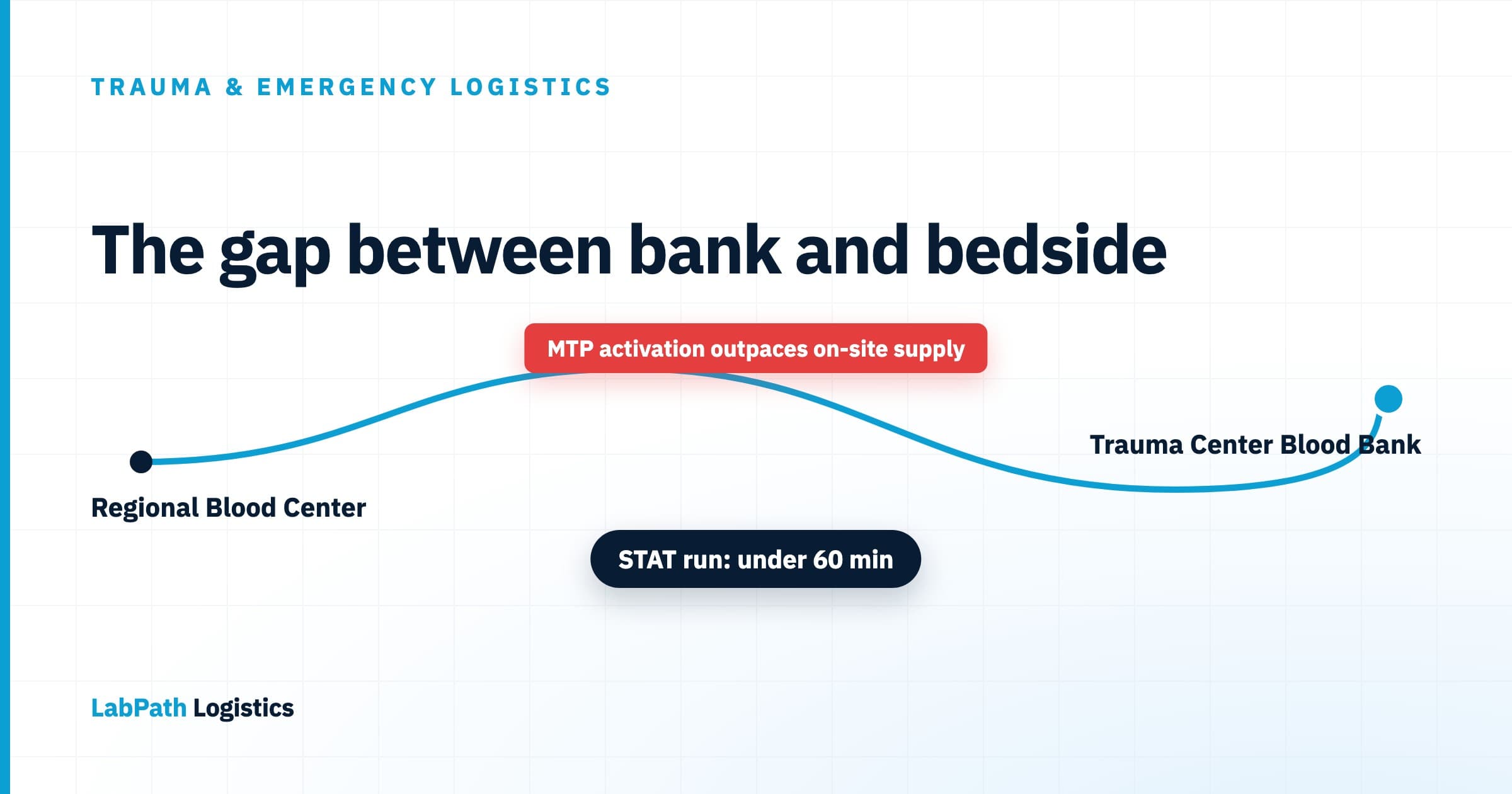
A massive transfusion protocol (MTP) activates when a trauma patient needs 10 or more units of red blood cells within 24 hours, or meets American College of Surgeons criteria such as an Assessment of Blood Consumption score of 2 or higher. Once activated, a hospital blood bank can typically issue emergency-release red cells, plasma, and platelets within about 5 minutes, per UCSF's transfusion medicine guide — far faster than the 1-hour STAT or 4-hour routine turnaround for a standard crossmatch order. The courier's role sits on either side of that 5-minute number: rushing the initial type-and-crossmatch specimen to the lab before matched units exist, and running emergency replenishment from Gulf Coast Regional Blood Center — the sole 24/7 supplier to roughly 170 Houston-area hospitals and facilities — when an activation outlasts on-site inventory. Neither leg tolerates a courier who treats a trauma run like any other stop on the route.
When a Houston trauma center activates a massive transfusion protocol, the hospital's own blood bank can usually beat the clock — emergency-release red cells reach the bedside in minutes. What's harder to guarantee is everything upstream and downstream of that shelf: the type-and-crossmatch specimen that has to reach the lab before matched units exist, and the replenishment run from the region's blood supplier when on-site inventory runs thin mid-activation. STAT blood delivery for Houston trauma centers is really a question about that second leg — and as trauma volume climbs at the county's busiest Level 1 centers, how a courier performs on it stops being a hypothetical.
What Actually Triggers an MTP Activation
A massive transfusion is conventionally defined as 10 or more units of packed red blood cells within 24 hours, with an ultra-massive transfusion crossing 20 units within 24 to 48 hours. That numeric threshold is a retrospective label more than a trigger, though — it doesn't account for patient size or how fast the bleeding is happening. In practice, trauma teams activate on the Assessment of Blood Consumption (ABC) score: one point each for a heart rate over 120, systolic blood pressure under 90, a positive FAST exam, and penetrating torso injury, with a score of 2 or higher flagging high risk. The American College of Surgeons' criteria are broader still, requiring just one of: an ABC score of 2+, persistent hemodynamic instability, active bleeding requiring surgery or angioembolization, or any transfusion given in the trauma bay itself.
The Blood Bank's Own Clock — And Where a Courier Fits Into It
UCSF's transfusion medicine guide lays out three distinct turnaround tiers: routine crossmatch orders are processed within 4 hours, STAT orders within 1 hour, and emergency-release red cells, thawed plasma, and platelets are provided within about 5 minutes for a patient who is actively bleeding and can't wait for a full crossmatch. Cryoprecipitate is the exception — it takes roughly 40 minutes to thaw and prepare regardless of urgency.
That 5-minute emergency-release number is the blood bank doing its job well. It's not the whole timeline. Before matched — rather than universal-donor — product can be issued, the patient's type-and-crossmatch specimen has to reach the lab, get accessioned, and get run. A courier who treats that tube as just another stop on a route, instead of the specimen that determines how long a trauma team keeps drawing down universal O-negative supply, adds delay exactly where a facility can least absorb it. And if an activation burns through 10, 15, 20 units faster than the on-site blood bank can restock, the next leg belongs to whoever is running emergency replenishment from the regional supplier — a run that has nothing to do with routine scheduled deliveries and everything to do with whether a courier actually answers the phone differently for it.
Why This Isn't Hypothetical in Houston Right Now
Harris County has only two adult Level 1 trauma centers, and Ben Taub Hospital — part of the Harris Health system — is one of them. The hospital has been running at and beyond its 402-bed capacity for years. Harris Health's board has approved a $410 million expansion, funded from the county's 2023 voter-approved bond, expected to add roughly 100 patient rooms and expand surgical capacity on Ben Taub's Texas Medical Center campus. The justification cited for the project isn't abstract: Harris Health projects the hospital will need capacity for about 18,000 additional emergency room visits and 3,200 additional admissions a year by 2030.
18,000
Additional annual ER visits Harris Health projects Ben Taub Hospital — one of only two adult Level 1 trauma centers in Harris County — will need capacity for by 2030, cited as justification for its $410 million expansion (Harris Health; Community Impact, 2025).
None of that projected volume growth waits for construction to finish. A busier Level 1 trauma center means more MTP activations, not fewer, and every one of them tests the same courier relationships a facility may not have stress-tested since it signed the contract.
Where a Courier Gap Actually Shows Up
Gulf Coast Regional Blood Center, headquartered in the Texas Medical Center, is the sole 24/7 blood supplier to roughly 170 hospitals and healthcare facilities across a 26-county region, offering both routine online ordering and what it describes as urgent rapid deliveries. A full academic trauma center leans on that relationship for baseline supply, but usually holds meaningful on-site inventory of its own. Smaller facilities — freestanding ERs, ambulatory surgery centers, community hospitals without a full-service transfusion service — carry thinner margins, and a contracted medical courier often becomes the practical link between "the regional supplier has it" and "the patient has it," whether that's an inter-facility transfer or getting a crossmatch specimen to an outside reference lab fast enough that emergency-release product doesn't have to carry the entire activation.
If that courier can't produce a validated, correctly tempered container for whichever product is moving — chilled red cells, agitated platelets, frozen plasma, each governed by its own federal temperature rule — and can't prioritize a trauma-flagged call over a routine stop already on the route, that gap becomes the receiving facility's problem in the middle of an active hemorrhage. It doesn't show up in a sales pitch. It shows up during the fourth STAT run inside an hour.
What MTP-Ready Courier Support Actually Looks Like
- A published, tested sub-60-minute commitment for blood and specimen runs tied to an active trauma or MTP activation — separate from a general "STAT" tier that also covers routine urgent orders.
- Validated, temperature-monitored transport matched to the product moving, consistent with the cold-chain rules covering blood product transport.
- A dispatch line that bypasses the standard call queue during an active activation, with drivers trained to treat a crossmatch specimen or emergency blood request as the top-priority stop, not the next one in sequence.
- Documented chain of custody tying each unit or specimen to the ordering physician and encounter, not a generic manifest reconciled after the fact.
- Demonstrated surge capacity — a courier already stretched thin during flu-season volume doesn't develop trauma-grade reliability by accident.
The question to ask before an activation, not during one
"Walk me through exactly what happens if we activate MTP and need a fourth STAT run inside an hour." A vague answer about who gets called, which vehicle responds, or how fast is the answer.
Key Takeaway
A hospital blood bank can hit a 5-minute emergency-release window on its own. What determines whether a massive transfusion protocol runs cleanly from there is everything the blood bank doesn't control — the crossmatch specimen getting to the lab fast enough, and replenishment arriving before on-site inventory runs out. As trauma volume climbs at Houston's busiest Level 1 centers, that's not a line item to review once a year. It's the difference between a courier relationship that holds up during an activation and one that only ever looked adequate on paper.
Frequently Asked Questions
What triggers a massive transfusion protocol at a Houston trauma center?
MTP is conventionally defined as 10 or more units of red blood cells within 24 hours, but activation in practice follows American College of Surgeons criteria: an Assessment of Blood Consumption score of 2 or higher, persistent hemodynamic instability, active bleeding requiring surgery or angioembolization, or any transfusion given in the trauma bay.
How fast does emergency blood actually move once MTP is activated?
Per UCSF's transfusion medicine guide, emergency-release red cells, plasma, and platelets are typically issued within about 5 minutes for an actively bleeding patient, versus a 1-hour turnaround for a standard STAT crossmatch order and 4 hours for a routine one. Cryoprecipitate takes roughly 40 minutes to thaw regardless of urgency.
Does every Houston hospital keep enough blood on-site for a full MTP activation?
Not necessarily. Smaller facilities — freestanding ERs, ambulatory surgery centers, community hospitals without a full transfusion service — carry thinner on-site inventory and depend more heavily on Gulf Coast Regional Blood Center, the sole 24/7 supplier to roughly 170 facilities across a 26-county region, along with their own contracted courier for replenishment and inter-facility runs during an extended activation.
Why does Ben Taub Hospital's expansion matter to medical courier planning?
Ben Taub is one of only two adult Level 1 trauma centers in Harris County and has run at or beyond its 402-bed capacity for years. Its approved $410 million expansion cites a projected need for capacity to handle about 18,000 additional ER visits a year by 2030 — growth that means more MTP activations, and more tests of whether a courier partner can actually deliver a sub-60-minute STAT run under pressure.