Blood Product Transport Rules for Houston Hospitals
July 25, 2026 · By LabPath Logistics Editorial Team, Medical Logistics Desk
Quick Answer
Blood product transport moves blood components under three separate, non-interchangeable temperature regimes: red cells travel chilled, platelets travel at room temperature under continuous agitation, and plasma travels frozen. Federal regulation sets the ranges — 21 CFR 640.4(h) requires whole blood in transit to be cooled continuously toward 1 to 10 °C and stored at 1 to 6 °C, while 21 CFR 640.25(a) requires platelets held at 20 to 24 °C to be gently agitated throughout storage. A courier that treats every blood product as one generic "cold chain" will compromise at least one of them.
Most temperature-controlled logistics runs on a single question: is it cold enough? Blood product transport does not work that way. A hospital blood bank hands off three fundamentally different products — red cells, platelets, and plasma — and each has its own temperature range, its own clock, and its own way of being ruined. Chill a platelet unit and you have degraded it. Let a red cell unit drift warm on a Houston loading dock and you may not be able to return it to inventory. This guide covers what federal rules require for each component in transit, why the 30-minute rule is weaker than most people assume, and what to verify before a blood product leaves the building.
Three Products, Three Temperature Regimes
The most common mistake in blood logistics is treating "blood" as one product class. A blood bank routinely releases components that require opposite handling on the same run:
- Red blood cells and whole blood — refrigerated. Federal rules require storage at 1 to 6 °C, with transit handled in a wider 1 to 10 °C band.
- Platelets — room temperature, roughly 20 to 24 °C, and gently agitated continuously. Refrigerating them is a handling failure, not a safety margin.
- Plasma — frozen, and held frozen until it is thawed for use, which puts it closer to dry-ice logistics than to refrigerated transport.
That means a courier carrying a mixed blood order is running two or three separate cold chains inside one vehicle at the same time. There is no single container setting that satisfies all of them, and no "keep it cold" instruction that is safe to apply across the load. This is a different discipline from the 2–8 °C work covered in our cold-chain pharmacy delivery guide and from the deep-frozen tier in our dry ice transport playbook — blood sits across all of them at once.
Why the Transport Range Is Wider Than the Storage Range
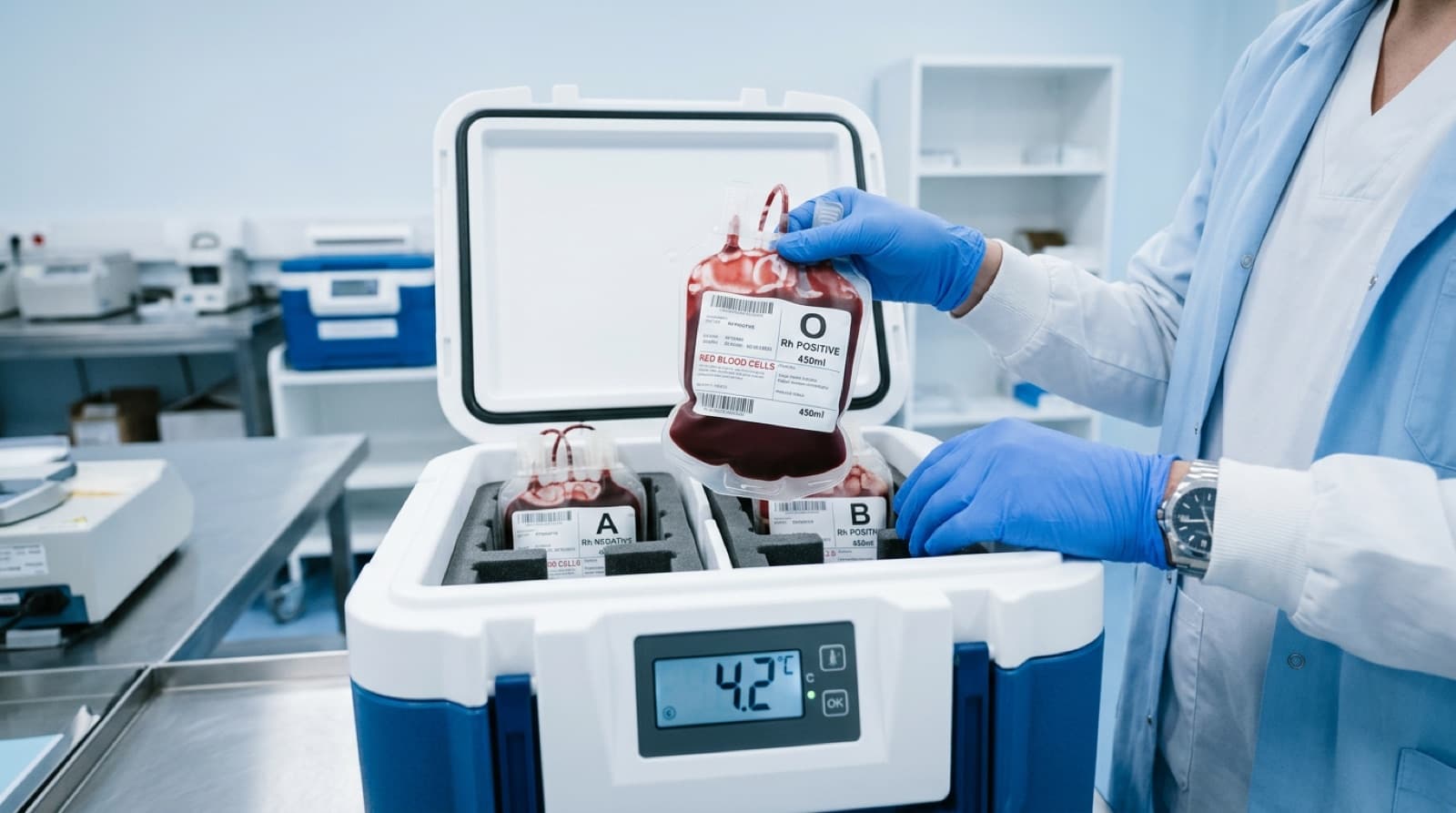
The numbers for red cells look inconsistent until you understand what each one is for. FDA regulation at 21 CFR 640.4(h) states that when blood is transported it must be placed in temporary storage with sufficient refrigeration capacity "to cool the blood continuously toward a temperature range between 1 and 10 °C until arrival at the processing laboratory" — and that at the processing laboratory it is maintained between 1 and 6 °C.
1–10 °C
Transit range for whole blood under 21 CFR 640.4(h); storage at the processing laboratory tightens to 1–6 °C
The wider transit band is not permission to be sloppy. It acknowledges that a moving container cannot hold a five-degree window as tightly as a monitored blood bank refrigerator, so the rule specifies a direction — cooling continuously toward the range — rather than a setpoint. For a courier, that means a blood run has to be actively cooled and time-bound, not merely insulated. An insulated box with no cooling capacity is not compliant transport; it is a countdown.
Platelets Break the Cold-Chain Reflex
Platelets are where trained cold-chain instincts actively cause harm. Under 21 CFR 640.25(a), platelets stored between 20 and 24 °C must be gently agitated continuously throughout the storage period. Room temperature is the requirement, not a compromise — and on a July afternoon in Houston, "room temperature" means the unit needs protection from heat just as urgently as a red cell unit needs protection from it, only toward a different target.
20–24 °C
Required platelet range under 21 CFR 640.25(a), with continuous gentle agitation — refrigerating platelets is a handling failure
The time pressure is severe. Because room-temperature storage supports bacterial growth, platelet dating is the shortest of any blood component. FDA's bacterial risk control guidance describes a maximum dating period of up to 7 days at 20 to 24 °C, and that extension beyond day 5 is available only with cleared or approved storage containers plus bacterial detection or pathogen reduction — meaning a five-day product is the working assumption in most inventories.
When a product has a five-day life, transport delay is not an inconvenience — it is inventory loss. A platelet unit that sits an extra half-day in transit has spent roughly ten percent of its usable life in a vehicle.
The 30-Minute Rule — and Why Temperature Is the Better Test
Most transfusion services still run some version of the 30-minute rule: a red cell unit that has been out of controlled storage for more than 30 minutes should not be returned to inventory for reissue. It is simple, it is easy to enforce at a counter, and it is a proxy — a stand-in for the temperature measurement nobody was taking.
Research published in Transfusion has quantified how loose that proxy is. In a single-hospital analysis of returned red cell units, the 30-minute rule would have accepted 15.2% of units that were outside the allowed temperature range, while switching to temperature-based acceptance was associated with roughly a 13% increase in wastage. Both numbers matter: the clock lets warm units back into inventory, and measuring instead of guessing costs you units you used to keep.
15.2%
Share of returned red cell units that the 30-minute rule would have accepted despite being outside the allowed temperature range (DeSimone et al., Transfusion, 2018)
For the transport leg, the takeaway is direct. A courier who can only tell you how long a unit was out is giving you the weaker signal. A courier who can tell you what temperature the container held, and when each custody change happened, gives the blood bank something it can actually decide on — the same argument for timestamped handoffs we make in our chain of custody guide.
What This Looks Like in Houston
Houston runs one of the densest blood supply networks in the country. Gulf Coast Regional Blood Center reports that it serves 170 hospitals and healthcare facilities across a 26-county area — including the Texas Medical Center — and needs roughly 1,000 blood donations per day to meet regional demand.
170 facilities
Hospitals and healthcare facilities across 26 counties supplied by Gulf Coast Regional Blood Center, which reports needing about 1,000 donations per day
That density is what makes the logistics unforgiving. An inventory serving 170 facilities depends on constant lateral movement — units shifting between hospitals to cover a trauma case, a surgical schedule, or a short-dated platelet one facility can use today and another cannot. Every one of those moves is a transport leg, and every leg is a chance to lose a unit to temperature or time.
Picture a Houston-area hospital transferring short-dated platelets to a partner facility in the medical center corridor on a weekday afternoon. The distance is trivial. The exposure is not: a vehicle in traffic on a 100 °F day, a product with days rather than weeks of life, and a receiving blood bank that has to decide whether what arrived is still issuable. That run fails when a courier treats it as a package delivery instead of a temperature-controlled transfer with a documented handoff — the same heat math we walk through in our Houston heat and specimen integrity guide.
What to Verify Before a Blood Product Run
Before a component leaves the building, confirm the transport partner can answer these:
- Which component is in the container, and which of the three temperature regimes applies to it — verified per item, not per run.
- Whether the container provides active cooling capacity or only insulation, and whether it has been validated for the component and the expected transit duration.
- Whether mixed loads are physically separated so a chilled component and a room-temperature component never share a compartment setting.
- What temperature evidence arrives with the unit — a recorded profile, not a driver's recollection of elapsed time.
- Timestamped chain of custody at every handoff, so a temperature excursion can be located to a segment rather than inferred.
- A committed delivery window short enough that a five-day product does not spend a meaningful share of its life in transit.
These belong in a written service agreement, not in a verbal understanding with a dispatcher. Our SLA evaluation guide covers converting transport promises into measurable commitments, and our compliance page documents how LabPath Logistics handles temperature-controlled and custody-tracked runs.
Key Takeaway
Blood is not one cold chain — it is three, and they point in different directions. Red cells move chilled toward 1 to 10 °C in transit and 1 to 6 °C in storage, platelets move at 20 to 24 °C under continuous agitation with a five-day working life, and plasma moves frozen. The 30-minute rule governing reissue is a proxy that measurable temperature data outperforms. Any facility moving blood components should be buying documented temperature and documented custody, not just a vehicle — because the difference between a transfusable unit and a discarded one is often a single unmonitored hour.
Frequently Asked Questions
What temperature should blood be transported at?
It depends entirely on the component. Under 21 CFR 640.4(h), whole blood in transit must be cooled continuously toward 1 to 10 °C, then stored at 1 to 6 °C at the processing laboratory. Platelets are the opposite case: 21 CFR 640.25(a) requires them to be held at 20 to 24 °C with continuous gentle agitation. Plasma is transported frozen. There is no single correct blood transport temperature.
Why can't platelets be refrigerated during transport?
Platelets are regulated for room-temperature storage at 20 to 24 °C with continuous agitation, and chilling them outside an approved cold-stored platelet protocol is a handling deviation rather than an extra safety margin. Room-temperature storage is also why platelets carry the shortest dating of any component — FDA guidance describes a maximum of up to 7 days, and only with cleared containers plus bacterial detection or pathogen reduction, so most inventories work to a five-day assumption.
What is the 30-minute rule for blood?
It is the long-standing practice that a red blood cell unit left out of controlled temperature storage for more than 30 minutes should not be returned to inventory for reissue. It is a time-based proxy for temperature. A 2018 Transfusion study found the rule would have accepted 15.2% of returned units that were actually outside the allowed temperature range, which is why many services are moving toward measuring the unit's temperature instead of the elapsed clock.
Who supplies blood to Houston hospitals?
Gulf Coast Regional Blood Center is the regional supplier, reporting service to 170 hospitals and healthcare facilities across a 26-county area that includes the Texas Medical Center, and a need for roughly 1,000 donations per day. That density means blood units move frequently between facilities, and each of those transfers is a temperature-controlled transport leg.