Cell Therapy Courier Houston: Chain of Identity Rules
August 11, 2026 · By LabPath Logistics Editorial Team, Medical Logistics Desk
Quick Answer
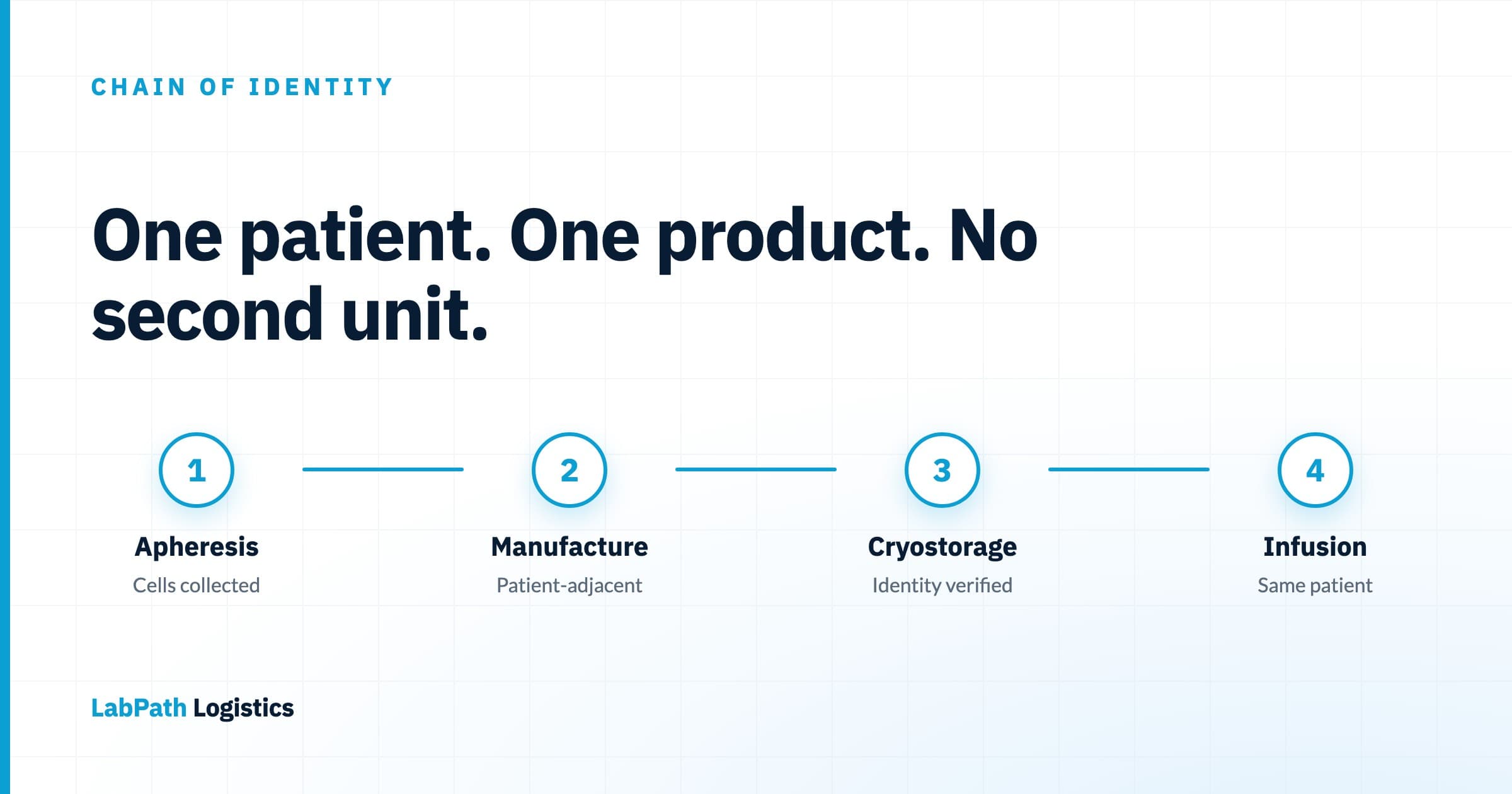
Autologous cell therapy transport is governed by chain of identity — the unbroken link between one named patient, the cells collected from them, and the finished product infused back into them — layered on top of ordinary chain of custody. Federal tracking rules at 21 CFR §1271.290 require a distinct identification code that traces a product from donor to recipient and back, and FACT standards for immune effector cells require verification of product and patient identity at multiple handoffs. For a courier, that means the shipment is not fungible: there is no second unit, no replacement lot, and no acceptable substitution.
A cell therapy courier in Houston is carrying something no other medical logistics run produces: a shipment with a population of one. A rejected chemistry tube gets redrawn. A spoiled vaccine vial gets replaced from inventory. An autologous cellular therapy product is manufactured from one patient's own cells, for that patient alone, and if it is lost, mishandled, or misidentified, there is no second unit on a shelf anywhere in the world. The patient starts over — if their disease and their remaining lymphodepletion window allow it.
That single fact reorganizes everything about how the transport leg should be scoped, staffed, and documented. Houston has more of this work than almost any metro in the country, and the geography of it is spreading. Here is what the rules actually require, which legs a local courier owns versus a specialty cryogenic provider, and what to put in a transport agreement before the first collection.
Chain of Identity Is Not Chain of Custody
These two terms get used interchangeably in vendor marketing, and they are not the same control. Chain of custody answers who had the package and when. Chain of identity answers whether this package is the right package for this patient. A courier can maintain perfect custody of a product that was mislabeled at collection and still deliver a catastrophe.
The federal tracking framework for human cells, tissues, and cellular and tissue-based products makes the identity requirement explicit. Under 21 CFR §1271.290, each HCT/P must be assigned and labeled with a distinct identification code that relates the product to the donor and to all records pertaining to it, and the establishment must maintain a tracking system that enables tracking from the donor to the consignee or final disposition, and from the consignee or final disposition back to the donor. The same section specifies that the code may not incorporate an individual's name, Social Security number, or medical record number.
Both directions
21 CFR §1271.290 requires a tracking system that works donor-to-consignee and consignee-to-donor — not a one-way delivery record
Read that bidirectional requirement as an operational spec rather than a filing rule. A delivery confirmation that proves a box arrived somewhere is a one-way record. A cell therapy program needs to be able to start from a patient and find every leg the product traveled, and start from a leg and name the patient it belonged to. If your courier's proof of delivery is a scrawled signature on a manifest, that reverse lookup does not exist.
Accreditation standards push in the same direction. The Foundation for the Accreditation of Cellular Therapy's standards for immune effector cells require quality systems that trace from the donor — including autologous patients — through to final administration, with verification of product and patient identity at multiple steps, and they push hard toward ISBT 128 coding and labeling for unambiguous identification. MD Anderson's Apheresis and Cell Therapy Laboratory holds FACT accreditation for collection for further manufacturing, which means the identity controls on the collection side of a Houston route are already formalized. The transport leg has to meet them, not dilute them.
The question to ask a courier
Not "can you track my shipment?" — everyone says yes. Ask: given a patient identifier from six months ago, can you produce every leg, every driver, every timestamp, and every temperature record associated with that patient's product, without calling anyone? If the answer requires a phone call to dispatch, the record is a memory, not a system.
Which Legs a Local Courier Actually Owns
Cell therapy logistics gets described as one continuous cryogenic journey, which obscures where the real handoffs are. The typical autologous flow runs: apheresis collection at a treatment center, transfer to a cryopreservation or manufacturing facility, manufacture, cryogenic storage, return shipment, and infusion. Some of those legs belong to specialty cryogenic providers running validated liquid-nitrogen dry shippers across the country. Some of them are local ground moves measured in miles.
Houston is unusual in how many of those legs are local. CTMC operates a patient-adjacent manufacturing model with MD Anderson from 2130 W. Holcombe Blvd. in the Texas Medical Center, which puts viral vector production and CAR-T, NK, and TIL manufacturing inside the same medical district as the collection floors and the infusion suites. When collection, manufacturing, and administration sit within a few miles of each other, the courier legs are short, frequent, and time-critical rather than long and logistically exotic.
The honest division of labor looks like this:
- Cross-country cryogenic transport of the finished product in a validated dry shipper is specialty work with its own qualification, monitoring, and customs documentation — hire the provider your manufacturer or sponsor already qualified.
- Local transfer of fresh apheresis starting material from a collection floor to a nearby processing or cryopreservation facility is ground courier work with a stability clock and an identity requirement.
- Same-day movement of ancillary materials, reagents, and controlled-temperature supplies between TMC facilities is ordinary medical courier work that becomes program-critical when a manufacturing slot depends on it.
- Documentation, sample, and correlative-study transport tied to a cell therapy patient carries the same identity linkage even when the payload itself is unremarkable.
A courier that claims all four without distinction is telling you something about its qualification process. A courier that can name which legs it is qualified for — and which it is not — is easier to build a program around. The cryogenic handling side overlaps closely with the discipline we cover in our guide to frozen specimen transport and dry ice.
The Geography of This Work Is Changing
For most of the CAR-T era, these therapies were delivered almost exclusively at certified academic centers, because a Risk Evaluation and Mitigation Strategy required treatment-site certification and specific readiness controls. That changed in 2025. FDA eliminated the REMS for the approved BCMA- and CD19-directed autologous CAR T cell immunotherapies, concluding that safe and effective use could be assured without one given the field's accumulated experience managing cytokine release syndrome and neurologic toxicity.
8 weeks → 2 weeks
Reduction in the labeled driving-avoidance period accompanying FDA's 2025 CAR-T REMS elimination; the proximity-to-facility period dropped from 4 weeks to 2
Site certification and mandatory on-hand tocilizumab requirements came off with it, and the labeling changes shortened the post-infusion tether. The stated expectation was improved access, particularly outside major metros. That is a clinical story with a logistics tail: as administration decentralizes toward community and regional centers, the distance between where cells are collected, where they are manufactured, and where they are infused stops being a single campus problem.
Picture it concretely. A Houston-area community oncology program begins referring patients into a cell therapy pathway anchored at a TMC manufacturing facility. Collection happens downtown, manufacturing happens a few blocks away, and follow-up care happens in Sugar Land or Kingwood. Every one of those relationships generates recurring, scheduled, identity-linked ground movement across a metro where a wreck on the 610 Loop is a Tuesday. The clinical model decentralized; the traffic did not improve.
What to Require in a Cell Therapy Transport Agreement
- Patient-linked record retrieval: the ability to produce every leg, driver, timestamp, and temperature trace for a given product identifier on request, without reconstructing it from memory.
- A written no-relabel, no-repackage, no-open rule. The identity linkage was established upstream by people qualified to establish it; a driver's only correct action when a label looks wrong is to stop and escalate.
- Named drivers on every run, with the roster available to your quality team — anonymous handoffs are a hole in a record that regulators expect to be continuous.
- A defined escalation path with a human decision-maker for the specific case where transport is disrupted mid-leg and someone has to decide whether the product goes forward or returns.
- Scope honesty in writing: which legs the courier is qualified to run, which container types it is trained on, and which shipments it will hand to a specialty cryogenic provider.
- Documented driver training on the difference between chain of custody and chain of identity, because the second one is the failure mode that generic courier training never covers.
Run the reverse lookup as a drill
Before a program goes live, pick a completed non-cellular run and ask your courier to produce the full record from the identifier alone. Time it. A vendor that can answer in minutes from a system has the infrastructure a cell therapy program needs; a vendor that answers in a day, after calling drivers, has a filing cabinet.
None of this is exotic technology. It is the same time-stamped, patient-linked custody discipline we apply to every route — described in detail in our chain of custody guide for Houston facilities — held to a standard where a single failure is unrecoverable rather than merely expensive. The sponsor-driven documentation expectations sit close to what we outline for clinical trial specimen transport.
Key Takeaway
Cell therapy transport is the clearest case in medical logistics where the record is part of the product. Federal tracking rules demand a bidirectional link between a donor and a finished product; accreditation standards demand identity verification at every handoff; and the therapy itself offers no margin for a lost unit. Houston's concentration of collection, manufacturing, and infusion capacity inside one medical district turns much of that burden into short local runs — which makes the ground courier a named participant in a chain that started in a patient and has to end in the same one.
Frequently Asked Questions
What is chain of identity in cell therapy transport?
Chain of identity is the unbroken, documented link between a specific patient, the cells collected from them, and the finished product returned for infusion. It is distinct from chain of custody, which only records who held the package and when. Federal tracking rules at 21 CFR §1271.290 require a distinct identification code linking an HCT/P to its donor and a tracking system that works in both directions, and FACT standards for immune effector cells require verification of product and patient identity at multiple steps.
Can a local medical courier transport CAR-T products?
It depends on the leg. Long-distance transport of a finished cryopreserved product in a validated liquid-nitrogen dry shipper is specialty work typically assigned to a provider already qualified by the manufacturer or sponsor. Local ground legs — fresh apheresis material moving to a nearby processing facility, ancillary materials, and correlative samples — are within the scope of a qualified medical courier. Ask any vendor to state in writing which legs and container types it is qualified for.
Why does a cell therapy shipment need different handling than a lab specimen?
Because it cannot be replaced. An autologous cellular therapy product is manufactured from one patient's own cells for that patient alone, so a loss is not a redraw or a reorder — it is a treatment the patient may not be able to receive again within their clinical window. That absence of a backup unit is why identity verification, named drivers, and retrievable patient-linked records matter more here than on any routine route.
Did the 2025 FDA REMS change affect cell therapy logistics in Houston?
Indirectly, and meaningfully. FDA eliminated the REMS for the approved BCMA- and CD19-directed autologous CAR T cell immunotherapies in 2025, removing treatment-site certification requirements and shortening labeled post-infusion restrictions. As administration decentralizes beyond certified academic centers, the physical distance between collection, manufacturing, and infusion grows — which increases the number of scheduled, identity-linked ground legs across a metro like Houston. Confirm current labeling and program requirements with your treatment center and product manufacturer.