Next-Flight-Out Specimen Shipping From Houston
October 11, 2026 · By LabPath Logistics Editorial Team, Medical Logistics Desk
Quick Answer
Next-flight-out moves a specimen on the first available commercial flight, with couriers handling both ground legs. Use it when the specimen cannot survive an overnight parcel cycle and the receiving lab is too far to drive. The package must be air-ready: 95 kPa leak-tested, within air quantity limits, and any dry ice marked and declared.
Most Houston labs choose a shipping mode for an out-of-state specimen by habit: it goes in the overnight box. That works until a specimen arrives with a stability window shorter than the parcel network's sort cycle, or it is collected after the last pickup on a Friday. Next-flight-out specimen shipping exists for exactly that gap. It is also the mode most often done badly, because packaging that is fine in a van can fail at altitude, and custody gets thin at the airport counter.
This guide is for lab managers, send-out coordinators, and research site staff who sometimes have to get a specimen from Greater Houston to a lab in another state the same day. It explains what next-flight-out actually involves, which federal packaging rules change when a box flies, and gives you the Wheels-Up Test, six questions that pick between overnight, next-flight-out, and a long ground drive before the stability clock picks for you.
What Is Next-Flight-Out Specimen Shipping?
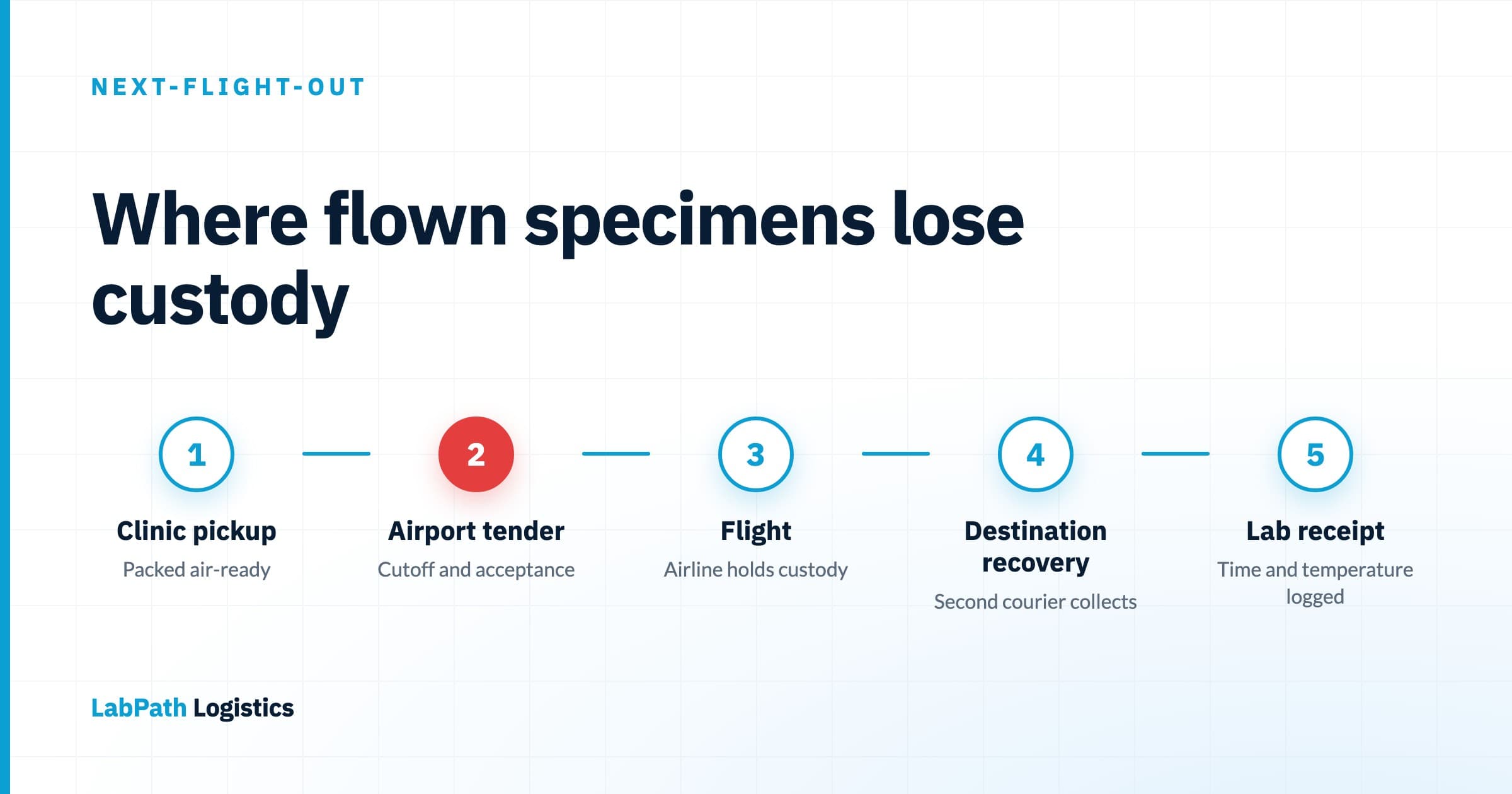
Next-flight-out, often shortened to NFO, means a specimen is tendered to an airline's cargo counter and booked on the first available commercial flight to the destination city. It has three legs. A ground courier picks up at your site and drives to the cargo counter at Bush Intercontinental (IAH) or Hobby (HOU). The airline carries it. A second ground courier recovers it at the destination airport and delivers it to the receiving lab.
Overnight parcel shipping runs through a hub sort and delivers the next morning. NFO skips the sort and can land a specimen the same day. The trade-off is that you are now coordinating three parties and two handoffs instead of one, and the two ground legs are where most of the risk sits. If you are new to managing referral volume, start with our send-out testing logistics guide, which covers the routine side of the same problem.
What Changes in the Packaging When a Specimen Flies?
A Category B box that is compliant on a ground route is not automatically compliant on an aircraft. The DOT rule for Category B specimens, 49 CFR 173.199, adds air-only conditions on top of the triple packaging you already use. Our Category B packaging guide covers the ground baseline. These are the additions that matter when the box flies:
95 kPa
Pressure differential that the primary or secondary receptacle must withstand without leakage for liquid specimens shipped by aircraft, per 49 CFR 173.199(b)(4)
- Pressure: for liquids, the primary or secondary receptacle must hold a 95 kPa pressure differential without leaking. Most purpose-made specimen bags state this rating. A zip-top bag does not.
- Quantity: each liquid primary receptacle may not exceed 1 L, and each outer packaging may not exceed 4 L, with refrigerant excluded from that limit. Solids are capped at 4 kg per outer packaging.
- Marking: the Category B diamond must have sides of at least 50 mm, and for aircraft the entire mark must appear on one side of the package.
- Contact: the name and telephone number of a person who knows the shipment must be on the package or a shipping document.
Dry ice adds its own rules. Under 49 CFR 173.217, the package must let carbon dioxide gas escape, must be marked "Dry ice" or "Carbon dioxide, solid" with the net weight (or an indication that it is 2.5 kg or less), and "the shipper must make arrangements with the operator for each shipment." That last line is the one that bites NFO. Each airline sets its own dry ice acceptance terms, so confirm them when you book, not at the counter. Our dry ice transport guide covers how much to pack for the full door-to-door time.
When Is Next-Flight-Out Worth It Over Overnight Shipping?
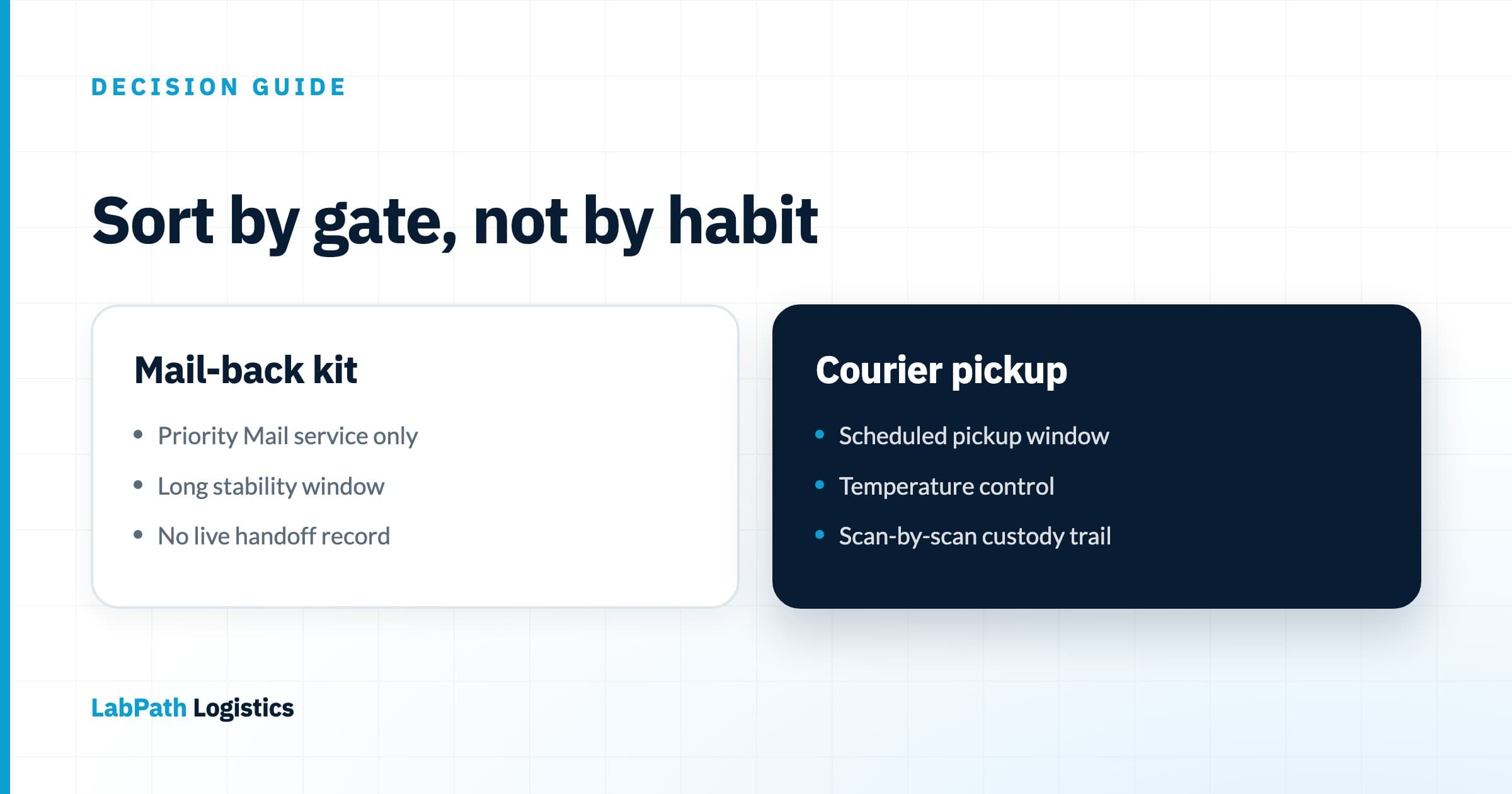
NFO costs more than an overnight label, and it is not always faster door to door once you add two ground legs and a counter cutoff. It earns its price in a narrow set of cases: the stability window will not survive an overnight cycle, the specimen was collected too late for the day's parcel pickup, the receiving lab needs it during a processing window that closes today, or a recollection would be costly or impossible. Clinical trial kits with protocol time limits and cell therapy starting material are the classic examples. Our clinical trial and cell therapy guides cover those protocols.
There is also a third option labs forget. For a receiving lab in another Texas metro, a dedicated ground run can beat a flight door to door, because it never waits at a cargo counter or a recovery desk, and one driver holds custody end to end. Before booking a flight to Austin, San Antonio, or Dallas, price the drive.
The Wheels-Up Test: save and send to your lab director
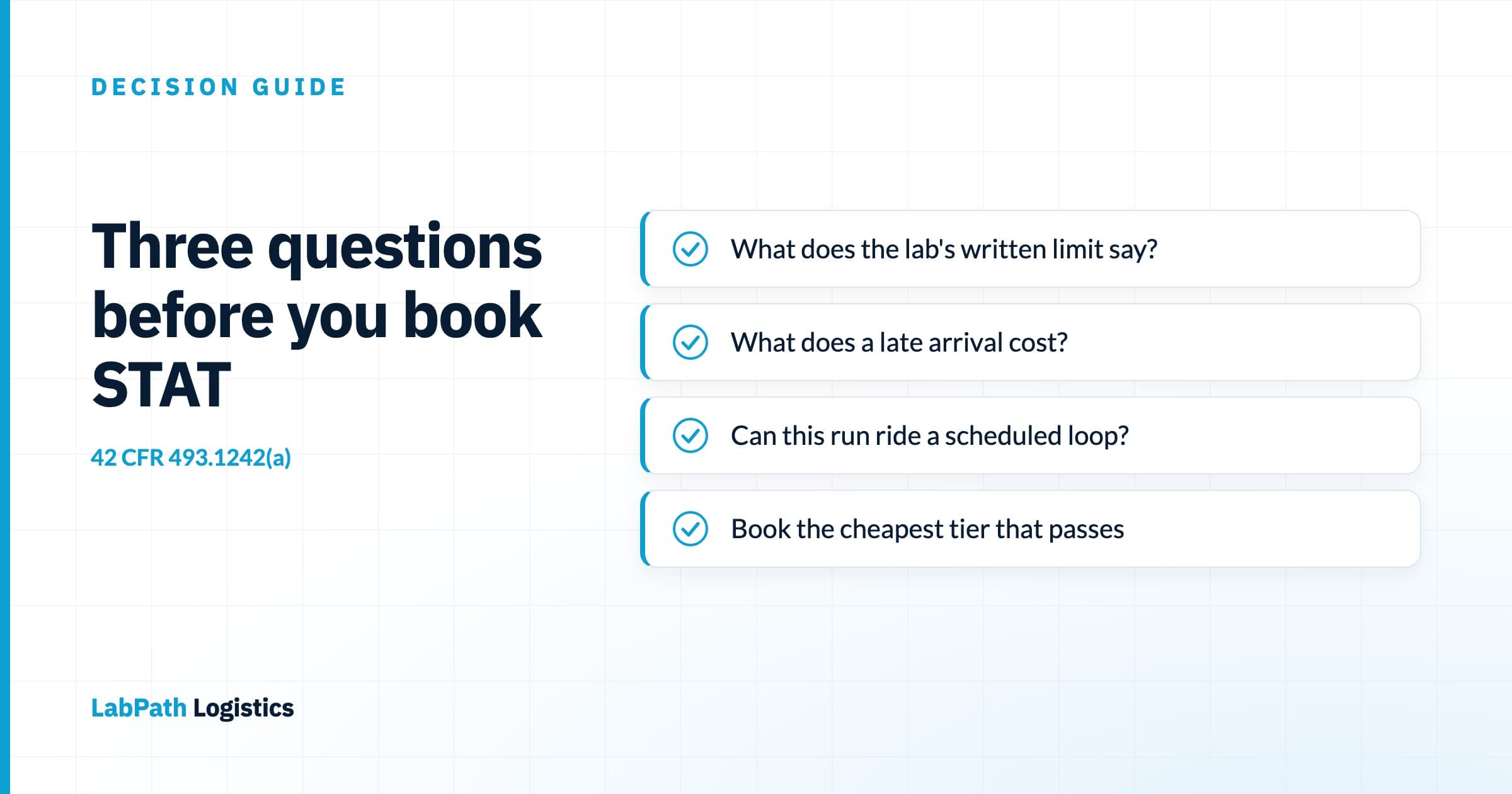
Before the next out-of-state specimen leaves, answer six questions. (1) Stability: will the specimen still be in its window at the earliest overnight delivery time? If yes, ship overnight. (2) Distance: can a ground courier reach the receiving lab inside the window? If yes, price a dedicated drive. (3) Packaging: is the box air-ready, with a 95 kPa rated receptacle, within 1 L inner and 4 L outer, and the full mark on one side? (4) Refrigerant: if dry ice is aboard, is it marked with net weight and cleared with the airline for this flight? (5) Recovery: is a named courier booked to collect at the destination airport, and is the receiving lab open when it lands? (6) Custody: who records tender time at the Houston counter and recovery time at the other end? Any no on 3 through 6 means the flight is not ready to book.
A Houston Scenario: The 2:40 p.m. Research Draw
Consider a research site near the Texas Medical Center. A study visit runs late, and a whole-blood specimen for a central lab in another state is drawn at 2:40 p.m. on a Thursday. The protocol requires receipt within a set number of hours, and the overnight pickup has already left. The coordinator books NFO. The ground courier reaches the IAH cargo counter, but the box is marked on two sides, the dry ice weight is missing, and the airline has not pre-approved dry ice on that flight. The specimen misses the flight it was booked on.
Run the Wheels-Up Test at 2:45 instead of at the counter and questions 3 and 4 fail before a driver is dispatched. Fixing the label and calling the airline takes ten minutes at the bench. At the counter it takes a flight. The general rule: NFO failures are almost always packaging or booking failures that show up at the tender point, which is why the airport counter is the critical step in the chain.
Who Holds Custody While the Specimen Is in the Air?
The airline does, from the moment the counter accepts the package to the moment the recovery courier collects it. That window is the thinnest part of your custody record. Your courier should give you a tender time and the airway bill number at the Houston counter, and the recovery courier should give you a pickup time at the destination. Without both, a delayed or missing specimen becomes an argument between three companies. Our chain of custody guide explains what a defensible record looks like, and our lost specimen guide covers what happens when one goes missing.
Timing compounds the risk. A Thursday-afternoon flight that lands after the receiving lab closes for the day has not saved anything. Late flights, weekends, and holidays need a confirmed receiving contact, not an assumed one. Our after-hours courier guide covers how to line up those calendars.
What Should You Ask a Courier About Airport Runs?
- Which cargo counters do your drivers tender to, and what are the cutoff times you plan around?
- Do drivers check air-specific packaging and markings before leaving our site, or only at the counter?
- Will you send the tender time and airway bill number as soon as the airline accepts the package?
- Who arranges destination recovery, and how do we reach that courier directly?
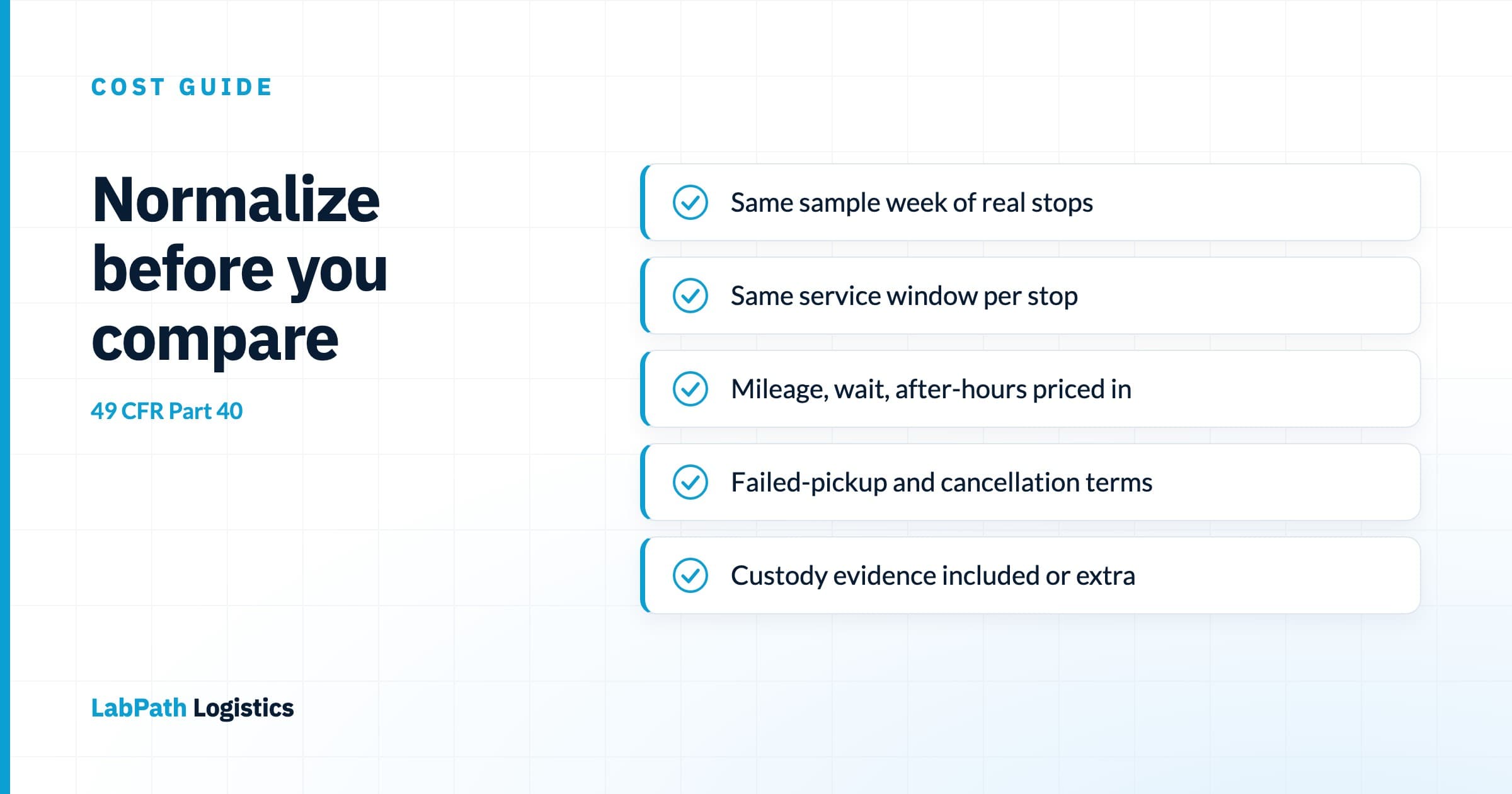
- How is the Houston ground leg priced, and what is the charge for a wasted trip if the airline refuses the package?
The last question matters because the wasted trip is the most common NFO surprise on an invoice. Our invoice audit guide lists the other line items worth checking. If the Houston leg of your send-outs is a recurring cost, price that leg in the LabPath estimator or compare it against our planned service levels.
Frequently Asked Questions
What does next-flight-out mean for specimen shipping?
Next-flight-out means a specimen is taken to an airline cargo counter and booked on the first available commercial flight to the destination, with a ground courier at each end. It skips the overnight parcel sort and can deliver the same day, but it involves two handoffs and an airline custody window.
Can Category B specimens be shipped on passenger aircraft?
Yes, under 49 CFR 173.199, if the packaging meets the air-specific conditions. For liquids, the primary or secondary receptacle must withstand a 95 kPa pressure differential, primary receptacles are limited to 1 L, outer packages to 4 L, and the full Category B mark must appear on one side of the package.
How do you mark dry ice on an air specimen shipment?
Under 49 CFR 173.217, the package must vent carbon dioxide gas and be marked "Dry ice" or "Carbon dioxide, solid" with the net weight of dry ice, or an indication that it is 2.5 kg or less. The shipper must also make arrangements with the airline for each shipment.
Is next-flight-out faster than driving a specimen from Houston to Dallas or Austin?
Not always. Once you add the drive to the airport, the counter cutoff, the flight, and destination recovery, a dedicated ground run to another Texas metro can match or beat a flight door to door, with one driver holding custody throughout. Price both before booking.