2027 Lab Fee Cuts: Audit Your Houston Courier Costs
October 7, 2026 · By LabPath Logistics Editorial Team, Medical Logistics Desk
Quick Answer
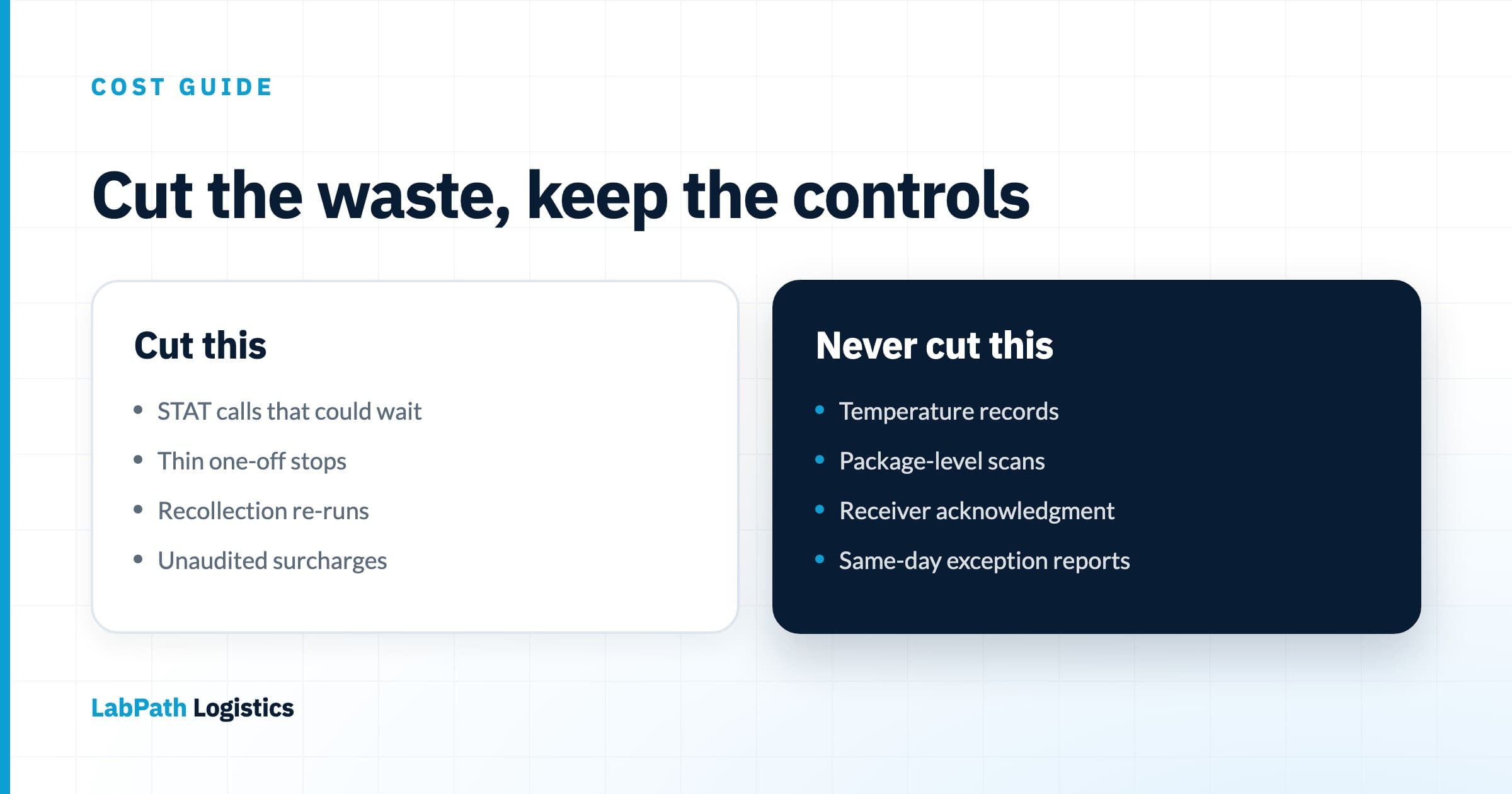
CMS's preliminary 2027 Clinical Laboratory Fee Schedule cuts nearly 1,200 tests, 775 of them by the 15% maximum. For Houston outreach labs, courier spend is one of the few logistics costs you control. Cut waste first: misclassified STATs, thin one-off stops, recollection runs, and unaudited surcharges. Never cut temperature records, package scans, or receiver acknowledgment.
The cheapest courier is rarely the cheapest courier. That matters more than usual this fall, because Medicare is about to pay Houston labs less for the same tests. When reimbursement drops, the first instinct is to squeeze lab courier costs by finding a lower rate card. The better move is to find the runs you are paying for that never needed to happen.
This guide is for outreach lab directors, practice administrators, and finance leads building 2027 budgets. It explains what changed, why courier spend is a real lever, and a four-line audit you can run on your own invoices this month, before any contract conversation.
What Is Changing in the 2027 Medicare Lab Fee Schedule?
On September 22, 2026, CMS released preliminary 2027 rates for the Clinical Laboratory Fee Schedule, the first full application since 2018 of the market-based method set by the Protecting Access to Medicare Act of 2014 (PAMA). As Healthcare Dive reported, nearly 1,200 tests face lower payments, with more reductions in 2028 and 2029. CMS estimates about $1 billion in annual Medicare savings.
775 tests
Lab tests facing the maximum 15% Medicare payment cut in 2027 under preliminary CLFS rates, per ACLA as reported by HFMA
According to HFMA, the 2026 federal budget law caps reductions at 15% per year from 2027 through 2029. Without that cap, preliminary decreases would have reached 16% in chemistry and 22% in molecular pathology. Final rates are expected in November, and the lab industry is lobbying for the RESULTS Act, which would cap annual cuts at 5%. Plan for the preliminary numbers and treat any relief as upside.
Why Is Courier Spend a Margin Lever Now?
An outreach lab cannot reprice a Medicare test. It can change how specimens reach the bench. Courier spend is driven by decisions the lab makes every day: which calls get STAT, how stops are grouped, how often specimens arrive in a condition that forces a redraw. Those decisions compound across 250 working days. If you are weighing a bigger move, such as selling or restructuring outreach, our guide to outreach lab sales and courier logistics covers that path.
The trap is cutting the wrong thing. Dropping temperature monitoring or package-level scans saves a little per run and then costs far more when a batch is rejected or a specimen goes missing. Pre-analytical errors already account for most lab errors, and transport sits in that phase. Cheaper transport that raises rejection rates is not cheaper.
The Four-Line Courier Cost Audit
Pull the last 90 days of courier invoices and manifests. Score each line below. You do not need new software, just the invoices, your STAT request log, and your accessioning rejection log.
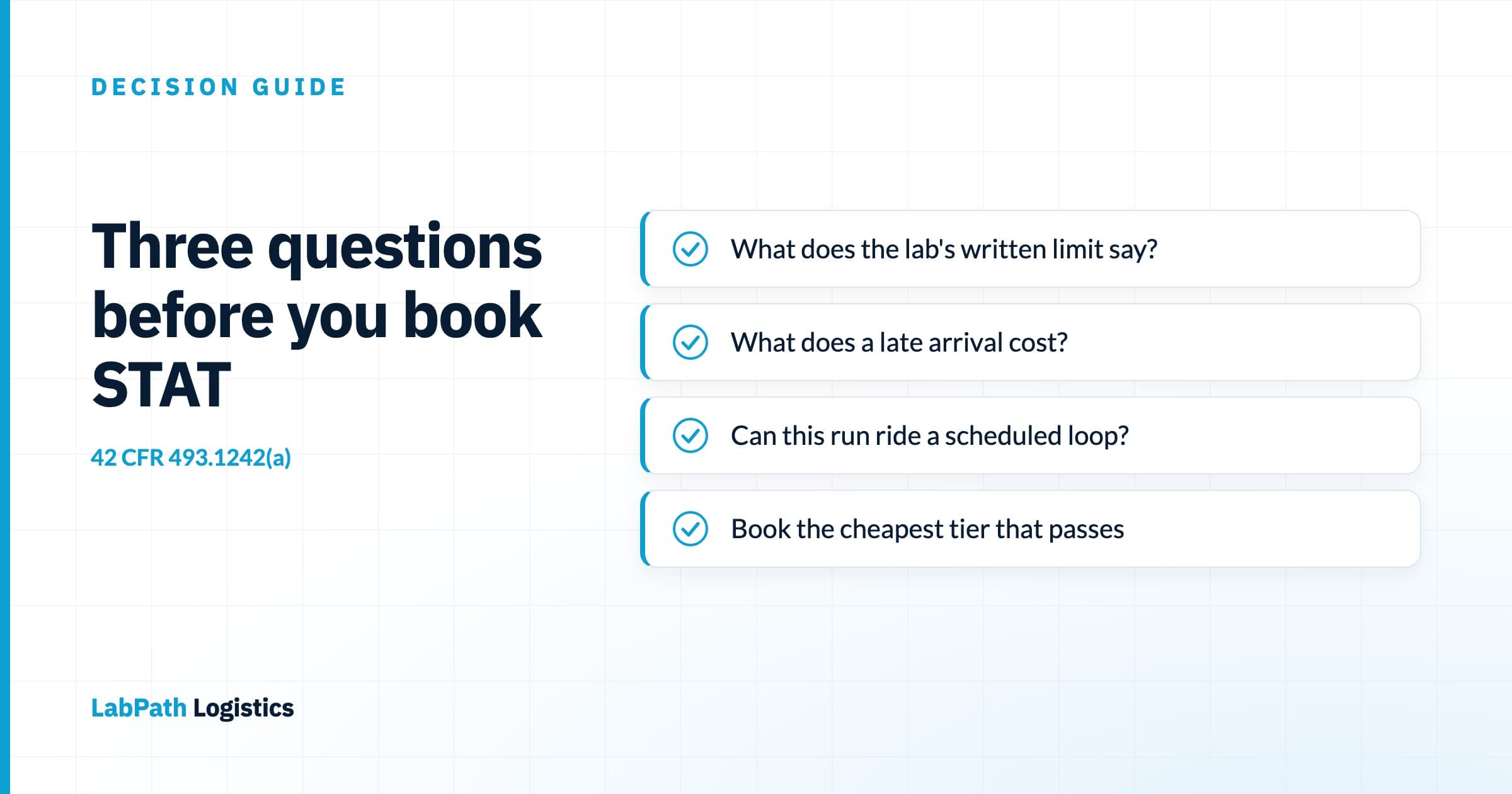
- STAT discipline: what share of STAT calls could have ridden the next scheduled sweep without affecting care? Ask the ordering clinicians which test types truly need STAT, then publish that list. Our STAT checklist helps draw the line.
- Stop density: which stops generate one or two specimens a day on their own run? Those are candidates for shared scheduled stops or a consolidated loop. See scheduled vs on-demand routes and sizing pickup schedules.
- Recollection runs: how many courier trips existed only because a specimen was rejected and redrawn? Each one is a second draw, a patient callback, and often a second run. Our specimen rejection guide lists the transport-related causes.
- Surcharge leakage: are wait-time, after-hours, fuel, and mileage adjustments on the invoice backed by a manifest entry and the contract? Our invoice audit guide shows how to check line by line.
Save and send this
Forward the four lines above to your lab director and finance lead with one ask: "Can we score our last 90 days before budget lock?" Together they cover four of the biggest controllable drivers of courier spend, and none of them requires changing vendors.
What Should a Lab Never Cut to Save on Couriers?
Four controls protect the specimen and your liability. Keep them in every contract, at every price point.
- Temperature records for refrigerated and frozen runs, with a defined excursion plan. See our specimen transport temperature guide.
- Package-level scans at pickup and drop-off, not just a stop signature.
- A named receiver acknowledgment at every handoff.
- Same-day exception reporting when anything goes wrong.
A quote that comes in lower because one of these is missing is not a discount. It is a transfer of risk back to your lab. If a courier will handle protected health information, a business associate agreement is also non-negotiable under 45 CFR 164.504(e).
A Houston Scenario: The Southwest Loop
Picture an outreach lab serving physician offices from Sugar Land to Bellaire. Its courier runs a midday loop plus on-demand pickups whenever an office calls. The audit shows three patterns: one Missouri City office calls a STAT almost daily for routine panels, two Alief offices each get their own run for a handful of tubes, and a cluster of hemolyzed samples from a hot afternoon lockbox caused repeat draws and repeat runs. None of these fixes involves a cheaper rate. They involve a STAT policy, a consolidated stop, and a cooler. Our post on Houston heat and specimen integrity covers the lockbox problem.
When Should You Compare Couriers?
After the audit, not before. Once you know your real STAT share, stop density, and rejection-driven runs, you can price the route you actually need instead of the route you have. Compare per-stop, scheduled, and dedicated-route pricing against that profile using our Houston courier cost breakdown. For a no-commitment reference point, the LabPath estimator gives a nonbinding estimate in under a minute. Then test the finalist with a 14-day pilot scorecard before you sign anything.
Frequently Asked Questions
How much is Medicare cutting lab payments in 2027?
CMS's preliminary 2027 Clinical Laboratory Fee Schedule lowers payment for nearly 1,200 tests. 775 of them face the maximum 15% cut, and further reductions are planned for 2028 and 2029. Final rates are expected in November 2026.
How can a lab reduce courier costs without risking specimens?
Cut waste, not controls. Tighten STAT criteria, consolidate low-volume stops onto shared or scheduled routes, reduce recollection runs by fixing transport-related rejections, and audit surcharges against manifests. Keep temperature records, package-level scans, receiver acknowledgment, and same-day exception reporting.
Is a cheaper medical courier always cheaper for a lab?
No. A lower rate that drops temperature monitoring or package scanning can raise specimen rejections, redraws, and repeat runs. Measure total cost per specimen accepted at accessioning, not the price per stop.
What does PAMA have to do with lab courier costs?
PAMA sets Medicare lab rates from private-payer data, which is driving the 2027 cuts. Lower reimbursement squeezes outreach margins, so controllable costs such as specimen transport become one of the few places a lab can recover margin.