Freestanding ER Lab Courier Houston: Send-Out Guide
August 20, 2026 · By LabPath Logistics Editorial Team, Medical Logistics Desk
Quick Answer
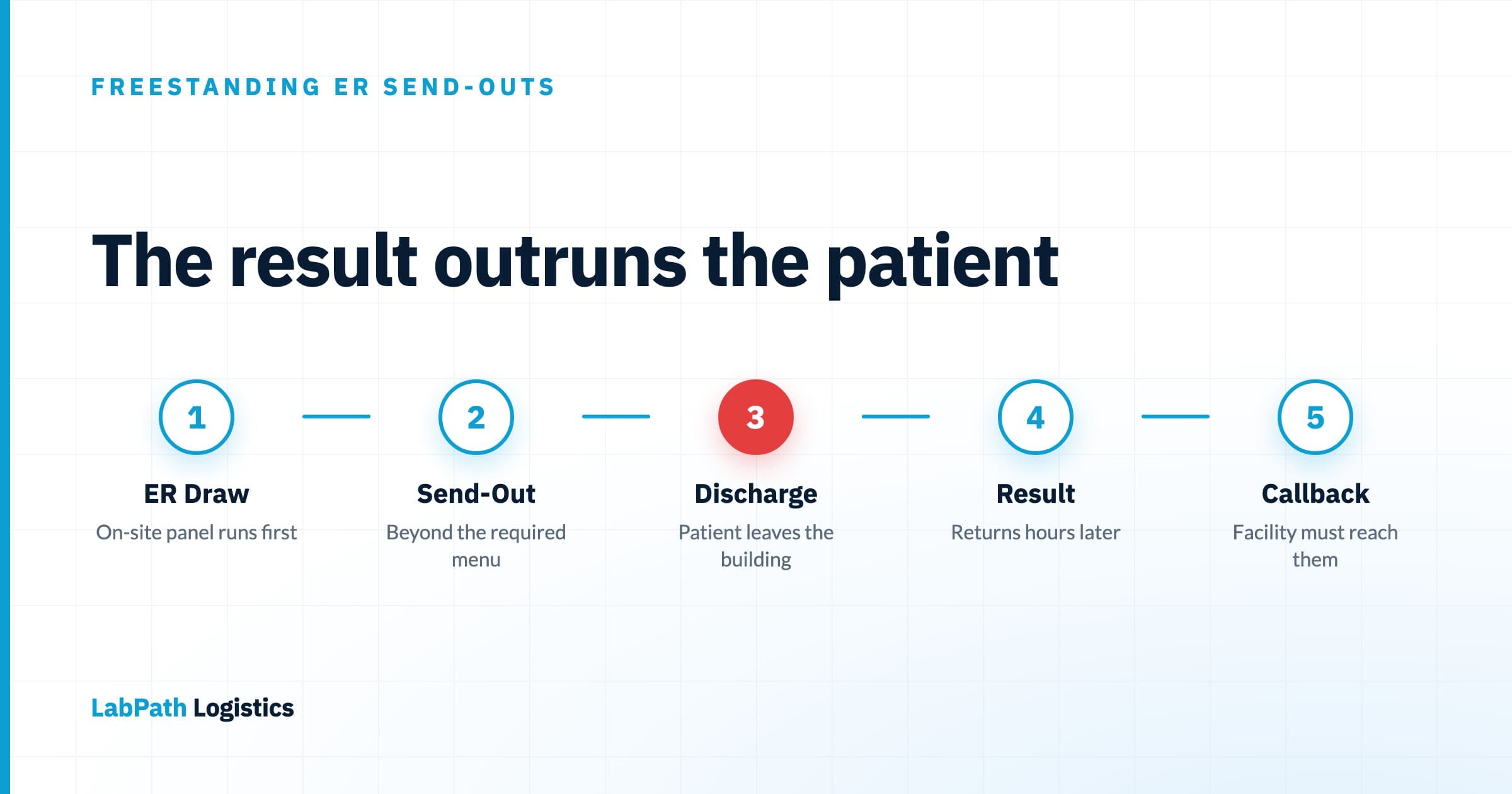
A freestanding ER lab courier moves everything a freestanding emergency room cannot test on-site — anything beyond the cardiac marker, hematology, chemistry, and pregnancy testing Texas requires it to run in-house under 26 TAC §509.49(d). The defining difference from a hospital emergency department is discharge timing: freestanding ERs send most patients home within hours, so a send-out result almost always returns after the patient has left the building. That makes the courier's job not merely fast transport, but transport fast enough that a critical value reaches a physician who can still act on it.
A freestanding ER lab courier has a harder problem than a hospital courier, and it is not distance. It is that the patient leaves. A hospital emergency department holding someone for six hours can wait on a send-out result. A freestanding emergency room in Katy or Sugar Land discharges that patient in ninety minutes, and the specimen your driver picked up is still in transit when they pull out of the parking lot. Nearly everything about how you buy transport for a freestanding ER follows from that single fact.
Texas has more of these facilities than any other state, and Greater Houston has a dense share of them. They are licensed under Chapter 254 of the Texas Health and Safety Code, they run real laboratories, and they generate real send-out volume — but the operating assumptions that make hospital courier programs work do not transfer cleanly. Here is what actually changes.
What a Freestanding ER Can Test On-Site
Texas is specific about this. Under 26 TAC §509.49, a freestanding emergency medical care facility must maintain directly, or have immediately available on the premises, adequate laboratory services — and subsection (d) names the emergency services that must be available on-site during operating hours: cardiac marker assays, hematology, chemistry, and pregnancy testing.
That is a deliberately narrow floor. It covers the decisions a physician has to make in the room: is this a myocardial infarction, is this patient bleeding, is this patient pregnant, are the electrolytes survivable. It does not cover much else. Subsection (b) requires those laboratory services to comply with CLIA 1988 as specified in 42 CFR Part 493, which applies to any facility examining human specimens for diagnosis, prevention, treatment, or health assessment.
Everything outside that floor moves. In practice, the recurring send-out categories are:
- Cultures and susceptibilities — blood, urine, wound, respiratory — which are collected in the ER and read somewhere else entirely.
- Confirmatory toxicology, when a waived screen needs a defensible confirmation.
- Specialty chemistry and endocrine assays that no one runs on a four-analyzer footprint.
- Anatomic pathology from procedures performed on-site, including incision and drainage specimens and foreign body retrievals.
- Molecular and reference testing ordered because the patient presented after every physician office in the corridor had closed.
The on-site menu is a floor, not a scope
Facilities that size their courier program against the required on-site panel consistently undercount send-out volume. The regulation defines what cannot leave the building — not what will.
The Scale Is Larger Than Most Labs Assume
A 2026 analysis in Health Affairs Scholar worked from a Department of State Health Services list of 351 Texas freestanding emergency departments, drawn on November 11, 2024. That is not a fringe facility type. It is a distribution network.
24%
Share of Texas emergency department visits occurring at freestanding EDs — 12% satellite and 12% independent — across 21,605,421 visits studied in 2021–2022 (Texas A&M School of Public Health, Health Services Research)
That figure comes from a Texas A&M School of Public Health study published in Health Services Research, which compared freestanding ED visits with hospital-based ones and found 76 percent of visits occurred at hospitals, 12 percent at satellite freestanding EDs, and 12 percent at independent freestanding EDs. Roughly one in four Texas emergency visits now begins somewhere that has no inpatient floor to hold the patient while a result comes back.
The Discharge Gap Is the Real Problem
Read §509.49(i) carefully and you will find the whole logistics problem stated in regulatory language. The facility must notify physicians of critical laboratory values — and the rule contemplates that notification happening either before or after the patient is discharged.
That phrase is an admission built into the rule. The regulator understood that a freestanding ER will routinely receive a result for a patient who is already gone. Your courier program either shrinks that window or it does not.
The operational consequences are concrete, and they are not the ones a hospital lab manager would predict:
- Transit time converts directly into callback difficulty. A result that lands two hours after discharge reaches a patient at home; one that lands at 11 p.m. reaches voicemail.
- The escalation path has to reach a physician who may no longer be on shift, which means the courier's delivery confirmation needs to trigger something on your side, not just close a ticket.
- A recollection is usually impossible. The patient is not coming back for a redraw, so a specimen lost or compromised in transit is a clinical gap, not an inconvenience.
- Pickup cadence matters more than raw speed. A run that leaves every two hours beats a faster run that leaves once, because the average specimen sits less.
This is why freestanding ERs should evaluate courier performance on time-from-collection rather than time-from-pickup — the same measurement discipline covered in our guide to lab turnaround time. The clock the patient experiences starts at the draw.
Your Contracted Lab Has to Be Certified for the Specialty
Subsection (c) of the same rule requires that contracted laboratory services be performed in facilities certified in the appropriate specialties under 42 CFR Part 493. This sounds like a contracting detail and behaves like a routing constraint.
If your microbiology goes to one reference laboratory and your anatomic pathology to another, you do not have one send-out lane. You have two, with different cutoffs, different receiving hours, and different accessioning behavior. Couriers that quote a single daily pickup are quietly assuming a single destination. Map the specialties to the certified performing laboratories first, then design the routes — the sequencing our send-out testing logistics guide walks through in detail.
Blood Storage Makes the Courier Part of Resupply
Freestanding ERs that stock blood inherit an obligation most outpatient facilities never touch. Subsection (h) requires written procedures for blood storage that address temperature maintenance and protocols for power failure, alongside requirements covering transfusion prescribing, personnel training, sterile transfusion sets with filters, patient observation for adverse reactions, and documentation in the medical record.
Transport is where that written procedure meets the road. A facility carrying a small inventory depends on timely resupply and timely return of unused units, and both legs are courier work with a validated temperature lane and a custody record — the handling requirements detailed in our blood product transport guide. A power failure protocol that assumes someone can move product to another site is only as good as the vehicle available at that hour.
Houston Geography Works Against the Clock
Freestanding ERs are sited where hospitals are not. In Greater Houston that means the growth corridors — Katy, Cypress, Sugar Land, Pearland, Spring, and the outer loop generally. Reference and specialty laboratory capacity, by contrast, concentrates in and around the Texas Medical Center.
The result is a structural reverse commute. Your specimens travel inbound toward the core during the afternoon, which is exactly when the corridors feeding the TMC are least predictable, and they do it from a facility whose peak arrival hours are evenings and weekends. A hospital courier moving specimens between buildings on one campus has none of these variables.
One thing improves after dark: the drive itself. Freestanding ER volume runs heavily into the night, and night transit through Houston is among the most reliable of the day — provided a vehicle is actually scheduled, which is the distinction drawn in our guide to after-hours coverage. A freestanding ER without standing night coverage is a facility whose busiest hours have the thinnest transport.
What to Require From a Freestanding ER Courier
Put these in the agreement rather than discovering them during an incident:
- Coverage that matches your actual arrival curve — evenings, weekends, and named holidays — stated as scheduled coverage rather than a number to call.
- A pickup cadence, not just a response time, since average specimen dwell is what your patients experience.
- Separate lanes documented for each certified performing laboratory you use, with each one's receiving hours and cutoffs in writing.
- Temperature lanes that cover what you actually send, including any refrigerated or frozen send-outs, and any blood product resupply leg.
- Time-stamped custody at collection and at receipt, so the record supports your critical value timeline rather than contradicting it.
- A delivery confirmation that reaches a named person at your facility, closing the loop on a patient who has already gone home.
- A defined exception path with a real phone number for the night a driver cannot reach a receiving dock.
Key Takeaway
A freestanding emergency room is not a small hospital ED, and its courier program should not be a scaled-down version of one. The regulation gives it a narrow on-site testing floor and explicitly anticipates critical values arriving after discharge. That combination makes transit time a clinical variable rather than an administrative one. Measure from collection, buy cadence rather than heroics, map every certified performing laboratory as its own lane, and cover the evening hours when your volume is highest and the roads are emptiest.
Frequently Asked Questions
What lab tests must a freestanding ER perform on-site in Texas?
Under 26 TAC §509.49(d), a freestanding emergency medical care facility must have emergency laboratory services available on-site during operating hours, including cardiac marker assays, hematology, chemistry, and pregnancy testing. Subsection (a) also requires the facility to maintain directly, or have immediately available on the premises, adequate laboratory services to meet its patients' needs, and subsection (b) requires those services to comply with CLIA 1988 under 42 CFR Part 493. Anything beyond that floor — cultures, confirmatory toxicology, anatomic pathology, specialty and molecular assays — generally leaves the building as a send-out.
Why is specimen transport harder for a freestanding ER than a hospital?
Because the patient is discharged before the result returns. A hospital emergency department can hold a patient while a send-out runs; a freestanding ER usually cannot, since it has no inpatient floor. Texas rules acknowledge this directly — §509.49(i) contemplates critical value notification occurring either before or after discharge. The practical effects are that transit time converts into callback difficulty, recollection is usually impossible once the patient has left, and delivery confirmation needs to trigger action at the facility rather than simply closing a courier ticket.
How many freestanding emergency departments are there in Texas?
A 2026 analysis published in Health Affairs Scholar used a Texas Department of State Health Services list of 351 freestanding emergency departments, drawn on November 11, 2024. Volume is proportionally significant as well: a Texas A&M School of Public Health study in Health Services Research examined 21,605,421 emergency department visits from 2021 to 2022 and found 76 percent occurred at hospitals, 12 percent at satellite freestanding EDs, and 12 percent at independent freestanding EDs — roughly one in four visits outside a hospital-based department.
Can one courier route cover all of a freestanding ER's send-outs?
Often not, and assuming so is a common planning error. 26 TAC §509.49(c) requires contracted laboratory services to be performed in facilities certified in the appropriate specialties under 42 CFR Part 493, so microbiology, anatomic pathology, and specialty chemistry may each go to a different certified performing laboratory. Each destination carries its own receiving hours, cutoffs, and accessioning behavior. Map specialty to performing laboratory first, then design routes against that map — a single daily pickup quoted against a single destination will not hold once the second lane appears.