Specimen Transport Validation in Houston: Assess the Route
November 19, 2026 · By LabPath Logistics Editorial Team, Medical Logistics Desk
Quick Answer
You cannot validate specimen transport against a universal pass mark, because none exists. CLSI's PRE06 standard, published in February 2026, describes evaluating the whole external transport system instead. Pick one route, then document its stops, containers, vehicle, worst-day conditions, logger evidence against your lab's stability limits, and a named owner at each site.
Sooner or later, someone asks a lab manager a plain question: how do you know the courier route protects your specimens? The usual answers are that the vendor is experienced, the cooler has ice packs, and nothing has gone wrong. None of those is evidence.
The search for an answer usually starts with the phrase specimen transport validation. In Houston, where a tote can sit in a lockbox on a 98-degree afternoon before a 40-minute drive, the question matters. But validation is the wrong word, and a 2026 standard explains why. This guide covers operations only and is not regulatory advice.
Can You Validate a Specimen Courier Route?
Not in the strict sense. Validating means testing against a set pass mark, and no universal pass mark exists for courier transport. What you can do is assess one route at a time: record every part of it, measure it on a hard day, and compare the result with the stability limits in your lab's own test directory.
What Changed in 2026?
The Clinical and Laboratory Standards Institute published PRE06, Evaluation of External Transport Systems. It is the first edition, and it covers the trip from an off-site location to the lab: courier systems, storage and transport containers, portable incubators, and newer modes such as drones.
February 4, 2026
Publication date of CLSI PRE06, Evaluation of External Transport Systems, first edition, a 90-page standard on evaluating how specimens travel from off-site locations to the laboratory. Source: Clinical and Laboratory Standards Institute.
Before release, the document's chair, Joe Wiencek, PhD, of Vanderbilt University Medical Center, described it to CAP TODAY this way:
“It's the first comprehensive framework for evaluating external specimen transport systems.”
— Joe Wiencek, PhD, PRE06 document development chair, in CAP TODAY, December 2025
In the same interview he said the document favors assessment over validation or verification, because transport has many variables and few standard performance criteria to test against. He called it a risk-based way to map the transport problems of a specific site.
A note on our sources: this post relies on CLSI's public abstract and scope, and on that interview. It does not reproduce the standard. If you run a laboratory, buy the document and use its criteria. What follows is a working page for the conversation with your courier.
Which Three Ideas Matter Most to a Courier Buyer?
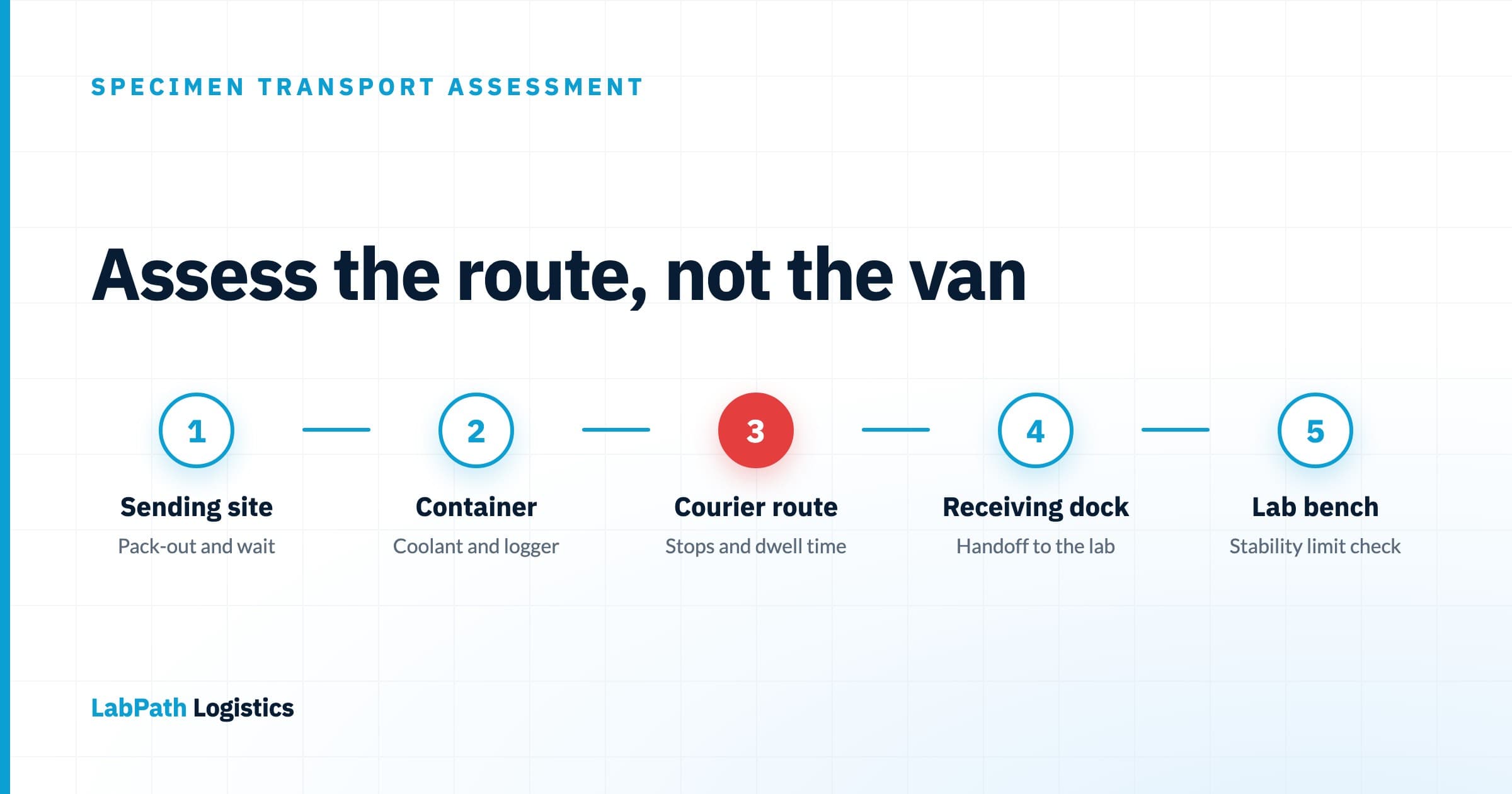
- The system is bigger than the van. CLSI's abstract describes the external transport system as the sending site, the receiving site, the testing lab, every mode of transport, and components such as specimen carriers and data loggers.
- Parts are judged alone and together. The abstract says each component, route, and mode should be evaluated individually and as a set. A good cooler on a bad route is still a bad system.
- Responsibility is shared. The sending site, the receiving site, and the testing lab each have a part in the evaluation. The abstract also says ways to handle adverse conditions, such as extreme weather, should be communicated between facilities in real time.
The standard also has limits. Its scope leaves out pneumatic tubes and in-house robots, and it does not go deep on dangerous goods rules. For those, see our guide to Category B specimen packaging.
Why Does the Trip to the Lab Deserve This Much Attention?
Most lab errors happen before the analyzer runs. Research led by Mario Plebani found that the preanalytical phase accounts for 46% to 68.2% of errors in the total testing process, as summarized in MLO. That phase includes collection and labeling as well as transport, so the figure is not a transport error rate. It does show where the risk is.
Transport is also the part of that phase the lab cannot see. Nobody from the lab is in the vehicle. Without a record, a specimen that arrives warm looks the same as one that stayed in range. Our guide to specimen transport temperature explains why both heat and too much cold cause damage.
What Is the Six-Line Route Assessment?
It is our one-page worksheet for a single route. It is not the CLSI procedure. It follows the same logic as the public abstract: list the parts, test them together, and name who is responsible. Start with your hardest route, which is usually the longest one or the one with a lockbox.
The Six-Line Route Assessment: save this and send it to your lab director
For one route, write down: 1. Route: origin, every stop in order, destination, and the longest scheduled time from pack-out to the lab bench. 2. Components: the container, the coolant, the secondary packaging, and any lockbox. 3. Mode: the vehicle, where the tote rides in it, and every handoff. 4. Conditions: the worst realistic day, such as an August afternoon, a long lockbox wait, or a storm detour. 5. Evidence: a data logger reading from pack-out to bench on that kind of day, compared with the tightest stability limit among the tests on the route. 6. Owners: one named person at the sending site, the courier, and the lab, plus how each is told when conditions turn bad.
Line five is the one most sites are missing. Our guide to temperature data loggers for courier transport covers what a usable logger record looks like. The stability limits come from your testing lab's directory, not from the courier.
A Houston Scenario: One Route, Six Lines
A Pearland clinic sends specimens to a core lab near the Texas Medical Center. This is an illustration, not a real client. The clinic closes at 5 p.m. and leaves the tote in an outdoor lockbox. The courier picks up at 6:15, makes two more stops, and reaches the lab dock at 7:40.
- Route: three stops, with a scheduled pack-out-to-bench time of about three hours once the lockbox wait is counted.
- Components: an insulated tote with gel packs, inside a metal lockbox that faces west.
- Mode: a car, with the tote in the cabin. There are two handoffs, at the lockbox and at the dock.
- Conditions: the worst case is a late-summer afternoon when the pickup also runs late.
- Evidence: none. Nobody has ever put a logger in the tote.
- Owners: the clinic assumed the lab was responsible. The lab assumed the courier was.
Filling in the page shows two gaps, and neither is the drive. The lockbox wait has never been measured, and nobody owns the route. Our specimen lockbox guide covers the first gap. The second one is solved with three names on the page.
What Should You Ask Your Courier to Do Next?
- Ask for the route as it actually runs: the stop order and the usual time at each stop. Scheduled times are not enough.
- Ask to place your own logger in the tote for a week, with at least one hot afternoon in it.
- Ask who calls your site, and who calls the lab, when a pickup will be late or the weather turns.
- Repeat the assessment whenever something changes: a new stop, a new container, a new pickup time, or a new season.
A courier that will not share the stop order or carry a logger has given you useful information. Put both requests in writing when you evaluate a new courier or run a small pilot. If the page shows that the route is the problem, price a different design, such as a direct run or a later pickup, in our nonbinding estimator.
LabPath Logistics is in early access for Greater Houston. We are not a live fleet, and we make no fixed-minute pickup promise. Device temperature telemetry is not live in our platform yet, so for now line five means your own logger in the tote. Our booking model has no patient fields, by design. See services for the planned service levels.
Frequently Asked Questions
What is CLSI PRE06?
PRE06 is a Clinical and Laboratory Standards Institute standard titled Evaluation of External Transport Systems. The first edition was published on February 4, 2026. It describes how to evaluate the way specimens travel from off-site locations to a laboratory, including couriers, containers, portable incubators, and drones.
Is specimen transport validation required for a clinic?
PRE06 is a consensus standard, not a law. Your testing lab's accreditor and its own procedures decide what is required, so ask your lab director. Even where nothing is required, a one-page route assessment gives you an answer when a specimen arrives out of range.
Who is responsible for evaluating a courier route?
CLSI's abstract for PRE06 says the sending site, the receiving site, and the testing laboratory share responsibility for evaluating the whole process. In practice, name one person at each, plus a contact at the courier, and write those names on the route assessment.
How often should a specimen transport route be reassessed?
Reassess when something changes: a new stop, a different container or coolant, a new pickup time, or a new vehicle. In Houston, repeat the logger run in summer as well, because a route that stays in range in January may not in August.