Platelet Function Test Transport: The 4-Hour Tube
November 27, 2026 · By LabPath Logistics Editorial Team, Medical Logistics Desk
Quick Answer
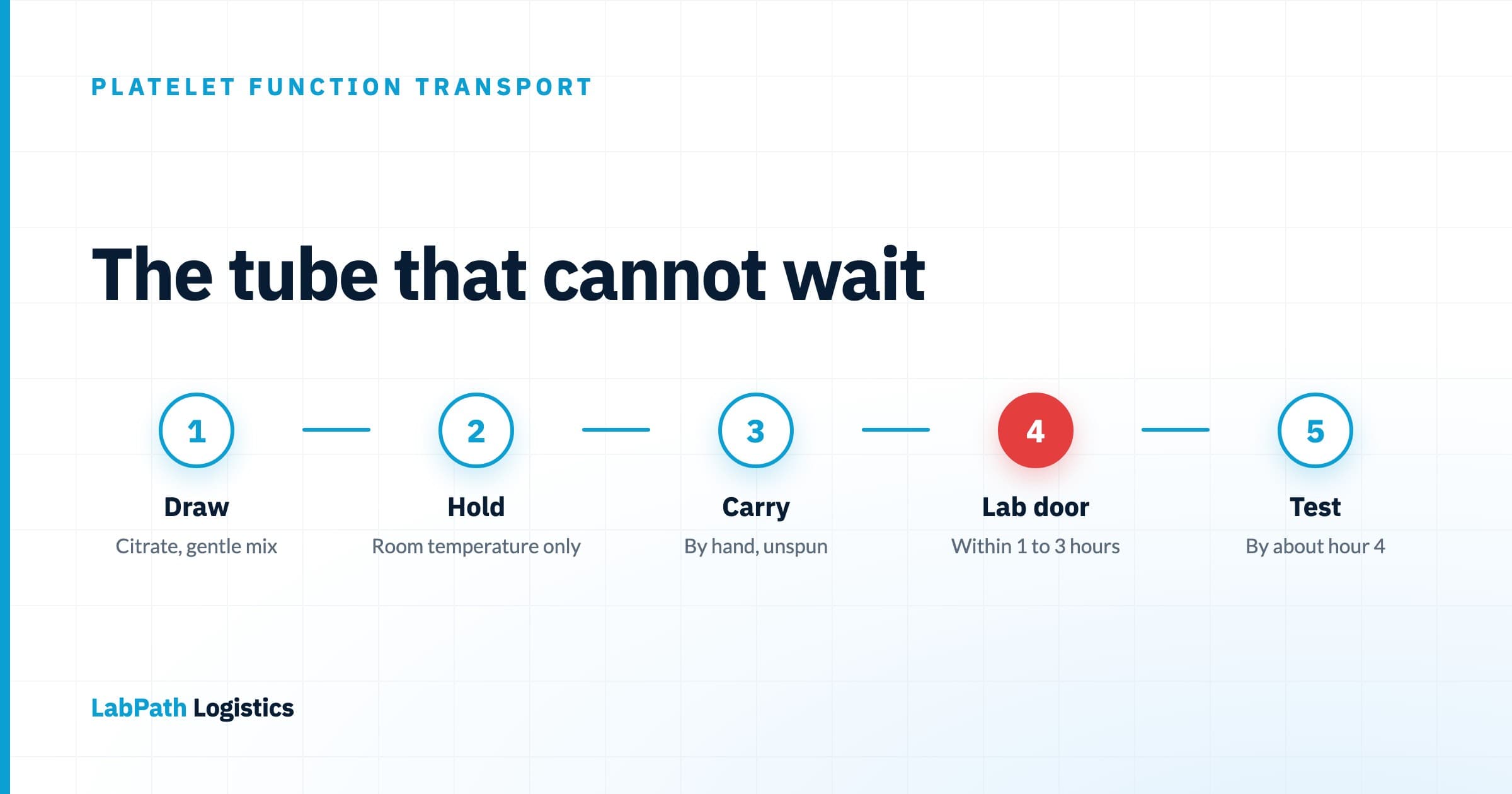
Platelet function specimens travel as unspun citrate whole blood at room temperature. Never refrigerate, ice, freeze, or centrifuge them. Labs set short receipt limits, often 1 to 3 hours from the draw, with testing finished by about 4 hours. If a direct drive cannot beat the limit, send the patient to the lab instead.
Most specimen problems are solved by doing more: spin it, chill it, hold it for the afternoon pickup. A platelet function test is the tube where every one of those habits is the error. Platelet function test specimen transport has almost no handling steps at all. The blood stays whole, stays at room temperature, and has to reach the bench in a few hours. For a Houston clinic, that turns a lab order into a drive-time question.
This guide is for cardiology, hematology, neurology, and pre-operative clinics that order platelet aggregation studies, platelet function analyzer (PFA) screens, or P2Y12 assays. It covers logistics only. Which test to order and how to prepare the patient belong to the ordering provider and the performing lab. What you get here is a five-line tool, the Walk-or-Ride Check, that tells you before the draw whether the tube can travel or the patient should.
How Should a Platelet Function Specimen Be Transported?
As unspun whole blood in light blue citrate tubes, at room temperature, carried by hand, and fast. Do not refrigerate it, put it on ice, freeze it, or centrifuge it. Labs publish two numbers: a stability window of about 3 to 4 hours, and a shorter limit for when the tube must arrive. Some labs want it in 1 hour. Plan the trip against the arrival limit, not the stability window.
Why Can't This Tube Be Chilled, Spun, or Held?
Most coagulation tests measure proteins in plasma, so the usual fix for a long trip is to spin the tube and freeze the plasma. Our coagulation specimen guide covers that route. Platelet function tests measure living platelets, so there is nothing to spin off and freeze. The cells have to arrive able to respond.
Cold is the first hazard. The University of Texas Medical Branch (UTMB) in Galveston says in its platelet aggregation test entry not to refrigerate or freeze the specimen because platelets are activated at cold temperature. It adds that the sample should never be chilled on ice. Rady Children's Hospital lists refrigerated and frozen specimens as unacceptable in its platelet aggregation entry and says samples must be kept at room temperature at all times.
Handling is the second. Oregon Health & Science University (OHSU) says of its PFA test: do not refrigerate, do not centrifuge, do not send by pneumatic tube. UTMB's P2Y12 entry says to hand deliver the tube and lists specimens that were centrifuged, sent through the tube system, or stored in a refrigerator as causes for rejection. A tube that cannot ride a hospital's own tube system is a tube to carry upright and gently in a car, too. Ask the lab how it wants it packed.
How Long Do You Have to Get It to the Lab?
Less than the stability line suggests. A lab needs time to check the tube in, run a platelet count, and set up the test, so it publishes an arrival limit that is shorter than the stability window. Four published examples show the range:
- Platelet aggregation, UTMB: delivered to the lab within 1 hour of collection. Stable at room temperature for 3 to 4 hours. Samples received after 1 hour are rejected.
- Platelet aggregation, Rady Children's: transported by rush courier to the testing lab within 1 to 2 hours of collection.
- PFA, OHSU: must arrive within 3 hours of the draw. The entry notes the sample is stable only 4 hours after collection.
- P2Y12 assay, University of Washington: outside laboratories are told to deliver at room temperature within 3 hours of collection. UTMB lists 4 hours after collection for the same assay.
1 hour
Delivery limit from collection for a platelet aggregation specimen at UTMB, against a stated room-temperature stability of 3 to 4 hours. Samples received after 1 hour are listed as a cause for rejection. Source: UTMB Laboratory Survival Guide, Platelet Aggregation (LAB000680).
Some labs skip the trip entirely. OHSU's aggregation with ATP release entry says the specimen must be collected at its own sites, by appointment only, and received in the lab within 1 hour of the draw. That is the lab telling you the patient travels, not the tube. These are examples, not your rule. The performing lab's current entry is the final word, and limits differ by lab and by assay.
Where Do Platelet Function Specimens Fail Between Draw and Lab?
- The shared cooler. A routine courier bag holds cold packs for refrigerated specimens. A citrate tube dropped in with them is chilled before the car leaves the lot. Our specimen transport temperature guide explains why room temperature needs its own container.
- The afternoon pickup. A 9:00 a.m. draw that waits for a 2:00 p.m. route stop is past every limit above before the driver arrives.
- The helpful spin. Staff who spin every light blue tube for PT and PTT will spin this one too. Label it "do not spin" at the draw.
- The wrong clock. Planning to the 4-hour stability line when the lab rejects at 1 hour.
- The wrong day. Some labs run aggregation only on set days or by appointment. A tube that arrives on time on the wrong day is still a redraw.
- A missing draw time. The lab cannot accept a timed specimen it cannot time. Write the collection time on the tube and on the manifest.
Platelet function is not the only tube that breaks the cold-is-safe habit. Cryoglobulins must stay warm, as our cryoglobulin guide shows, and renin must stay off ice before the spin, as our renin and ACTH guide shows. The fix is the same each time: write the rule down per tube, per lab.
What Is the Walk-or-Ride Check?
Five lines, filled in once for each platelet function test you order and each lab that runs it. It answers one question before anyone picks up a needle: does the patient walk into the lab's draw site, or does the tube ride with a courier?
The Walk-or-Ride Check: save this and send it to your lab director
1. Which test, which lab? Aggregation, PFA, and P2Y12 assays have different clocks. Test: ___. Performing lab and receiving door: ___. 2. When does the lab run it? Testing days and hours: ___. Appointment or call-ahead required: yes / no. 3. What is the arrival limit? Minutes from draw to lab receipt (not the stability window): ___. 4. What is the real trip? Door-to-door drive at the hour you draw, plus handoff time at both ends: ___ minutes. If line 4 is more than about half of line 3, the patient goes to the lab. 5. If the tube rides: timed direct run booked before the draw, no other stops. Room-temperature container with no cold packs. Tube upright, unspun, labeled "do not spin, do not chill." Draw time on the tube and the manifest.
The half rule on line 4 is our rule of thumb, not a lab standard. It leaves room for a blocked loading dock, a slow elevator, and the lab's own check-in. If your lab gives you a different margin, use theirs.
Line 5 is the courier's line. This is not a route stop. It is a direct run timed to a draw, which is what a STAT or timed tier is for. Our STAT vs same-day guide explains how to pick the tier, and the estimator shows what a direct run between your two addresses is likely to cost.
A Houston Scenario: The 9:00 a.m. Draw in Katy
A cardiology practice in Katy draws a platelet function order at 9:00 a.m. The tube goes into the lab bag with the morning's refrigerated specimens. The route courier arrives at 1:30 p.m. and delivers to a hospital lab near the Texas Medical Center by 3:00. Every scan is on time. The specimen is six hours old and has spent four of them against a cold pack. The lab cancels the test, and the patient drives back another day.
With the Walk-or-Ride Check, the clinic learns two things in advance. Its lab accepts the test within 3 hours of the draw, and the drive on I-10 at mid-morning is not something to gamble a 1-hour test on. So the PFA order rides: a timed run is booked the day before, the draw is set for 10:00 a.m. after rush hour, and the tube leaves in a room-temperature carrier with the draw time on the label. The aggregation order walks: the patient is sent to the hospital's own draw site. Same clinic, two tests, two answers.
What Should You Do This Week?
- Pull the current directory entry for each platelet function test at each lab you use. Write down the arrival limit, the testing days, and whether an appointment is required.
- Fill in the Walk-or-Ride Check and keep it with the order set, so the decision is made at scheduling and not at the draw chair.
- Ask the lab how many of your platelet function orders were canceled or redrawn last quarter, with the reason where known.
- Check your courier bag. If the only container on the route is a cold one, a room-temperature tube has nowhere safe to go.
LabPath Logistics is in early access for Greater Houston, with no patient fields in the booking model, by design. Each order declares a temperature, so a room-temperature tube is booked as its own line instead of sharing a cold bag. Our public estimator prices a timed direct run from pickup and drop-off addresses. It is a nonbinding estimate, not a booking quote, a fixed-minute promise, or proof of live coverage. See planned service levels for what is live today.
Frequently Asked Questions
Can a platelet function test specimen be refrigerated?
No. Labs list refrigerated, iced, and frozen platelet function specimens as unacceptable. UTMB's platelet aggregation entry explains that platelets are activated at cold temperature. Keep the tube at room temperature from the draw to the lab, and keep it away from cold packs in a shared courier bag.
How long is a platelet function specimen stable?
Labs commonly list about 3 to 4 hours at room temperature, but they set a shorter limit for arrival. Published examples range from 1 hour for platelet aggregation at UTMB to 3 hours for a PFA test at OHSU. Use your performing lab's current arrival limit, not the stability window.
Should a platelet function tube be centrifuged before transport?
No. These tests run on whole blood or on plasma the lab prepares itself. OHSU's PFA entry says do not centrifuge, and UTMB lists a centrifuged P2Y12 specimen as a cause for rejection. Label the tube so it is not spun with routine coagulation tubes.
Can a courier transport a platelet function specimen, or must the patient go to the lab?
It depends on the lab's arrival limit and your drive time. Some labs accept a rush courier delivery within 1 to 3 hours. Others require collection at their own site by appointment. If a direct drive cannot comfortably beat the limit, send the patient to the lab.