Cytogenetics Specimen Transport: Keep the Cells Alive
November 24, 2026 · By LabPath Logistics Editorial Team, Medical Logistics Desk
Quick Answer
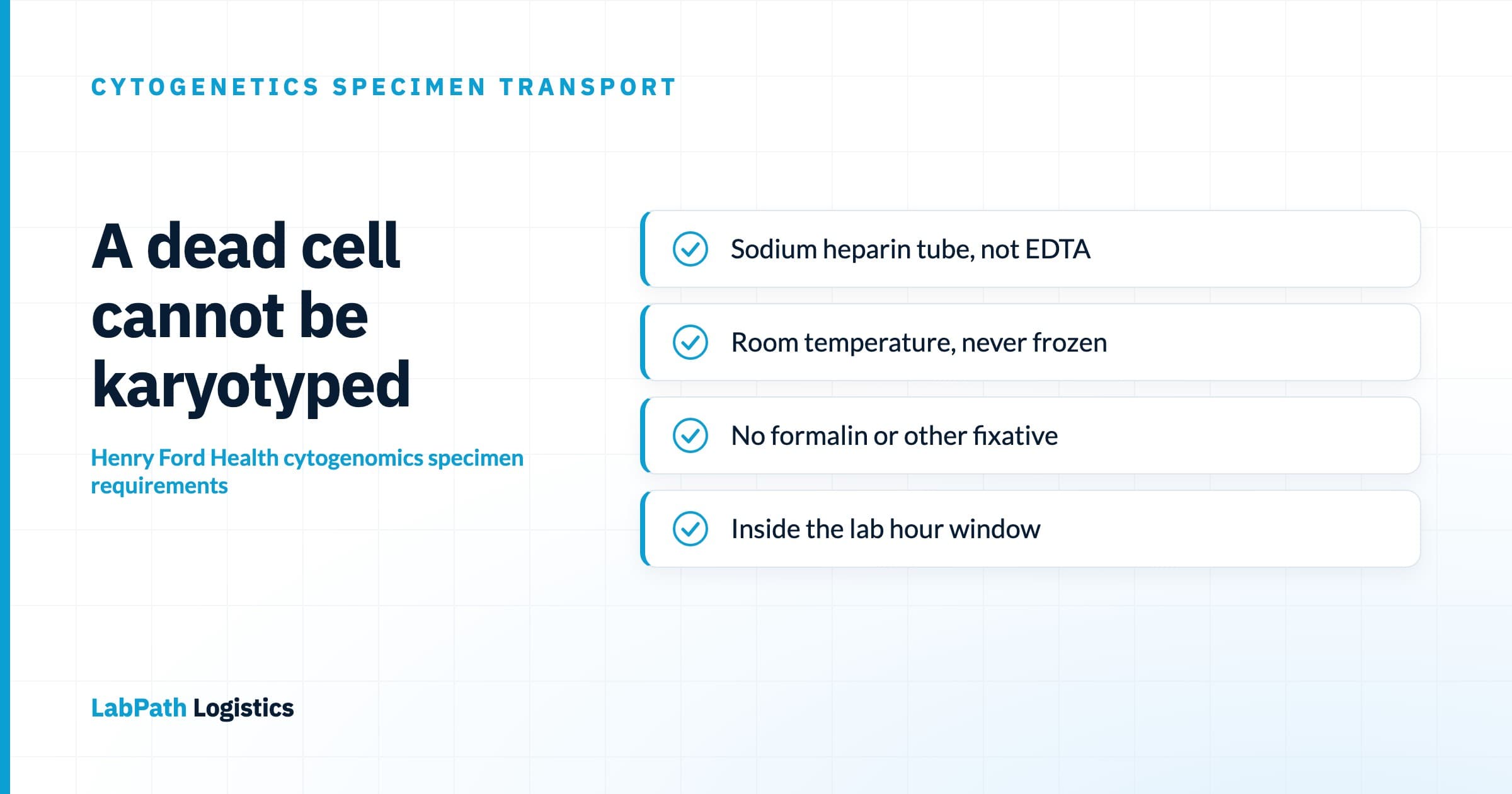
Chromosome analysis needs living cells, so the specimen must arrive able to grow. Send blood and bone marrow in a sodium heparin tube at room temperature, never frozen, and never put tissue in formalin. Henry Ford Health asks for delivery within 24 hours for oncology specimens and 24 to 72 hours for constitutional ones.
Most specimens are tested as they arrive. A chromosome study is different: the lab has to grow the cells first. That one fact changes every rule of cytogenetics specimen transport. A tube that would be fine for a chemistry panel can be worthless for a karyotype, because the cells inside died on the way. For Houston clinics, the usual cause is not the draw. It is the cold box, the formalin jar, or the afternoon the tube spent waiting.
This guide is for hematology-oncology practices, OB-GYN and maternal-fetal medicine offices, pediatric and genetics clinics, and outpatient procedure sites that send chromosome studies to a cytogenetics lab. It covers logistics only. Which test to order belongs to the ordering provider. What you get here is a four-line tool, the Live-Cell Check, that your staff can post at the packing station.
How Should a Chromosome Analysis Specimen Be Transported?
Alive. Blood and bone marrow go in a sodium heparin tube, at room temperature, never frozen and never fixed. Tissue goes fresh in the sterile transport medium or saline the lab specifies, not formalin. Then the specimen has to reach the lab inside the window that lab publishes. The performing lab's directory is the final word, because labs differ on details.
Why Is a Cytogenetics Specimen Different From Other Lab Samples?
A karyotype is read from cells that are dividing in culture. If the cells are dead on arrival, there is nothing to grow and nothing to read. That is why the handling rules protect viability rather than chemistry. Henry Ford Health's cytogenomic specimen submission requirements say to transport all specimen types at room temperature as soon as possible and to avoid temperature extremes. They name three reasons for rejection: the incorrect collection tube, frozen samples, and formalin or other fixed tissue.
24 hours
Henry Ford Health's transport window for oncology cytogenetics specimens at room temperature, against 24 to 72 hours for constitutional specimens. Source: Henry Ford Health, Cytogenomic Specimen Submission Requirements.
The same lab says sodium heparin is required for constitutional blood and that other collection containers may be rejected. UW Medicine's cytogenetics collection instructions agree on the tube, asking for preservative-free sodium heparin or a sterile heparinized syringe. They list EDTA only for other tests, such as microarray.
Where Do Chromosome Studies Fail in Transit?
- The lavender-top habit. Staff grab EDTA because it is the tube for most blood work. For a karyotype, it can be a rejection reason. Mark the sodium heparin green top in the draw kit.
- The refrigerator reflex. Cold is the default safe choice for many specimens, which is why the specimen transport temperature guide exists. For blood and marrow headed to cytogenetics, the instruction is room temperature. Frozen is a rejection.
- The formalin jar. Pathology sites fix tissue by reflex, as our breast biopsy guide shows. A sample meant for chromosome culture cannot be fixed. UT Health San Antonio's product of conception listing says do not place in formalin, and UW lists formalin and alcohol among what not to use.
- The hot car. Room temperature does not mean a parked vehicle in a Houston afternoon. UT Health San Antonio says to avoid freezing or heating over 35 °C, and our heat and specimen integrity guide explains why a closed car or outdoor lockbox is not ambient.
- The slow lane. A specimen that waits for tomorrow's route, then a weekend, can run out of window. Ask each lab whether it receives and sets up cultures on weekends before you book a Friday pickup.
8 hours
Room-temperature stability for a product of conception specimen sent for chromosome analysis, after which it should be refrigerated. Source: UT Health San Antonio, Clinical Molecular Cytogenetics, Chromosome Analysis – Product of Conception.
Notice that tissue rules can differ from blood rules, and from lab to lab. UT Health San Antonio holds that tissue at room temperature for 8 hours, then refrigerates it. UW asks for tissue to be kept refrigerated or on ice. That is the reason the Live-Cell Check is filled in per lab and per specimen type, not copied from memory.
What Is the Live-Cell Check?
Four lines, one per question that decides whether the cells survive. Fill it in once for each cytogenetics lab you use, and once more for each specimen type you send.
The Live-Cell Check: save this and send it to your lab lead
1. Right container? Blood and marrow: sodium heparin green top, not EDTA, unless the lab says otherwise. Tissue: the lab's sterile transport medium or sterile saline. Where the kit is kept: ___. 2. Right temperature? Blood and marrow: room temperature, never frozen, never in a hot car. Tissue: this lab's rule is ___ (room temperature for __ hours, or refrigerated). 3. No fixative? Nothing for chromosome culture goes in formalin or alcohol. If pathology also needs a fixed piece, it travels in a separate, labeled container. 4. Right clock? This lab's window: ___ hours. Does it receive on weekends? ___. Last pickup that still makes the window on a Friday: ___.
Line 4 is the one a courier controls. The window is often a day or more, so most chromosome studies do not need a STAT run. They need a room-temperature pickup that is booked, not hoped for, and a lane that does not sit a tube over a weekend. Our guide to STAT vs. same-day courier tiers shows how to price the two separately.
A Houston Scenario: One Marrow, Three Labs
A hematology-oncology practice in the Energy Corridor performs bone marrow procedures in the office. One draw feeds pathology, flow cytometry, and cytogenetics, and the cytogenetics tube goes to a different lab than the slides. Staff pack everything together in the refrigerated box the practice uses for most send-outs, and the afternoon route picks it up.
With the Live-Cell Check filled in, the sodium heparin cytogenetics tube rides at room temperature in its own labeled bag, the pathology material travels as pathology requires, and Friday cases get a pickup time that reaches the cytogenetics lab inside its window. Our bone marrow specimen guide covers the full split, and surgical pathology transport covers the fixed side.
What Should You Do This Week?
- Pull the current directory entry for every cytogenetics lab you send to. Directories change.
- Fill in the Live-Cell Check and post it where specimens are packed.
- Ask each lab for last quarter's rejections and no-growth results on chromosome studies, with the reason where known.
- Check where these specimens wait before pickup. If the answer is a refrigerator, an outdoor lockbox, or a car, fix that first.
LabPath Logistics is in early access for Greater Houston, with no patient fields in the booking model, by design. A run is booked door to door, and the package code carries no patient data. Our public estimator prices a scheduled pickup or a one-off run from pickup and drop-off addresses, so you can see what a room-temperature lane that meets your lab's window would cost. It is a nonbinding estimate, not a booking quote or a promise of live coverage. Review planned service levels for what is live today.
Frequently Asked Questions
What tube is used for chromosome analysis?
Most cytogenetics labs ask for a sodium heparin green-top tube for blood and bone marrow. Henry Ford Health says sodium heparin is required for constitutional blood and other containers may be rejected. UW Medicine lists EDTA only for other tests, such as microarray. Confirm with the performing lab.
Should a cytogenetics specimen be refrigerated?
Blood and bone marrow for chromosome analysis usually travel at room temperature and must never be frozen. Henry Ford Health lists frozen samples as a rejection reason. Tissue rules vary by lab: some hold it at room temperature for hours, others ask for refrigeration. Follow the performing lab's directory.
Can tissue for chromosome analysis be sent in formalin?
No. Chromosome analysis needs living cells that can grow in culture, and formalin kills them. UT Health San Antonio says do not place the specimen in formalin, and Henry Ford Health rejects formalin or other fixed tissue. Use the lab's sterile transport medium or sterile saline.
How fast does a chromosome study specimen need to reach the lab?
As soon as possible, inside the lab's published window. Henry Ford Health asks for 24 hours for oncology specimens and 24 to 72 hours for constitutional specimens. Check whether the lab receives on weekends before booking a Friday pickup.