Temperature Data Loggers for Courier Transport in Houston
November 8, 2026 · By LabPath Logistics Editorial Team, Medical Logistics Desk
Quick Answer
A temperature data logger in a courier cooler is only useful if its file answers six questions: where the probe sat, whether the device is in calibration, how often it logged, who downloaded it and when, what happened on an alarm, and where the file is kept. Ask any courier for a sample file before you sign.
Every courier that moves refrigerated specimens or medications in Houston will tell you the same thing: "We use temperature data loggers." It is the right answer, and it tells you almost nothing. A logger clipped to the lid of a cooler on a 3 p.m. run down the West Loop records the air near the lid. Whether that record protects your specimen, your patient's medication, or your audit depends on the file behind it.
This guide covers how to judge temperature data logger evidence in courier transport, and it gives you one tool, the Logger File Test. It is about logistics and documentation only. Your performing laboratory, the product manufacturer, or your pharmacy's procedures set the temperature range; this helps you check whether a courier can prove the range held.
Does a Medical Courier Need a Temperature Data Logger?
For refrigerated or frozen work, you should expect a temperature monitoring device in each transport container, and a record you can read afterward. The more useful question is whether the logger produces evidence: a probe placed where the payload sits, a device that is in calibration, readings frequent enough to catch an excursion, and a file that reaches you before anyone argues about what happened.
+/-0.5 °C, every 30 minutes
CDC's Vaccine Storage and Handling Toolkit (March 2024) recommends digital data loggers with a recommended uncertainty of +/-0.5 °C (+/-1 °F) and a logging interval that records at least every 30 minutes, and calls for a temperature monitoring device in each transport unit. It is written for vaccines, and it is the most specific public benchmark for logger quality.
What Is the Logger File Test?
The Logger File Test: save this and send it to your lab director or pharmacy manager
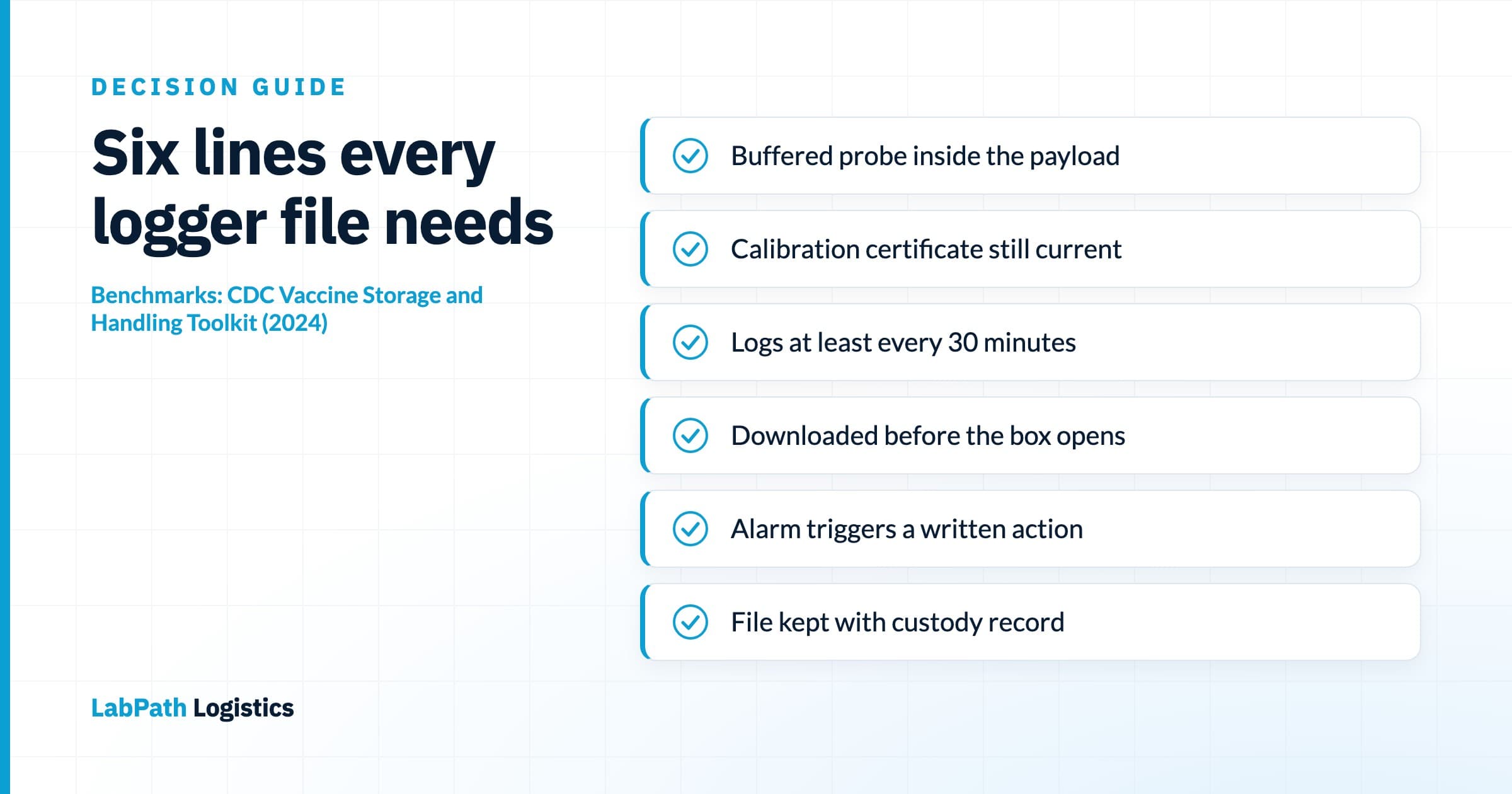
Ask every courier for one sample logger file from a real run, with identifiers removed, and check six lines. Line 1, Probe: where did it sit, in a buffer inside the payload or in open air? Line 2, Calibration: is there a current certificate with the device's serial number? Line 3, Interval: how often did it log? Line 4, Download: who pulled the data, and was it before or after the container was opened? Line 5, Alarm: if the range was exceeded, what was done, by whom, and when? Line 6, Retention: where does the file live, and does it link to the custody record for that run? A courier that hands you a file that answers all six has a system. One that sends a marketing sheet does not.
Line 1: Where Was the Probe?
Air temperature swings every time a lid opens. CDC notes that a buffered probe, one set in glycol, glass beads, sand, or Teflon, matches product temperature more closely than a standard thermometer, which tends to reflect only air. For courier work, ask whether the probe sits among the payload or is taped to the container wall. A wall-mounted air probe will show alarming spikes that never reached the tubes, and it can also miss a slow drift that did.
Lines 2 and 3: Is the Logger Accurate, and Did It Log Often Enough?
A logger drifts. CDC recommends calibration testing every 2 to 3 years, or on the manufacturer's timeline, and lists what a certificate should show: model, serial number, calibration date, a pass result, and the measurement uncertainty. Ask for the certificate that matches the serial number on the sample file, not a generic one for the product line.
Then check the interval. Thirty minutes is CDC's floor for storage units. On a 40-minute crosstown run, a 30-minute interval might capture two readings, which cannot show you how long an excursion lasted. For short urgent runs, ask whether the courier sets a shorter interval, and see our guide on specimen transport temperature ranges for why minutes matter.
Line 4: Who Downloaded the Data, and When?
The most common failure is not a bad reading. It is a file nobody looked at until a specimen was questioned. Ask whether data is reviewed at handoff, before the receiving team opens the container, or days later. A logger that is read at receipt lets your lab decide on acceptance with the facts in hand. One read at the end of the month only tells you what you lost.
Lines 5 and 6: What Happens on an Alarm, and Where Does the File Go?
An alarm needs a written action: who is notified, whether the receiving lab or pharmacy decides on use, and how the decision is recorded. The courier should not decide whether an exposed specimen or medication is still usable. That call belongs to the receiving lab, the manufacturer's guidance, or your pharmacist.
For retention, CDC advises keeping vaccine temperature data for 3 years, longer if your state program requires it. Whatever your own rule, the file should sit beside the run's custody record, so the temperature trace and the handoff timestamps tell one story. Our guide to medical courier proof of delivery shows what that record should contain.
A Houston Scenario: Two Coolers, One Hot Afternoon
Two refrigerated pickups leave Houston-area clinics on a September afternoon, bound for the same reference lab. Courier A's logger hangs from the lid, logs every hour, and is downloaded at the end of the week. Its file shows one warm reading and nothing else, so nobody can say whether the tubes warmed or the lid was simply opened. Courier B's probe sits in a buffer among the tubes, logs every few minutes, and is read at receipt. Its file shows a brief lid-open spike that the buffered probe barely registered, and the lab accepts the specimens the same afternoon.
Both couriers "used data loggers." Only one produced evidence. Houston heat makes the gap wider, as our heat and specimen integrity guide explains.
Is the Logger Enough Without a Qualified Container?
No. A logger records the problem; the packout prevents it. CDC's toolkit warns against commercial soft-sided food or beverage coolers for vaccine transport because most are poorly insulated, and recommends qualified containers and packouts with a monitoring device in each one. Ask your courier which container and coolant configuration it uses for your range and route length. Our vaccine transport rules guide and cold-chain pharmacy delivery guide cover the packout side.
How Do You Use the Test Before You Sign?
- Add the six lines to your vendor questionnaire. Our medical courier RFP checklist shows where they fit.
- Ask for a sample file from a real run, plus the matching calibration certificate.
- Agree in writing who reads the file at receipt and who decides after an alarm.
- Price a temperature-controlled pickup in the nonbinding estimator so the route length you are testing is real, not hypothetical.
- Run a short pilot and read every logger file from it with the test beside you.
LabPath Logistics is in early access for Greater Houston. Our booking model has no patient data fields, by design, and our custody workflow records pickup and receiver attestations. Device-temperature telemetry is not live yet, and we will not claim it is. If your route needs logger evidence, we would rather plan it with you against these six lines than promise it on a rate card. See our services for planned levels and the platform preview for what is verified today.
Frequently Asked Questions
What is a temperature data logger in specimen transport?
It is a small electronic device that records temperature at set intervals while a container is in transit. Unlike a min/max thermometer, it shows every reading over time, so you can see whether an excursion happened, how long it lasted, and when.
How often should a transport data logger record temperature?
CDC recommends that digital data loggers for vaccine storage record at least every 30 minutes. For short courier runs, a shorter interval is more useful, because two readings on a 40-minute trip cannot show how long an excursion lasted.
How often does a data logger need calibration?
CDC recommends calibration testing every 2 to 3 years, or on the manufacturer's suggested timeline. The certificate should list the model, serial number, calibration date, a pass result, and the measurement uncertainty.
Who decides if a specimen is usable after a temperature excursion?
The receiving laboratory, the product manufacturer's guidance, or the responsible pharmacist decides, not the courier. The courier's job is to deliver the logger file and report the alarm so that decision can be made with the facts.