Medical Courier RFP Checklist for Houston Facilities
September 28, 2026 · By LabPath Logistics Editorial Team, Medical Logistics Desk
Quick Answer
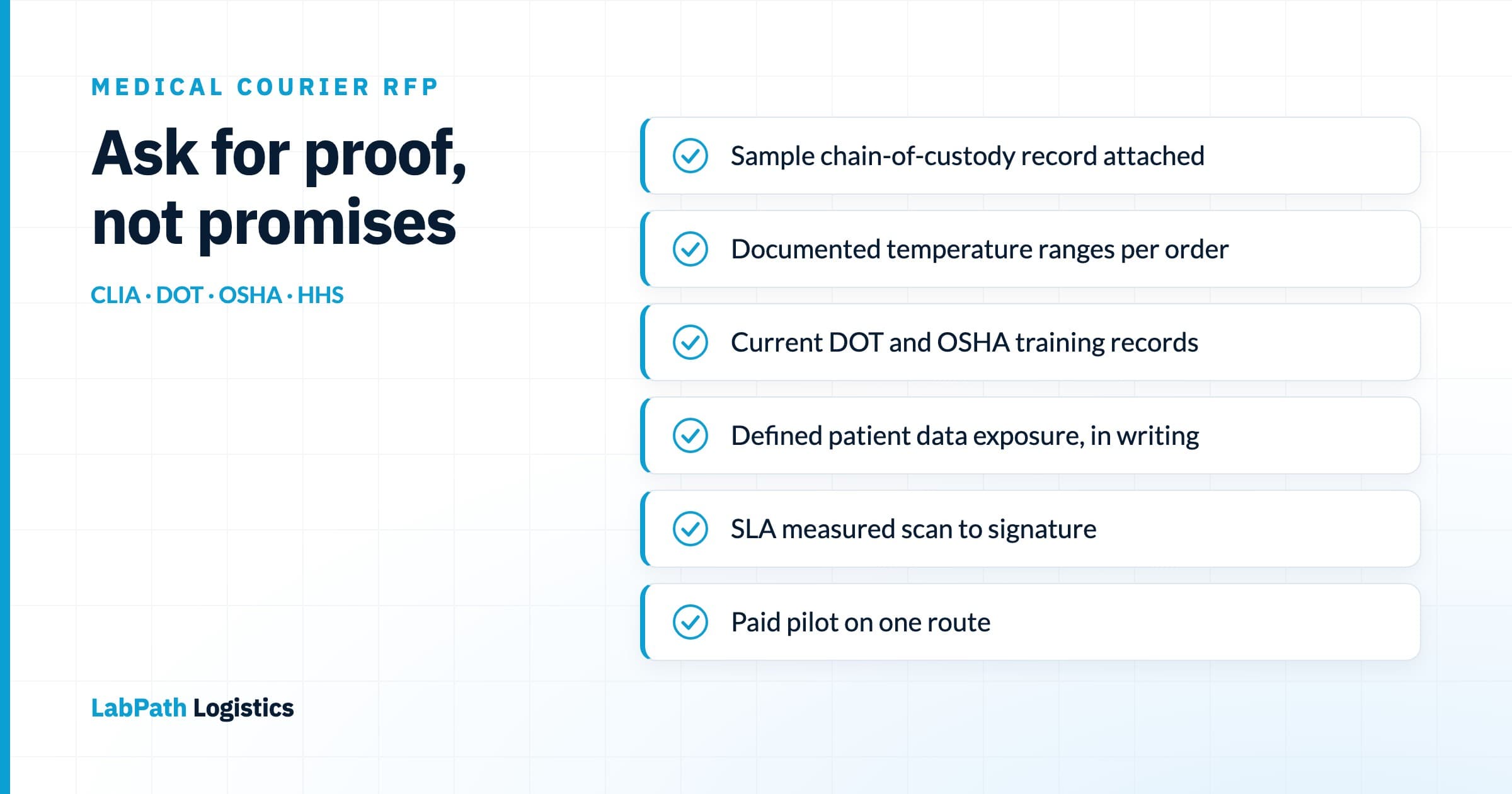
A medical courier RFP should require evidence, not promises: a sample chain-of-custody record, the temperature ranges the courier can document, current DOT hazmat and OSHA bloodborne pathogens training records, a clear statement of what patient information the courier will touch, and SLA terms measured from pickup scan to delivery signature. Score each answer on proof you can audit, then run a paid pilot on one route before signing a full contract.
A medical courier RFP is usually written in an afternoon and regretted for three years. Most requests ask vendors for a price per stop, a coverage map, and a paragraph on compliance. Every bidder answers those well, so the contract goes to the lowest number, and the real differences show up later as missed pickups, warm specimens, and receipts nobody can find.
This checklist is for Houston lab managers, pharmacy directors, clinic administrators, and procurement teams who are replacing a courier or buying one for the first time, often during fourth-quarter budget planning. It lists the questions that separate vendors, the evidence to request with each answer, and how to score what comes back. It is operations guidance, not legal advice; your compliance officer and counsel should review the final contract.
Why Most Courier RFPs Don't Separate Vendors
Generic RFPs ask yes-or-no questions. "Are you HIPAA compliant?" and "Do you offer temperature-controlled transport?" get a yes from everyone. The fix is to ask for artifacts: a redacted custody record, a training roster, a sample incident report, a late-delivery report from last month. A vendor who can hand those over runs a documented operation. A vendor who can't is describing a plan.
Your lab already carries the obligation. Under CLIA, 42 CFR 493.1242 requires laboratories to keep written policies for specimen transportation conditions and specimen referral, and to refer specimens only to CLIA-certified labs or equivalents. The courier executes part of that policy, so the RFP should test whether the vendor can follow it and prove they did.
1. Chain of Custody and Proof of Delivery
- Request a redacted sample of a real custody record from pickup to receipt, not a screenshot of an app.
- Ask what is scanned at each handoff: the bag, the tote, or each package.
- Ask how a missing or extra package is flagged at pickup, and who is notified.
- Ask how long records are retained and how quickly you can pull one during a CAP or Joint Commission inspection.
Our chain-of-custody guide covers what a complete record should contain.
2. Temperature Control You Can Audit
Ask which ranges the vendor supports (ambient, refrigerated 2–8 °C, frozen) and how each is documented on the order. Then ask what happens when a range is breached: who is told, how fast, and whether the specimen continues or returns. Houston's heat makes this a practical question for most of the year, not an edge case.
3. Training Records, Not Training Claims
Two federal requirements give you specific dates to check. OSHA's bloodborne pathogens standard, 29 CFR 1910.1030, requires training at initial assignment and at least annually after that for employees with occupational exposure. DOT's hazmat rule, 49 CFR 172.704, requires recurrent hazmat training at least once every three years.
12 months
Maximum gap between bloodborne pathogens trainings under OSHA 29 CFR 1910.1030(g)(2)
Ask for a training roster with completion dates for the drivers who would serve your routes. Any date older than those windows is a finding before the contract starts. Our post on medical courier driver training lists what else belongs in the curriculum.
4. HIPAA Scope: What the Courier Actually Touches
Don't ask whether a courier is "HIPAA compliant." Ask what protected health information it sees, stores, or transmits. HHS guidance says a business associate agreement is not required for the Postal Service or certain private couriers that act merely as conduits, accessing information only on a random or infrequent basis. A courier whose app stores patient names or order details is doing more than that.
- Do manifests, labels, or tracking screens show patient identifiers?
- Where is order data stored, and who can see it?
- Will the vendor sign a business associate agreement if your counsel requires one?
- Can the workflow run on opaque order references instead of patient data?
The best answer is less data
A courier that never needs patient names has less to protect and less to lose. Design your RFP so vendors can propose a no-PHI workflow, then have counsel decide whether an agreement is still needed.
5. SLA Terms That Measure the Right Clock
On-time percentages mean nothing until you define the start and stop. Specify that the clock starts at the pickup scan and stops at the receiving signature, not at dispatch or at "arrived" on a map. Ask for last month's on-time report for a comparable account, the credit owed for a missed STAT, and how exceptions are logged. Our medical courier SLA guide has sample language.
6. Pricing You Can Reconcile
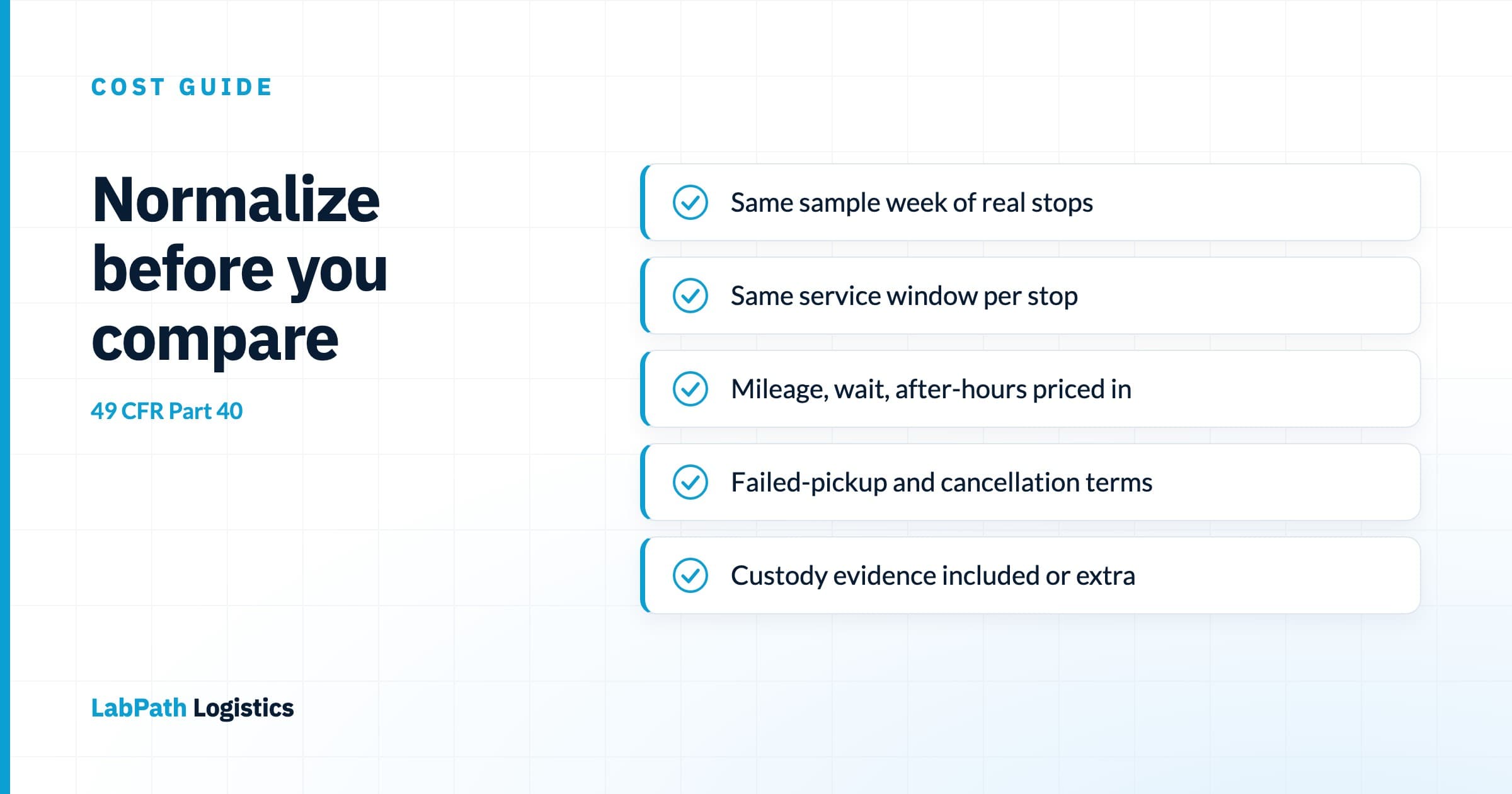
Ask every bidder to price the same scenario: your actual weekly stops, STAT volume, after-hours calls, and wait time. Then ask for a sample invoice. Fuel surcharges, wait fees, and after-hours multipliers are where bids that looked close drift apart. Our breakdowns of medical courier cost in Houston and courier invoice audits show what to compare.
A Houston Scenario: Scoring Two Bids
Picture a multi-site clinic group in Sugar Land and Pearland sending specimens to a reference lab near the Texas Medical Center. Vendor A bids 12% lower and answers every question with "yes." Vendor B attaches a redacted custody record, a training roster with dates, and a sample invoice that itemizes wait time. On a weighted scorecard where evidence counts for more than price, Vendor B wins, and the clinic group knows exactly what it bought.
A simple scoring model
- Custody and proof of delivery: 25%
- Temperature control and excursion response: 20%
- Training records and safety: 15%
- Data handling and HIPAA scope: 15%
- SLA definitions and reporting: 15%
- Price, reconciled to your volume: 10%
Score each category 0 for a claim, 1 for a description, and 2 for evidence you can check. Then run a paid 30-day pilot on one route before committing the network. If you are replacing an incumbent, our guide to switching medical couriers covers the transition.
Frequently Asked Questions
What should a medical courier RFP include?
Ask for a sample chain-of-custody record, the temperature ranges the courier documents, training records with dates, a written description of what patient data the courier handles, SLA terms measured from pickup scan to delivery signature, and a sample invoice priced on your real volume.
Does a medical courier need a business associate agreement?
It depends on what the courier touches. HHS guidance says couriers that act merely as conduits do not require one, but a courier that stores or views patient information in its systems may. Have counsel decide based on the vendor's actual workflow.
What training records should I request from a courier?
Request OSHA bloodborne pathogens training dates, which must be at least annual under 29 CFR 1910.1030, and DOT hazmat training dates, which must be renewed at least every three years under 49 CFR 172.704, for the drivers assigned to your routes.
How do I compare medical courier bids fairly?
Give every bidder the same volume scenario, score each answer by evidence rather than claims, weight custody and temperature control above price, and confirm the winner with a paid pilot on a single route before signing a network-wide contract.